I spent four hours last month watching a client’s keyword research turn into a spreadsheet I’d be embarrassed to bill for. Then I ran the same research through an AI SEO tool and had a sharper, better-organized list in twenty minutes. That gap is what this guide is about.
This guide is part of our GEO & AI Search hub – everything we have published on getting cited by AI search engines, in one place.
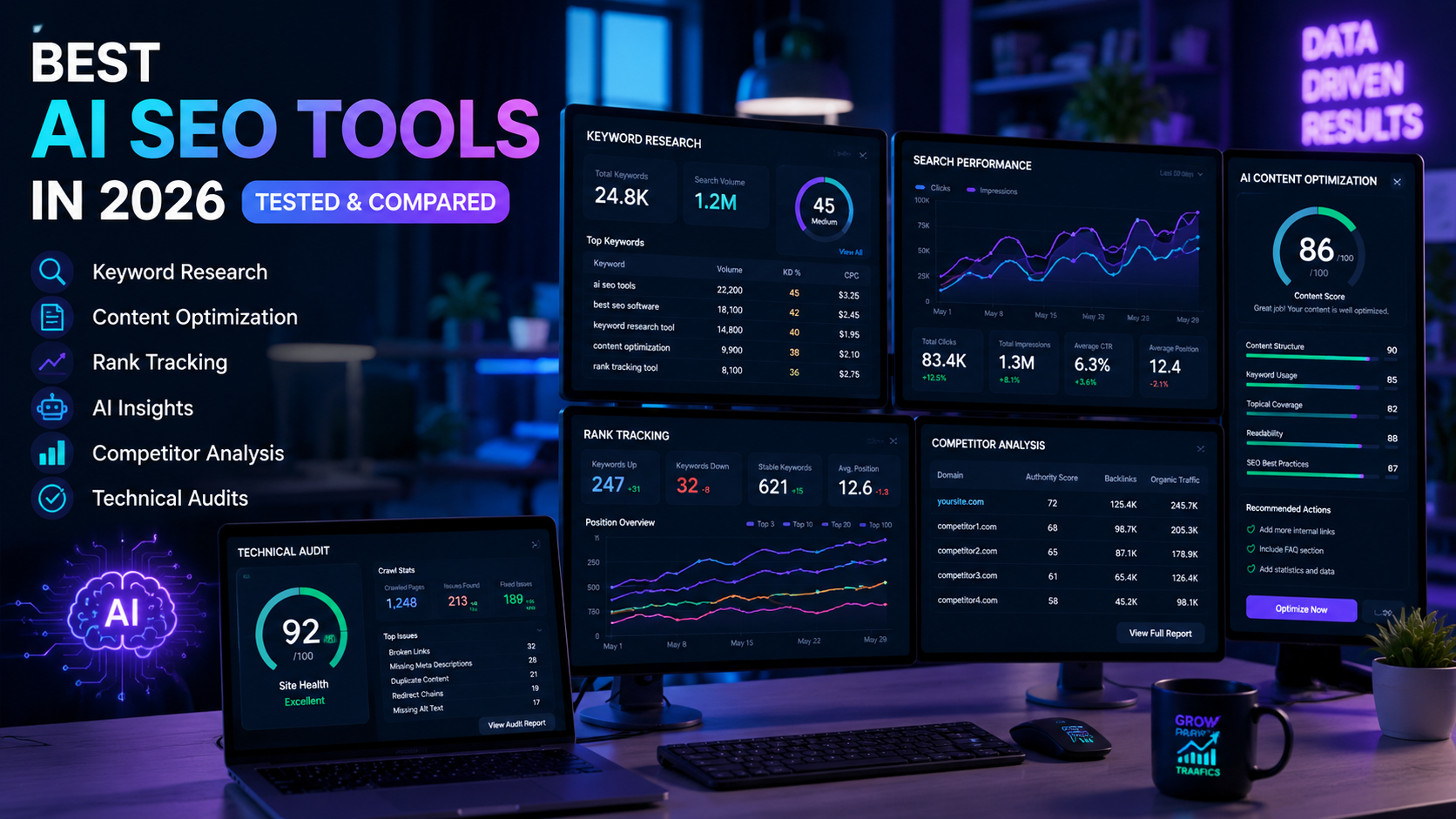
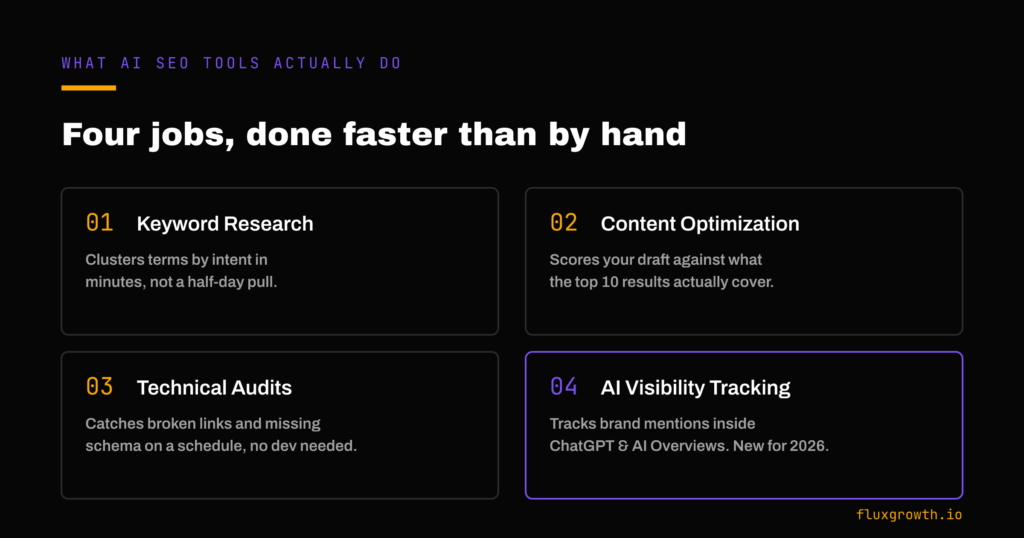
AI SEO tools use machine learning and large language models to handle the parts of search optimization that used to eat your whole day — keyword research, content scoring, technical audits. And now, the newest piece: tracking whether ChatGPT or Google’s AI Overviews even mention your brand.
They’re not magic. They won’t write your strategy for you (if a tool’s landing page promises that, close the tab). What they will do is hand back the hours you used to spend on work. A computer is, frankly, better at than you are.
This guide breaks down which AI SEO tools are worth paying for in 2026 what they actually cost, where each one falls short, and how to use them without producing the kind of generic AI filler Google’s been cracking down on all year.
What Are AI SEO Tools?
Definition of AI SEO Tools
AI SEO tools are software products that apply artificial intelligence, usually some mix of natural language processing, predictive modeling, and large language models to traditional search optimization tasks. That’s keyword research, on-page content scoring, technical audits, rank tracking. And the newer category: AI visibility tracking, which monitors whether your brand gets cited when someone asks ChatGPT or Perplexity a question in your niche.
The “AI” label gets slapped on almost everything in this space now, so it’s worth being precise. A tool that scores your draft against the top 20 ranking pages for a keyword (Surfer, Clearscope) is doing something very different from a tool that generates a 2,000-word article from a keyword prompt (Jasper, Koala AI).
Both are marketed as “AI SEO software.” Only one of them is actually optimizing anything, the other is just writing fast.
How AI Is Used in SEO
In practice, AI SEO tools earn their keep in a handful of ways. Pattern recognition, mostly the kind of competitor comparison that used to take a research team days, done in minutes. Language understanding, too: a good tool flags that the top 10 results all cover “return policy” or “shipping cost” and yours doesn’t, instead of just counting how many times you typed your keyword.
Then there’s prediction how hard this keyword will actually be to rank for your domain, not a generic difficulty score every other user on the platform gets. And monitoring, the newest one: watching whether your brand shows up inside an AI-generated answer at all, which a traditional rank tracker simply can’t see.
That last one is new enough that most marketers still don’t have a system for it. A 2026 GoodFirms survey of 100+ marketing professionals found only 14% currently track their AI visibility, even though search behavior is shifting fast underneath them.
Traditional SEO vs AI-Powered SEO
Traditional SEO tools hand you data and let you draw your own conclusions: here’s the search volume, here’s a generic difficulty score, go figure out what to do with it. AI-powered SEO tools draw a first conclusion for you. Instead this keyword is realistically rankable for your domain, your draft is missing four topics your competitors cover, this page’s traffic is decaying and here’s the likely reason why.
The real difference isn’t more data. It’s interpretation built into the product instead of left entirely to you.
Benefits of AI in Search Optimization
The honest list: less time on research and audits. Content that’s harder to accidentally publish is thin, because the tool flags gaps before you hit publish. Visibility into AI-generated answers is a part of search that flatly didn’t exist five years ago.
The dishonest list is everywhere in this niche’s marketing copy: “automate your entire strategy,” “guarantee rankings.” Neither happens. Here’s the thing: these tools are good at narrowing down what to do next. They’re still useless without a person deciding what actually matters for the business behind the content.
How I Tested and Scored These Tools?
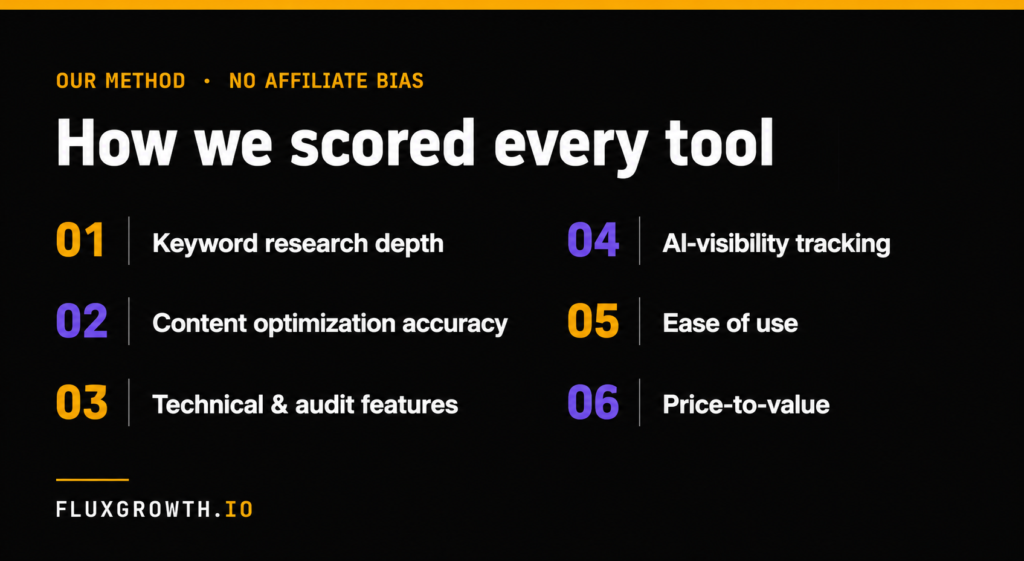
I didn’t rank which one pays the highest affiliate commission. I scored each against six things that actually move organic traffic.
Keyword research depth:- How good is the data, and does it surface intent, not just volume?
Content optimization accuracy:- Do its suggestions actually match what’s ranking, or does it just push keyword density?
Technical and audit features:- can it find what’s broken?
AI-visibility tracking:- does it monitor AI Overviews and LLM citations, or ignore them?
Ease of use:- how fast can a normal person get value? And
price-to-value:- because a tool you can’t afford to keep isn’t a tool, it’s a trial.
“In my own workflow at FluxGrowth, I regularly use ChatGPT, Claude, Gemini, Rank Math, and Google Search Console for content planning, optimization, and SEO research.”
A note on scores: a high optimization score is not a ranking. I’ll repeat that later, because it’s the single most common way people misuse these tools.
Why AI SEO Tools Are Becoming Essential
Faster Keyword Research
Manual keyword research means pulling volume data, checking difficulty, cross-referencing search intent, and building clusters by hand easily a half-day task for a single content pillar. AI keyword research tools compress that into clustering algorithms that group related terms by intent in minutes, not hours. The time saved isn’t the point by itself. What you do with that time is.
Better Content Optimization
Tools like Surfer and Clearscope analyze what’s already ranking and tell you, specifically, what your draft is missing not “add more keywords,” but which entities, subtopics, and terms the top 10 results cover that yours doesn’t. That’s a meaningfully different kind of feedback than a generic readability score.
Improved Search Rankings
No tool can promise a ranking. What the better ones do is remove the guesswork around why a piece of content might be underperforming thin coverage, missing search intent, outdated information so you’re not publishing and hoping.
Automated SEO Tasks
Site audits that used to require a developer or a freelancer crawling your site by hand now run on a schedule and flag issues automatically: broken links, missing schema, pages that have quietly lost rankings over the past month. This is where AI SEO automation earns its name. Honestly the audit work genuinely doesn’t need a human doing it manually anymore.
Competitor Analysis Made Easy
The newest wave of features Semrush’s AI Visibility Toolkit, Ahrefs’ Brand Radar, SE Ranking’s AI Rankings Report track how often you and your competitors get mentioned inside ChatGPT, Perplexity, and Google AI Mode responses. This isn’t a vanity metric.
Adobe’s April 2026 announcement of its Semrush acquisition cited internal data showing AI-driven traffic to U.S. retail sites jumped 269% year-over-year as of March 2026. That’s the entire reason this feature category exists now.
Key Features to Look for in AI SEO Tools
Not every “AI-powered” feature is worth paying for. Here’s what actually moves the needle:
AI Keyword Research
Look for personalized difficulty scoring how hard a keyword is to rank for your domain specifically, not a one-size-fits-all number every tool shows every user.
Content Optimization
Real-time scoring against current top-ranking pages, not a static checklist from six months ago. Search results shift; your optimization targets should too.
SERP Analysis
A breakdown of what’s actually ranking right now: word count, heading structure, content types (listicle vs. guide vs. comparison), and which SERP features show up (featured snippets, AI Overviews, People Also Ask).
Content Brief Generation
A brief that hands a writer the topics, questions, and structure to cover built from real competitor analysis, not a generic template.
Technical SEO Audits
Automated crawls that catch broken links, duplicate content, missing metadata, and now, whether your site is even accessible to AI crawlers in the first place.
Backlink Analysis
Link data that updates frequently enough to matter. Ahrefs refreshes its backlink index every 15 to 30 minutes; plenty of competitors update daily or weekly, which is a real gap if you’re tracking a live link-building campaign.
Rank Tracking
Daily position updates across desktop and mobile, ideally combined with visibility into whether you’re showing up in AI Overviews alongside traditional results.
AI Content Writing Assistance
This is the most overhyped feature on the list, full stop. AI-generated drafts are a fine starting point but even the best ones still need 30 to 60 minutes of human editing per article. That’s where you add the one client story, the specific number, the line that only makes sense if you’ve actually done the work.
Treat it as a first-draft accelerator. Not a finished product.
The 11 Best AI SEO Tools in 2026
1. Surfer SEO — Best for content optimization
Surfer is the tool most people picture when they hear “AI SEO.” You paste a draft, it scores you against the pages already ranking, and it tells you in real time which terms and entities you’re missing. For on-page optimization, it’s still the category standard.
What it does well: the Content Editor is fast, the SERP analysis is specific, and it recently added AI Search guidelines so your content is shaped for AI answers, not just blue links.
Where it falls short: Surfer’s content score can become a trap. Chase a green 90+ and you’ll sometimes stuff in terms that make the writing worse. Treat the score as a guide, not a grade.
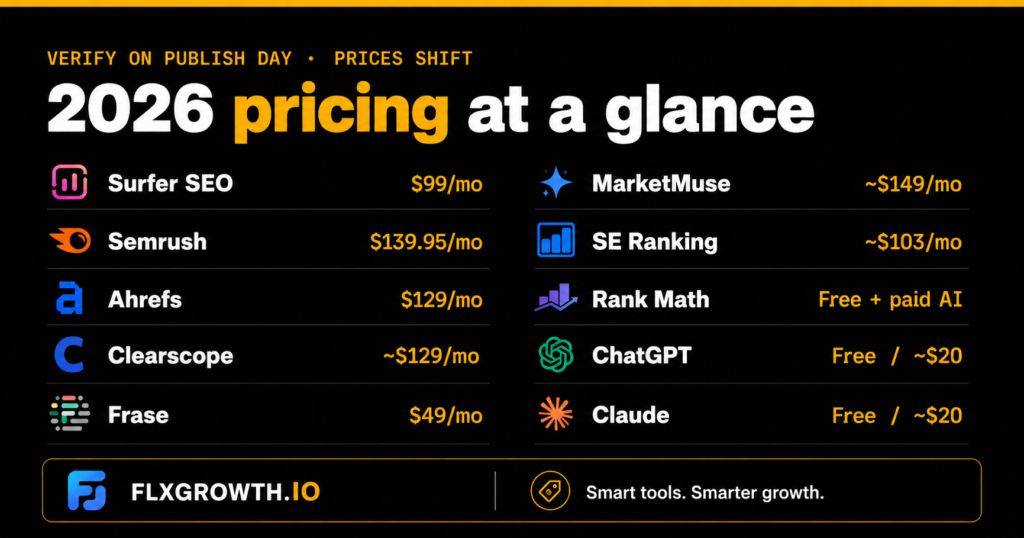
Pricing: Essential starts at $99/month ($79/month billed annually), Scale starts at $219/month ($175/month billed annually), and Enterprise pricing is available on request. Surfer also offers AI-powered features and add-ons for teams that need deeper optimization and AI search visibility tracking.
Best for: Bloggers, content marketers, SEO agencies, affiliate marketers, and businesses focused on improving organic rankings through content optimization.
2. Semrush — Best all-in-one platform with AI visibility
Semrush is the Swiss Army knife. Keyword research, rank tracking, site audits, competitor analysis, backlinks, content tools it’s all in one login. In 2026 it also pushed “Semrush One,” a bundle that adds AI-visibility tracking across ChatGPT, Perplexity, and Google’s AI Mode on top of the classic toolkit.
What it does well: breadth and competitor intelligence. If you want to see exactly what a rival ranks for and where their traffic comes from, few tools touch it.
Where it falls short: the price, and the upsell maze. The base plans don’t include the newer AI-visibility layer that’s the pricier Semrush One track so the real cost climbs once you add what you actually came for.
Pricing: Pro $139.95/month, Guru $249.95/month, Business $499.95/month, with roughly 17% off on annual billing. Semrush One bundles start around $199/month. A 7-day free trial is available.
Best for: Agencies and serious in-house teams who’ll use more than the keyword tool.
3. Ahrefs — Best for backlinks, with AI content help
Ahrefs built its name on the biggest, freshest backlink index in the business, and that’s still the reason to pay for it. The AI Content Helper and Brand Radar (its AI-visibility tracker) are newer additions sitting on top of that data foundation.
What it does well: backlink and competitive research that cheaper tools can’t fully replicate. The Site Explorer alone tells you more about a competitor in ten minutes than most audits do in an hour.
Where it falls short: there’s no free trial in 2026, the credit caps frustrate users on lower tiers, and the AI features are add-ons, not included. Bolting AI onto a legacy platform isn’t the same as building for it.
Pricing: Starter $29/month, Lite $129, Standard $249, Advanced $449, Enterprise from $1,499. Brand Radar (AI visibility) is a $199/month add-on; AI Content Helper is another $99/month. There’s a free Webmaster Tools tier for verified site owners.
Best for: Anyone whose strategy lives or dies on link building and competitive data.
4. Clearscope — Best premium content grading
Clearscope does one thing and does it cleanly: it grades your draft against what’s ranking and tells you what’s missing. No bloated dashboard, no week-long onboarding; you paste your text and get a letter grade (A+ down to F) plus the exact terms to add. That’s why editors who’d never open a 12-tab SEO suite happily live inside it.
What it does well: precision and simplicity. When a writer needs to know “is this good enough to rank,” Clearscope gives a fast, trustworthy answer.
Where it falls short: it’s expensive for what it is, and the report caps bite. Hit your monthly limit and you’re either rationing or upgrading. It also doesn’t generate content.
Pricing: Clearscope offers premium plans designed for content teams, agencies, and enterprises. Pricing varies based on usage limits, content reports, and team requirements.
Best for: Editorial teams that want a dead-simple, accurate optimization grader and have the budget.
5. Frase — Best budget brief-to-draft tool
Frase is the value pick. It takes you from a keyword to a research-backed brief to an AI-assisted draft faster than almost anything in its price range. For lean teams that need to ship, it’s the workhorse.
What it does well: speed to brief. It pulls the questions people ask, summarizes top results, and hands you an outline you can actually use. The integrated AI writer means you don’t bounce between tools.
Where it falls short: the strategic depth isn’t there. It won’t map topical authority across your whole site the way MarketMuse will, and the optimization scoring is solid but not best-in-class.
Pricing: From $49/month ($39/month annual), with a 7-day free trial and no credit card required to start.
Best for: Solopreneurs and small teams (1–3 people) who need to go from keyword to draft fast and cheap.
6. MarketMuse — Best for topical authority and strategy
MarketMuse isn’t a writing tool. It’s a strategy engine. It models entire topic areas, finds the gaps in your content coverage, and tells you what to build to own a subject, not just rank one page.
What it does well: planning at scale. If you’re building hundreds of interconnected pages around a topic, MarketMuse maps the territory better than the optimizers.
Where it falls short: the price and the opacity. There’s a limited free plan, but the real power is behind plans you mostly have to talk to sales for, and the top tier runs steep. It also demands a strategist who knows what to do with topic models; it’s not point-and-click.
Pricing: MarketMuse offers a limited free plan for testing core features. Paid plans are designed for content teams, agencies, and businesses that need deeper content strategy and planning capabilities.
Best for: Content strategists and larger teams building long-term topical authority.
7. SE Ranking — Best value all-rounder with AI tracking
SE Ranking is the one I’d point to as a budget-conscious agency. It covers most of what Ahrefs and Semrush do rank tracking, audits, keyword research, competitor analysis at a noticeably lower price, and it includes AI-search tracking across ChatGPT, Perplexity, and Google AI without a separate add-on.
What it does well: price-to-value and white-label reporting. For freelancers and small agencies billing clients, including AI tracking and branded reports are a real edge.
Where it falls short: the data isn’t quite as deep as Ahrefs on backlinks, and a few features still sit behind add-ons. The low entry price can climb once you need more keywords tracked.
Pricing: SE Ranking offers Core, Growth, and Enterprise plans, along with a free trial. Pricing varies based on usage limits, projects, tracked keywords, and additional features.
Best for: Freelancers and small agencies who want most of the big-suite power without the big-suite bill.
8. Rank Math Content AI — Best for WordPress users
If you live inside WordPress, Rank Math is hard to ignore. The core plugin has one of the most generous free tiers in the SEO-plugin world, with a built-in rank tracker that competitors charge for. Content AI is its writing-and-optimization layer.
What it does well: it’s right there in your dashboard. No tab-switching, no copy-paste. For a WordPress blogger, that convenience is the whole pitch.
Where it falls short, and this is the honest part: Content AI is a separate paid subscription on top of the plugin, it runs on a credit system (one credit per word, credits don’t roll over), and there’s a documented history of billing complaints on G2, Reddit, and Capterra users reporting the AI add-on charged at checkout or renewed without clear notice. Read the cart carefully.
Pricing: Core plugin has a strong free version; PRO starts around $72/year on sale (renews higher). Content AI is billed separately on its credit-based plans.
Best for: WordPress bloggers who want SEO and AI assistance in one dashboard and who watch their billing.
9. ChatGPT — Best free general workhorse
ChatGPT isn’t an SEO tool, We recently covered several practical ways to use ChatGPT for SEO in our guide. which is exactly why it’s so useful for SEO and How to Use ChatGPT for SEO It clusters keywords, drafts outlines, writes meta descriptions, builds FAQ schema, and reverse-engineers search intent all in plain language, for free.
What it does well: flexibility and speed. Feed it to your top-ranking competitors and ask what they’re missing; you’ll get a usable content angle in seconds.
Where it falls short: no live SERP data, and it invents facts with total confidence. It’s also the most over-used tool here; half your competitors are feeding it the same prompts so use it for thinking and structure, not for facts or final copy.
Pricing: A generous free plan is available. ChatGPT Plus costs $20/month, while ChatGPT Pro costs $200/month for users who need higher limits and advanced capabilities.
Best for: Everyone, as the brainstorming and drafting layer underneath your real SEO tool.
10. Claude — Best free tool for long-form and editing
Claude is the writer’s AI. You may also want to compare Claude and ChatGPT before choosing your workflow. It holds long documents in mind better than most, edits with a lighter touch, and tends to produce cleaner, less robotic prose which matters more than ever now that Google is openly hunting low-effort AI content. Claude vs ChatGPT for Content Writing
What it does well: long-form drafting, editing existing content, and humanizing copy that reads like a template. If you’re refining a 3,000-word post, it keeps the whole thing coherent.
Where it falls short: same core limits as any LLM no live SERP data and no built-in SEO scoring. It’s the editorial brain, not the data engine.
Pricing: Claude offers a free plan for everyday use. Claude Pro costs $20/month, while Claude Max plans start at $100/month and increase based on usage requirements.
Best for: Creators and editors who write long, care about voice, and want AI that doesn’t flatten it.
11. Jasper AI — Best for on-brand content at volume
Here’s the thing about Jasper: it’s not really an AI SEO tool. It’s a generalist AI writing platform for marketing content broadly: ad copy, landing pages, email, social posts, and yes, blog content. The SEO piece comes from a built-in Surfer SEO integration on the Pro plan, not from anything proprietary Jasper built itself.
That’s not a knock on Jasper as a writing tool. It’s a reason to be honest about what you’re actually buying. If SEO content optimization is your primary need, you’re paying for Jasper and effectively renting Surfer’s scoring through it.
Pros: Brand Voice training keeps output consistent across a team or multiple client accounts. The Canvas editor and template library cover far more content types than any dedicated SEO tool. Genuinely useful if you need one platform across formats, not just blog SEO.
Cons: The SEO functionality is borrowed, not built-in. You’re effectively paying for two tools’ worth of capability under one subscription if you want real content scoring (Jasper plus Surfer). All generated output still needs editing, regardless of plan tier, and the Brand Voice caps on Pro push agencies toward the custom Business tier faster than expected.
Pricing: Creator $39/month (billed annually) or $49/month monthly. Pro $59/month annually or $69/month monthly this is the tier with Surfer integration. Business is custom-priced.
AI SEO Tools at a Glance
| Tool | Best For | Starting Price* | AI Search Tracking | Free Option |
| Surfer SEO | Content Optimization | $99/month | Available as add-on | No (7-day money-back guarantee) |
| Semrush | All-in-One SEO Platform | $139.95/month | Available through Semrush AI tools | Limited free account |
| Ahrefs | Backlinks & Competitor Research | $129/month (Lite) | Brand Radar add-on | Ahrefs Webmaster Tools |
| Clearscope | Premium Content Optimization | Custom/Premium Pricing | No | No |
| Frase | Content Briefs & AI Writing | From $45–$49/month | No | Free trial available |
| MarketMuse | Topical Authority & Content Strategy | Premium Pricing | No | Limited free plan |
| SE Ranking | Value All-Rounder | From $100+/month (Core) | Included | Free trial |
| Rank Math Content AI | WordPress SEO | Free plugin + paid AI credits | No | Yes |
| ChatGPT | Content Planning & Drafting | Free / $20/month (Plus) | No | Yes |
| Claude | Long-Form Writing & Editing | Free / $20/month (Pro) | No | Yes |
A few quick winners so you don’t have to re-read all ten:
1.Best for keyword research:- Semrush and Ahrefs for depth; SE Ranking if you want most of that data for less.
2.Best for content optimization: Surfer for real-time scoring, Clearscope for editorial precision, Phrase of budget is tight.
3.Best for AI-search visibility: SE Ranking (included) or Semrush One the two that treat AI tracking as core, not an upsell.
Best Free AI SEO Tools That Are Actually Worth It
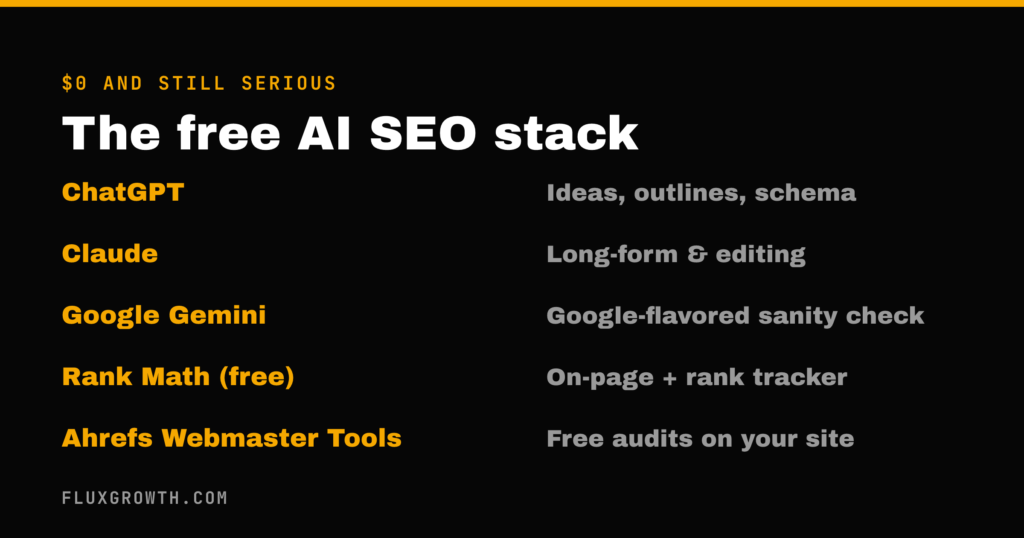
You can do real SEO work without paying a cent. You just need to know what each free tool can’t do. If budget is your main concern, check out our roundup of the best free SEO tools.
1.ChatGPT and Claude:handle the thinking and writing, clustering, outlines, meta copy, editing, schema. Free, flexible, no SERP data. Use both: ChatGPT for ideation, Claude for long-form and cleanup.
2.Google Gemini is worth keeping open for a different reason: it’s wired into Google’s own ecosystem, so it’s a useful sanity check on how Google’s AI tends to frame a topic. The free tier is generous.
3.Rank Math’s free plugin gives WordPress users on-page guidance, schema, and a rank tracker inside the dashboard without a subscription. The free tier alone beats a lot of paid plugins.
4.Ahrefs Webmaster Tools is the sleeper. Verify your site and you get free site audits and backlink monitoring for your own domain genuinely useful, no card required.
The honest limit on all of these: none of them give you live competitor SERP data or accurate keyword volume. For that, you eventually pay. But for a new blog finding its feet, this free stack covers more than people expect.
Free vs Paid: Where’s the Real Line?
The line isn’t about quality. It’s about data and scale.
Free tools are brilliant at making ideas, drafts, edits, schema. They’re poor at measuring things that your competitors rank for, real search volume, where you stand in AI answers. That measurement is what you’re actually buying when you get paid.
So here’s a simple rule. If your bottleneck is producing content, the free stack will take you surprisingly far. If your bottleneck is knowing what to produce and whether it’s working, that’s when a paid tool earns its keep.
My rough threshold: under ~4 posts a month, stay free and reinvest the money. Past that, one focused paid tool not three starts paying for itself in saved hours and better targeting.
From my experience with FluxGrowth, free tools are enough when you’re publishing occasionally. But once you’re creating content consistently, paid SEO tools start saving hours on keyword research, competitor analysis, and tracking. For me, the tipping point is around 4–5 quality articles per month. Beyond that, one good SEO tool usually pays for itself.
How to Use AI SEO Tools Effectively
Finding High-Value Keywords
Start with personalized difficulty scores, not generic ones. A “medium difficulty” keyword from a tool that doesn’t know your domain’s authority can be effectively unrankable for a new site and easy for an established one. Cluster by intent before you cluster by topic two keywords with similar search volume can need completely different content formats.
Creating SEO Content Briefs
A good brief lists the questions competitors are answering, the topics they’re covering that you might miss, and a realistic word count range not a rigid template. Generate it, then edit it. The brief is a starting point for a writer, not a finished outline.
Optimizing Existing Content
Run your published articles through a content audit tool quarterly, not just once at launch. Search results shift, competitors update their content, and a piece that ranked well a year ago can quietly lose ground without you noticing until traffic drops.
Improving Internal Linking
Most AI SEO platforms now suggest internal linking opportunities based on topical relevance. Use the suggestions as a starting list, then check manually that the anchor text actually makes sense in context automated suggestions sometimes prioritize relevance over readability.
Monitoring SEO Performance
Combine traditional rank tracking with AI visibility tracking if your platform offers both. Industry research has consistently found a strong correlation between first-page Google rankings and inclusion in AI-generated search results. In many studies, the majority of AI Overview citations originate from pages already ranking in the top organic results, reinforcing the importance of traditional SEO fundamentals even as AI-powered search evolves.
Track both organic rankings and AI visibility metrics to gain a complete picture of search performance and identify new opportunities for growth.
The two metrics aren’t separate goals. Ranking well organically is still the foundation AI visibility builds on.
AI SEO Tools for Different Users
For Bloggers
Prioritize content optimization and brief generation over enterprise features you won’t use. Frase or Koala AI cover most blogger needs without the agency-level price tag.
For Small Businesses
A single all-in-one platform (Semrush Pro or Ahrefs Lite) usually beats stacking three specialized tools, mostly because the time cost of switching between platforms outweighs the marginal feature gains for a single-site operation.
For Marketing Agencies
White-label reporting and multi-client project management matter more than any individual AI feature. This is where Semrush and SE Ranking earn their higher price tags.
For E-commerce Stores
Technical audit depth and indexing speed matter disproportionately; a 500-product catalog with slow indexing loses more revenue to delayed discovery than to imperfect keyword targeting. Tools with strong technical crawling (Ahrefs, Semrush) and dedicated indexing acceleration are worth the premium here.
For Enterprise Companies
Custom pricing tiers exist for a reason at this scale: API access, SSO, and dedicated account support matter more than any single feature. Budget for Enterprise-tier negotiation rather than assuming list pricing applies.
5 Ways People Misuse AI SEO Tools (and Tank Their Rankings)
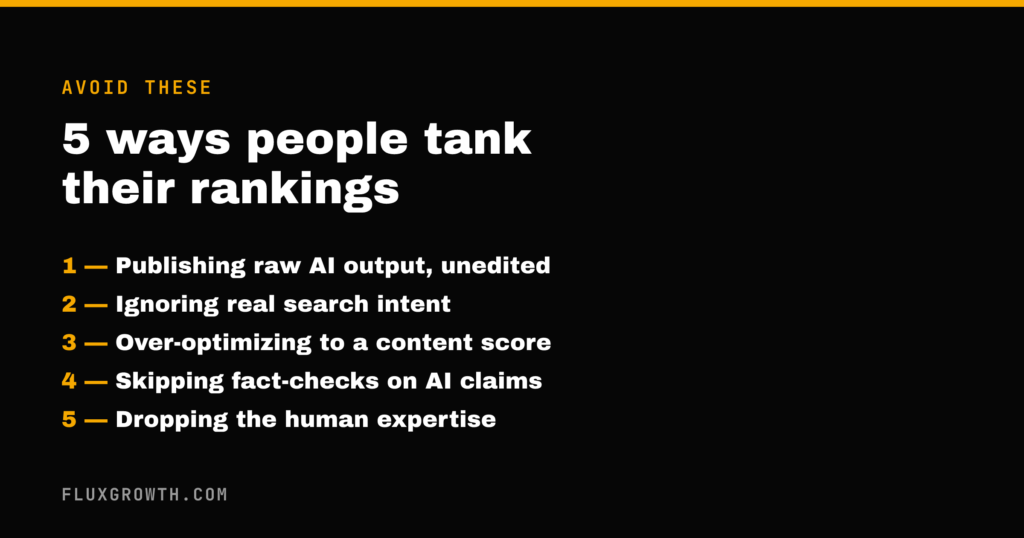
The tools rarely fail. The way people use them does. Here are the five mistakes I see most.
1.Publishing AI output without editing it:-
This is the big one. Google’s helpful-content systems are explicitly built to demote low-effort, mass-produced content. Raw AI text, no edits, no experience, no point of view is exactly the profile they’re filtering. The tool drafts; you make it worth reading.
2.Ignoring search intent:-
A keyword tool hands you a term with great volume, and you write the wrong thing for it. If the searcher wants a comparison and you give them a how-to, no amount of optimization saves you. Check what’s actually ranking before you write a word.
3.Over-optimizing to a score:-
Chasing a 95 in Surfer or Clearscope can quietly wreck your writing. The score approximates what’s ranking; it doesn’t grade whether a human wants to read it. Hit a strong score, then read it out loud and cut anything that sounds stuffed.
4.Skipping fact-checks:-
LLMs invent statistics, misquote sources, and fabricate citations with total confidence. Every number an AI gives you is a claim to verify, not a fact to publish. (Yes, including the ones in your competitors’ AI-written posts.)
5.Dropping human expertise:-
The thing AI can’t fake is the thing Google now rewards most: real experience. Your screenshot, your client result, your “here’s what actually happened when I tried this” that’s the moat. Lean into it harder, not less, as everyone else automates.
Can AI-Generated Content Rank on Google?
Google’s View on AI Content
Google’s ranking systems aim to reward original, high-quality content that demonstrates expertise, experience, authoritativeness, and trustworthiness, regardless of whether it’s human-written or AI-assisted. The company has held this position consistently since 2023 the focus has always been on quality, not production method.
E-E-A-T and AI Content
Google’s March 2026 core update re-weighted ranking signals toward what the SEO community calls Information Gain whether content contains something genuinely new relative to what already ranks for a query along with verifiable author expertise. Anonymous content or generic author bylines are losing ground, independent of whether AI was involved in drafting.
Best Practices for AI-Assisted Writing
Use AI for structure and first drafts. Add the things AI can’t fabricate convincingly: direct experience, specific numbers from your own testing, and judgment calls about what actually matters for your reader. That’s the difference between AI-assisted and AI-replaced.
Future of AI SEO
AI Search Engines
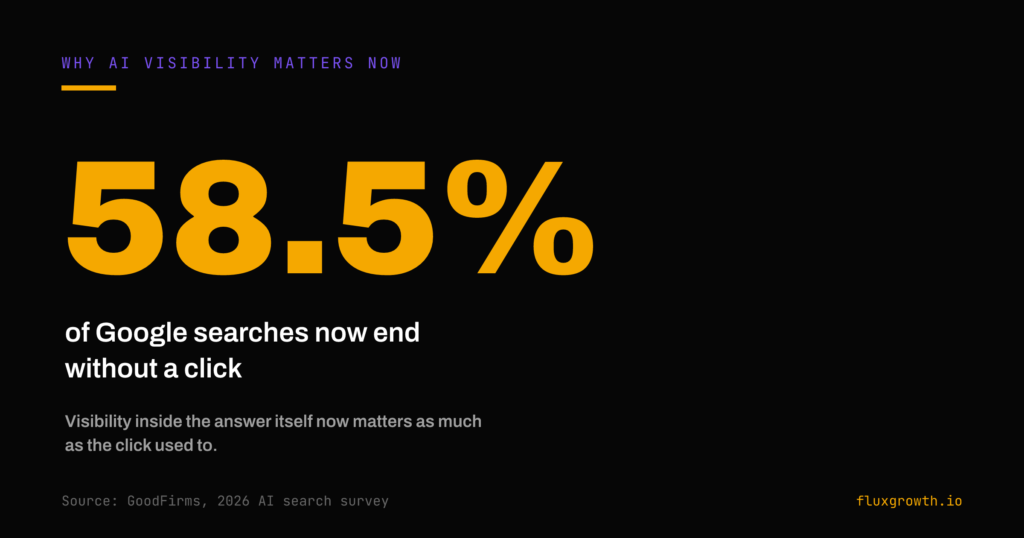
ChatGPT, Perplexity, and Google’s own AI Mode are no longer side experiments; they’re a parallel discovery channel that traditional rank tracking doesn’t capture. GoodFirms’ 2026 survey found over 58.5% of Google searches now end without a click, which means visibility inside the answer itself matters as much as the click used to.
Google’s AI Overviews
Recent studies suggest that Google’s AI Overviews can significantly reduce click-through rates for some organic search results, particularly when the AI-generated answer satisfies the user’s query without requiring a click. Several analyses have reported CTR declines ranging from roughly 15% to more than 30% for certain query types, though the impact varies by industry, search intent, and SERP layout.
At the same time, research indicates that AI Overview citations frequently originate from pages that already rank well in organic search results. Rather than replacing traditional SEO, AI-powered search appears to reward many of the same signals that contribute to strong organic visibility. The two systems aren’t separate battles; success in organic search remains one of the strongest predictors of visibility in AI-generated results.
Voice Search Optimization
Voice search optimization remains a smaller piece of the puzzle than the AI search shift, but the underlying skill of writing direct, answerable content overlaps heavily with what works for AI Overviews and chat-based search.
Predictive SEO
Expect more tools to move from “here’s what’s ranking now” to “here’s what’s likely to rank in three months based on emerging search patterns.” This is still early and imperfect, but the direction is clear from where Semrush, Ahrefs, and Surfer are all investing.
Generative AI and Search
Demandsage’s 2026 AI SEO Statistics report projects the AI SEO tools market growing from $1.2 billion in 2024 to $4.5 billion by 2033. That growth isn’t hype, it’s a direct response to search behavior actually changing, not a trend SEO tool vendors invented to sell subscriptions.
What I’d Do If I Were Starting Today?
If I were starting from zero in 2026, here’s the exact stack not a menu, a path.
No budget: ChatGPT plus Claude for thinking and writing, Rank Math’s free plugin for on-page, and Ahrefs Webmaster Tools for free audits on my own site. That combination is enough to publish well-optimized, genuinely useful content. Spend the saved money on one thing instead: original research or a real expert quote, because that’s what wins now.
Small budget (~$100/month): Add one focused paid tool. For most people that’s Phrase (cheap, fast, brief-to-draft) or SE Ranking (data plus included AI tracking). I’d pick based on my bottleneck Phrase if I struggle to produce, SE Ranking if I struggle to measure.
Agency or serious operator: Semrush or Ahrefs as the data spine, plus a dedicated optimizer (Surfer or Clearscope) for the editorial workflow, plus AI-visibility tracking switched on. Yes, it’s a few hundred a month. At client volume it returns that in a week of saved time.
For FluxGrowth, I keep things simple. My core stack is ChatGPT for research and brainstorming, Claude for editing and long-form writing, Rank Math for on-page SEO, and Google Search Console for performance tracking. I’ve tested plenty of tools, but I quickly realized that adding more subscriptions doesn’t automatically produce better content. I’d rather spend time creating useful content than jumping between dashboards.
The tool matters less than the discipline. A free stack used with real expertise beats a $400 stack used to mass-produce filler. Every time.
Are AI SEO Tools Worth It?
Advantages
Real time savings on research and audits, content gaps you’d otherwise miss, and visibility into AI-generated answers that didn’t exist as a measurable channel five years ago.
Limitations
No tool replaces judgment about what your specific audience needs. Pricing in this category has moved fast and unpredictably in 2026 three of the seven tools in this guide repriced or changed ownership within the past 18 months.
Cost vs ROI
For a solo creator publishing a few articles a month, a $29-99/month tool pays for itself if it saves even two hours of manual research weekly. For an agency managing a dozen clients, the math shifts toward whichever platform consolidates the most tools into one subscription switching costs between platforms add up faster than feature gaps do.
Frequently Asked Questions
What is the best AI SEO tool?
There isn’t one universal answer; it depends on whether you need all-in-one coverage (Semrush), backlink depth (Ahrefs), or content optimization specifically (Surfer or Clearscope).
Can AI replace SEO experts?
No. AI tools handle research and analysis faster, but strategy decisions about what to prioritize, how to interpret data for a specific business still need a person making the call.
Is ChatGPT good for SEO?
For brainstorming, meta descriptions, and outlines, yes. For keyword data, rank tracking, or technical audits, no it wasn’t built for that and will confidently generate inaccurate numbers if you ask.
Which AI tool is best for keyword research?
Semrush and Ahrefs both offer the deepest keyword databases. Frase and Keywordly are lighter, cheaper alternatives if comprehensive keyword discovery isn’t your main need.
How much do AI SEO tools cost?
Anywhere from $29/month (Ahrefs Starter) to $500+/month (Semrush Business, Clearscope Business), with most useful tools for a solo operator or small team landing between $99 and $250/month.
Are AI SEO tools worth it?
For anyone publishing content regularly or managing more than one site, yes the time saved on research and audits alone usually covers the subscription cost.
Can AI-generated content rank on Google?
Yes, if it meets the same quality bar as any other content: genuine expertise, original insight, and editing that goes beyond what the AI produced on its own.
What are the limitations of AI SEO tools?
They can’t make strategic judgment calls, they occasionally hallucinate data, and pricing in this category has been unstable. Several tools in this guide changed pricing or ownership within the last 18 months alone.
How do AI SEO tools improve rankings?
Indirectly. They identify content gaps, technical issues, and competitive weaknesses faster than manual research would. The improvement comes from acting on what the tool finds, not from the tool itself.
Which AI SEO tool is best for beginners?
Ahrefs’ new $29 Starter plan or Koala AI for content generation both offer real functionality without the steep learning curve or price tag of enterprise platforms.
Final Thoughts
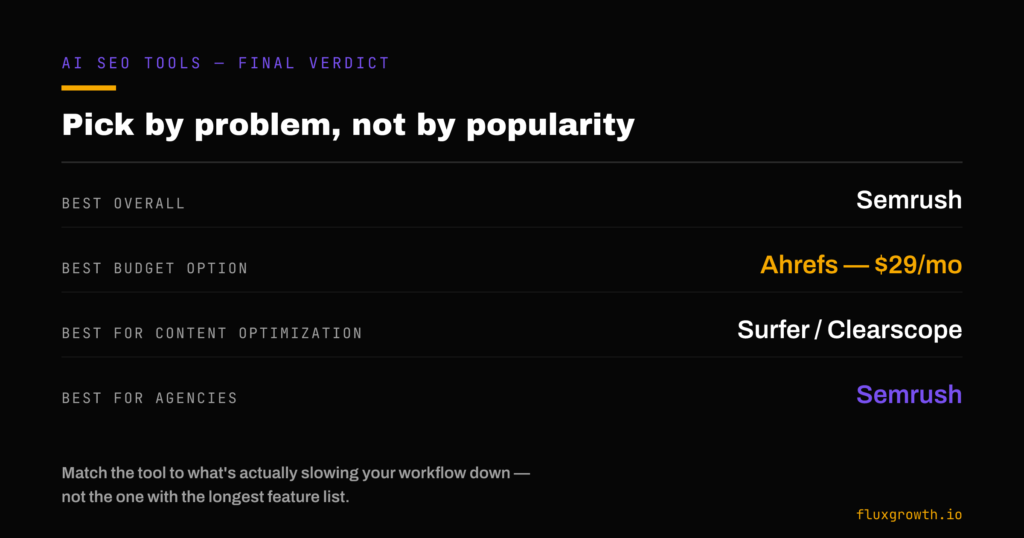
Best AI SEO Tool Overall
Semrush, for the breadth of AI Visibility tracking combined with the classic SEO toolkit if the learning curve doesn’t scare you off.
Best Budget-Friendly Option
Ahrefs’ $29 Starter tier. It’s a real shift for a platform that used to lock everything behind $129/month.
Best Tool for Content Optimization
Surfer SEO or Clearscope, depending on whether you want more granular control (Surfer) or a simpler, faster workflow for non-specialist writers (Clearscope).
Best Tool for Agencies
Semrush, for white-label reporting and multi-client management at scale.