FluxGrowth is reader-supported. Some links in our guides are affiliate links — if you buy through one we may earn a commission, at no extra cost to you. It never changes which tools we recommend. How we test tools.
Most people picking AI marketing tools are doing it wrong. They compare pricing pages, pick the cheapest option, and then wonder why their content output is still slow and their campaigns aren’t moving. The real question isn’t “which tool costs less?” It’s “which tool earns back more time and revenue than it costs?”
This guide is part of our AI Marketing hub – everything we have published on AI marketing tools and content workflows, in one place.
I run FluxGrowth, where I test AI tools for content creation, automation, and marketing workflows. What I’ve noticed: most marketers grab two or three tools without a strategy, end up duplicating work across all of them, and still rely on manual processes for the things that actually take the most time.
This guide cuts through that. You’ll get honest breakdowns of the 10 best artificial intelligence marketing tools in 2026: what they actually do well, where they fall short, and who should use them.
Why AI Marketing Is Growing Faster Than Anyone Expected
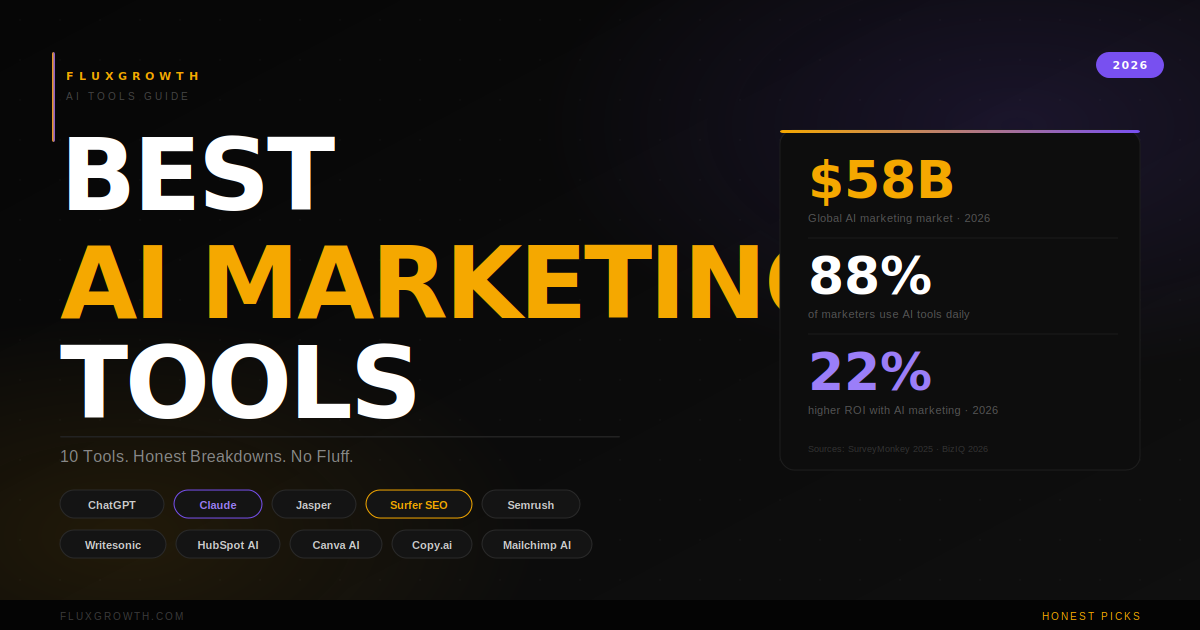
The numbers are hard to argue with. The global AI marketing market sits at roughly $58 billion in 2026, up from $6.46 billion in 2018. That’s not hype in fact, that’s sustained enterprise spending shifting toward AI-integrated platforms.
According to SurveyMonkey’s 2025 marketing survey, 88% of marketers now use AI tools in their daily workflow, and 93% say AI accelerates content creation. Those aren’t soft adoption numbers. That’s near-universal integration.
HubSpot’s 2025 State of Marketing report backs this up content creation tops the list of AI use cases at 35%, followed by data analysis at 30% and workflow automation at 20%.
But here’s what those adoption stats don’t tell you: only 17% of marketing professionals have received meaningful AI training. Most teams are using tools they don’t fully understand and that’s the actual gap this guide fills.
What Are Artificial Intelligence Marketing Tools?
AI marketing tools are software platforms that use machine learning and large language models to automate, accelerate, or improve specific marketing tasks: writing content, analyzing keywords, personalizing emails, generating ad copy, and building social posts.
These aren’t simple templates with fill-in-the-blank prompts. In fact, modern AI marketing software learns from your inputs, adapts to your brand voice, and in many cases pulls live data from the web to inform its output.
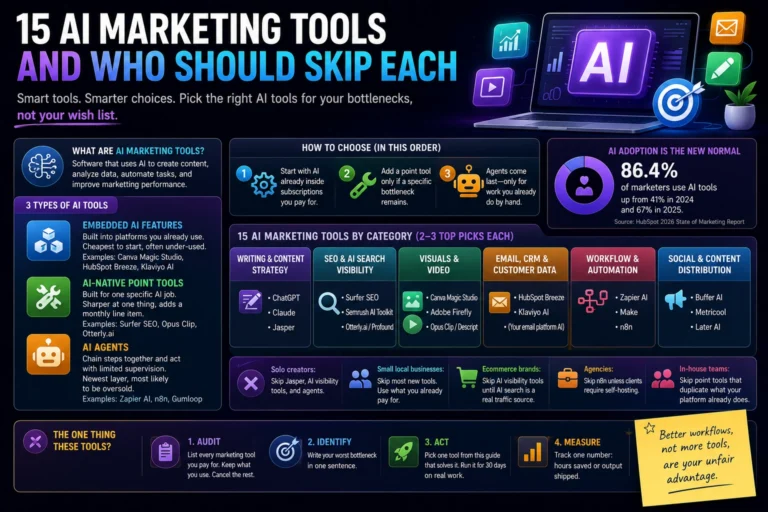
The Three Categories That Matter
1.Generative AI platforms (ChatGPT, Claude, Jasper) Build content, copy, and strategy from prompts. The most versatile category, and where most marketers start.
2.SEO-specific AI tools (Surfer SEO, Semrush) Analyze search intent, optimize existing content, track rankings, identify gaps. Different jobs than generative AI don’t conflate them.
3.Workflow and channel AI tools (HubSpot AI, Mailchimp AI, Canva AI, Writesonic, Copy.ai) Automate specific channel tasks: email sequences, social graphics, ad copy, landing pages.
Most teams need at least one from each category. Picking only one and expecting it to do everything is where the ROI math breaks down.
How to Choose the Right AI Marketing Tool
Before you test anything, answer four questions.
1.What’s your primary bottleneck?
Slow on content volume? You need a generative AI platform. Content not ranking? You need an SEO tool. Leads not converting? Start with email or CRO automation. Don’t buy an SEO tool if your real problem is production speed.
2.How technical is your team?
Claude and ChatGPT reward users who can write detailed prompts — if you’ve never done this before, our guide on how to write AI prompts that actually convert is the place to start. Jasper and Write sonic have more guided templates, better for teams who need guardrails. Pick the tool that matches your team’s actual comfort level, not the one with the best demo.
3.Does it integrate with your current stack?
Because a tool that doesn’t talk to your CRM, CMS, or ad platform creates more manual work — not less. Before committing, verify native integrations with WordPress, HubSpot, Google Ads, or wherever your current workflow lives.
4.What’s the real cost?
Monthly subscription is one number. Total cost includes onboarding time, editing hours after AI generates content, and any per-usage fees. Surfer AI charges $29 per article on top of the subscription, for example. Write 10 AI articles a month and that’s an extra $290 before any editing time.
Best Artificial Intelligence Marketing Tools
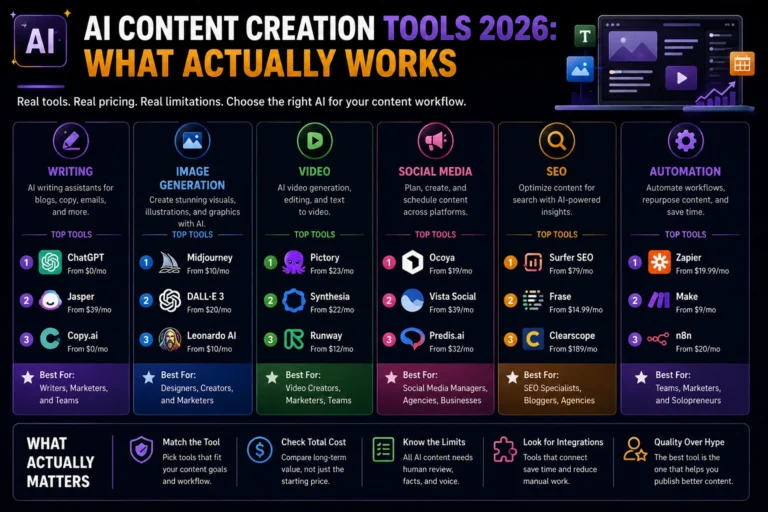
1.ChatGPT
What it does well: ChatGPT is the most versatile AI platform available right now. It handles content writing, data analysis, image generation via DALL-E, web browsing, Python code, and video through Sora all from one interface. The 2025 Stack Overflow Developer Survey found 81% of developers use ChatGPT, which reflects how broadly it’s integrated into professional workflows.
For marketers, it’s especially strong for research-heavy content. Feed it a brief, point it at recent web data, and it can draft an outline, find supporting stats, and write the first pass — all in one session. So no tool-switching required.
Honest limitations: It doesn’t remember your brand voice between sessions unless you configure the memory feature deliberately. And if you’re not writing specific prompts, the output style drifts toward the generic competent but flavourless.
Pricing: $20/month for Plus. $200/month for Pro. Free tier available with message caps.
Best for: Marketers who need a multi-purpose tool and are comfortable writing detailed prompts. Strong for agencies handling varied content types across different formats.
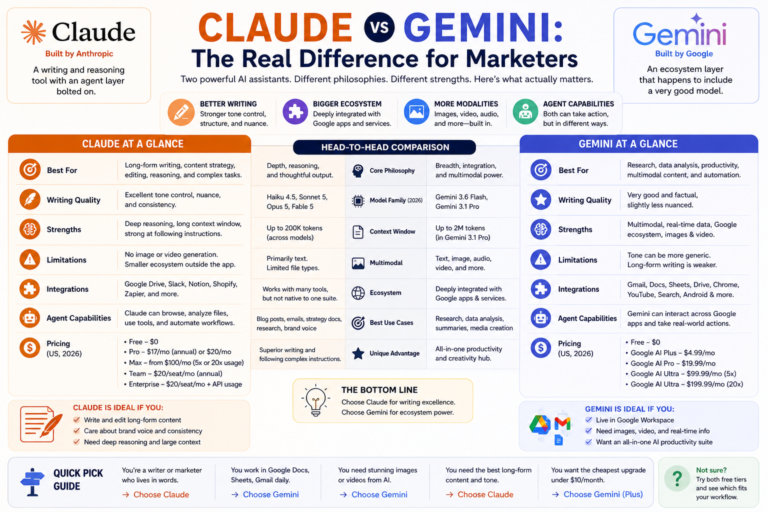
2.Claude
What it does well: Claude is the sharpest AI for long-form writing and nuanced copy. Independent testing across 12 AI writing tools found Claude produces the most natural-sounding writing with better tone control than ChatGPT. On the technical side, Claude Opus 4.6 scores 80.8% on SWE-bench Verified and 91.3% on GPQA Diamond the graduate-level reasoning benchmark. That matters if you’re using it for complex campaign strategy or technical content.
The context window is a real differentiator. Claude handles 200,000 tokens on its paid plan roughly equivalent to an entire novel. For marketers working with long documents like full content audits, brand style guides, or long interview transcripts, that’s genuinely useful. For marketers working with long documents like full content audits, brand style guides, or long interview transcripts, that’s genuinely useful., For marketers working with long documents like full content audits, brand style guides, or long interview transcripts, that’s genuinely useful. You can paste the whole thing and ask questions about it. No chunking, no summarizing first.
Honest limitations: No native image generation. Web browsing is available but not as fluid as ChatGPT’s research mode. If you need heavy multimodal output, you’ll want ChatGPT alongside it.
Pricing: $20/month for Pro. Free tier with usage limits.
Best for: Content creators and marketing teams who prioritize copy quality and regularly work with long documents. The best standalone writing tool at the $20 price point — full stop. Still deciding between the two? Our Claude vs ChatGPT for content creators breakdown goes deeper on where each one actually wins.
3.Jasper
What it does well: Jasper’s real advantage is brand consistency at scale. It stores brand voices, audience profiles, and knowledge assets so five writers all produce on-brand content without briefing Claude or ChatGPT from scratch every session. For content marketing teams running 20+ pieces a month, that coordination layer is worth paying for. Jasper Studio also lets non-technical teams build custom AI workflows without code. Brief in, draft out, every time.
Honest limitations: Solo? Wrong tool. If you can write a detailed system prompt, you’ll get better output from Claude at $20/month than from Jasper at $49–$59/month. The premium makes sense for teams, not individuals.
Pricing: Creator plan from $39/month (annual). Pro from $59/seat/month. Business: custom.
Best for: Content teams of 3+ managing multiple brand voices. Agencies with repeatable production needs.
4.Surfer SEO
What it does well: Surfer is the go-to tool for optimizing content against live SERP data. It analyzes the top-ranking pages for your keyword and gives you a content score based on structure, keyword coverage, NLP entities, and word count. The Content Editor integrates natively with Google Docs and WordPress, so you’re optimizing as you write not after.
Its AI Tracker monitors how your brand appears in AI-generated answers from ChatGPT, Perplexity, Google AI Overviews, and Gemini which matters as AI search grabs more of the query traffic that used to go to organic results.
Honest limitations: The per-article AI writing fee is the real catch. Surfer AI costs an additional $29 per article on top of your subscription. Ten AI-generated articles a month adds $290 before you’ve touched the draft. And it has no backlink analysis or technical audit capability; you still need Ahrefs or Semrush alongside it.
Pricing: Essential $99/month ($79/month annual). Scale $219/month ($175/month annual).
Best for: Content marketers who already have keyword research covered and need a dedicated on-page optimization layer.
5.Semrush AI Toolkit
What it does well: Semrush is the closest thing to an all-in-one AI marketing platform in this list. Keyword research, backlink analysis, technical site audits, competitor intelligence, content optimization, paid ad analysis all under one subscription. <It starts at $139.95/month, higher than Surfer, but eliminates the need for multiple separate SEO tools.
The AI Writing Assistant generates SEO-optimized content briefs and drafts using your keyword data. No switching between Semrush and a separate writing tool it’s built in.
Honest limitations: It’s wide, not deep. For pure content scoring and NLP optimization, Surfer still edges it out. And at $139.95/month, it’s a tough sell for solo operators.
Pricing: Pro $139.95/month. Guru $249.95/month. Business $499.95/month.
Best for: Marketing managers and agencies who want one platform covering SEO, content, and competitive intelligence. Once you’re replacing three or more standalone tools, the math works.
5.Writesonic
What it does well: Writesonic sits in the middle of the market more structured than Claude or ChatGPT, cheaper than Jasper. Its Chatsonic feature integrates real-time web data, so it can write content informed by what’s ranking today. It integrates with HubSpot, Shopify, WordPress, Google Ads, Facebook Ads, and Mailchimp genuine utility inside existing stacks.
For solopreneurs who need decent output without a steep learning curve, it works.
Honest limitations: The output is decent but you’ll still clean it up. Writesonic drafts tend to flatten your brand voice, over-explain things the reader already knows, and occasionally miss the point of the brief. Call it a 70% draft. Good enough to start from, not good enough to publish directly.
Pricing: From $16/month (annual). Team plans from $39/month.
Best for: Small business owners and solopreneurs who need content volume with light editing and don’t want to pay $20/month for a frontier model.
6.HubSpot AI
What it does well: Here’s the thing about HubSpot AI: it’s not really an AI writing tool. It’s an AI layer on top of your CRM data. So when it suggests email copy, it’s pulling from your actual contacts and engagement data. That’s a different input than what Claude or Jasper ever sees.
The AI assistant is embedded across Marketing Hub, Sales Hub, and Service Hub. One tool, one subscription, no separate product to manage.
Honest limitations: The AI features are only valuable if you’re already paying for HubSpot which starts at $800/month for Marketing Hub Professional. For teams not on HubSpot, this isn’t a reason to switch.
Pricing: Starter from $20/month. Professional from $800/month.
Best for: Marketing teams already running HubSpot who want AI built into their existing workflow. Not a standalone purchase.
7.Canva AI
What it does well: Canva’s AI suite Magic Write, Magic Design, Magic Resize, and the AI image generator has made it the default visual tool for non-designers. Magic Design turns a text prompt into a complete branded social post or presentation template in seconds. Magic Resize reformats any design across every social platform automatically.
For social media managers producing daily content across LinkedIn, Instagram, and X, this isn’t a nice-to-have. It’s infrastructure.
Honest limitations: Magic Write is weak. Genuinely. Use Canva AI for design and visual workflow, full stop not for copy quality.
Pricing: Free plan available. Canva Pro $15/month. Teams from $10/person/month.
Best for: Content creators, social media managers, and small business owners who need polished visual content without a design budget.
8.Copy.ai
What it does well: Copy.ai has evolved from a simple copywriting tool into a marketing workflow automation platform The free plan includes 2,000 words per month enough to test it seriously before paying anything. The workflow builder automates multi-step content processes: brief → draft → social variants, without any technical setup. That’s the actual value here, less the individual copy quality.
Honest limitations: At scale, the output quality plateaus faster than Claude or ChatGPT. It’s built for speed and templated outputs, not nuanced long-form content.
Pricing: Free (2,000 words/month). Starter from $49/month. Advanced from $249/month.
Best for: Freelancers and small teams who need workflow automation around content production and want a zero-cost entry point.
9.Mailchimp AI
What it does well: Mailchimp’s AI features are built specifically for email subject line optimization, send-time prediction, content personalization, and automated segmentation.Mailchimp trains its subject line suggestions on billions of sent emails — pattern recognition no generic AI tool can replicate for this specific job.
Honest limitations: Mailchimp has well-documented pricing and usability complaints at scale. The AI features don’t fix those if you’re already outgrowing the platform.
Pricing: Free up to 500 contacts. Essentials from $13/month. Standard from $20/month. Premium from $350/month.
Best for: Small businesses and ecommerce brands already on Mailchimp who want AI to improve email performance without switching platforms.
AI Marketing Tools Comparison Table

| Tool | Starting Price | Free Plan | Best For | Key Strength |
| ChatGPT | $20/month | ✅ (limited) | General-purpose | Multimodal, web research |
| Claude | $20/month | ✅ (limited) | Long-form copy | Writing quality, 200K context |
| Jasper | $39/month | ❌ (7-day trial) | Content teams | Brand voice consistency |
| Surfer SEO | $99/month | ❌ | Content optimization | Real-time SERP scoring |
| Semrush | $139.95/month | ❌ (7-day trial) | Full SEO suite | All-in-one marketing intel |
| Writesonic | $16/month | ✅ | Solopreneurs | Templates + web data |
| HubSpot AI | $20/month | ✅ | CRM users | CRM-informed personalization |
| Canva AI | $15/month | ✅ | Visual content | Design automation |
| Copy.ai | $49/month | ✅ | Workflow automation | Multi-step content flows |
| Mailchimp AI | $13/month | ✅ | Email marketing | Subject line + send-time AI |
Best AI Tools by Use Case
Content Marketing
Claude and ChatGPT lead here for quality and flexibility. Jasper adds team coordination for larger content operations. Run your drafts through Surfer SEO’s Content Editor before publishing regardless of which generative AI you used to write them.
SEO
Semrush for the full picture. Surfer SEO for focused on-page optimization. They’re not competing tools, they’re complementary. Most serious SEO teams run both.
Social Media
Canva AI for design. ChatGPT or Claude for captions and hook writing. Write sonic if you need templated social copy at volume. Don’t look for one tool that does all three well — none of them do. For the full social-specific breakdown, see our guide to the best AI tools for social media marketing.
Email Marketing
Mailchimp AI if you’re already on Mailchimp. HubSpot AI if you’re in HubSpot with real segmentation data. For pure copy quality on email sequences, Claude still wins if you just paste the output into your ESP manually.
Lead Generation
HubSpot AI for CRM-integrated lead nurturing. Copy.ai for top-of-funnel content and landing page copy. These serve different parts of the funnel, so stack them rather than choosing one.
Free vs. Paid: What You Actually Get?
Free tiers are real tools, not demos. ChatGPT gives you GPT-4o on the free plan with message limits, but still. Claude’s free tier handles most basic writing. Canva free covers the core design workflow. Copy.ai gives you 2,000 words a month at zero cost. (That’s enough to test the product seriously before spending anything.)
However, where free breaks down: context limits, usage caps during peak hours, no brand voice memory, no team collaboration features. If you’re producing more than 10–15 pieces of content a month, paid plans pay for themselves quickly.
The math is simple: if a $20/month AI tool saves you three hours of writing time per month at your hourly rate, it’s already profitable.
Common Mistakes That Kill AI Marketing ROI

1.Publishing without editing:-
AI output is a first draft, not a final product. Every piece needs a human pass for accuracy, brand voice, and factual correctness. Skipping this is how brands end up publishing confidently wrong information at scale.
2.Running too many tools at once:-
Three tools max: one generative AI, one SEO tool, one channel-specific tool. More than that and you’re paying for overlap and creating cognitive overhead your team doesn’t need.
3.Ignoring your brand voice.
Claude and ChatGPT write in any style you give them. Brief them poorly and you get generic output. That’s the whole problem. That’s why your brand voice belongs in the prompt, every single time. Jasper solves this with stored brand voices. If you’re using frontier models, build a system prompt and use it consistently.
4.Measuring outputs, not outcomes.
“We published 30 AI-assisted articles this month” is an activity metric. “Our AI-assisted content drove 4,200 organic visits and $8,400 in attributed revenue this quarter” is a result. Tie your AI marketing work to real business outcomes or you’ll never know what’s actually working.
How to Build an AI Marketing Stack That Actually Works?

You don’t need all ten tools in this guide. You need three that cover your actual workflow gaps.
1.Solo creator or solopreneur:–
Start with Claude Pro ($20/month) for writing, Canva Pro ($15/month) for design, and Surfer SEO Essential ($99/month) if SEO is your traffic channel. Total: $134/month. That stack covers 90% of a content production workflow.
2.Small marketing team (2–5 people):-
Add Jasper Pro for brand voice consistency across writers, swap Surfer for Semrush if you need the full SEO suite, and layer in HubSpot Starter if email and lead nurturing are primary channels.
3.Agency:–
Build a routing system. Send copy and long-form tasks to Claude. Send multimodal and research tasks to ChatGPT. Use Semrush for client SEO work, Jasper for account-specific content production. Keep your generative AI costs below $200/month across the team. Measure editing time reduction monthly. That’s how you validate the spend.
What I’d Do If I Were Building an AI Marketing Stack From Scratch Today?
Start with one tool, not five. Pick the generative AI that matches your primary bottleneck Claude if you write a lot of long-form content, ChatGPT if you need multimodal and research capabilities. Run it for 30 days and track how many hours you’re getting back.
Then add one SEO tool. Surfer SEO’s Essential plan at $99/month is the lowest-friction entry. Run your draft through the Content Editor before publishing it takes 10 minutes and tells you exactly what’s missing. Semrush is the upgrade once you need backlink data and competitor intelligence, not just on-page scoring.
Everything else is optional — but only until you hit a constraint those two tools can’t solve.
The trap is buying a stack first and then trying to find uses for it. Because tools should solve problems you’ve already identified, not create workflows you hope will pay off later.
Frequently Asked Questions
What are artificial intelligence marketing tools?
They’re software platforms that use AI, mostly large language models and machine learning to automate or accelerate specific marketing tasks: content writing, SEO optimization, email personalization, ad copy, social media production, and campaign analytics. They range from general-purpose platforms like ChatGPT to channel-specific tools like Mailchimp AI.
Which AI marketing tool is best overall?
Depends on your primary workflow. For pure writing quality, Claude leads. For multimodal versatility, ChatGPT. For SEO-specific work, Semrush or Surfer SEO. For brand-voice consistency across a team, Jasper. There’s no universal winner, only the right fit for your specific bottleneck.
Are AI marketing tools worth the investment?
The data says yes. Companies using AI marketing tools report 22% higher ROI and campaigns that launch 75% faster than manual processes, according to 2026 benchmarking data. But ROI depends entirely on adoption. A tool you don’t use consistently is just a monthly subscription.
Can AI replace digital marketers?
Not at the strategy layer. AI tools produce content volume, optimize existing assets, and automate repetitive tasks well. They still need human judgment for strategy, audience insight, and brand positioning. The marketers getting displaced aren’t being replaced by AI they’re being replaced by marketers who use AI better.
What is the best free AI marketing tool?
Claude and ChatGPT both have solid free tiers for writing. Canva free covers the core design workflow. Copy.ai’s free plan (2,000 words/month) works for light usage. For SEO, free tools are limited, meaningful data access requires a paid plan across every major SEO platform.
Which AI tool is best for small businesses?
Canva AI (free plan), ChatGPT or Claude for writing ($20/month), and Mailchimp Essentials ($13/month) for email. That’s a complete stack under $35/month content creation, visual production, and email marketing covered.
The Real Question
The AI marketing tools in this guide aren’t magic. They’re multipliers; they make a good marketer faster and a good process more scalable. If your strategy is unclear or your content quality is already weak, AI produces those problems at higher volume.
Pick one artificial intelligence marketing tool, the one that hits your biggest bottleneck. Use it for 30 days. Track the hours you get back. Then decide if you need another tool or just need to use the first one better. Most teams add tools when they need reps.
That’s the difference.