FluxGrowth is reader-supported. Some links in our guides are affiliate links — if you buy through one we may earn a commission, at no extra cost to you. It never changes which tools we recommend. How we test tools.
Last updated: June 2026
Australia banned social media for anyone under 16 back in December 2025. A year and a half later, roughly a third of those kids are still logged in anyway, according to the country’s own safety regulator. That’s the messy reality of social media ban laws in 2026: governments are moving fast, but the rules keep running into walls legal, technical, and just plain logistical almost as fast as they get passed.
Maybe you’re a parent trying to figure out what’s actually required right now. Maybe you’re a teen wondering if your account is about to get pulled. Or maybe you’re just trying to track headlines from the UK, the EU, and a dozen U.S. states moving at once.
Either way, here’s the actual state of play, not the talking points, not the panic. Which countries have passed real laws? Which ones are still just talking? How platforms are covering themselves. And what you can actually do about it today.
What Is a Social Media Ban?
Definition of a social media ban
A social media ban is a law that stops a specific group of people, almost always minors from holding an account on certain platforms. Not a content filter. Not a warning label. A legal requirement, backed by real fines if the platform doesn’t comply.
That distinction matters because most of what shows up in news coverage isn’t a ban at all. Messaging apps like WhatsApp and Signal are routinely excluded, since lawmakers are targeting the recommendation-algorithm-plus-public-posting combination, not communication itself. Gaming platforms and educational tools usually get carved out too, even though plenty of teens spend more time on Roblox or Discord than on Instagram.
Complete bans vs partial restrictions
Most of what gets called a “ban” in 2026 headlines is actually narrower than it sounds. A true ban removes account access entirely for anyone under the cutoff age, full stop. Australia fits this category: no account, no exceptions, no parental override.
A partial restriction, on the other hand, might cap daily usage, turn off algorithmic feeds, or require parental consent without blocking the account altogether. Virginia’s new law is a good example of this second type; it limits under-16 users to one hour a day rather than locking them out, and a parent can extend that with consent.
New York’s SAFE for Kids Act goes a different route still: the account stays open, but the addictive, algorithm-driven feed gets switched off for anyone under 18 unless a parent opts back in. Same broad goal. Three completely different mechanisms.
Age-based social media restrictions
The age line itself varies by country and even by state. Sixteen has become the most common threshold globally, following Australia’s model, but you’ll see 13, 15, and 18 used elsewhere depending on what the law is actually trying to fix account access, data collection, or algorithmic feeds each get treated differently.
It’s worth knowing where 13 came from in the first place: it’s not a developmental milestone, it’s a legal artifact. The U.S. Children’s Online Privacy Protection Act set that age back in 1998 purely as a data-collection threshold, and most platforms simply adopted it as their minimum sign-up age ever since. The newer wave of 16-and-up laws reflects a different argument entirely based on adolescent brain development and mental health research, not data privacy law.
Why Are Governments Considering Social Media Bans?
Teen mental health concerns
This is the headline driver. Nearly half of U.S. teens 48% now say social media has a mostly negative effect on people their age, up from 32% just two years earlier, according to Pew Research’s 2025 survey. Teen girls report the sharpest personal impact: a quarter say it’s hurt their own mental health, and half say it’s disrupted their sleep.
There’s a strange gap buried in that same data, though. Only 14% of teens say social media hurts them personally even as nearly half think it’s bad for “people their age” generally. Researchers call this the bias blind spot.
Parents see it differently. 44% name social media as the single biggest negative influence on their kid’s mental health, ahead of technology generally and that gap between what teens admit and what parents fear is a big part of why lawmakers don’t fully trust teen self-reporting when writing these laws.
Cyberbullying and online harassment
Harassment doesn’t stay confined to one platform. It follows kids from app to app, comment section to DM, which is part of why lawmakers keep expanding the scope of these laws instead of targeting a single feature.
It’s also why “just block the bully” has never been a satisfying fix on its own. A blocked account can resurface under a new name in minutes, and harassment that starts in a TikTok comment section routinely continues in group chats the school never sees.
Several of the newer state laws, Tennessee’s and Georgia’s among them, specifically require platforms to give parents visibility into reported content, not just the ability to report it.
Privacy and data protection
Behavioral tracking, targeted ads aimed at kids, and biometric data collection through age-verification tools have all become flashpoints. Ironically, the laws meant to protect minors’ privacy often require collecting more personal data, IDs, selfies, sometimes both to prove who is a minor in the first place.
That tension has played out publicly in cases involving major platforms such as TikTok. In 2019, the FTC reached a $5.7 million settlement with Musical.ly (now TikTok) over alleged violations of the Children’s Online Privacy Protection Act (COPPA) tied to underage data collection. At the time, it was the largest civil penalty ever obtained by the agency in a children’s privacy case. More recently, the FTC and Department of Justice filed a new lawsuit alleging additional children’s privacy violations by TikTok and ByteDance, underscoring the ongoing regulatory scrutiny surrounding youth data collection.
It’s the kind of enforcement action that pushes lawmakers toward stricter rules. The irony: the verification systems built to comply with those rules create a fresh privacy problem of their own.
Addiction and excessive screen time
U.S. teens are spending close to five hours a day on social platforms, per recent industry tracking, and design features like infinite scroll and algorithmic feeds get singled out repeatedly in state legislation as the mechanism, not just the symptom.
New York’s SAFE for Kids Act gets specific about this: no algorithmic feed for under-18s without parental consent, and no notifications between midnight and 6 a.m. regardless of consent. California’s SB 976 takes a similar swing at “addictive” feed design, though a federal judge has already blocked the time-of-day notification piece while the broader law gets litigated.
The pattern across nearly every state bill is the same target: the feature that maximizes time-on-app, not the platform itself.
Online predators and harmful content
Stranger-contact features DMs from unknown adults, open comment sections, and livestreaming show up as specific targets in nearly every law on this list. The UK’s upcoming rules go further than Australia’s by separately restricting these features even outside full account bans, and the policy applies to gaming platforms too, not just social apps.
That gaming detail isn’t an afterthought. When Australia’s under-16 ban pushed kids off the named social platforms, regulators found a chunk of that traffic simply relocated to Roblox, Discord, and Steam within weeks.
By spring 2026, eSafety had to issue enforceable transparency notices to those same platforms after reports of grooming and extremist content surfaced there. Banning the front door doesn’t close the side windows.
Countries and Regions Introducing Social Media Restrictions
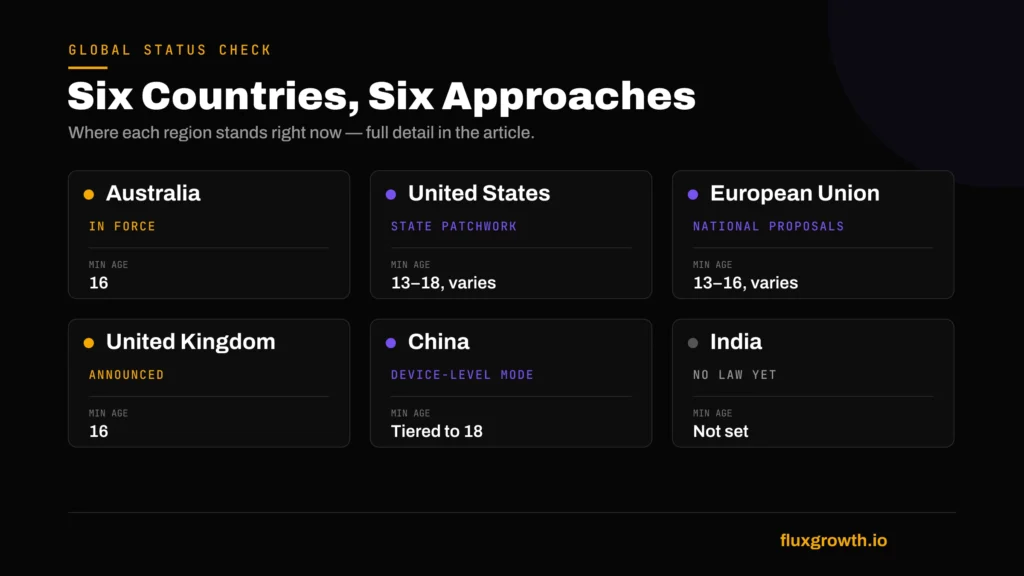
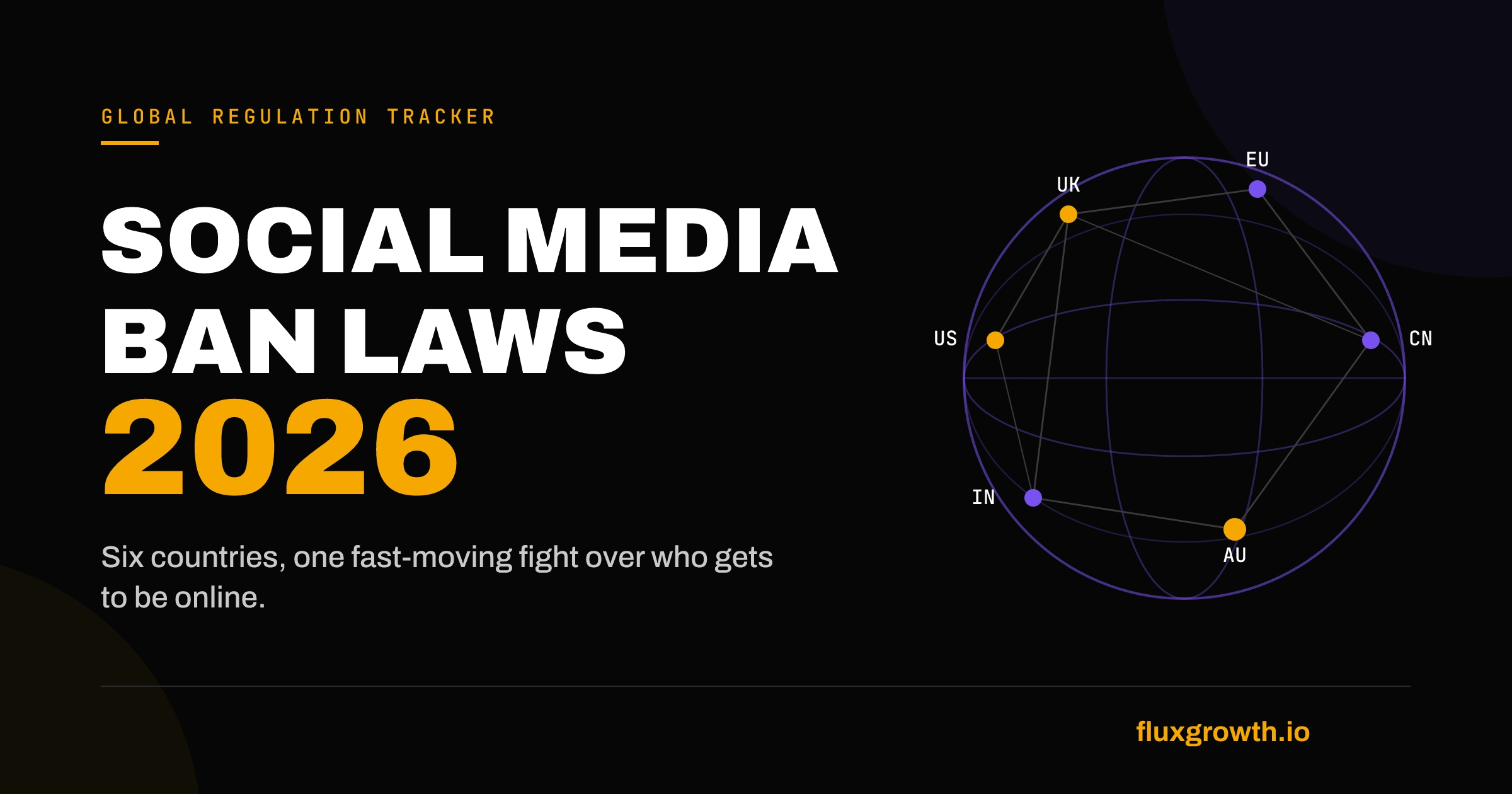
Here’s the global snapshot as of June 2026. Status changes fast, so treat the dates as a starting point, not gospel.
| Country/Region | Status | Minimum Age | Verification Method |
| Australia | In force since Dec. 10, 2025 | 16 | Facial scan or ID, platform-enforced |
| United States | No federal law; patchwork of state laws | Varies 13–18 by state | Third-party verification or parental consent, varies |
| European Union | No bloc-wide law; national proposals advancing | Proposed 13–16, varies by member state | EU age-verification app in pilot phase |
| United Kingdom | Announced June 2026; expected early 2027 | 16 | “Highly effective age assurance,” method not mandated |
| China | No account ban; mandatory device-level “minor mode” | Tiered by age, up to 18 | Device and app-level, parent-configured |
| India | No law in force; DPDP rules still in draft | None set yet | Parental consent verification, not child verification |
Australia is the test case everyone’s watching. Platforms including Facebook, Instagram, Snapchat, TikTok, and YouTube must take “reasonable steps” to remove under-16 accounts or face fines up to roughly $34 million USD. Enforcement has been bumpy, regulators are now investigating five major platforms for letting kids retry age checks after already declaring themselves underage.
Reddit, meanwhile, is challenging the law in Australia’s High Court, arguing it violates minors’ implied right to political communication under the constitution. That case could shape how every other country’s ban survives its own legal challenges.
The United States has no federal ban. Instead, you’ve got a sprawl of state laws — some enforceable, some blocked by courts, some passed but waiting on rulemaking. Texas and Florida currently have working laws; Arkansas, Georgia, and Ohio’s versions have been struck down on First Amendment grounds. We break this one down in more detail in the next section, since it’s genuinely the messiest piece of the global picture.
The European Union hasn’t passed bloc-wide legislation, but the pressure is building fast. As of May 2026, 23 of the EU’s 27 member states were at least drafting national proposals (and they don’t agree on much beyond the general direction).
Denmark, Italy, and Portugal are leaning toward a strict ban under 13 with parental approval required for 13-to-15-year-olds. Germany’s proposal looks similar but with different age bands. France has settled on a more targeted approach: a ban under 15 for specific “blacklisted” platforms, with parental consent and restrictions for the rest. The European Commission, for its part, is urging every member state to have an age-verification system running by the end of 2026, built on a privacy-preserving “mini-wallet” app that confirms age without sharing identity.
The United Kingdom announced its under-16 plan on June 15, 2026, modeled on Australia but going further it also targets livestreaming and stranger contact on gaming platforms, not just social apps. Ofcom will enforce it.
The government has been explicit that .no government ID or digital ID card will be required, according to the UK government’s fact sheet on the new rules the expectation is something closer to a facial age estimate. The catch is timing: regulations still need a vote in Parliament, with an effective date expected in early-to-spring 2027 depending on which official timeline you read.
China skips the ban model entirely in favor of “minor mode,” a tiered, device-level system that phone makers including Xiaomi, Honor, and Vivo now ship pre-installed. It caps usage at 40 minutes a day for kids under 8, an hour for ages 8 to 15, and two hours for 16-and-17-year-olds, while blocking access entirely between 10 p.m. and 6 a.m. Parents set and unlock the limits; there’s no account-level ban for anyone.
India is the outlier with no active law. The Digital Personal Data Protection Act technically requires verifiable parental consent for anyone under 18 to have personal data processed — which functions as an implicit age-gate.
The Act hasn’t been formally notified yet, though, and the implementing rules remain in draft. Non-compliance carries a potential penalty of up to ₹200 crore, so platforms have an incentive to get ahead of it even without a finalized mandate.
Social Media Ban Laws in the United States
State-level laws
At least 19 states have passed some form of minors’ social media law, but “passed” doesn’t mean “active.” Courts have split the landscape into three buckets: laws currently enforceable (Texas, Florida), laws permanently or preliminarily blocked (Arkansas, Georgia, Ohio), and laws enacted but waiting on rulemaking before they take effect (New York, parts of California).
Texas’s SCOPE Act applies to platforms with 100 million or more monthly users and requires age verification through government ID, financial account checks, or comparable methods and it bans “addictive” design features for minors outright. Utah’s Social Media Regulation Act, by contrast, leans on parental consent rather than blanket verification: it gives parents the right to access a minor’s private messages and restricts use between 10:30 p.m. and 6:30 a.m. without sign-off.
Both approaches are currently being challenged in court at the same time, which tells you how unsettled this still is.
Age verification requirements
Methods vary wildly by state government ID, financial account checks, facial age estimation, or simple self-declaration. Utah and Tennessee lean toward stricter ID-based checks, with Tennessee requiring third-party verification within 14 days of an existing account being flagged as belonging to a minor.
New York’s approach explicitly avoids requiring biometric or government ID data, instead tasking the state attorney general with approving methods “all New Yorkers can use.”
Ongoing legal challenges
First Amendment challenges have been the deciding factor almost everywhere. Federal courts have ruled against state laws more often than they’ve upheld them, and a 2026 Harvard Law Review analysis found nearly every district court to weigh in has sided against the states on free-speech grounds.
In one notable emergency-docket concurrence on a state age-verification law, Supreme Court Justice Brett Kavanaugh wrote that the law in question was “likely unconstitutional” under existing precedent language that’s now being cited in nearly every active NetChoice lawsuit challenging these laws nationwide.
Future federal regulation possibilities
The Kids Online Safety Act has bipartisan support but is stuck between two competing versions a Senate bill (S.1748) with a “duty of care” standard that preserves states’ ability to go further, and a House bill (H.R. 6484) that would preempt those stronger state laws entirely.
A coalition of 40 state attorneys general has formally urged Congress to pass the Senate version specifically because of that preemption gap. Until it closes, expect the state-by-state patchwork to keep growing rather than consolidating.
How Social Media Bans Affect Teens
Potential benefits
Less time online, in theory, means more sleep, fewer comparison spirals, and better focus during the day. Several child-development groups point to reduced late-night notification exposure as the single biggest realistic win, since overnight scrolling is consistently linked to sleep disruption and that’s one of the few effects laws like New York’s SAFE for Kids Act target directly, by cutting off notifications between midnight and 6 a.m.
Potential drawbacks
The flip side shows up fast. Teens cut off from mainstream platforms often migrate to less-moderated spaces Discord servers, smaller apps, or workarounds entirely. Digital exclusion is real too: a 13-year-old who can’t access Instagram isn’t opting out of socializing, just opting into doing it somewhere parents can’t see.
Critics like Jim Gamble, founding chief executive of the UK’s Child Exploitation and Online Protection Centre, have been blunt about this trade-off. He’s warned that blanket bans tend to push kids toward “darker corners” of the internet rather than removing the risk.
VPN usage tells the story. Some U.S. states saw VPN signups jump over 1,000% after age-verification laws went live, and Australian researchers found more than 60% of under-16s still using social platforms months into that country’s ban most by simply declaring themselves over 16 or passing a quick selfie check the system accepted.
How Social Media Platforms Are Responding
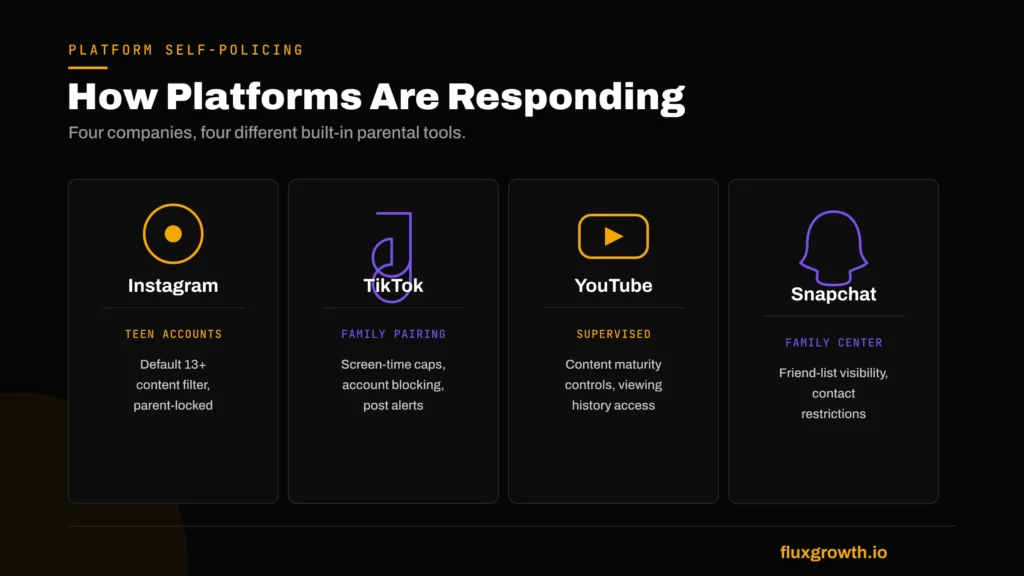
Instagram Teen Accounts
“Meta now defaults teens under 18 into Instagram’s Teen Accounts settings, a 13+ content setting inspired by movie-ratings criteria…”, inspired by movie-ratings criteria, that filters profanity, risky stunts, and adult themes. Teens can’t opt out without a parent’s permission, and a stricter “Limited Content” mode hides comments entirely for parents who want more control.
According to Meta’s own reporting, 9 out of 10 teens have stayed in the default setting since it rolled out. The company says it’s now using AI-powered visual analysis, not just self-reported birthdates to catch underage accounts that try to slip past the sign-up gate.
TikTok Family Pairing
TikTok’s Family Pairing lets a parent link accounts to set screen-time limits. We’ve got the full click-by-click version of setting up TikTok Family Pairing if you want to walk through it together.” (one hour a day by default for 13–17-year-olds), block specific accounts, and get notified when a teen posts something publicly visible. Teens can tighten the settings further but can’t loosen what a parent has locked in.
Newer additions let parents see who their teen has blocked and which content topics they’ve chosen to shape their feed giving parents a starting point for conversations rather than just a control panel.
YouTube supervised experiences
YouTube’s supervised accounts give parents control over content maturity levels and viewing history, positioned as a bridge between YouTube Kids and a full, unsupervised account typically recommended once a kid outgrows the Kids app around age 9 or 10.
YouTube has also said it’s testing AI-based age estimation to flag accounts that are likely underage regardless of what birthdate was entered at signup.
Snapchat safety tools
Snapchat’s Family Center mirrors the same pattern: visibility into who a teen is friends with, without exposing message content, plus the ability to restrict who can contact them.
Snapchat has also publicly warned that overly aggressive bans risk pushing young users onto “less safe platforms” entirely, a notably candid acknowledgment from a company with a direct financial stake in keeping teens on its own app.
Arguments For Social Media Bans
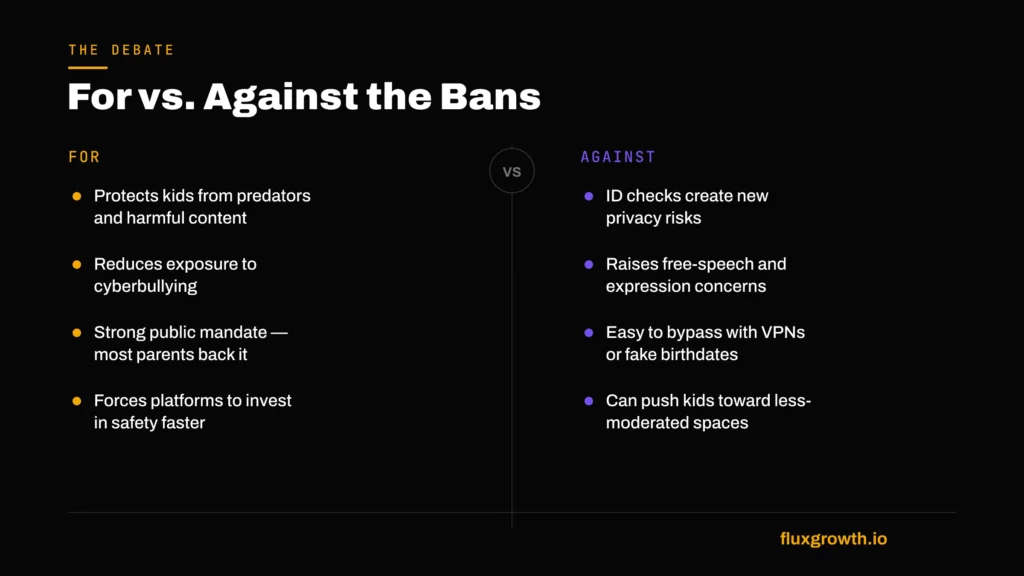
Supporters make a straightforward case. Protecting kids from predators, harmful content, and addictive design outweighs the inconvenience of an age check. Backers point to reduced cyberbullying exposure, better odds of offline activity, and a clear public mandate in the UK, 9 in 10 surveyed parents backed a ban for under-16s, and two-thirds of young people themselves agreed at least some platforms shouldn’t be open to that age group.
Supporters also argue that voluntary platform safety tools haven’t moved the needle fast enough on their own, and that a legal deadline forces investment that wouldn’t otherwise happen.
Arguments Against Social Media Bans
Critics argue that bans don’t necessarily work and can create new problems. Age verification often requires users to upload government IDs or biometric scans, raising separate privacy concerns. Those concerns are not hypothetical. In 2024, researchers discovered exposed credentials at identity-verification company AU10TIX, potentially exposing highly sensitive user data, including identity documents uploaded for verification purposes. Privacy advocates argue that incidents like this highlight the security risks of relying heavily on third-party age-verification systems.
Free-speech advocates argue the laws chill legitimate teen expression and political communication which is the exact argument Reddit is making in Australia’s High Court. Enforcement is genuinely hard, too: determined teens find workarounds within days. The Electronic Frontier Foundation, among others, argues these laws function less as child protection and more as the groundwork for broader internet identity verification that affects every adult user as well.
Alternatives to Social Media Bans
Parental controls
Built-in tools Family Pairing, Teen Accounts, Family Center already give parents real oversight without a government mandate. Third-party apps like Apple’s Family Sharing or Google’s Family Link add device-wide limits on top of whatever the platform offers natively.
The gap, honestly, is awareness rather than availability most parents have never opened the settings menu these companies already built.
Digital literacy education
Teaching kids to spot manipulation, misinformation, and unhealthy engagement patterns outlasts any single platform restriction. The skill travels with them to whatever app replaces TikTok in three years.
Common Sense Education’s digital-citizenship curriculum is one of the most widely used for this in U.S. schools, and it’s built to run as an ongoing unit not a one-off assembly the week before winter break.
Screen time management
Device-level limits, not just app-level ones, close the loophole where a kid abandons one app for five others. iOS’s Screen Time and Android’s Digital Wellbeing both offer this natively now, including the ability to set a hard daily cap across every app at once rather than managing each one separately.
Platform safety improvements
Default-private accounts, restricted DMs from strangers, and algorithm transparency requirements address the actual mechanisms of harm rather than just gating the door.
This is the approach groups like the Information Technology and Innovation Foundation have pushed as a middle ground to give device makers and app stores a standardized way to signal “this user is a minor” without forcing every platform to build its own separate verification system from scratch.
What Parents Should Do Instead of Relying on Bans
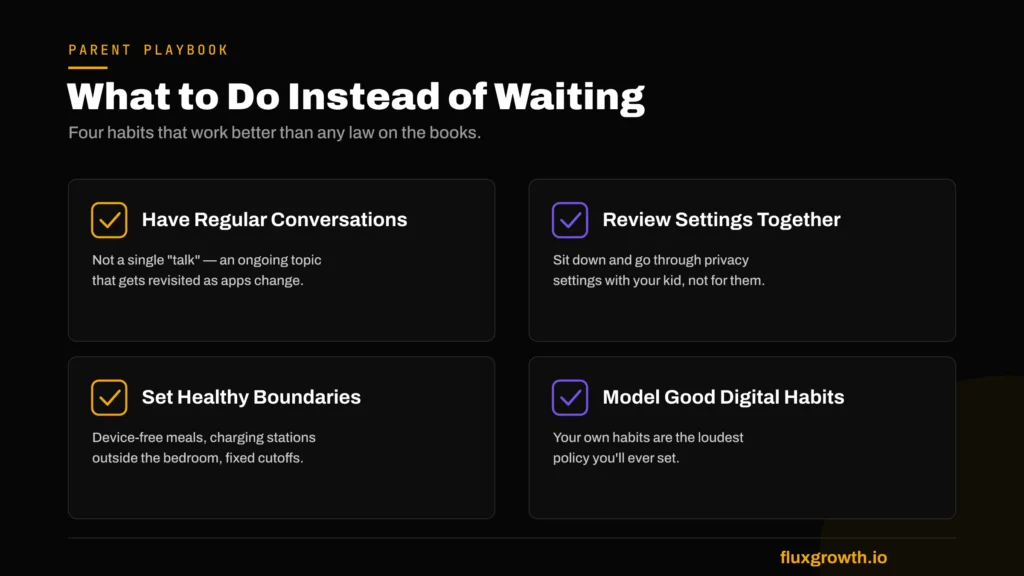
Have regular conversations
A single “the talk” doesn’t cut it. Treat social media the way you’d treat any other ongoing safety topic: revisit it as apps, friend groups, and content change. The conversation that matters most isn’t “are you on TikTok,” it’s “what’s something weird you saw this week” the second question actually gets answered.
Review privacy settings together
Sit down and go through the account settings with your kid, not for them. It teaches the skill and gives you a real, current picture of what’s visible and to whom. Do this every few months, not once defaults reset, apps update, and new features get added constantly.
Set healthy boundaries
Device-free meals, charging stations outside the bedroom, and agreed-upon cutoff times do more for sleep and mood than any single law currently on the books. The specific boundary matters less than the consistency of it; kids adapt fast to rules that don’t move.
Model good digital habits
Kids notice when the no-phones-at-dinner rule only applies to them. Your own habits are the loudest policy you’ll ever set, and a kid who watches a parent scroll through dinner will tune out anything said afterward about screen time.
The Future of Social Media Regulation
Age verification technology
Expect more privacy-preserving options. The EU’s “mini-wallet” app proves you’re over a threshold age without sharing your actual identity, built on the same technical standard as the upcoming European Digital Identity Wallet.
It’s a model likely to spread if it holds up under real-world use, since it solves the exact complaint critics raise about ID-upload and facial-scan systems: that they create a permanent, hackable record tying a real identity to an online account.
AI-powered moderation
Platforms are leaning harder on AI to detect underage accounts through behavioral and visual signals rather than just self-reported birthdates, since self-declaration has proven trivially easy to fake. Meta, YouTube, and TikTok have all confirmed they’re using some version of this now analyzing posting patterns, friend networks, and visual cues in photos rather than waiting for someone to misreport their age at signup.
Stronger child safety regulations
Expect feature-specific restrictions, stranger contact, livestreaming, algorithmic feeds to keep expanding even where full account bans stall out in court. COPPA 2.0 has already passed the U.S. Senate and would expand protections to teens up to 16 along with covering biometric and geolocation data explicitly for the first time, which the original 1998 law never anticipated.
Global regulatory trends
Australia opened the door. The UK, Indonesia, and Malaysia walked through it with their own versions. The EU and a long list of U.S. states are circling the same destination from different legal angles (some faster than others, some not moving at all).
Here’s the thing the direction is consistent even where the methods aren’t. Don’t treat any single country’s law as the final word. The next headline will probably contradict this one within a month.
What I’d Do If I Were a Parent Today
If I had a kid heading into the social media years right now, I wouldn’t be waiting on legislation to make the decision for me. Bans are slow, inconsistent, and easy to route around relying on one means outsourcing a parenting call to a law that might not survive its next court challenge.
I’d focus on guidance over outright prohibition. A flat “no” tends to just push the activity somewhere less visible. Better to be the adult they actually come to when something goes wrong online, instead of the one they’re hiding it from.
I’d keep communication open and ongoing, not a single sit-down talk. I’d teach responsible users directly how to spot a fake account, why oversharing location data matters, and what to do if a stranger DMs them.
And I’d use the parental tools that already exist Family Pairing, Teen Accounts, Family Center while deliberately loosening them over time. The goal isn’t permanent surveillance. It’s training wheels that eventually come off.
The question I get asked most, in some version or another, is “How do I know if my teenager is ready for social media?” My answer’s always the same: age matters, but maturity matters more.
A teen who understands privacy, talks openly about what they’re seeing online, and feels comfortable coming to a parent when something goes wrong is usually far better prepared than one who’s simply reached a certain birthday. Those conversations, repeated over time, do more than any single law or platform setting ever will.
Frequently Asked Questions
Is social media banned for children?
Only in a few countries so far. Australia has a full ban for under-16s in force from December 2025. Most other countries, including the U.S. as a whole, have partial restrictions or no federal law at all, just a patchwork of state and platform-level rules that varies depending on where you live.
Which countries have banned social media?
Australia is the clearest case of a true nationwide ban. The UK has announced one for early 2027. Indonesia and Malaysia have introduced similar under-16 restrictions of their own. Most of the EU is still in the national-proposal stage, with member states disagreeing on exact age thresholds and methods.
Is the U.S. banning social media?
Not at the federal level, and not anytime soon based on current momentum. Nineteen-plus states have passed some form of restriction, but courts have blocked several on free-speech grounds, and the federal Kids Online Safety Act remains stalled between competing House and Senate versions with no clear path to reconciliation yet.
Why do governments want to ban social media?
Mainly teen mental health, cyberbullying, data privacy, addictive design features, and exposure to predators or harmful content. Nearly every law on the books cites some combination of these five reasons, even when the specific mechanism full ban, time cap, algorithm restriction looks completely different.
Are social media bans effective?
Mixed results so far. Australia’s regulator found about a third of under-16s still had accounts months after its ban took effect, and VPN usage spikes consistently follow age-verification laws wherever they pass. That doesn’t mean zero impact overall account ownership did drop, just that “effective” and “fully enforced” aren’t the same thing.
What age should children start using social media?
There’s no universal answer, but 16 has emerged as the most common legal threshold globally. Pediatric and child-development groups generally recommend waiting until early teens at the earliest, with close supervision and a gradual increase in independence after that rather than an abrupt full-access switch.
Can teens legally use social media in 2026?
In most places, yes with restrictions that vary heavily by location. Full bans only apply in a small number of countries right now. Elsewhere, expect age verification, parental consent requirements, or usage caps rather than an outright block on the account itself.
What are the alternatives to banning social media?
Parental controls, digital literacy education, device-level screen time limits, and platform design changes default-private accounts, restricted DMs, algorithm transparency all address the underlying risks without an account-level ban, and most of them are already available today without waiting on any legislature.
The Bottom Line
Social media ban laws in 2026 are everywhere in the headlines, but the on-the-ground reality is messier than any single law suggests. Bans get passed, then partially blocked, then routed around by the kids they’re meant to protect. That’s not a reason to dismiss the effort, just a reason to stay realistic about what legislation alone can fix.
If you’re a parent, the tools to manage this already exist. You don’t need to wait for a legislature to catch up.
Start with the settings you already have access to today. Have the conversation again next month not as a one-time talk, but as a habit. No law is going to do that part for you.