Ahrefs tracked 863,000 keywords in December 2025 and found something that should worry anyone writing content for Google. When an AI Overview shows up on a search page, the #1 organic result loses 58% of its clicks. Fifty-eight percent.
This guide is part of our GEO & AI Search hub – everything we have published on getting cited by AI search engines, in one place.
Pew Research ran its own study of 68,000 queries, controlled and landed on the same story from a different angle. People click an organic result 15% of the time with no AI Overview on the page. Just 8% when there is one.
Google isn’t the only place this is happening. ChatGPT now handles somewhere between 250 and 500 million search-style queries a week, on top of its regular chat traffic. Perplexity, Claude, and Gemini are all pulling from the same web to build answers and none of them work exactly like Google.
That’s the gap most SEO advice hasn’t caught up to. Ranking #1 still matters. But it’s no longer the whole game. Two newer disciplines have shown up to cover what traditional SEO doesn’t: AEO (Answer Engine Optimization) and GEO (Generative Engine Optimization). They sound like the same thing. They’re not.
This guide breaks down exactly what separates them, how they work with (not against) your existing SEO, and what to actually do about it whether you’re running a blog, an agency, or a SaaS product. If you write anything that’s supposed to get found, this affects you.
What Is Answer Engine Optimization (AEO)?
Definition
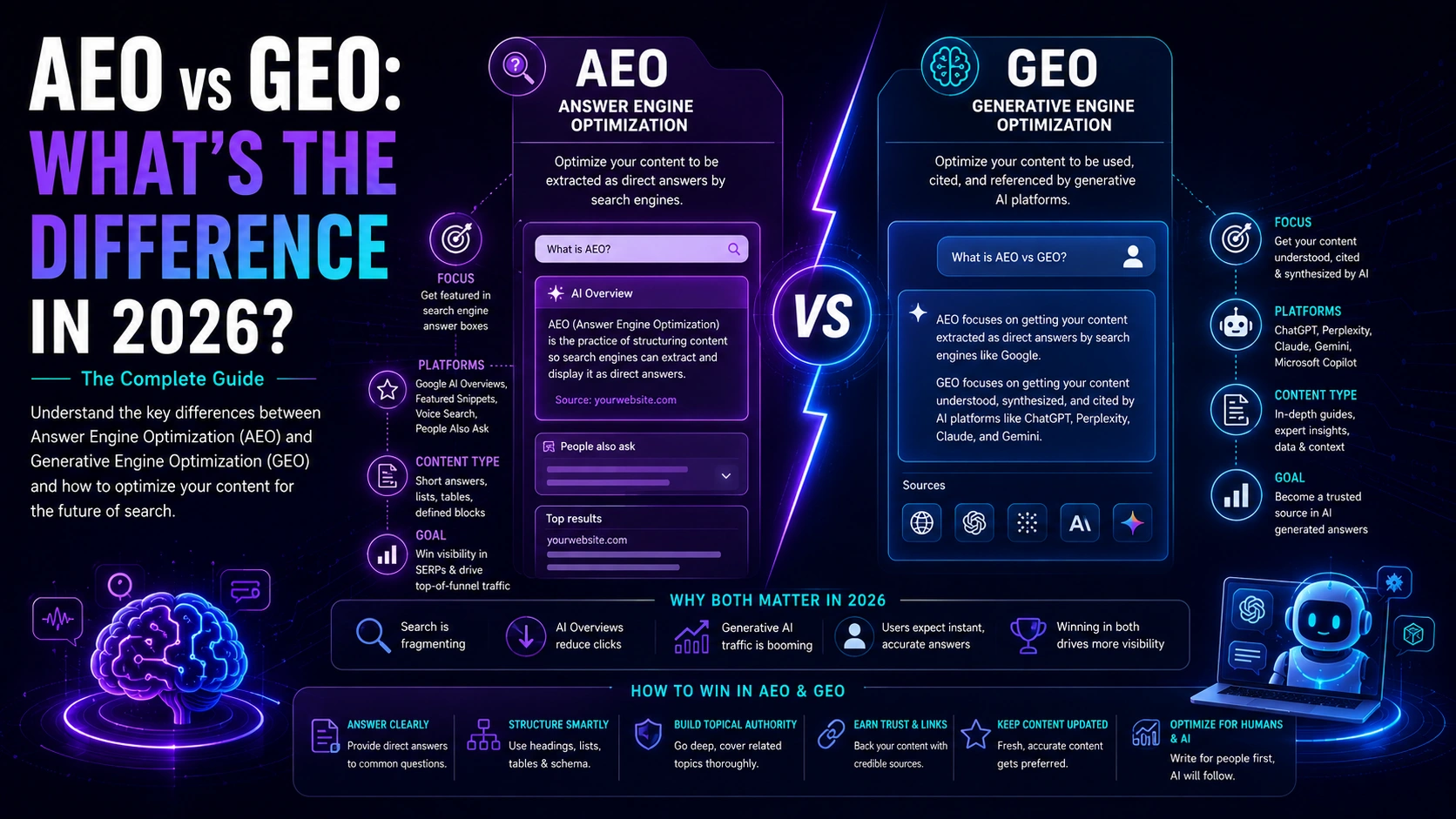
AEO is the practice of structuring content so a search engine can pull it out whole and hand it to the user as a direct answer no click required. Think featured snippets, Google’s “People Also Ask” boxes, voice assistant replies, and the summary text inside Google AI Overviews.
How answer engines work
An answer engine scans ranking pages, looks for a passage that cleanly resolves the query, and lifts it often word-for-word into the answer box. It’s not writing anything new. It’s extracting. That means your content has to already be in a shape the engine can grab: a tight definition, a numbered list, a short direct sentence right after the question.
Google AI Overviews
AI Overviews are Google’s AI-generated summary blocks that sit above the traditional blue links. They now appear on a large share of informational searches; estimates for 2026 range from roughly 25% up to 60% of U.S. queries depending on how the study defines and tracks it, according to data compiled by BrightEdge and SERPs.io. Eight-word-plus queries are about 7x more likely to trigger one, per Heroic Rankings’ 2026 analysis, which tells you a lot about which searches to prioritize.
Bing Copilot
Bing’s Copilot works similarly to AI Overviews but sits inside Microsoft’s ecosystem Bing, Edge, and Windows Search. It pulls from Bing’s index, so classic Bing SEO signals (site verification, Bing Webmaster Tools, clean crawlability) still matter here even if you’ve mostly ignored Bing for years.
Voice search
Voice assistants read one answer aloud. There’s no scrolling, no second option. That forces even tighter extraction than AI Overviews, usually a single sentence, 20 to 30 words, answering the exact phrasing of the question.
Benefits of AEO
Win an AEO placement and you get the most visible real estate on the page, often above every other result. You also get authority by association showing up as the answer signals expertise even to people who don’t click through. The catch: fewer of them click through at all. AEO is a visibility play as much as a traffic play.
What Is Generative Engine Optimization (GEO)?
Definition
GEO is the practice of getting your content read, understood, and reused by generative AI systems ChatGPT, Perplexity, Claude, Gemini when they synthesize an answer from multiple sources. Unlike AEO, the engine doesn’t just lift a sentence. It reads several sources, blends them, and writes something new. Your job is to be one of the sources it trusts enough to cite or paraphrase.
How generative AI search works
A generative engine doesn’t rank pages the way Google does. It retrieves a set of relevant documents, reads them for facts and context, and generates a response in its own words sometimes with links back to sources, sometimes without. What gets you selected as a source is less about keyword match and more about topical depth, clarity, and how trustworthy the content reads to the model.
ChatGPT Search
ChatGPT crossed roughly 900 million weekly active users by February 2026, according to reporting compiled by SERPs.io (more than double the figure from a year earlier; that’s not a typo). Not all of that is search, but a meaningful and growing slice is: OpenAI’s own search feature inside ChatGPT is now estimated at 250–500 million weekly search queries, per Presence AI’s 2026 market data.
Perplexity AI
Perplexity is smaller in raw user count estimates for monthly active users in 2026 range roughly from 30 to 45 million depending on the source but it’s built specifically as a citation-first answer engine. It shows its sources inline by default, which makes it the platform where “getting cited” is most literal and most measurable.
Claude
Claude’s share of generative AI web traffic grew from about 1.4% to roughly 6% between early 2025 and March 2026, per SimilarWeb data reported by TechnologyChecker.io, the fastest percentage growth of any major platform in that window. Claude leans toward longer, more researched responses, which tends to reward content with real depth over content built purely for snippet extraction.
Gemini
Google’s Gemini surged from about 6% to over 25% of generative AI traffic share over the same period, largely on the back of its integration directly into Google Search and Workspace. Because Gemini draws on Google’s own index and Knowledge Graph, strong traditional SEO and structured data both feed it directly.
Why GEO is growing
Search is fragmenting, and it happened fast. A year ago, “optimize for AI search” basically meant Google AI Overviews. Now it means ChatGPT, Perplexity, Claude, and Gemini too, four different systems, four different ways of deciding what to trust. Skip GEO and you can be ranking #1 on Google and still be invisible everywhere else.
AEO vs GEO — Key Differences
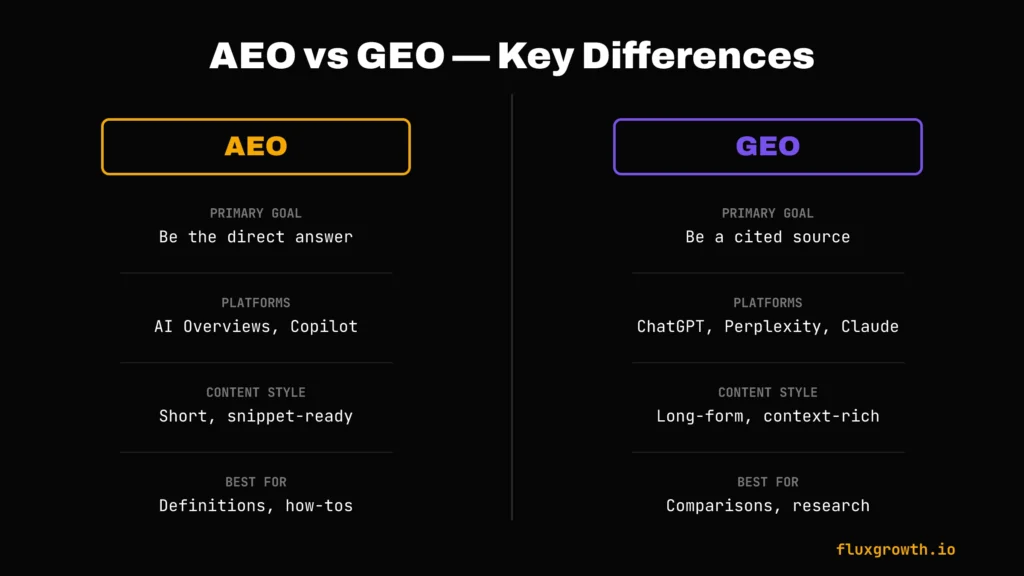
| Feature | AEO | GEO |
| Primary goal | Get selected as the direct answer | Get cited or paraphrased as a trusted source |
| Search platforms | Google AI Overviews, Bing Copilot, voice assistants | ChatGPT, Perplexity, Claude, Gemini |
| AI models | Extraction-based (pulls existing text) | Generation-based (writes new text from sources) |
| Content style | Short, precise, snippet-ready | Long-form, well-explained, context-rich |
| Citations | Rarely shown; text often lifted without a link | Frequently shown, especially on Perplexity |
| Schema | FAQ, HowTo, and Q&A schema help directly | Less about schema, more about entity clarity and topical depth |
| User intent | Quick factual answers | Research, comparison, decision-making |
| Optimization focus | Structure, clarity, extractability | Authority, depth, freshness, trustworthiness |
| Best for | Definitions, how-tos, quick facts | Comparisons, guides, original research |
If your content answers a question in one clean sentence, you’re playing the AEO game. If it explains a topic well enough that an AI model would want to draw on it while building a longer response, that’s GEO.
AEO vs GEO vs Traditional SEO
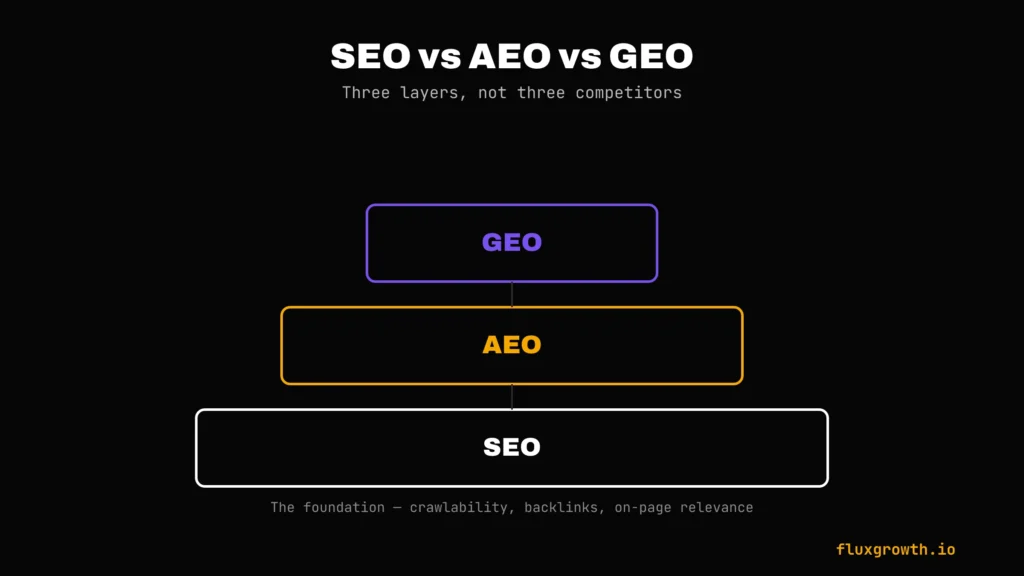
This is the part most AEO-vs-GEO articles skip and it’s the part that actually determines what to do Monday morning. SEO, AEO, and GEO aren’t three competing strategies. They’re three layers, and each one depends on the one below it.
Traditional SEO is the foundation: technical health, crawlability, backlinks, on-page relevance. If you’re looking for the tools that help improve these signals while also increasing AI search visibility, check out our guide to the best AI SEO tools in 2026.
AEO builds on SEO. It doesn’t replace rankings; it adds a structural layer (clear answers, schema, scannable formatting) that lets extraction engines lift your content once it’s already indexed and trusted.
GEO builds on both. It needs the technical trust SEO provides and the answer-clarity AEO provides, then adds a third requirement generative engines specifically look for: depth, citation-worthy originality, and consistency across the wider web (mentions on other sites, forums, and platforms not just your own domain).
| SEO | AEO | GEO | |
| Goal | Rank in search results | Become the direct answer | Become a cited/trusted source in AI answers |
| Success metric | Rankings, organic traffic | Featured snippet share, voice answer share | Citation frequency, brand mentions in AI responses |
| Content shape | Comprehensive pages targeting a keyword | Tight, extractable answer blocks | In-depth, well-sourced, entity-rich content |
| Where it shows up | Blue links | Snippet boxes, AI Overviews, voice replies | ChatGPT, Perplexity, Claude, Gemini responses |
| Click behavior | Click-driven | Often zero-click | Mostly zero-click, occasional cited link |
Weak technical SEO? Fix that first. Nothing downstream works without it you can’t get extracted or cited on a page nobody can find in the first place.
If your SEO is solid but traffic has flattened despite decent rankings, that’s usually an AEO problem. Your content ranks. It just isn’t shaped for extraction.
And if SEO and AEO both check out but you never show up when someone asks ChatGPT or Perplexity about your category? That’s the GEO gap. It’s the one most sites haven’t touched yet which is exactly why it’s worth fixing now.
How AI Search Has Changed SEO
Search stopped being just a list of ten blue links a while back, but 2026 is when that shift became impossible to ignore. A few things are driving it:
Google AI Mode. Google’s dedicated AI search experience separate from AI Overviews has crossed 2 billion monthly users across more than 200 countries, according to Lasso Up’s 2026 reporting. It works more like a conversation than a search box: you ask, it asks follow-ups, it keeps context.
AI Overviews. Still the biggest single force reshaping SEO in 2026. They compress traditional CTR, but the effect isn’t uniform — comparison and “X vs Y” queries trigger them over 95% of the time in one Seer Interactive study, while local and transactional queries barely trigger them at all.
ChatGPT Search and Perplexity. These platforms don’t rank pages in the traditional sense. They retrieve and synthesize. A page that never cracks Google’s top 10 can still get pulled into a ChatGPT answer if it’s well-written and topically deep.
Conversational search. The average ChatGPT query runs about 23 words, compared to roughly 4 words for a typical Google search, according to a16z’s analysis cited in SERPs.io’s 2026 roundup. People type full questions into AI tools the way they’d talk to a person, not the clipped phrases they type into Google.
Zero-click search. SparkToro and Datos put the share of Google searches ending without any website click at around 60% as of 2026, up from 58% the year before. Traffic is no longer the only signal that content is working; brand visibility inside AI answers is becoming its own metric.
The practical takeaway: rankings alone don’t tell you whether you’re visible anymore. You need to know whether you show up when someone asks an AI assistant about your category, not just when they type it into Google.
How to Optimize for AEO
Structured data
Add schema markup FAQ, HowTo, Article so search engines get an unambiguous, machine-readable version of your content alongside the human-readable one. Google has said repeatedly that no special AI-only markup is required for AI Overviews, but standard schema still helps traditional extraction features like featured snippets, and it costs you nothing to add.
FAQ schema
Pull real questions from Google’s “People Also Ask” box and answer each one in 2–3 direct sentences, marked up with FAQPage schema. This is one of the highest-leverage AEO moves because it’s purpose-built for extraction; you’re handing the engine a pre-packaged answer.
Clear headings
Every H2 and H3 should be phrased close to how someone would actually search or ask. “How to optimize for AEO” beats “AEO Optimization Strategies” because it mirrors real query language.
Featured snippets
Answer the question in the first sentence after the heading, in under 40–50 words, then expand below it. Google typically pulls from that exact spot.
Question-based content
Structure sections around real questions instead of topic labels where it makes sense. “What is a featured snippet?” extracts more cleanly than “Understanding Snippets.”
E-E-A-T
Show real experience, not just correct information. A byline with actual credentials, a “last updated” date, and specific first-hand detail all signal to Google’s quality systems and increasingly to AI systems that a real person with real knowledge wrote this.
Entity optimization
Pick one name and stick with it everywhere. If your bio calls you a “social media strategist” on LinkedIn, a “content consultant” on your site, and a “marketing advisor” on your About page, you’ve just made three different entities out of one person. Search engines build knowledge graphs around entities, not keywords inconsistent naming just muddies the signal.
How to Optimize for GEO
Original research
Generic advice doesn’t get cited. A number nobody else has. Run a small survey, pull data from your own product or client work, or synthesize public data into a new state. Original research is one of the highest-performing content types for AI citation.
AI citations
Structure claims so they’re easy to lift cleanly: name the source, the year, and the specific number in the same sentence. “According to Ahrefs’ December 2025 study of 863,000 keywords” is more citable than “recent research shows.”
Statistics
Back claims with real, dated numbers from named sources, never vague ones like “studies show.” If you can’t verify a number, cut it or flag it rather than guess.
Expert opinions
Quote or reference real practitioners, not just aggregate data. AI models weigh perspective and expertise as trust signals, not only raw facts.
First-hand experience
[ADD: a specific result from your own work e.g., “When I rewrote a client’s comparison page around a 4-stage workflow instead of flat categories, X happened.” Swap in a real number or outcome you’ve actually seen.] This is the section Google’s helpful-content guidance cares about most, and it’s the one part of GEO no AI system can fake convincingly for you.
Semantic entities
Cover a topic completely enough that the related terms show up on their own. This article doesn’t just say “GEO” it also covers AI Overviews, LLMs, citations, ChatGPT, and Perplexity, because those are the concepts a model expects to see clustered together. Skip half of them and your page reads thinner than it actually is.
AI-friendly formatting
Google is explicit that you shouldn’t chunk content into artificial AI-only fragments. Write normal paragraphs and headings for humans that same structure is what generative engines parse cleanly too. Don’t create a separate “AI version” of your content; that risks running into Google’s scaled-content-abuse policy.
Internal linking
Link your AEO/GEO content to related pieces on your own site comparison posts, tool roundups, definitional guides. AI systems reading one of your pages are more likely to register you as a topical authority if your site clearly covers the surrounding cluster, not just the one page they landed on.
Which Is Better: AEO or GEO?
Neither wins outright; it depends on where your audience actually searches.
Bloggers. AEO first. Featured snippets and AI Overview visibility drive real traffic to ad- or affiliate-supported content, and that traffic is still the business model.
Agencies. Both, but GEO is the newer differentiator. Clients already expect rankings. Showing up inside ChatGPT and Perplexity answers is the pitch that separates you from competitors still selling “SEO” alone.
SaaS. GEO matters more than most SaaS teams realize. Buyers increasingly ask ChatGPT or Perplexity to compare tools before they ever hit a vendor’s site; if you’re not in that answer, you’re not on the shortlist.
Enterprise. SEO and GEO together, with GEO weighted higher for informational and comparison content. Enterprise brands usually have the domain authority AEO snippets don’t move the needle on as much.
Local businesses. AEO, and mostly through traditional local SEO plus voice search “near me” queries still route through Google Maps and local packs more than generative engines.
Ecommerce. AEO for product-comparison and how-to content; SEO still owns transactional intent. GEO is emerging here too, as shoppers ask AI assistants for recommendations before they search a retailer directly.
Best Practices for Combining AEO + GEO
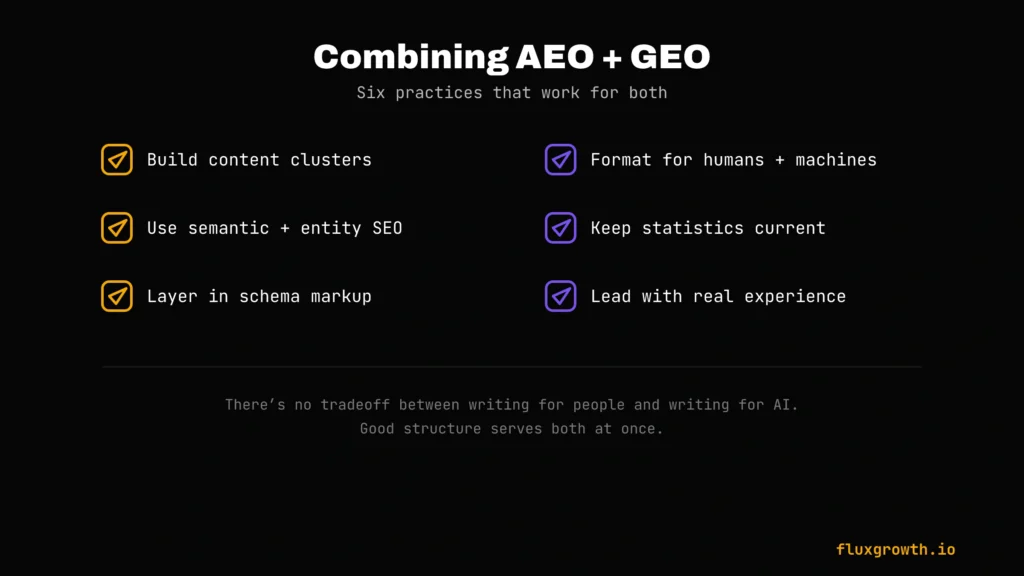
Build content clusters, not isolated posts. A pillar page plus supporting articles, all interlinked, signals topical authority to both extraction engines and generative ones.
Use semantic and entity SEO together. Cover a topic’s full vocabulary related terms, tools, and concepts instead of narrowly targeting one keyword phrase.
Layer in schema without overdoing it. FAQ, HowTo, and Article schema help AEO directly. Don’t invent schema types that don’t exist just to seem thorough.
Format for both humans and machines at once. Here’s the thing: short paragraphs, clear headings, and direct answers aren’t a compromise between “written for people” and “written for AI.” They’re the same format. You’re not actually choosing between them.
Keep statistics current. AI systems weigh freshness heavily. A “last updated” date and genuinely refreshed data beat a static page that hasn’t changed in two years.
Lead with experience-driven content. A specific result, a named tool you actually tested, an honest limitation you found these are the details that separate content an AI model trusts from content it treats as generic filler.
Common Mistakes
Writing only for Google. Optimizing exclusively for traditional rankings ignores a fast-growing share of how people now find information.
Ignoring AI search entirely. With AI Overviews appearing on a large share of informational queries and ChatGPT handling hundreds of millions of weekly searches, sitting this out isn’t a neutral choice anymore.
Publishing thin AI-generated content. Mass-produced, unedited AI output tends to read as generic and generic content is exactly what AI systems skip when choosing what to cite.
Skipping citations. Content without named sources and dated stats reads as untrustworthy to both readers and AI systems evaluating what to reference.
Weak E-E-A-T signals. No author bio, no update date, no first-hand detail all of it undermines trust, and trust is the entire currency of GEO.
Using stale statistics. A number from 2023 presented as current is one of the fastest ways to lose credibility once a reader or an AI system cross-checks it.
Poor content structure. Walls of text. No headers, no lists, no clear answer near the top extraction engines and generative models both skip right past it.
Keyword stuffing. This one cuts against old SEO instincts: a Princeton study on generative engine optimization found that keyword stuffing actually reduces AI visibility by about 10%, rather than helping. Write naturally.
Future of AI Search
AI search engines
Expect continued fragmentation rather than one winner. ChatGPT’s share of generative AI traffic fell from roughly 77% to 57% between early 2025 and March 2026 as Gemini and Claude both grew, per SimilarWeb data a shift toward a genuinely multi-platform search environment rather than a single dominant player.
Agentic AI
Tools like ChatGPT’s Operator and browser-based agents are starting to take actions on a user’s behalf, booking, comparing, filling forms, not just answering questions. Content and pricing pages that are clearly structured and machine-readable will matter more as agents, not just chat interfaces, start reading them.
Personalized AI search
AI assistants are starting to remember more about you across sessions, what you’ve asked before, what you clicked, what you ignored. That context shapes the next answer. Generic, one-size-fits-all content loses out here. Content written for one specific person with one specific problem wins.
AI assistants
The line between “search engine” and “assistant” keeps blurring. People increasingly ask the same tool to search, summarize, draft, and compare all in one conversation.
Conversational search
Expect query length and complexity to keep climbing as people get more comfortable typing full questions instead of keyword fragments reinforcing the value of content written to answer real questions, not just match search terms.
Multimodal search
Image- and video-based search is growing alongside text. Alt text, video transcripts, and captioned visuals are becoming part of the same optimization conversation as written content, not a separate task.
What I’d Do If I Were Optimizing a Website Today
If I were starting a website today, I wouldn’t optimize for Google alone. Over the past year, while creating content for FluxGrowth, I’ve noticed that the pages performing best aren’t just the ones targeting traditional rankings, they’re the ones that answer questions clearly, include original insights, and cite trustworthy sources. That’s exactly the type of content that AI search experiences like Google AI Overviews, ChatGPT, and Perplexity increasingly surface.
I’d build every article to answer the primary question immediately, then support it with first-hand observations, current research, comparison tables, and practical examples. Rather than writing for a search engine, I’d write content that an AI assistant would feel confident referencing in its answer.
The first thing I’d implement is a strong content structure: clear headings, concise definitions, FAQ sections, schema markup, and original commentary that goes beyond what every other article says. In my experience, making content easier to understand and easier to cite naturally improves both search visibility and user engagement.
Businesses that start optimizing for both AEO and GEO today while many competitors are still focused only on traditional SEO rankings will be much better positioned as AI-powered search becomes the default way people discover information.
Frequently Asked Questions
What is AEO?
AEO (Answer Engine Optimization) is the practice of structuring content so search engines can extract it directly as an answer in featured snippets, AI Overviews, or voice search results without the user needing to click through.
What is GEO?
GEO (Generative Engine Optimization) is the practice of getting your content read, trusted, and cited or paraphrased by generative AI tools like ChatGPT, Perplexity, Claude, and Gemini when they synthesize answers from multiple sources.
What is the difference between AEO and GEO?
AEO gets your exact content extracted and displayed as-is. GEO gets your content read and reused inside a new, AI-generated response, often without displaying your original text at all.
Is GEO replacing SEO?
No. GEO depends on the technical trust and indexing that SEO builds. Without solid SEO fundamentals, generative engines have nothing reliable to retrieve from in the first place.
Is AEO better than SEO?
Neither replaces the other. AEO adds a structural layer on top of SEO to win extraction placements; SEO remains the foundation that gets your content found and trusted at all.
Can one strategy work for both AEO and GEO?
Largely yes. Clear, well-structured, well-sourced content with real expertise serves both. The main addition GEO needs on top is depth and topical breadth beyond a single tight answer.
How does ChatGPT choose sources?
ChatGPT’s search feature retrieves and evaluates web content for relevance, clarity, and apparent trustworthiness, then synthesizes an answer sometimes citing sources directly, depending on the query and mode.
Does Google AI Overview use AEO?
Yes. AI Overviews largely apply the same extraction logic as featured snippets and other answer-engine features clear, well-structured, directly-answering content performs best.
Should small businesses optimize for GEO?
Selectively. If your customers research using ChatGPT or Perplexity before buying, yes. If your business runs on local and transactional search, AEO and traditional local SEO usually matter more.
What’s the future of SEO after AI?
SEO isn’t disappearing, but it’s no longer the whole picture. The sites that do best going forward will treat SEO, AEO, and GEO as one connected system instead of three separate projects.
One takeaway
If your content only answers Google’s version of the question, you’re optimizing for a search engine that’s already sharing the stage with three or four others. Structure for the answer. Write for the citation. Do both, and you’re covered either way.