FluxGrowth is reader-supported. Some links in our guides are affiliate links — if you buy through one we may earn a commission, at no extra cost to you. It never changes which tools we recommend. How we test tools.
Gartner just polled more than 3,400 companies actively investing in agentic artificial intelligence. The number that should worry you more than the hype excites you: Gartner predicts over 40% of those projects will be cancelled by the end of 2027. Not because the technology doesn’t work, but because almost nobody buying it understands what they’re actually buying.
This guide is part of our AI Automation hub – everything we have published on automating a small business with AI, in one place.
In testing AI tools and automation workflows for FluxGrowth, I’ve found that the most successful agentic AI setups are usually the simplest ones. Narrow, well-defined workflows consistently outperform ambitious “automate everything” projects.
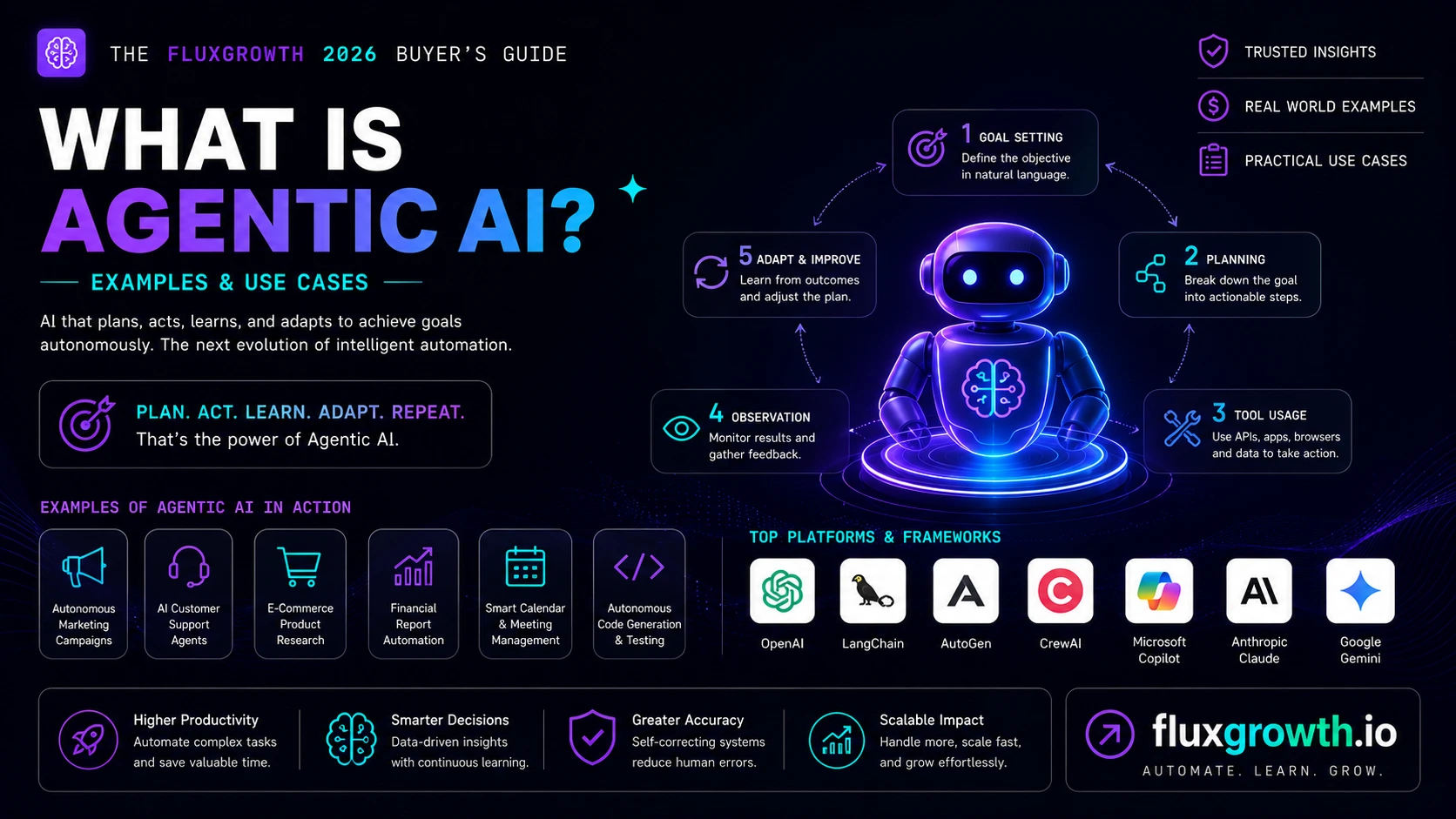
Here’s the short version. Agentic artificial intelligence is AI that doesn’t just answer a question. It plans the steps, uses real tools like APIs, browsers, and code, watches what happens, and adjusts until the job is actually done. The long version, including what separates real agentic AI from “agent washing,” where this pays off for a one-person business instead of just a Fortune 500, and which platforms in 2026 are actually worth your money, is everything below.
What Is Agentic Artificial Intelligence?
Definition of agentic AI
Agentic AI is artificial intelligence that pursues a goal with minimal hand-holding. You give it an objective, something like “find three vendors under $5,000 that do X,” and it breaks that down into steps, picks the right tool for each one, executes, checks its own work, and tries again if something fails.
That loop, plan, act, observe, adjust, is the whole definition. If a system can’t run that loop on its own, it’s not agentic. It’s just AI-assisted.
How agentic AI differs from traditional AI
A standard AI model, including most of what you’ve used in ChatGPT or Claude up to this point, answers one prompt at a time. You ask, it responds, the interaction ends. It has no persistent goal and no ability to act outside the chat window unless you copy and paste its output somewhere yourself.
Agentic AI systems keep working after you walk away. They hold onto the goal across multiple steps, reach into other software to get things done, and decide what to do next without you typing a new prompt for every move.
Why agentic AI matters
This matters because it changes what AI is for. Generative AI makes you faster at producing things: drafts, summaries, code, images. Agentic AI is built to remove you from the loop entirely for specific, well-defined tasks.
That’s a bigger shift than it sounds, and it’s also why the failure data above matters. When a system can act without you checking every step, a bad assumption baked into its plan doesn’t just produce one wrong paragraph. It can send the wrong email, file the wrong report, or quietly burn through your AI budget on a workflow that isn’t doing what you think it’s doing.
How Does Agentic Artificial Intelligence Work?
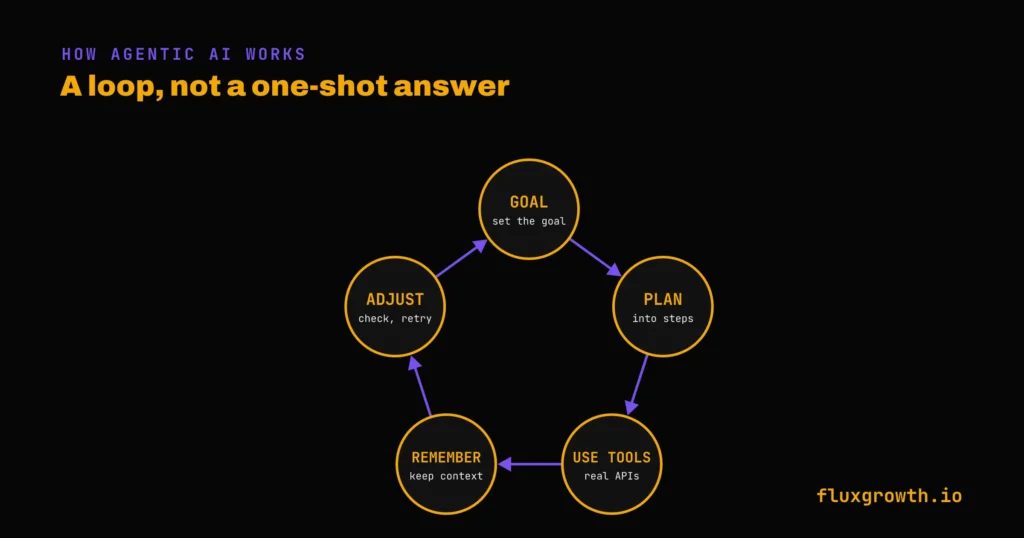
Strip away the marketing and every agentic AI system runs roughly the same loop, broken into five parts.
Goal setting
You, or another system, hand the agent an objective in plain language. Not a single instruction, but a result you want. “Qualify these 50 leads and flag the ones worth a call” is a goal. “Write one sentence” is not.
Planning and reasoning
The agent breaks the goal into a sequence of smaller steps. Frameworks like LangGraph and CrewAI make this explicit. You can actually watch the plan get built before any action happens, step by step, which is one reason developers lean on them instead of a black-box tool.
Tool usage
The agent calls real tools to execute each step: a web browser, a code interpreter, your CRM’s API, a file system. This is the piece that separates agentic AI from a chatbot. It’s not describing what you should do. It’s doing it.
Memory and context
Good agents track what’s happened so far in the current task, and increasingly, across sessions. Microsoft’s Copilot Memory and Work IQ are built specifically around this longer-term version: remembering your habits, your preferences, and the context of past work instead of starting fresh every time.
Execution and feedback loops
After each action, the agent checks the result against the goal. Did the email send? Did the API call return what it expected? If not, it adjusts the plan and tries again instead of just reporting the failure back to you.
That feedback loop is the part most “agentic” products skip, and it’s a big reason for the failure rate covered later in this article.
Core Components of Agentic AI Systems
Every working agentic AI system is built from a handful of parts.
Large language models (LLMs)
The reasoning engine, usually a GPT-5-class, Claude, or Gemini model, interprets the goal and decides what to do next. This is the “brain,” but on its own, it can’t act on anything.
Memory systems
Short-term memory for the current task, plus a growing layer of longer-term memory that persists across sessions. This is what lets an agent pick up where it left off instead of treating every interaction like the first one.
Tools and APIs
The hands of the system: connectors to your email, calendar, CRM, code environment, or the open web. An agent without tool access is just a chatbot with extra steps.
Reasoning engines
The layer that turns “do this” into an actual step-by-step plan, including error handling when a step fails partway through.
Multi-agent collaboration
Increasingly, one agent hands work to another, specialized agent. A “researcher” agent passes findings to a “writer” agent, which passes a draft to a “reviewer” agent. This is what frameworks like CrewAI and AutoGen are built around.
One infrastructure detail worth knowing, because it’ll show up in nearly every serious agentic AI platform you evaluate from here on: the Model Context Protocol (MCP), an open standard Anthropic introduced in late 2024 for connecting AI systems to outside tools and data. OpenAI added support in 2025, and by early 2026 it had been built into ChatGPT, Microsoft Copilot, Gemini, and most major coding tools. A companion protocol, Agent2Agent (A2A), handles how separate agents talk to each other. Think of these two as the plumbing that makes “multi-agent collaboration” an actual working system instead of a slide-deck concept.
Agentic AI vs Generative AI
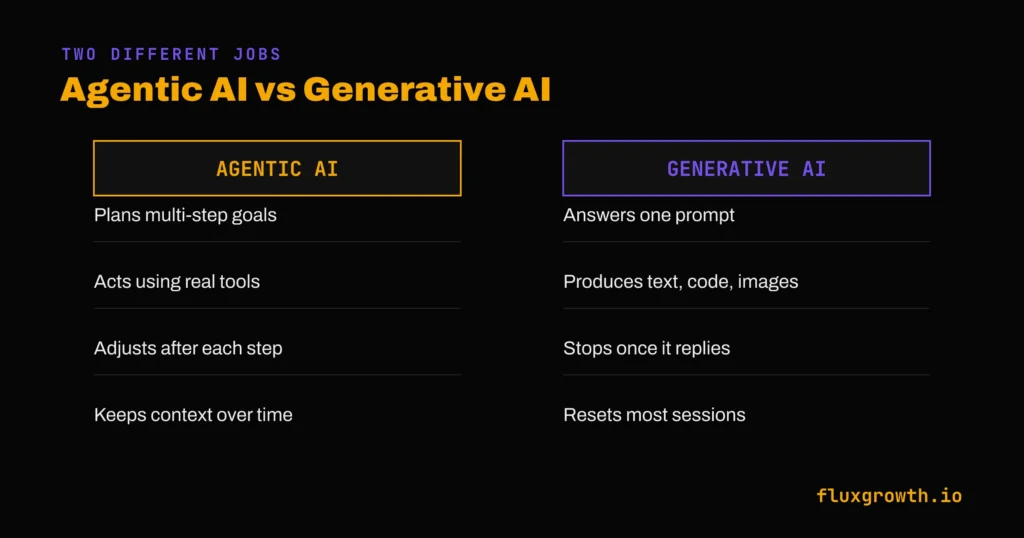
| Feature | Agentic AI | Generative AI |
| Goal-oriented | Yes, works toward an objective across multiple steps | Limited, responds to one prompt at a time |
| Autonomy | High, acts without a new prompt for each step | Low, needs a human to direct every output |
| Planning | Yes, breaks goals into a sequence of actions | Minimal, no persistent plan |
| Tool usage | Extensive, calls APIs, browsers, code, business systems | Limited, mostly text, image, or code generation |
| Memory | Persistent across a task, sometimes across sessions | Session-based, usually resets each conversation |
The easiest way to remember it: generative AI creates. Agentic AI does. Most tools today are some blend of both. ChatGPT is generative by default, but its agent mode borrows agentic behavior for specific tasks. That overlap is exactly why “is ChatGPT agentic AI?” is such a common search. More on that in the FAQ below.
Agentic AI vs Traditional Automation
If you’ve used Zapier, Power Automate, or any of this, then that” tool, you’ve used automation, not agentic AI. The difference comes down to who’s making the decisions.
Rule-based automation follows a fixed script: if X happens, do Y. It never deviates, and it breaks the moment something it didn’t anticipate shows up. Workflow automation chains several rule-based steps together, which is more useful, but it’s still deterministic. Someone designed the exact path in advance, and the system just walks it.
Related: a practical guide to using artificial intelligence
Autonomous decision-making, the core of agentic AI, works differently. The system isn’t following a pre-built path. It’s deciding, in real time, what the next step should be, based on the goal and what it’s observed so far. That’s more powerful, and it’s also why governance matters more here than with a basic Zapier workflow. An automation can’t decide to do something you didn’t authorize. An autonomous agent, in theory, can. That single difference is the reason every serious deployment in the next section keeps a human checkpoint somewhere in the process.
Agentic AI Examples & Real-World Use Cases
Forget hypotheticals. Here’s what’s actually shipping in 2026, with names and numbers attached.
Customer support at scale. Klarna’s AI agent saved the company $60 million and took on a workload equivalent to 853 employees by Q3 2025, handling customer service interactions end-to-end instead of just suggesting responses for a human to send. [VERIFY: confirm this figure is still current as of publish; source is dated Q3 2025]
Financial services. JPMorgan runs more than 450 agentic AI use cases in production, drafting M&A presentations in roughly 30 seconds instead of the hours a junior analyst used to spend, automating trade settlement, and flagging fraud in real time. That’s backed by an $18 billion annual technology budget, so the scale isn’t directly comparable to a small business. But the workflow pattern, research, then draft, then flag for human review, is exactly what scales down.
Enterprise operations on a smaller budget. Salesforce uses its own Agentforce internally to handle 380,000-plus customer support interactions, with 84% fully resolved without a human stepping in. Separately, Unifi, a North American aviation ground-handling company and not a tech giant, used Microsoft Copilot Studio to cut contract review time from days to minutes by breaking the process into coordinated agent steps rather than relying on a single do-it-all bot.
Healthcare. Agentic AI is handling appointment scheduling end-to-end (booking, confirming, rescheduling based on provider availability and patient urgency) and generating the compliance documentation and audit trails that used to eat hours of clinical staff time.
Manufacturing. Predictive maintenance agents monitor equipment signals and schedule repairs before a breakdown happens, instead of waiting for a person to notice a problem on a dashboard.
Software development. Coding is the single biggest real-world use case for agentic AI right now. Anthropic’s own usage data shows tasks involving computers and math make up the largest category of activity on Claude.ai. Agents here don’t just suggest code. They write it, run tests, and fix their own failures in a loop.
Where this actually matters if you’re not running a department
Almost every example above is enterprise-scale, which is exactly why most explainers stop there. But the U.S. solopreneur economy now spans roughly 29.8 million independent operators contributing an estimated $1.7 trillion, about 6.8% of GDP. According to a 2026 small-business tech survey, 82% of small-business employers have already invested in AI tools, and marketing is the most common use case.
I personally use an agentic workflow at FluxGrowth to research topics, generate content ideas, write carousel scripts, and organize everything into a publishing pipeline. By combining AI tools and automation, I can produce consistent content with far less manual work and spend more time improving strategy and serving clients.
The pattern across every example that actually works, big budget or small: a narrow, well-defined task with a clear success condition. None of these is a “replace my whole department” agent. They’re “handle this one specific, measurable thing end-to-end” agents, which is exactly the lesson buried in the failure-rate data below.
Benefits of Agentic Artificial Intelligence
1.Increased productivity
Not “AI helped me draft faster,” but entire multi-step processes completed without a human touching them. The gap between those two things is the whole point of agentic AI.
2.Reduced operational costs
Klarna’s $60 million savings figure is the headline number. At a smaller scale, the math looks the same: every hour an agent owns from start to finish is an hour you’re not paying someone, including yourself, to do it manually.
3.Faster decision-making
JPMorgan’s 30-second presentations versus hours is the extreme end of the scale. For most businesses, the win isn’t seconds, it’s getting a task off next week’s to-do list and onto today’s.
4.24/7 automation
Agents don’t clock out, which matters most for anything customer-facing. A support agent handling tickets at 2 a.m. doesn’t need overtime.
5.Scalable workflows
Once an agent handles a task well, running it ten times costs barely more than running it once. That’s a different cost curve than hiring a person to do the same thing.
Challenges and Risks of Agentic AI
This is the section most agentic AI explainers gloss over, and it’s the one worth reading most carefully before you spend a dollar.
The failure rate (and why it’s not random)
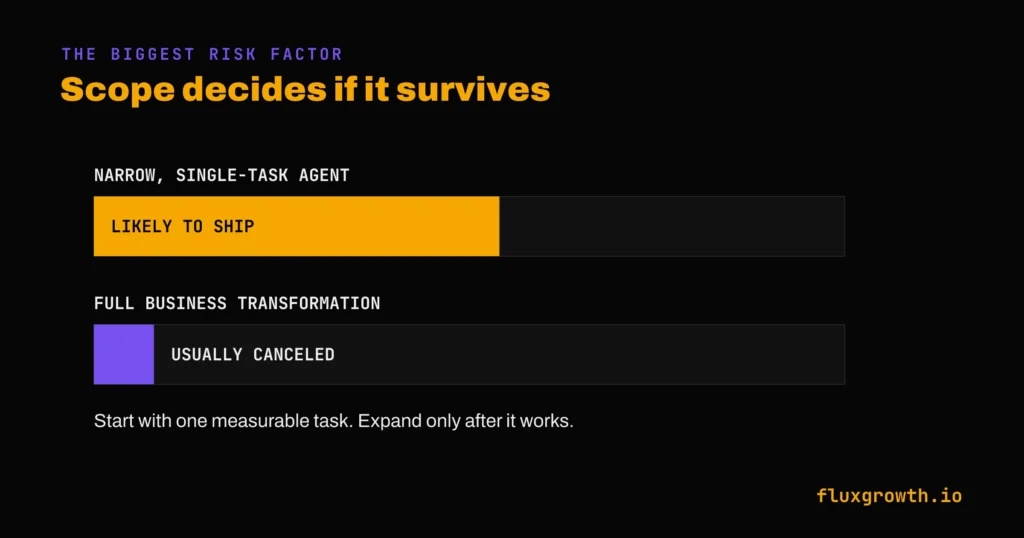
Gartner’s prediction that more than 40% of agentic AI projects will be cancelled by the end of 2027 comes from a poll of over 3,400 organizations actively investing in the technology. The stated reasons aren’t model quality. They’re escalating costs, unclear business value, and weak governance. One breakdown of project types found single-task agents with a defined scope succeed about 54% of the time, while large-scale “transform the whole business” agentic projects succeed only about 8%. Scope, not technology, is the biggest predictor of whether your project survives.
Here’s the thing: the failure data isn’t an argument against using agentic AI. It’s an argument against starting with the most ambitious version of it.
“Agent washing” is widespread
Gartner uses this term for vendors rebranding existing chatbots and basic automation as “agent washing” without delivering real autonomous capability. Of the thousands of vendors using the word “agentic” in their marketing, the firm estimates only around 130 actually offer genuine agentic features. If a tool can’t explain, specifically, what it plans, what tools it calls, and how it checks its own work, treat the “agentic” label with suspicion.
Hallucinations carry more weight here
When a generative AI hallucinates, you get a wrong sentence. When an agentic AI hallucinates mid-task, inventing a policy, misreading a data field, acting on a false assumption, it can act on that mistake before anyone catches it. A Canadian tribunal already ruled an airline legally responsible for a refund its chatbot invented out of nowhere. “The AI said so” stopped being a viable defense a while ago.
Security concerns scale with autonomy
An agent with access to your email, CRM, or payment systems is a bigger attack surface than a chatbot that only talks. Prompt injection, tricking an agent into ignoring its instructions through hidden text in a webpage or document, is the specific attack pattern worth knowing about.
Lack of transparency
Ask an agent why it made a decision three steps into a task, and you’ll often get a plausible-sounding answer that isn’t actually how it got there. That’s the transparency problem in one sentence: you can’t fix a process you can’t actually see.
Regulatory compliance
Industries like healthcare and finance already have rules about human review of automated decisions. Agentic AI doesn’t get a pass just because it’s new.
Human oversight requirements
Every credible deployment researched for this piece, Salesforce’s own internal use, JPMorgan’s, Unifi’s, keeps a human checkpoint somewhere in the loop, even at full scale. “Fully autonomous, zero oversight” is closer to a marketing claim than a real deployment pattern in 2026.
Top Agentic AI Tools and Platforms in 2026
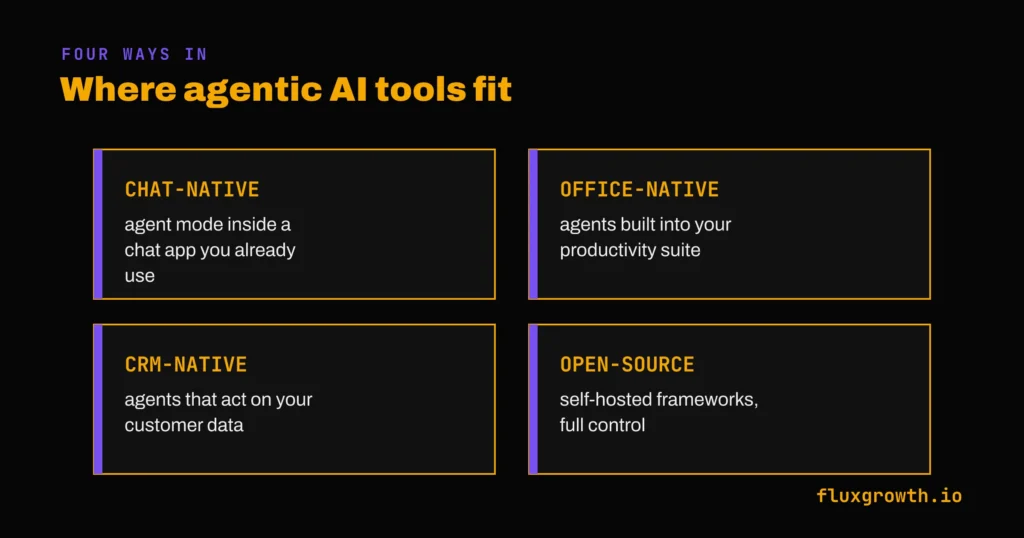
Four platforms cover the real range here: one consumer-to-enterprise giant, one Microsoft-ecosystem play, one CRM-native enterprise platform, and one open-source framework for builders who want full control. Match the tool to your actual workflow, not the one with the biggest marketing budget.
| Tool | Best For | Starting Price | Key Strength | Key Limitation |
| OpenAI (ChatGPT agent + AgentKit) | Solopreneurs already living in ChatGPT | $20/month (Plus) | Lowest barrier to entry, no technical skill needed | Monthly task limits fill up fast on lower tiers |
| Microsoft Copilot Studio | Small businesses on Microsoft 365 | $200/month (standalone credits) or included with M365 Copilot | Deep integration with Office apps your team already uses | Pricing is genuinely confusing across licenses, credits, and Azure compute |
| Salesforce Agentforce | Businesses already deep in the Salesforce ecosystem | $0 to start (Foundations), then $2/conversation | Most native fit for CRM-driven workflows | Real production use gets expensive fast |
| CrewAI | Builders comfortable with some Python | Free (open-source, self-hosted) | No vendor lock-in, full control over agent reasoning | Not no-code; requires technical comfort |
OpenAI built agent mode directly into ChatGPT. It can browse the web, fill out forms, work with your files, and connect to apps like Slack and Google Drive, completing tasks in roughly 5 to 30 minutes depending on complexity. For developers, AgentKit adds a visual builder for multi-step workflows, though OpenAI is winding down its Agent Builder and Evals tools as of November 30, 2026, pointing developers toward the Agents SDK instead. Worth knowing if you’ve seen older tutorials still recommending Agent Builder.
Microsoft Copilot Studio lets you build custom agents that plug into Teams, SharePoint, and Outlook, with over 1,400 external connectors and support for multi-agent orchestration on more complex processes. Internal agent use is included for Microsoft 365 Copilot license holders, while standalone capacity runs on Copilot Credits.
Salesforce Agentforce offers a free Foundations tier with Agent Builder, Prompt Builder, and 200,000 Flex Credits to start, then scales through per-action credits or per-user add-ons up to $550/user/month for the bundled Agentforce 1 edition.
CrewAI’s core orchestration engine is MIT-licensed and free forever if you self-host and bring your own LLM API key, though you’ll pay for the underlying model calls separately. Paid cloud tiers exist for hosted deployment, support, and compliance features, but exact current pricing has shifted enough across sources recently that it’s worth confirming the live number before quoting it.
If you’d rather write code directly than use any platform, LangGraph, AutoGen, and LangChain are the three frameworks doing the heavy lifting under the hood of a lot of “agentic AI” products marketed elsewhere. Worth knowing by name even if you never touch them yourself. When someone says they “built a custom agent,” one of these three is usually involved.
Future Trends in Agentic AI
Multi-agent systems are quickly becoming the default architecture, not a power-user feature. Instead of one agent trying to do everything, specialized agents hand work to each other.
Enterprise AI agents are moving from pilot to production faster than the success-rate data suggests they should. Gartner expects 40% of enterprise applications to include task-specific agents by the end of 2026, up from under 5% in 2025.
Agent marketplaces, places to discover and deploy pre-built agents instead of building from scratch, are an early but fast-growing category, mirroring how app stores developed for mobile.
Human-AI collaboration is settling into a pattern, not disappearing. Every serious deployment researched for this piece keeps a defined human checkpoint, not full autonomy.
Autonomous enterprises, the idea of a business running largely on agent-to-agent workflows, is still mostly a thesis in 2026, not a deployment pattern. A frequently cited claim is that some chip makers now run far more AI agents than human employees internally; confirm the exact figure and source before using it, since it traces back to a conference quote rather than a published report
What I’d Do If I Were Exploring Agentic AI Today
If I were exploring agentic AI today, I wouldn’t start by building a fully autonomous system. I’d begin with a narrow workflow, like lead qualification, content research, or customer support, and gradually expand from there.
Agentic AI is powerful, but the companies seeing the best results are usually the ones that start small, measure outcomes, and scale carefully. The 54-versus-8 success rate gap between narrow and “transform everything” projects isn’t a coincidence. It’s the whole lesson.
I personally tested an AI-powered content workflow for FluxGrowth using Claude, ChatGPT, and Canva. Over several weeks, I used it to create Instagram carousels and blog content, cutting my content production time by more than 70% and making it easier to post consistently.
Frequently Asked Questions
What is agentic artificial intelligence?
Agentic artificial intelligence is AI that pursues a goal on its own, planning steps, using real tools, and adjusting its approach, instead of just answering a single prompt and stopping.
How does agentic AI work?
It runs a loop: set a goal, plan the steps, use tools to execute each one, check the result, and adjust if something didn’t work, repeating until the task is done.
What is the difference between agentic AI and generative AI?
Generative AI creates content in response to a prompt. Agentic AI takes that further. It plans multi-step tasks and takes action across real tools and systems, mostly without a new prompt for every step.
What are examples of agentic AI?
Customer support agents that resolve tickets end-to-end, coding agents that write and fix their own code, research agents that gather and synthesize information, and CRM agents that qualify leads and follow up automatically are all live examples in 2026.
Is ChatGPT agentic AI?
ChatGPT is generative AI by default, but its agent mode adds agentic behavior for specific tasks: browsing the web, filling out forms, and completing multi-step actions. So partly, depending on which mode you’re using.
What are multi-agent systems?
Multi-agent systems use several specialized AI agents that each handle part of a task and pass work to each other, one might research, another writes, another reviews, instead of relying on a single agent to do everything.
Which industries benefit most from agentic AI?
Financial services, retail, software development, and customer-service-heavy businesses currently show the clearest, most measurable returns, largely because they have high volumes of well-defined, repeatable tasks.
What are the risks of agentic AI?
The biggest risks are hallucinations that turn into real actions, security exposure from agents with broad system access, and projects that fail simply because their scope was too ambitious from the start.
The Bottom Line
Agentic artificial intelligence is genuinely useful, but only when you start with a task small enough to actually measure. That’s the one piece of advice buried in the Gartner data that’s worth more than any tool comparison above: scope it small, prove it works, then expand.