FluxGrowth is reader-supported. Some links in our guides are affiliate links — if you buy through one we may earn a commission, at no extra cost to you. It never changes which tools we recommend. How we test tools.
In April 2026, Microsoft quietly retired one of the most popular multi-agent frameworks on the planet. AutoGen, the tool half the “best AI agent frameworks” listicles still recommend, is now in maintenance mode. It got folded into something called Microsoft Agent Framework. If you’re researching multi-agent systems right now, that single fact tells you something important: this space moves fast enough that yesterday’s best practice is this month’s legacy advice.
This guide is part of our AI Automation hub – everything we have published on automating a small business with AI, in one place.
So what are multi-agent systems, exactly? Picture one chatbot trying to research a topic, write a draft, fact-check every claim, and format it for WordPress all in one pass. Quality slips somewhere in there. Now picture four specialized agents splitting that same job: one researches, one writes, one checks, one formats. That’s a multi-agent system. Not a smarter chatbot. A small team.
And this isn’t a side project for most enterprises anymore. Gartner predicts that 40% of enterprise applications will include task-specific AI agents by the end of 2026, Businesses planning to deploy these systems often work with specialized AI software development services to design custom workflows, integrate enterprise data, and build production-ready AI agents. up from less than 5% in 2025. That’s a signal that AI agents are moving beyond experimental pilots and becoming part of mainstream enterprise software, not just another conference buzzword.
Here’s what you’ll get: a working definition, the architecture patterns teams actually use in production, real examples by industry, the frameworks worth your time right now, and because most “best practices” roundups skip this part an honest look at where these systems still break.
What Are Multi-Agent Systems?
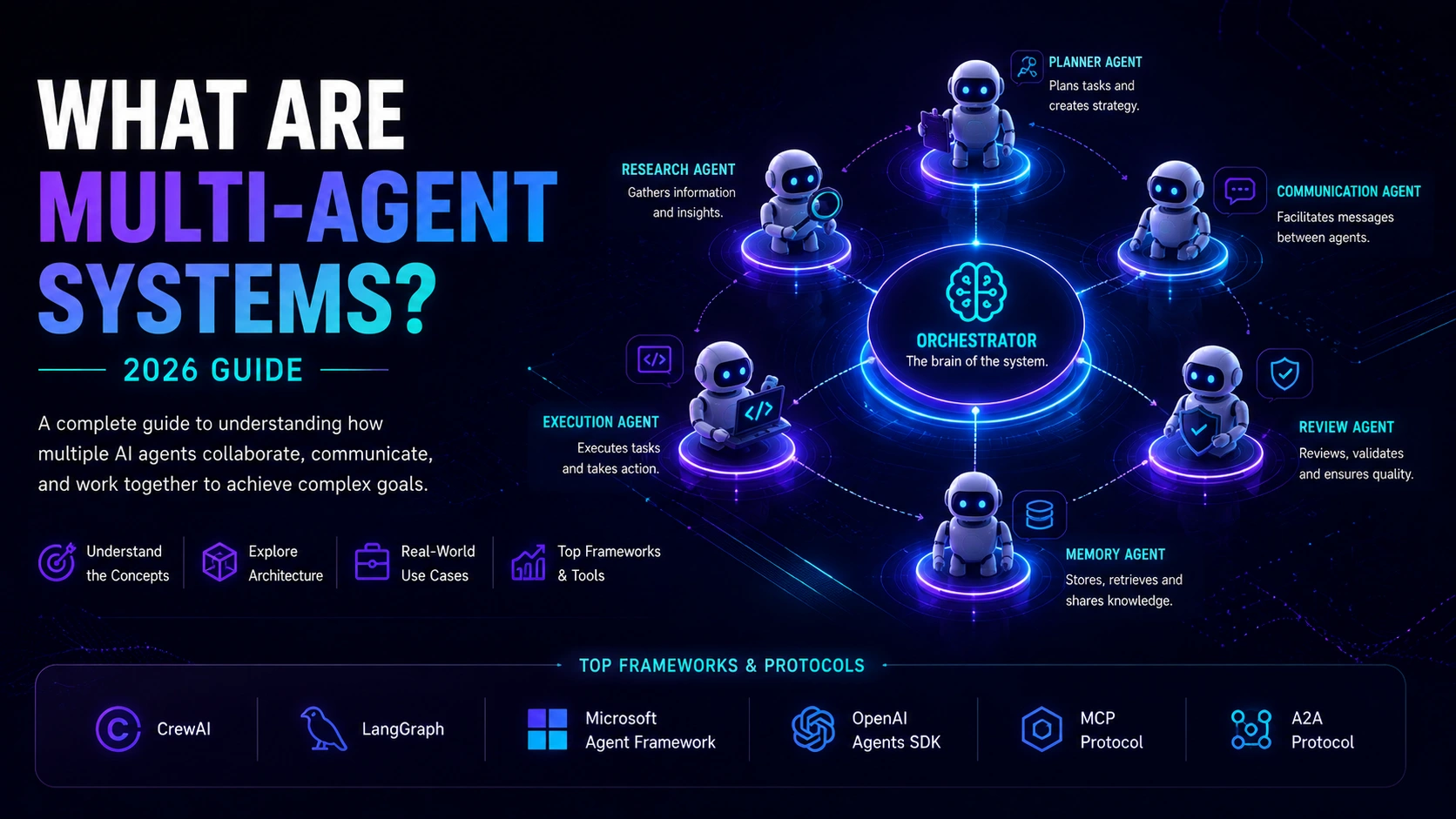
A multi-agent system is a group of independent AI agents that collaborate, communicate, and divide labor to reach a shared goal. Each agent typically specializes: one researches, one plans, one executes, one reviews. They don’t just run in parallel, they coordinate.
Definition of Multi-Agent Systems
Strip away the jargon and it’s this: instead of asking one large language model to do everything in a single pass, you split the job across multiple smaller, focused “agents,” each with its own instructions, memory, and tool access. A researcher agent might pull data. A planner agent decides what to do with it. An executor agent takes the action. They hand off context as they go.
How Multi-Agent Systems Work
Under the hood, agents share state through a common memory layer and pass each other structured messages not free-form chat, something closer to JSON. Some kind of orchestration logic decides who does what, when.
That orchestration piece is the part most teams underestimate. Get it wrong and you get agents stepping on each other, or burning tokens arguing in circles (yes, this actually happens two agents can get stuck “negotiating” a task neither one finishes).
Why Multi-Agent AI Matters
Single-agent systems hit a wall fast not because the model is weak, but because attention degrades over a long, multi-step task. Ask one model to juggle five different jobs in a single context window and somewhere around job four, it starts forgetting instructions from job one. Splitting the work across specialized agents, each with a narrow job and a clean context, tends to hold quality steadier across longer, more complex tasks.
How Multi-Agent Systems Work
Here’s the mechanical version, broken into the pieces that actually matter when you’re building or evaluating one.
Autonomous AI Agents
Each agent in the system operates with some independence. It gets a goal, decides how to pursue it (within guardrails), and acts by calling tools, querying data, or talking to other agents without a human approving every step.
Goal Assignment
Someone (a human, or an orchestrator agent) breaks the larger objective into sub-goals and assigns them. A content-production system might assign “find three recent statistics” to one agent and “write the intro” to another.
Planning and Coordination
This is where agents figure out sequencing what has to happen before what. A planner agent often sits above the others, deciding the order of operations and re-planning when something fails.
Communication Between Agents
Agents pass messages, usually structured (JSON-like, not conversational chat) so the receiving agent can parse exactly what it’s getting. This is also where standards like Model Context Protocol (MCP) and Agent-to-Agent (A2A) protocol come in more than those below.
Decision Making
Individual agents make local decisions (which tool to call, how to phrase output) while the orchestration layer makes system-level decisions (which agent goes next, whether to retry a failed step).
Learning and Feedback Loops
The better-built systems include some feedback mechanism, an agent checking another agent’s output, a human-in-the-loop approval gate, or logged outcomes that inform future runs. Without this, errors compound silently.
Core Components of a Multi-Agent System
Every production multi-agent system you’ll encounter is built from roughly the same parts.
1.Large Language Models (LLMs)
The reasoning engine behind each agent. Different agents in the same system can run different models: a cheap, fast model for simple lookups and a stronger model for the agent doing the actual analysis.
2.AI Agents
The individual workers: each one wrapped with a system prompt, a defined role, tool access, and (often) its own memory scope.
3.Shared Memory
A common store vector database, key-value store, or simple shared state object that lets agents access context other agents have already gathered, instead of re-discovering it.
4.Tool Integration
Agents need to actually do things: search the web, query a database, call an API, write to a file. Tool integration is what turns a chatty LLM into something that can take real action.
5.AI Orchestration Layer
The traffic controller. It decides which agent runs next, handles retries, and enforces whatever workflow logic (sequential, parallel, conditional) the system needs.
6.Agent Communication Protocols (MCP & A2A)
Two standards matter in 2026. Model Context Protocol (MCP), originally introduced by Anthropic and now hosted under the Linux Foundation’s Agentic AI Foundation (AAIF), standardizes how AI agents connect to external tools, APIs, and data sources. Think of it as a universal plug instead of building a custom integration for every application. The MCP ecosystem has grown rapidly to more than 10,000 publicly available servers, making it one of the most widely adopted standards for connecting AI agents with real-world software and services.
Agent-to-Agent (A2A) protocol, meanwhile, standardizes how agents talk to other agents including agents built on completely different frameworks. Microsoft Agent Framework, for example, now ships with native A2A support specifically so its agents can collaborate with agents built on other stacks.
Single-Agent vs Multi-Agent Systems
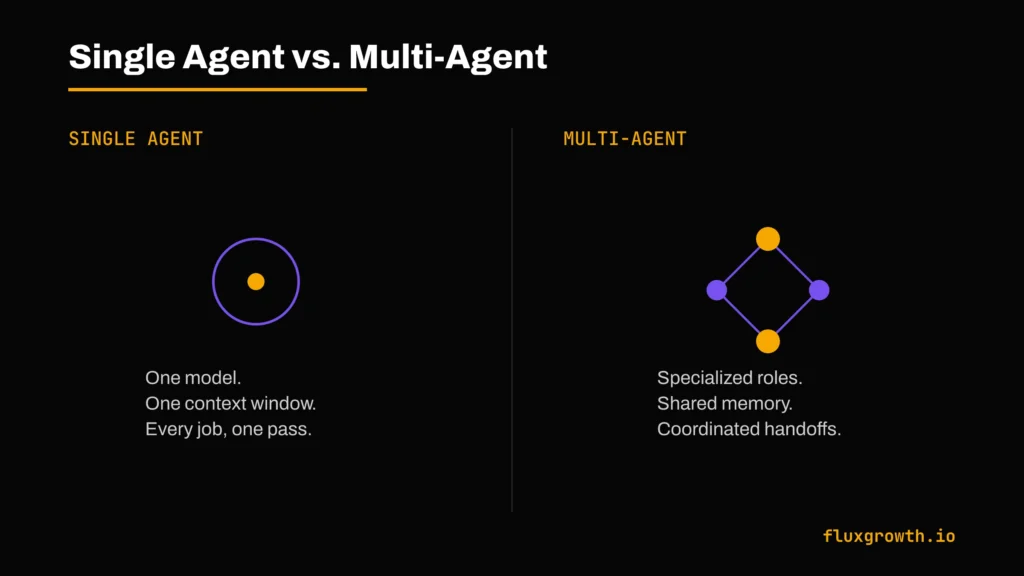
| Feature | Single-Agent AI | Multi-Agent Systems |
| Number of agents | One | Multiple |
| Collaboration | No | Yes |
| Task execution | Individual | Coordinated |
| Scalability | Moderate | High |
| Enterprise use | Limited | Extensive |
A single agent is fine for a contained task to answer this question, summarize this document. But add a second distinct stage, then a third, and a single agent starts dropping context. That’s the line. Once a workflow needs different skills at different steps, multi-agent design earns its complexity.
Multi-Agent System Architecture
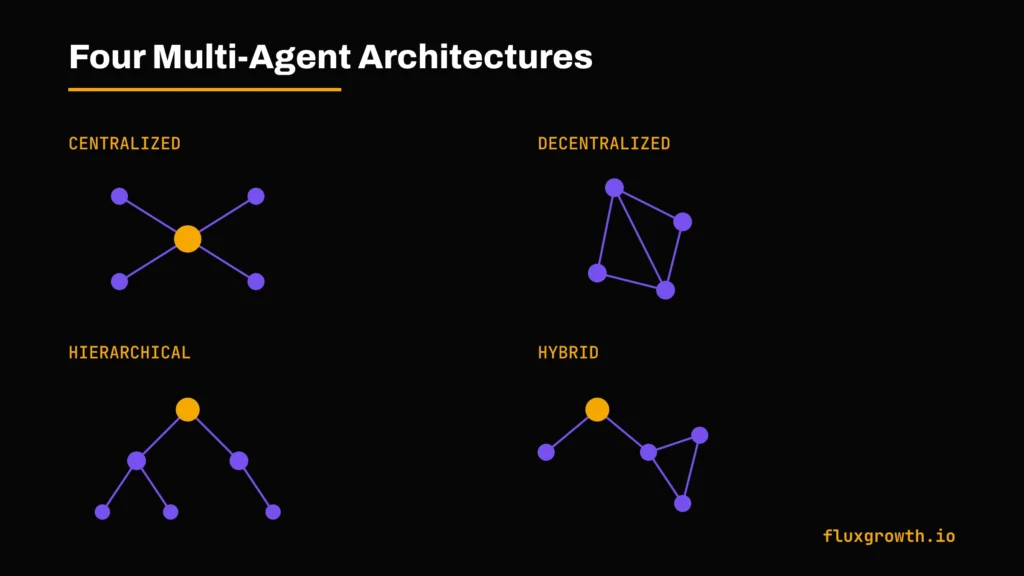
Architecture decides how agents are connected and who’s in charge. Four patterns cover most real-world setups.
Centralized Architecture
One orchestrator agent directs everything. Simple to reason about, simple to debug, but it’s a single point of failure if the orchestrator breaks, the whole system stalls.
Decentralized Architecture
No single controller. Agents communicate peer-to-peer and negotiate who does what. More resilient, much harder to debug when something goes sideways, since there’s no one place to look for “what happened.”
Hierarchical Architecture
A layered version of centralized: a top-level orchestrator delegates to mid-level managers, who delegate to worker agents. This scales better than flat centralization because no single agent is coordinating everything directly.
Hybrid Multi-Agent Architecture
Most production systems in 2026 actually land here centralized control for the core workflow, with pockets of decentralized negotiation for specific sub-tasks (like multiple research agents dividing up sources without a manager micromanaging each query).
In practice, hybrid architectures have become the preferred choice for many production deployments because they combine centralized orchestration with the flexibility of autonomous agents. This approach helps teams maintain control over core workflows while allowing specialized agents to collaborate efficiently on complex tasks.
Real-World Multi-Agent System Examples
Customer Support Automation
A triage agent classifies the incoming ticket, a knowledge-retrieval agent pulls relevant docs, and a response agent drafts the reply escalating to a human when confidence is low. This is one of the most mature use cases, partly because the failure mode (a bad draft reply) is low-stakes if a human reviews before sending.
Software Development Teams
Tools like Claude Code and frameworks like CrewAI support setups where a planner agent breaks a coding task into pieces, a coder agent writes the implementation, and a reviewer agent checks the diff before it’s merged. If you’ve tested a multi-agent coding workflow, briefly describe your setup (for example, Claude Code + CrewAI or OpenAI Agents SDK + LangGraph), what each agent was responsible for, and the biggest lesson you learned. Mention one thing that worked well and one bottleneck you encountered, such as coordination overhead, context sharing, or debugging agent interactions. Keep this to 2–3 sentences based on your real experience.
Healthcare AI Assistants
Multi-agent systems in healthcare typically separate intake (gathering patient information), triage (flagging urgency), and documentation (drafting notes) into distinct agents, with a human clinician as the final decision-maker on anything clinical. Regulatory scrutiny here is heavy, and rightly so.
Financial Analysis Agents
One agent pulls market data, another performs the analysis, and a third drafts a summary for a human analyst to review. Financial services is among the earliest adopters of agentic AI because many workflows such as fraud detection, compliance, risk analysis, and document processing are highly structured and data-intensive. Banks are increasingly moving beyond AI assistants toward supervised AI agents that can execute multistep workflows while keeping humans in the loop for high-risk decisions.
Supply Chain Optimization
Agents monitoring inventory levels, predicting demand, and adjusting routing can each run independently but share a common data layer so a demand-forecasting agent’s output directly feeds a routing agent’s decisions without a human relaying the handoff.
Marketing & Content Creation
This one’s close to home. A research agent gathers current data and competitor angles, an outline agent structures the article, a drafting agent creates the first version, and an audit agent checks for AI-generated patterns, factual accuracy, and missing citations before anything gets published.
At FluxGrowth, I follow a similar stage-based workflow rather than relying on a single AI tool to do everything. Breaking research, writing, verification, and final editing into separate steps consistently produces more accurate, better-optimized content than asking one model to handle the entire process in a single prompt.
Business Use Cases of Multi-Agent Systems
Enterprise Operations
Cross-functional workflows are natural fits onboarding a new vendor, processing an expense report end to end, the stuff that already gets routed through three or four different “departments” before it’s done. A vendor-onboarding flow alone might touch compliance review, contract drafting, and payment-system setup; a multi-agent system can run those as parallel sub-tasks instead of a week of email back-and-forth.
Sales Automation
Lead research, personalized outreach drafting, and follow-up sequencing can each be handled by a dedicated agent, with a human sales rep approving before anything sends.
Marketing Campaigns
Campaign planning, content generation, and performance analysis split cleanly across agents especially when each stage needs a different tool. A research agent pulling from Semrush or a social listening API, a drafting agent writing copy, an agent pulling Meta Ads or Google Analytics data for the post-mortem. Three different jobs, three different toolsets.
Customer Service
Beyond basic ticket triage, more mature deployments now handle full resolution flows refunds, account changes, troubleshooting with agents escalating only the edge cases.
HR & Recruitment
Resume screening, interview scheduling, and candidate evaluation can run as separate agents feeding into a single hiring-manager dashboard. Bias and compliance review needs to stay a human checkpoint here; this isn’t a place to fully automate.
Cybersecurity
Threat-detection agents, triage agents, and remediation agents working together is one of the fastest-maturing enterprise use cases for multi-agent systems. Palo Alto Networks says organizations using Cortex XSIAM have reduced mean time to respond (MTTR) by up to 98%, with many deployed customers cutting response times from days or weeks to under 10 minutes by combining AI agents with automated investigation and remediation workflows. As with most vendor-reported performance figures, these results should be viewed as customer-reported outcomes rather than independently audited benchmarks.
Benefits of Multi-Agent Systems
1.Better Scalability
Adding capacity often means adding another instance of a specialized agent, rather than re-architecting a single monolithic model’s prompt.
2.Faster Decision Making
Parallel agents working on sub-tasks simultaneously can finish a multi-stage workflow faster than one agent working through it sequentially.
3.Improved Productivity
Specialized agents tend to perform their narrow task more reliably than one generalist agent juggling everything: fewer dropped steps, fewer “forgot the instructions from three paragraphs ago” failures.
4.Parallel Task Execution
Independent sub-tasks (researching three different sources, say) can run at the same time instead of one after another.
5.Greater Reliability
If one agent fails or produces a bad output, a reviewer or orchestrator agent can catch it before it propagates something a single-pass model can’t do for itself.
6.Cost Savings
Routing simple sub-tasks to cheaper, smaller models while reserving expensive frontier models for the genuinely hard reasoning steps can meaningfully cut total spend. This only works, though, if you’re actually tracking per-agent token costs which most teams don’t, at first.
Challenges and Limitations
No hype here. These are the real failure points.
Communication Overhead
Every agent-to-agent handoff passes conversation history, and every reasoning loop burns more tokens. More agents doesn’t automatically mean better results, it often means a bigger bill for marginal gains.
Agent Coordination
Getting agents to hand off work cleanly, without duplicating effort or contradicting each other, is genuinely hard. This is usually the first thing that breaks in a new multi-agent build.
Hallucinations
Multi-agent doesn’t fix hallucination, it can compound it. If agent one hallucinates a fact and agent two builds on it without verification, the error now has two agents’ worth of confidence behind it.
Security Risks
More agents means more tool access, more API keys, more attack surface. An agent with write access to a production database is a very different risk than a single chatbot answering FAQs.
Data Privacy
Shared memory across agents means sensitive data can end up visible to agents that didn’t need it. This needs explicit scoping, not an assumption that “it’ll be fine.”
Governance & Compliance
Here’s the thing: this is the gap most competing articles skip entirely, and it’s arguably the one that matters most right now. Gartner predicts over 40% of agentic AI projects will be canceled by the end of 2027, not because the underlying technology failed, but because of escalating costs, unclear business value, and inadequate risk controls. In other words, governance, measurable ROI, and operational discipline not model capability are increasingly becoming the deciding factors between successful deployments and abandoned projects.
If you’re evaluating multi-agent systems for your business, governance deserves as much planning time as the architecture itself. Who owns the agent? What it’s allowed to do. How its actions get logged. Skip that part and you’re not building a multi-agent system, you’re building a liability with good intentions.
Best Multi-Agent AI Frameworks in 2026
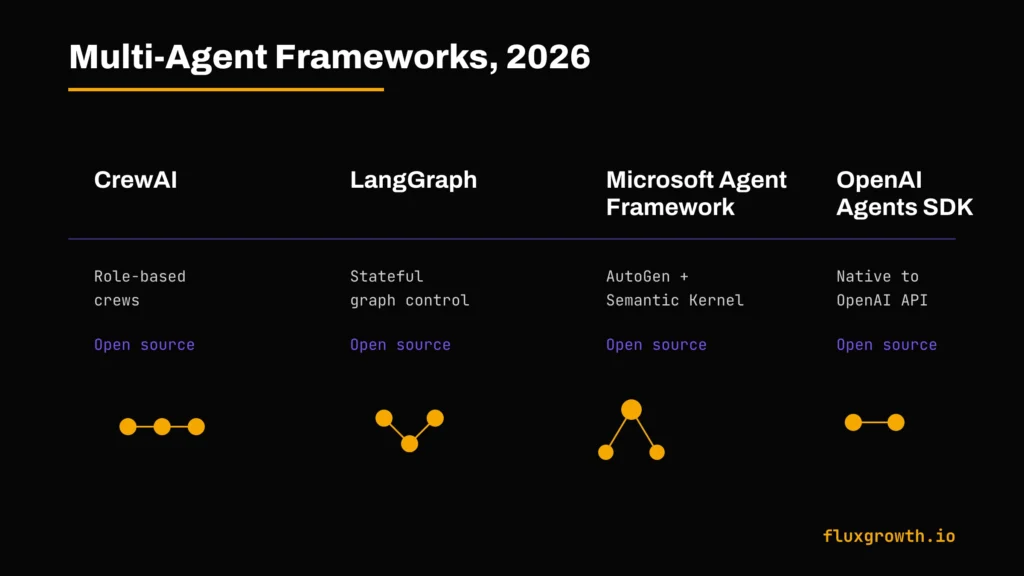
1.CrewAI
Features: Role-based agent design (Crews), event-driven Flows for stateful workflows, hierarchical and sequential process modes.
Pricing: The CrewAI core framework is free and open source under the MIT license for self-hosted deployments. CrewAI also provides a Free Basic managed cloud plan that includes 50 workflow executions per month. Organizations that need dedicated infrastructure, enterprise security, compliance, and managed deployments must contact CrewAI for custom Enterprise pricing, as public monthly subscription pricing is no longer listed on the official website.
Best for: Teams that want role-based, low-code-leaning agent design without building orchestration from scratch.
Pros: Free and open-source core (MIT license), active developer community, extensive documentation, and vendor-reported adoption across 63% of Fortune 500 companies, making it one of the most widely used multi-agent frameworks for enterprise AI.
Cons: Production costs can scale fast with token-heavy workflows; paid tier pricing isn’t fully transparent without creating an account.
2.LangGraph
Features: Graph-based orchestration with explicit state management, cyclic workflows (loops and retries), human-in-the-loop checkpoints, native support for single, multi-agent, and hierarchical control flows.
Pricing: The open-source LangGraph framework is free. LangGraph Platform is offered as a managed, usage-based service, with pricing based on compute, deployments, and storage rather than a fixed per-node execution fee. LangSmith is available with a free Developer tier, while advanced collaboration, observability, and enterprise capabilities are available through paid plans and custom enterprise pricing. Refer to the official LangChain pricing page for the latest rates.
Best for: Teams building complex, stateful workflows that need fine-grained control over agent behavior.
Pros: Reached 1.0 stability in October 2025 with a no-breaking-changes commitment; companies including Klarna, Uber, and LinkedIn have built production systems on it.
Cons: Steeper learning curve than role-based frameworks; meaningful production costs once you add LangSmith.
3.AutoGen → Microsoft Agent Framework
Features: AutoGen pioneered multi-agent conversation patterns (async messaging, modular agents) and is still useful for research and rapid prototyping. But as of 2026, Microsoft has moved production development to Microsoft Agent Framework (MAF), which unifies AutoGen’s orchestration patterns with Semantic Kernel’s enterprise stability including sequential, concurrent, handoff, and group-chat orchestration, plus native MCP and A2A support.
Pricing: Both are open source under MIT license and free. Hosted deployment through Microsoft Foundry uses standard Azure usage-based pricing, with a scale-to-zero model so idle agents don’t bill.
Best for: Teams in the Microsoft/Azure ecosystem, or anyone needing cross-framework agent interoperability via A2A.
Pros: Free, enterprise-grade stability, strong protocol support, backed by the team that originally built AutoGen.
Cons: AutoGen itself is now community-managed only if you’re starting fresh in 2026, go straight to Microsoft Agent Framework rather than building new projects on legacy AutoGen.
4.OpenAI Agents SDK
Features: Lightweight orchestration with built-in handoffs (transferring control between agents), configurable guardrails for input/output safety, and tracing for debugging agent execution.
Pricing: The SDK itself is free and open source. You pay standard OpenAI API token costs for whichever model your agents call.
Best for: Teams already building on OpenAI’s API who want orchestration without adopting a separate ecosystem.
Pros: Simple to start, works with Chat Completions and Responses APIs, added sandboxing for safer long-horizon tasks in April 2026.
Cons: Tighter coupling to OpenAI’s ecosystem compared to model-agnostic frameworks like LangGraph.
Comparison Table of Multi-Agent AI Frameworks
| Framework | Best For | Open Source | Pricing | Enterprise Ready | Difficulty |
| CrewAI | Role-based AI workflows | Yes | Free core / Paid cloud | Medium | Easy |
| LangGraph | Complex, stateful workflows | Yes | Free core / Usage-based platform | High | Medium |
| AutoGen / Microsoft Agent Framework | Microsoft ecosystem, cross-framework interop | Yes | Free | High | Medium-Advanced |
| OpenAI Agents SDK | OpenAI-native builds | Yes | API token costs only | High | Medium |
Multi-Agent Systems vs Agentic AI
These two terms get used almost interchangeably, but they’re not quite the same thing. Agentic AI is the broader concept of any AI system that plans, makes decisions, and takes multi-step action toward a goal with minimal human supervision. A single AI agent booking your travel can be “agentic.” A multi-agent system is a specific implementation of agentic AI: multiple agents, each agentic on their own, coordinating together.
Put another way: every multi-agent system is agentic AI, but not every agentic AI system is multi-agent. Use a single agent when the task is contained and doesn’t naturally split into distinct roles. Reach for multi-agent design when the workflow has genuinely separate stages of research, then write, then verify that benefit from specialization.
Future Trends in Multi-Agent Systems
AI Agent Marketplaces
Expect more places to discover and deploy pre-built specialized agents closer to an app store than a coding project.
Enterprise AI Teams
The idea of an AI agent as a digital coworker is quickly becoming reality. Rather than treating AI agents as standalone tools, many organizations are assigning clear ownership for how they’re deployed, monitored, and governed. Gartner has increasingly emphasized the need for dedicated AI leadership and governance as enterprises scale agentic AI, with CIOs expected to play a much larger role in overseeing AI agent systems across the business over the next few years.
Human-AI Collaboration
The most durable production systems keep a human checkpoint at the highest-stakes decision points, rather than chasing full autonomy for its own sake.
AI-to-AI Communication
A2A protocol adoption means agents built on entirely different frameworks: a LangGraph agent and a Microsoft Agent Framework agent can increasingly talk to each other directly, without custom integration work.
Autonomous Business Operations
Full end-to-end autonomous workflows are still rare in practice. Most “autonomous” systems today still have a human approval gate somewhere in the loop and that’s probably the right call for now, given how many agentic AI projects are still getting canceled over governance gaps.
What I’d Do If I Were Building a Multi-Agent System Today
If I were building a multi-agent system today, I wouldn’t start with five agents on day one. I’d start with two or three researchers, a planner, and an executor, get that simple workflow running end to end, and only add more agents after identifying a real bottleneck. In my own content workflow at FluxGrowth, I’ve found that breaking research, outlining, writing, and quality review into separate stages consistently produces better results than expecting one AI model to do everything in a single prompt. The same principle applies to multi-agent systems: begin with a simple, measurable workflow, validate the output, and then scale gradually. Simple architectures are easier to debug, cheaper to maintain, and usually deliver business value much faster than overly complex systems that spend months being tuned before they become useful.
Frequently Asked Questions
What are multi-agent systems?
Multi-agent systems are setups where multiple specialized AI agents collaborate, each handling a distinct part of a task, coordinated by some form of orchestration logic.
How do multi-agent systems work?
Agents receive assigned goals, communicate through structured messages, use shared memory and tools, and operate under an orchestration layer that sequences their work and handles handoffs.
What is the difference between single-agent and multi-agent AI?
A single agent handles a task on its own. A multi-agent system divides a more complex task across multiple specialized agents that coordinate with each other.
What are examples of multi-agent systems?
Customer support triage-and-response pipelines, multi-agent software development teams, financial analysis pipelines, and content production workflows (research, outline, draft, audit) are common real-world examples.
What industries use multi-agent AI?
Financial services, software development, customer service, healthcare, supply chain, and marketing are the most mature adopters as of 2026, with financial services and software leading enterprise production rates.
Are multi-agent systems better than traditional automation?
Not automatically. Traditional rule-based automation is often more reliable and cheaper for well-defined, repetitive tasks. Multi-agent systems earn their complexity when a workflow involves judgment, ambiguity, or tasks that don’t follow a fixed script.
What are the best multi-agent AI frameworks?
CrewAI, LangGraph, Microsoft Agent Framework (the successor to AutoGen), and OpenAI Agents SDK are the most widely adopted frameworks in 2026, each suited to slightly different team needs and ecosystems.
What is the future of multi-agent systems?
Expect more protocol standardization (MCP, A2A), more cross-framework interoperability, agent marketplaces, and a continued emphasis on human-in-the-loop governance as enterprises work through the gap between pilot projects and production-grade deployment.
The Bottom Line
Multi-agent systems aren’t magic, they’re a division-of-labor strategy applied to AI. The teams getting real value from them in 2026 are the ones that started small, kept a human in the loop at the right checkpoints, and treated governance as seriously as architecture. Start with two agents before you build five.