Yes, Google is testing direct payments to publishers whose content helps generate its AI answers. Google has confirmed the program, it runs inside Google Search Console, and it pays only when Google decides your content shaped a response. But how much it pays, and who qualifies, is still mostly unknown.
This guide is part of our GEO & AI Search hub – everything we have published on getting cited by AI search engines, in one place.
If you run a website that depends on Google traffic, that gap between confirmed and unclear is the whole story right now. AI Overviews are answering more questions directly on the results page, clicks to many sites are down, and Google is quietly experimenting with paying for the content those answers rely on. This piece separates what’s confirmed from what’s only reported, explains what Google paying publishers for AI answers could mean for your SEO, and points you to the numbers worth watching. No hype, no doom.
What Is Google’s AI Contribution Pilot?
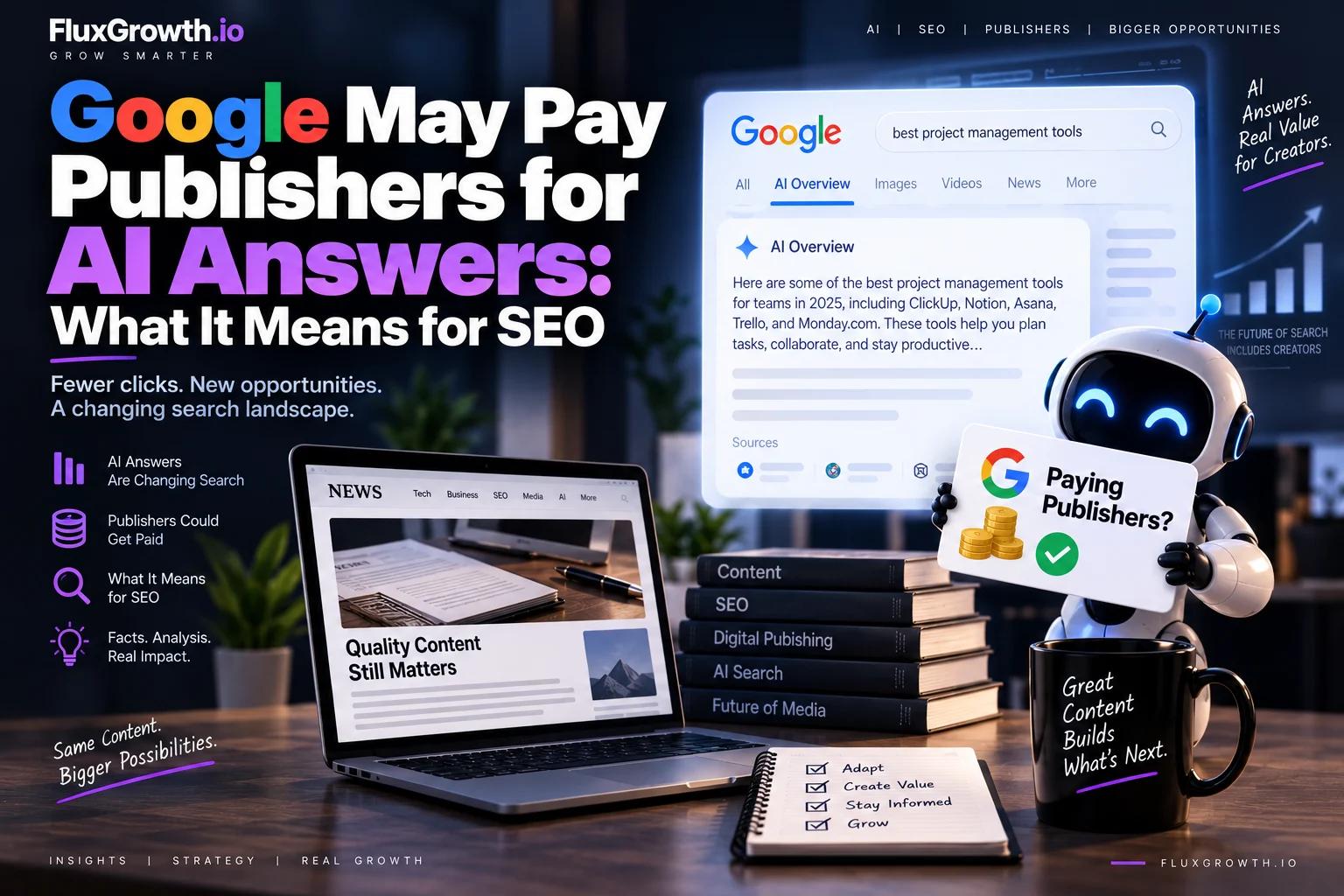
Google’s AI Contribution pilot is an early-stage test that pays participating publishers when their content contributes “significantly” to an AI-generated answer across Gemini, AI Overviews, and AI Mode. The system pays when Google determines that a publisher’s content has contributed “significantly” to an answer in Gemini, AI Overviews or AI Mode. It surfaced publicly through a Digiday report in mid-September 2026.
What Google Has Confirmed
Google confirmed the program exists and called it an early-stage learning pilot. Google confirmed the scheme is an early-stage learning pilot to test how best to reward high-quality content, on top of the traffic and tools it already provides. When Digiday asked for detail, the company pointed back to a June blog post, noting that it is testing a new model for working with websites whose content helps keep its generative AI answers fresh and accurate, by using that material to ground responses. That’s the confirmed core: the pilot is real, it’s a test, and Google frames it as a reward on top of existing traffic.
What Digiday and Trade Publications Have Reported
Digiday has learned that Google has approached at least dozens of publishers, though the pilot appeals more to small and mid-sized sites than to large ones, and now reaches far beyond news. Access is invitation-only, with no public sign-up. Treat those details as reported, not confirmed — Google hasn’t published a program page, eligibility rules, or a payment formula.
Treat those details as reported, not confirmed. Google hasn’t published a program page, eligibility rules, or a payment formula.
How the Reported Payment Model Works
The reported model ties payment to value, not to clicks or raw usage. Screenshots from Google Search Console, seen by Digiday, show an “AI contribution” panel that appears once a publisher opts into the program. Publishers see a monthly earnings figure there.
A few reported mechanics stand out:
- Compensation is based on Google’s assessment of value rather than raw usage.
- Publishers can opt out at any time, but they cannot currently see how individual articles affected their payout.
- It is usage-based, carries no upfront fee, and can be exited at any time.
This is different from a traditional licensing deal with a fixed fee. It’s closer to a per-value payout that Google calculates on its own terms.
What’s Still Unknown
The unknowns are bigger than the known. Google hasn’t disclosed the payment formula, the eligibility criteria, the total number of publishers, or how earnings compare across sites. Early payouts have been tiny next to ad revenue, and some publishers have turned it down, worried that joining would weaken their hand in pushing for bigger licensing deals. So the pilot is confirmed, but its economics are not something you can plan a budget around yet.
Worth separating from all of this: Google ran an earlier, different pilot too. In December 2025, it launched an AI pilot with major publishers, including The Guardian, The Washington Post, and the Times of India. That effort was about content access and AI features inside Google News, not the Search Console payment panel. Don’t conflate the two.
Why Would Google Pay Publishers for AI Answers?
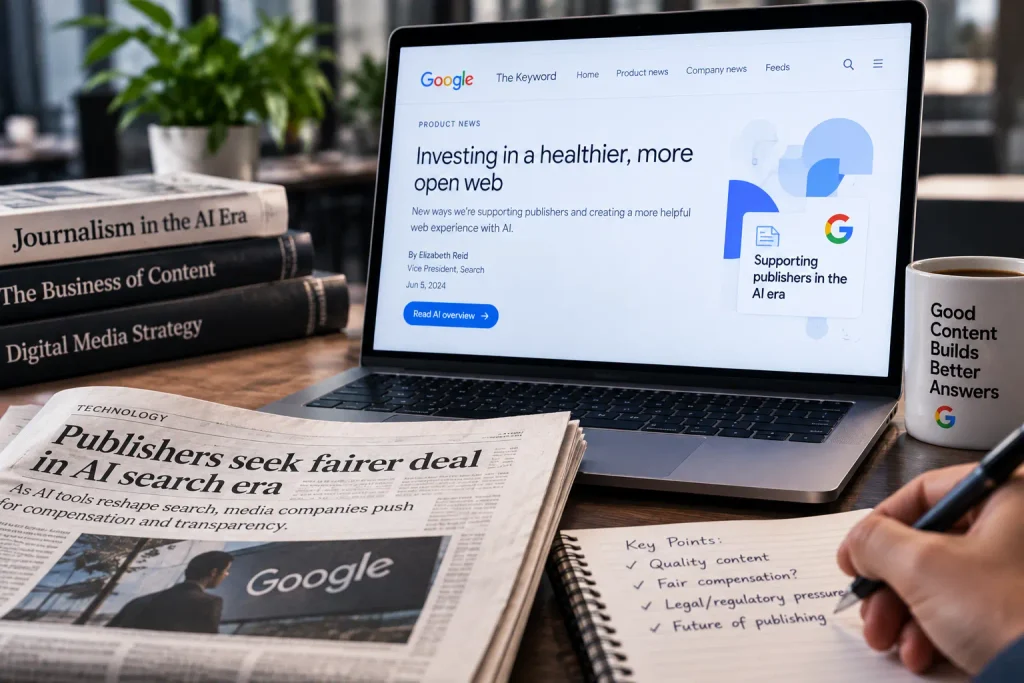
Google’s stated reason is to reward high-quality content that helps ground its AI answers. Per its own framing, the material keeps generative answers fresh and accurate. That’s Google’s explanation, and it’s the only one coming from the company directly.
External analysts read more into it. Some argue it’s an early attempt to price the content AI systems consume before a user ever clicks. Others see it as a hedge against mounting legal and regulatory pressure over how AI answers use publisher work. Those are interpretations from industry observers, not confirmed motives. When you hear a confident claim about why Google is doing this, check whether it’s Google talking or someone reading the tea leaves.
The Traffic Problem Behind the Debate
The reason any of this matters is that AI answers appear to be changing how often people click. Publishers worry that when Google answers a question on the results page, the searcher never visits the source. The research is real, and so is Google’s push-back.
What Pew Research Center Found
Pew Research Center found that Google users click less often when an AI summary appears. The Pew Research Center analysis of Google AI summaries examined browsing activity from 900 U.S. adults during March 2025. It drew on real browsing data through Knowledge Panel Digital, covering 68,879 searches.
The key findings:
- About six-in-ten respondents (58%) conducted at least one Google search in March 2025 that produced an AI-generated summary.
- Users clicked on a traditional result in just 8% of searches with an AI summary, nearly half the 15% click rate on pages without one.
- Clicking on links within the summaries was even rarer: 1% of all visits.
- Users were more likely to abandon browsing after visiting a page with a summary (26%) than without one (16%).
One limitation matters more than any single number. It is a snapshot of Google search behavior in March 2025, not a measure of every search engine, country, audience, or query type. Pew reports an association between AI summaries and lower clicks, not proof that summaries caused the drop.
What Ahrefs Reported, and Why There Are Two Numbers
Ah-refs reported a click-through decline for top-ranking pages when AI Overviews are present, and it published the finding twice with different numbers. The first study found the presence of AI Overviews reduces the click-through rate for position 1 by ~34.5%. That was based on 300,000 keywords.
Ah-refs then re-ran it with newer data. Ah-refs today published research showing Google’s AI Overviews now correlate with a 58% reduction in click-through rates for top-ranking pages, nearly doubling the 34.5% decline the company documented in April 2025. The analysis examined 300,000 keywords using aggregated Google Search Console data from December 2025, comparing them against baseline measurements from December 2023 before AI Overviews launched.
Here’s the part most headlines skip. In the same Ah-refs dataset, pages with no AI Overview also lost clicks. For informational keywords that trigger an AI Overview, position-one click-through fell from 7.3 percent to 1.6 percent. For informational keywords with no AI Overview at all, position-one click-through fell from 7.6 percent to 3.9 percent. The story is real. The cause is more complicated than “AI Overviews did it.”
Both Ah-refs studies are single-vendor, focused on informational intent, specific to Google’s AI Overviews, and measure association rather than proven causation.
Google’s Different View of Search Traffic
Google disputes the idea that its AI features are draining traffic. In an August 2025 post, Google’s head of search, Liz Reid, wrote that total organic click volume from Google Search to websites has been relatively stable year-over-year. She added that average click quality has increased and we’re actually sending slightly more quality clicks to websites than a year ago.
Google’s argument is that people now ask more questions and see more links, which creates more chances to get clicked. The company also called many third-party studies flawed. Notably, Google shared no specific traffic figures of its own to back the claim.
Why the Evidence Doesn’t Give One Clean Answer
Different studies measure different things, which is why they disagree. Pew tracked real user behavior for one month on Google in the U.S. Ah-refs modeled CTR from Search Console keyword data. Google is looking at aggregate clicks across its entire index, where gains at giant sites can mask losses at smaller ones. Each is measuring a different slice, so a single “true” number doesn’t exist. The honest read: for many informational sites, top-of-page AI answers line up with fewer clicks, but the size of the effect depends heavily on who’s counting and what they count.
Confirmed vs. Reported vs. Speculation: A Clear Breakdown
Here’s the evidence sorted into buckets so you can weigh each claim.
Confirmed (Google or primary sources): The AI Contribution pilot exists and is an early-stage test. It runs in Search Console with an opt-in earnings panel. Google says total organic clicks are “relatively stable” year-over-year. AI Mode and AI Overviews are live and expanding.
Reported (trade press, not confirmed by Google): At least dozens of publishers approached; more uptake among small and mid-sized sites; early payouts small versus ad revenue; value-based payment with no upfront fee and opt-out anytime.
Independent research: Pew (March 2025, 900 U.S. adults) on lower clicks with AI summaries; Ah-refs (34.5% then 58%) on lower position-one CTR with AI Overviews present.
Unresolved: The exact payment formula, eligibility rules, total participants, and whether payouts can ever offset traffic loss.
Speculation: That the pilot becomes a permanent, scaled revenue stream; that it replaces referral traffic; that it reshapes the publisher-Google relationship long term. None of that is established.
How AI Overviews, AI Mode, and Gemini Change Search
These three products are the reason “search visibility” no longer means just ranking. Each puts an AI-generated answer between the searcher and your website.
Google AI Overviews
AI Overviews are AI-generated summaries that appear at the top of many Google results pages, usually with a few source links. Per Pew’s study, the vast majority of these summaries (88%) cited three or more sources. Because a single overview links several sources, any one citation earns a smaller share of attention than a classic number-one ranking used to.
Google AI Mode
AI Mode is Google’s conversational, AI-first search experience, a dedicated tab that returns a synthesized answer instead of ten blue links. As of the May 2026 update, AI Mode is available in more than 200 countries and territories across 98 languages, appearing automatically as a standard tab next to All, Images, and Videos. It breaks a complex question into several sub-searches, runs them together, and stitches the results into one answer, so broad topical coverage matters more than a single keyword.
Gemini
Gemini is the AI model family that powers these experiences. Gemini 3.5 Flash powers AI Mode: now the default model globally as of May 19, 2026. For SEO, the practical point is that these systems retrieve live pages, then generate an answer grounded in them, which is why being a clear, cit-able source is the new visibility goal.
What Does This Mean for SEO?
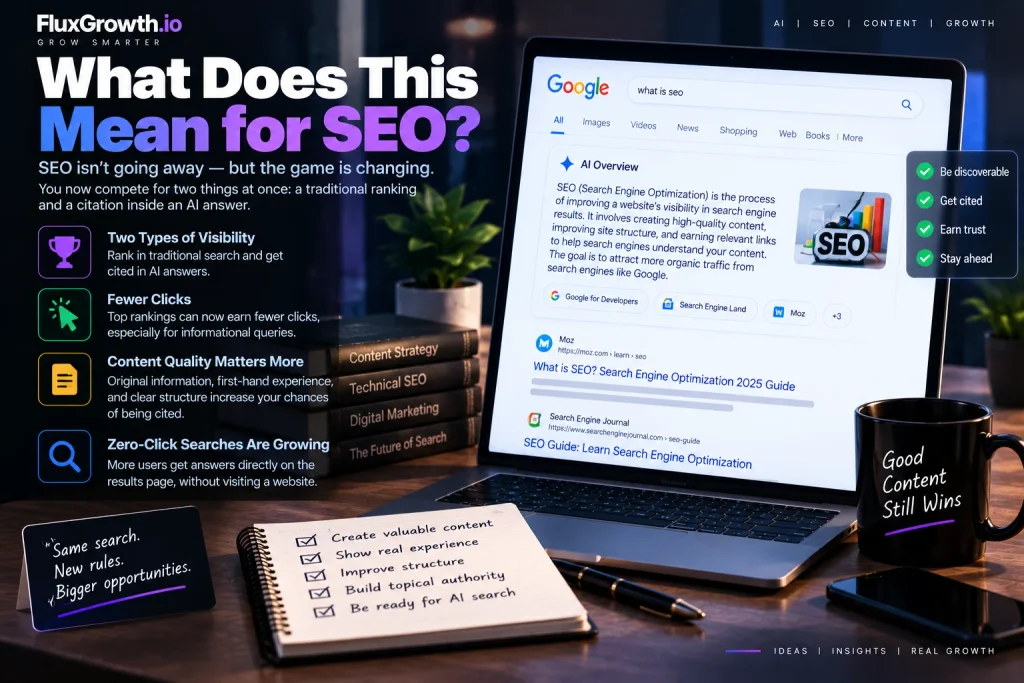
SEO isn’t going away, but the definition of “search visibility” is widening. You now compete for two things at once: a traditional ranking, and a citation inside an AI answer. Those are related but not identical, and a page can win one without the other. AI SEO tools can help publishers and SEO teams analyze these changes and adapt their workflows. Explore the best AI SEO tools in 2026
Ranking factors haven’t been publicly rewritten by Google. What’s shifting is the payoff: a top ranking can now earn fewer clicks than it did two years ago, especially for informational queries where an AI answer sits above you. That pushes more weight onto original information, first-hand experience, clear structure, and topical authority, the qualities that make a page worth citing rather than just worth ranking. Zero-click searches, where the user gets the answer without visiting any site, become a bigger part of the picture.
GEO and AEO: Should You Optimize for AI Answers?
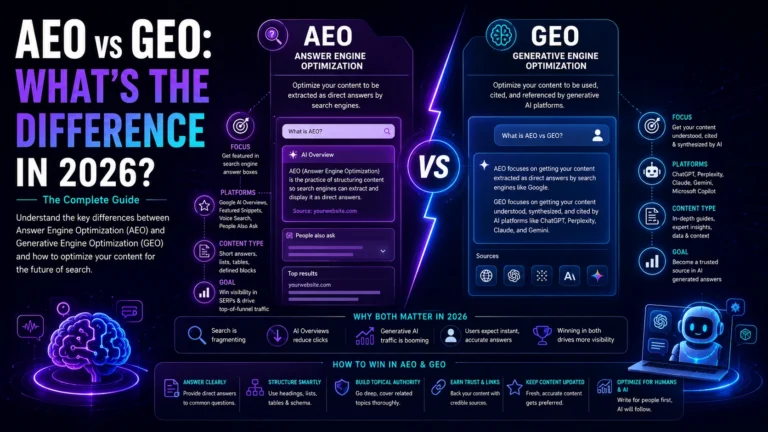
GEO and AEO both describe optimizing to be included in AI-generated answers, and both overlap heavily with good SEO. GEO (Generative Engine Optimization) aims to get your content used and cited by generative AI systems like AI Overviews, ChatGPT, and Perplexity. AEO (Answer Engine Optimization) focuses on structuring content so answer engines can extract a direct response from it.
In practice, the moves look like solid SEO with sharper structure:
- Answer the core question in the first sentence or two of a section.
- Use descriptive, question-style headings that match how people ask.
- Add original data, examples, or first-hand testing that summaries can’t get elsewhere.
- Cite reliable primary sources and make entity relationships clear.
- Keep definitions concise and self-contained.
No tactic guarantees a citation. Anyone promising one is selling something. What you can do is make your content the cleanest, most credible source on the question, which improves the odds without certainty.
What Should Publishers Do Now?
The right response is measured, not reactive. Here’s a practical order of operations.
Watch the Pilot, Don’t Forecast Revenue From It
Treat the AI Contribution pilot as an experiment to monitor, not income to project. Payouts are reportedly small and opaque, eligibility is unclear, and Google could change or end the test. Building a revenue forecast on an uncertain, invite-only pilot is the fastest way to get burned.
Measure Your Own Search Console Data
Your own data beats any headline. In Google Search Console, track impressions, clicks, CTR, and query types over time, and compare branded versus non-branded searches. If impressions hold steady while CTR falls on informational queries, that pattern is consistent with AI answers absorbing clicks. Just remember that correlation isn’t proof of cause, so look for the pattern before you conclude anything.
Reduce Dependence on One Traffic Source
If Google is your only channel, you’re exposed. Build traffic you own or control: email newsletters, direct visits, communities, social audiences, and referral partners. None of these guarantees a specific traffic number, and each takes real work, but together they make your business less fragile if organic clicks keep sliding.
Optimize to Be In the Answer, Not Just Under It
Being cited inside an AI answer is becoming its own visibility goal, separate from ranking beneath one. That means writing ex-tractable, well-sourced, genuinely useful passages that an AI system can quote with confidence. For a step-by-step approach, see our guide on how to get found in ChatGPT and Perplexity [TO CREATE].
Could Publisher Payments Replace Lost Search Traffic?
Not necessarily. Payments and traffic are different economic mechanisms, and one doesn’t automatically offset the other. A click can turn into ad impressions, affiliate sales, a lead, an email signup, or a subscriber, compounding value over time. A pilot payout is a one-time figure Google calculates on its own terms, reportedly small so far.
Citation value is real but harder to bank: it builds brand awareness and authority without a guaranteed click or sale. Until Google discloses how payments scale, treating pilot income as a replacement for traffic revenue is speculation, not planning.
What This Could Mean for Different Types of Websites
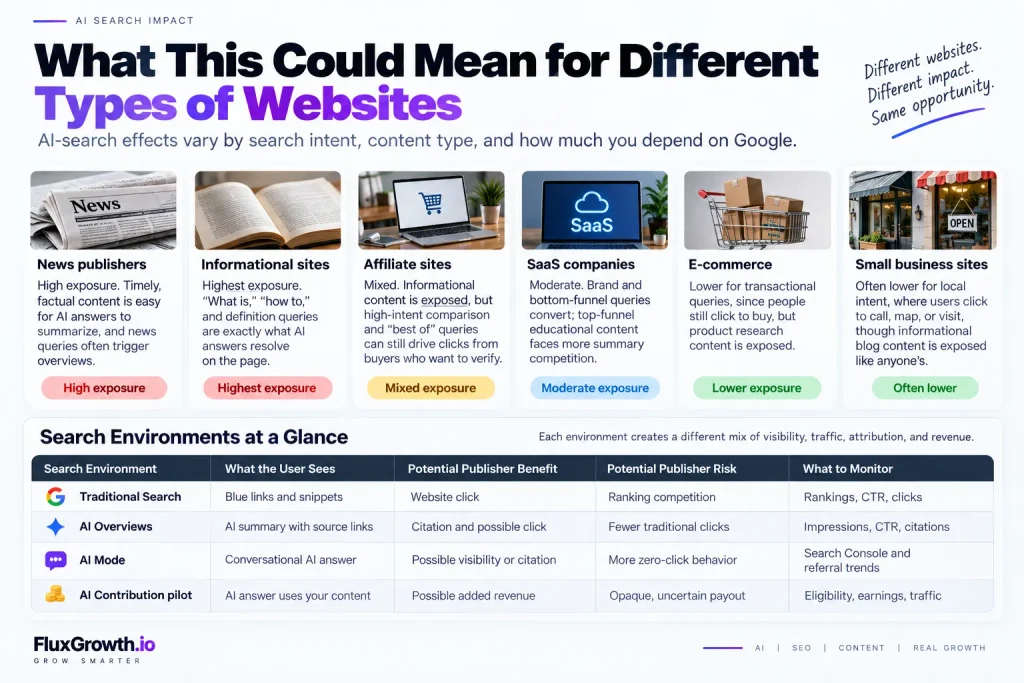
AI-search effects vary by search intent, content type, and how much you depend on Google.
- News publishers: High exposure. Timely, factual content is easy for AI answers to summarize, and news queries often trigger overviews.
- Informational sites: Highest exposure. “What is,” “how to,” and definition queries are exactly what AI answers resolve on the page.
- Affiliate sites: Mixed. Informational content is exposed, but high-intent comparison and “best of” queries can still drive clicks from buyers who want to verify.
- SaaS companies: Moderate. Brand and bottom-funnel queries convert; top-funnel educational content faces more summary competition.
- E-commerce: Lower for transactional queries, since people still click to buy, but product research content is exposed.
- Small business sites: Often lower for local intent, where users click to call, map, or visit, though informational blog content is exposed like anyone’s.
Search Environments at a Glance
| Search Environment | What the User Sees | Potential Publisher Benefit | Potential Publisher Risk | What to Monitor |
| Traditional Search | Blue links and snippets | Website click | Ranking competition | Rankings, CTR, clicks |
| AI Overviews | AI summary with source links | Citation and possible click | Fewer traditional clicks | Impressions, CTR, citations |
| AI Mode | Conversational AI answer | Possible visibility or citation | More zero-click behavior | Search Console and referral trends |
| AI Contribution pilot | AI answer uses your content | Possible added revenue | Opaque, uncertain payout | Eligibility, earnings, traffic |
There’s no universal winner here. Each environment creates a different mix of visibility, traffic, attribution, and revenue, so the right focus depends on your content type and how you make money. An informational blog should watch CTR and citations closely; an e-commerce store should care more about transactional-query behavior than overview citations.
Frequently Asked Questions
Is Google really paying publishers for AI answers?
Yes. Google confirmed to Digiday that it’s running an early-stage pilot that pays some publishers when their content contributes to AI answers. Payment runs through Google Search Console, and it’s invitation-only. The amounts and eligibility rules haven’t been publicly disclosed.
What is Google’s AI Contribution pilot?
It’s a test program that pays participating publishers when Google decides their content significantly shaped an answer in Gemini, AI Overviews, or AI Mode. Publishers see a monthly earnings figure in Search Console and can opt out anytime. Reporting indicates payment is based on Google’s assessment of value, not raw usage.
Will Google AI Overviews reduce website traffic?
The research points that way for many informational sites, though it’s not universal. Pew Research Center found users clicked a traditional result 8% of the time when an AI summary appeared, versus 15% without one, in March 2025. Google disputes claims of broad traffic decline, saying total organic clicks are relatively stable year-over-year.
How do publishers get cited in Google AI answers?
There’s no guaranteed method, but clear, well-structured, original content improves your odds. Answer questions directly near the top of a section, use descriptive headings, cite credible sources, and add information an AI can’t find elsewhere. Google’s systems retrieve and ground answers in live pages, so being a clean, cit-able source is the goal.
Does SEO still matter with Google AI Overviews?
Yes, SEO still matters, but the goal is expanding. You’re now optimizing for both a traditional ranking and a citation inside AI answers. Original content, first-hand experience, and strong structure matter more than ever, since those qualities make a page worth citing, not just ranking.
What’s the difference between GEO and AEO?
GEO (Generative Engine Optimization) focuses on getting your content cited by generative AI systems like AI Overviews and ChatGPT. AEO (Answer Engine Optimization) focuses on structuring content so answer engines can pull a direct answer from it. Both overlap heavily with good SEO, and in practice you work on them together.
Should publishers change their SEO strategy because of AI search?
Adjust it, don’t overhaul it overnight. Keep doing strong SEO, then add structure that makes your content easy to cite, and start measuring citations and zero-click behavior alongside rankings. Reducing dependence on any single traffic source is the safest strategic move while the AI-search picture keeps shifting.
The Takeaway
Google paying publishers for AI answers is confirmed as a pilot, but almost everything about its economics remains unproven. Keep the buckets straight: the program is real, the payment details are reported, and any claim that it will replace lost traffic is speculation. Meanwhile, the research on AI Overviews and clicks is genuine but contested, and Google reads its own data differently than outside studies do.
The one thing you control is measurement. Open Google Search Console this week and log your impressions, clicks, and CTR by query type as a baseline, then watch how those move over the next few months. AI citations are becoming a visibility goal worth tracking, but no single tactic solves this. Build content worth citing, measure your own numbers, and don’t bet your business on a pilot that’s still finding its shape.