FluxGrowth is reader-supported. Some links in our guides are affiliate links — if you buy through one we may earn a commission, at no extra cost to you. It never changes which tools we recommend. How we test tools.
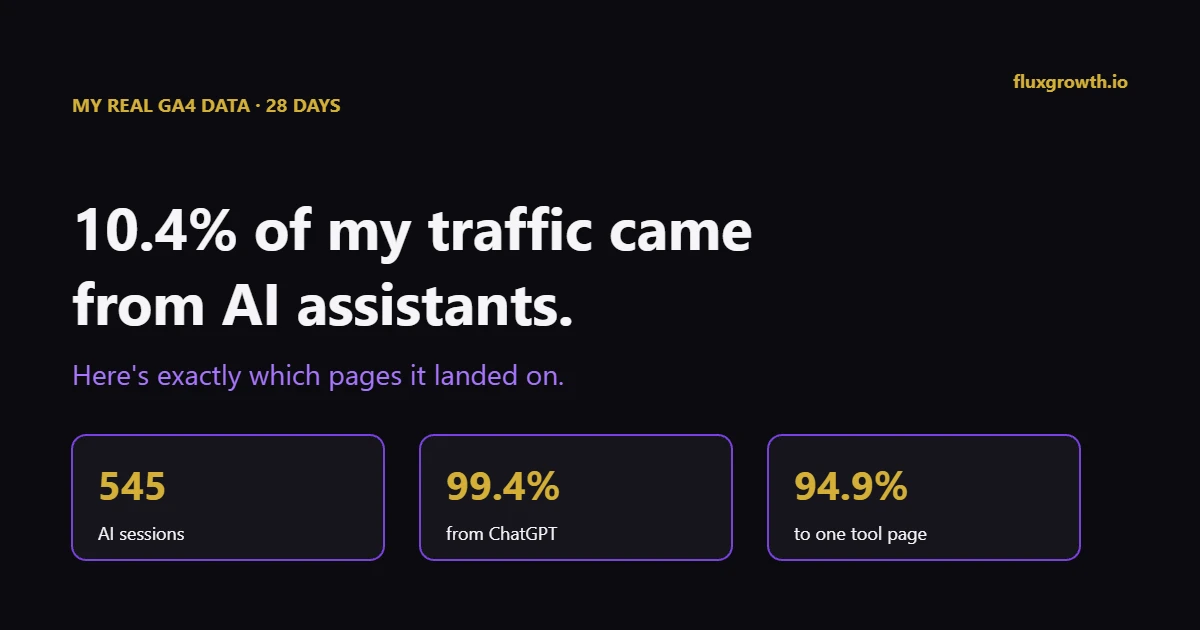
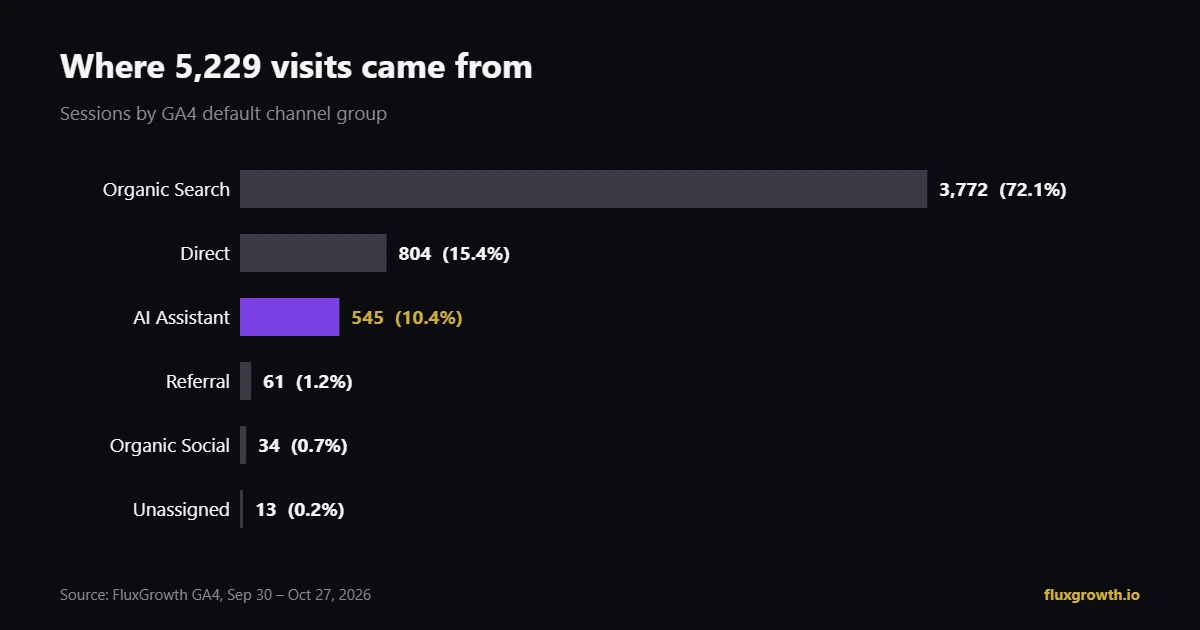
Over the 28 days ending October 27, 2026, 10% of FluxGrowth’s visits were AI referral traffic, meaning people clicked through from ChatGPT and other AI assistants. That’s straight from my GA4 data. For context, Ahrefs put the average at 0.43% of traffic across 115,254 websites in September 2026.
That’s more than 20 times the benchmark. I didn’t expect it, and I wanted to know why. So I opened GA4 and went through it page by page. Which pages are ChatGPT, Perplexity and the others actually sending people to? What do those pages have in common? And is any of it useful if you run a site of your own?
Short version: almost all of it came from ChatGPT, and almost all of it went to one free tool. Here’s the full breakdown, plus what I’d do first if I were starting a site from zero.
This post is part of our GEO & AI Search guides, where I share what’s actually working for getting found in AI answers.
How much traffic do AI assistants really send to websites?
Not much, at least on average. Ahrefs found AI referral traffic made up 0.43% of traffic across 115,254 websites in September 2026. SE Ranking, using a different set of 101,574 sites, saw ChatGPT’s share of referral traffic go from 0.23% in April 2026 to 0.32% in May 2026. And it varies a lot by site and industry.
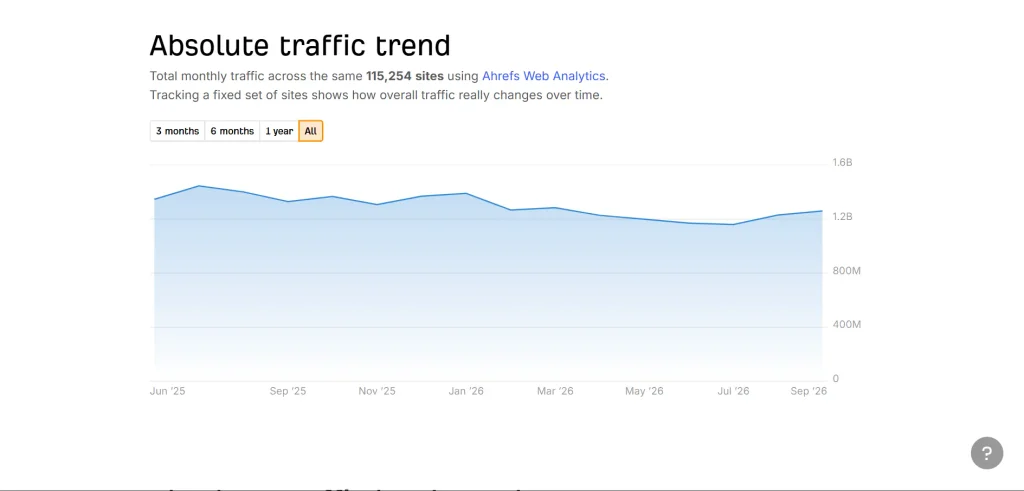
Small numbers, sure. But they’re growing, and they aren’t spread evenly. Some sites get almost no AI referral traffic. Others get a real chunk. A benchmark can’t tell you which camp you’re in. Your own analytics can, once you look at which assistants send you visitors and which pages those visitors land on.
Sources: Ahrefs AI vs. Search Traffic Analysis | SE Ranking’s ChatGPT referral traffic study
Which AI assistant sends the most traffic?
ChatGPT, by a long way. In SE Ranking’s 2026 study of 101,574 websites, ChatGPT sent 74.78% of all AI referrals. Gemini came next at 11.56%, then Perplexity (7.23%), Microsoft Copilot (3.51%) and Claude (2.62%). One thing to keep in mind: those are shares of AI referrals, not shares of total website traffic. Source: SE Ranking’s AI traffic research.
Still, I wouldn’t watch ChatGPT alone. Ahrefs found that from August to September 2026, Gemini referrals grew 40.4% while ChatGPT grew 14.1%, and Claude referrals actually fell 17.2%. Those are month-over-month changes, so they don’t mean Gemini is catching ChatGPT on volume. It’s growing faster from a much smaller base. Source: Ahrefs AI vs. Search Traffic Analysis.
Why do AI traffic studies disagree so much?
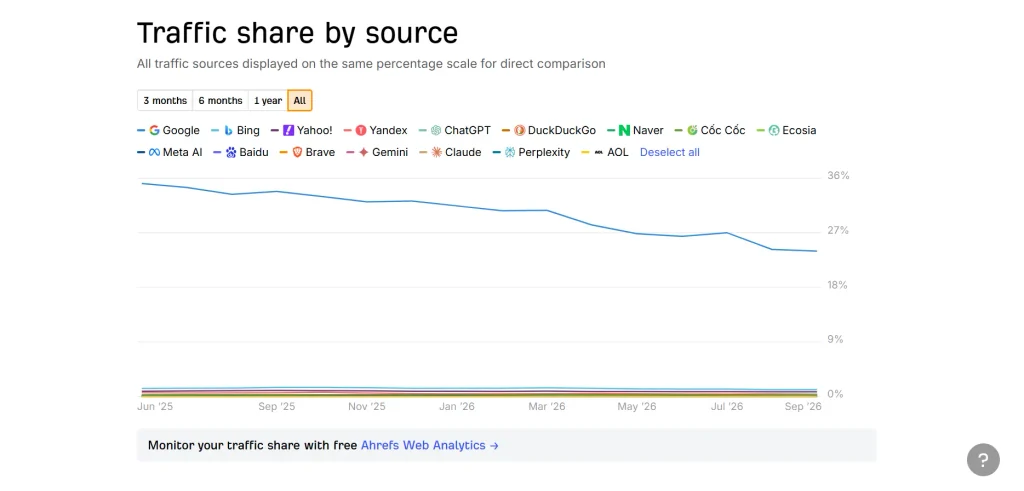
Because they’re counting different websites. Presenc lined up three big studies and found ChatGPT’s share of AI referrals ranged anywhere from 63% to 92%, depending on who did the counting. A panel full of SaaS sites is never going to look like one full of news sites.
That’s why I quit treating benchmarks as targets. Your number comes down to your niche, your pages and how much total traffic you get.
Why does my number look so much higher than average?
Because of one page and one week. 545 of my 5,229 sessions came through GA4’s AI Assistant channel. 542 of those came from chatgpt.com, and 517 landed on a single free tool: my Instagram Reels viewer. FluxGrowth is also still a small site, so a few hundred visits moves the percentage a lot. On a site with a million monthly visits, 545 AI sessions would be a rounding error.
How do you track AI referral traffic in GA4?
GA4 now sorts most AI referral traffic on its own. On May 13, 2026, Google added an AI Assistant channel to GA4’s Default Channel Group. If a visit’s referrer matches a known assistant like ChatGPT, Gemini or Claude, GA4 sets the medium to “ai-assistant” and puts the session in that channel.
That part’s easy. The problem is what the channel doesn’t catch.
What does GA4’s AI Assistant channel miss?
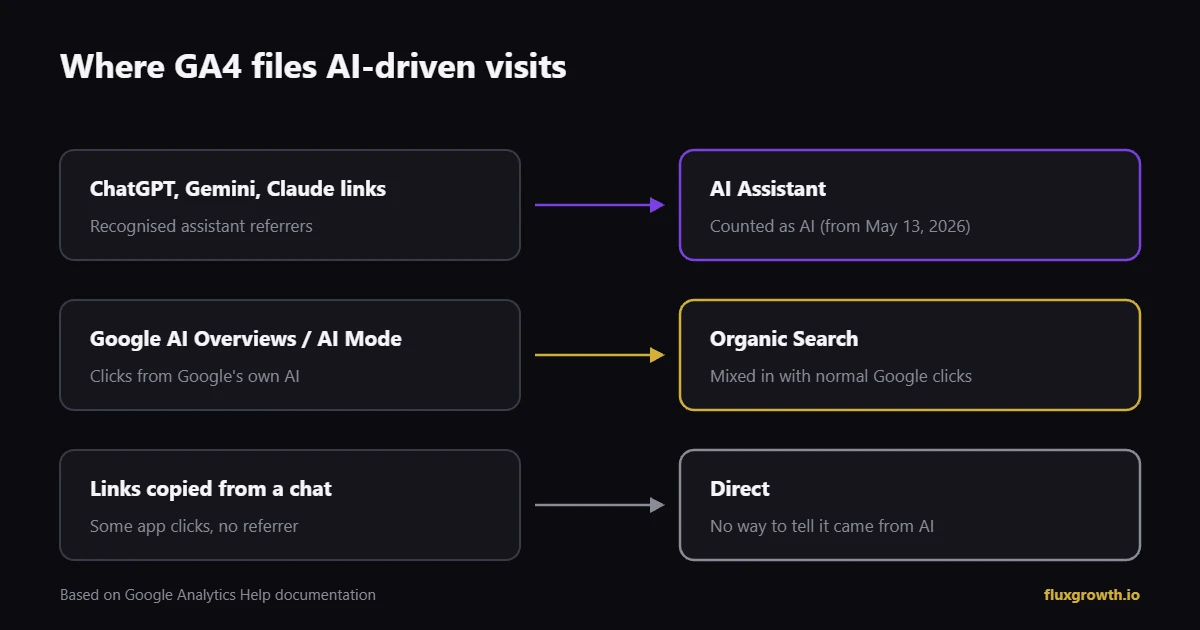
Three kinds of AI visits slip through:
- Older data. The channel doesn’t work backwards. Anything recorded before the rollout keeps its old Referral label.
- Google’s own AI. Clicks from AI Overviews and AI Mode count as Organic Search, not AI Assistants. Google says so in its Analytics Help docs.
- Visits with no referrer. If there’s no recognizable referrer, the session lands in Direct. That covers some app clicks and links people copy straight out of a chat.
So think of the AI Assistant number as your floor, not the full picture.
How I set up a custom AI channel that works on old data
A custom channel group solves the history problem. Google’s docs say custom channel groups apply to your reports retroactively, so your old data gets sorted too. Here’s how I set it up:
- In GA4, go to Admin, then Data display, then Channel groups.
- Click “Create new channel group.” GA4 gives you a copy of the default group to start from.
- Add a new channel and call it “AI Search.”
- Set the condition to Source matches regex, then paste in this:
chatgpt\.com|chat\.openai\.com|perplexity\.ai|gemini\.google\.com|claude\.ai|copilot\.microsoft\.com|deepseek\.com|meta\.ai|grok\.com
- Drag “AI Search” above the Referral channel. GA4 reads channels from top to bottom, so if Referral sits higher, it grabs these visits first.
- Save. Then go to Reports, then Acquisition, then Traffic acquisition, and switch the primary dimension to your new group.
On FluxGrowth, every number in this post comes from GA4’s native AI Assistant channel. The custom group is still worth setting up if you want to see AI visits from before May 2026.
Which pages on FluxGrowth get the most AI traffic?
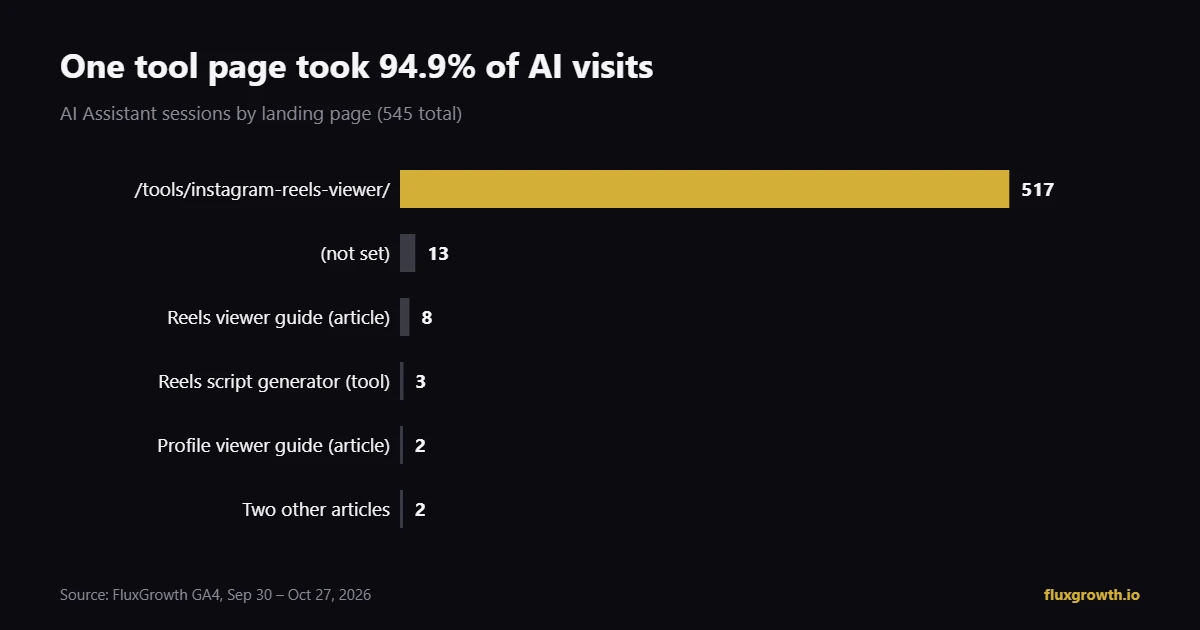
My top landing page for AI referral traffic is /tools/instagram-reels-viewer/, a free tool page. It took 517 of 545 AI sessions (94.9%), and 516 of those came from ChatGPT. Every other page on the site got 8 AI visits or fewer.
Here’s the full list for September 30 to October 27, 2026:
| Page | Page type | AI sessions | AI share of that page’s traffic | Main AI source |
|---|---|---|---|---|
| /tools/instagram-reels-viewer/ | Tool | 517 | 11.8% | ChatGPT |
| (not set) | Unknown | 13 | n/a | ChatGPT |
| /instagram-reels-viewer-how-to-watch-reels-online-in-2026/ | Guide | 8 | 13.8% | ChatGPT |
| /tools/instagram-reels-script-generator/ | Tool | 3 | 10.3% | ChatGPT |
| /instagram-profile-viewer-what-actually-works-2026/ | Guide | 2 | 40% (of 5 visits) | ChatGPT |
| /gemini-4-argon-for-developers-whats-verified-and-what-it-costs/ | Article | 1 | 8.3% | Gemini |
| /top-ai-tools-for-image-creation-in-2026/ | Listicle | 1 | 100% (1 visit) | Perplexity |
Want to build this table yourself? In GA4, go to Explore and start a free-form exploration. Add “Landing page + query string” as rows, filter “Session source” with the same regex, and sort by sessions.
What do the top AI landing pages have in common?
With one page taking 95% of the visits, there isn’t really a pattern across pages. There’s one winner and some noise. So I ran my checklist against the winner instead:
- Is it a tool or an article? A tool. That’s the big one.
- Does it do one specific job? Yes. You paste a public Reel link and watch it. Nothing else.
- Does it get to the point fast? The tool sits near the top of the page, so there’s no long intro to scroll past.
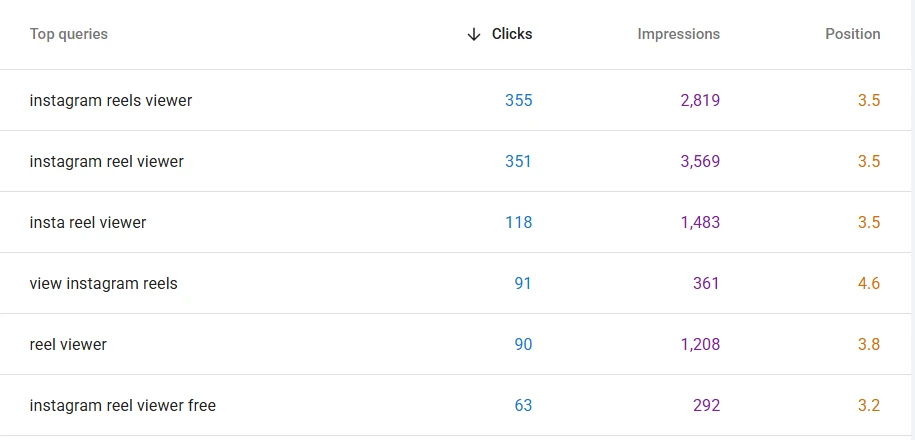
- Does it already rank on Google? Yes. In Search Console it sat around position 3.5 for “instagram reels viewer” over the same 28 days. My guess is ChatGPT’s web search found it the same way Google did.
- Is it the only page for that job? Yes, since October 2. Before that, my older Reels article also embedded the viewer, and the two URLs split the signal.
Two weeks after that cleanup, ChatGPT started sending people to it. I can’t prove one caused the other. But that’s the timeline.
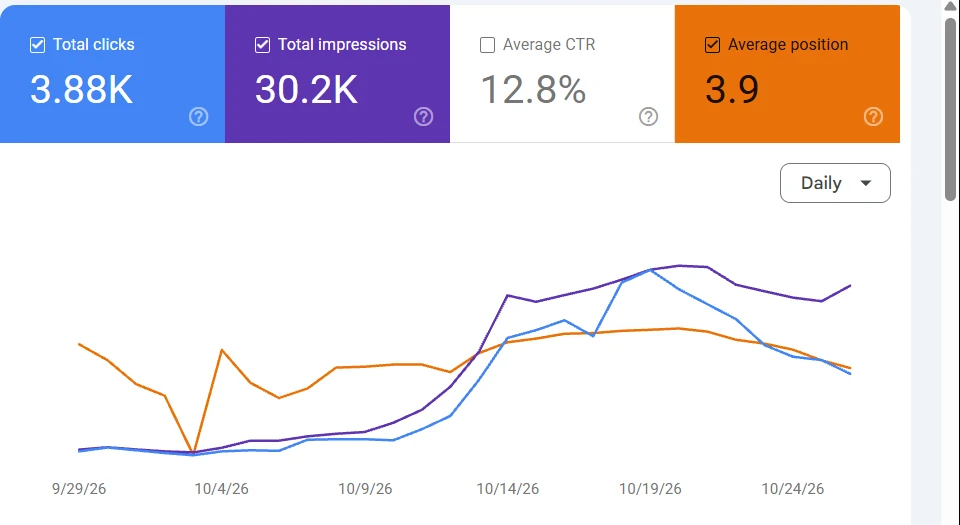
Search Console tells the same story from Google’s side. Over the last 28 days, the Reels viewer page got 3,880 clicks from 30,200 impressions, at an average position of 3.9. That one URL took about 98% of all my Google clicks.
And these are the searches bringing people in. Every top query is some version of “reel viewer,” and the page sits around position 3.5 for the two biggest ones:
Do AI assistants send traffic to tools or to articles?
Depends whose study you read. On neilpatel.com, tool pages pulled in 96.9% of ChatGPT referrals. Blog pages got 2.1% and the homepage 1.1%. Previsible’s earlier study found almost the opposite: blog posts took 77.35% of LLM referral traffic, and product pages got less than 0.5%.
Both can be right. Neil Patel’s site is built around free SEO tools people search for by name. Previsible’s panel covered finance, ecommerce, events and a bunch of other industries. Different sites, different winners.
FluxGrowth has both: free tools like the Instagram Reels viewer, caption generator and font generator, plus long-form guides. Here’s where my AI referral traffic actually went. Tool pages took 520 of 545 AI sessions (95.4%). Articles got 12 (2.2%). The other 13 had no landing page recorded.
Why tools earn the click
My theory goes like this. Ask ChatGPT a question and it usually answers you right there in the chat. You got what you came for. Why click?
A tool is different. ChatGPT can’t format your Instagram caption with a 125-character preview inside its answer. You have to go do that somewhere else. So the assistant links out, and this time people actually follow the link.
My data backs this up, at least for now. 95% tools, 2% articles. Not close.
Why articles still matter
Articles do work that doesn’t always show up as a click. An assistant might cite your guide or mention your brand, and the reader shows up later through Google or by typing in your URL. GA4 won’t connect those dots for you.
Articles also feed the tools. Every tool page on FluxGrowth gets links from related guides, and those guides are often what an assistant finds first.
Do AI visitors behave differently from Google visitors?
AI visitors were slightly less engaged than Google visitors, but not by much. Their engagement rate was 51.7% versus 58.2% for Organic Search, and they spent about 13.5 seconds engaged per session versus 16.0. Pages per session were basically identical.
| Metric | AI Assistant visitors | Organic Search visitors |
|---|---|---|
| Sessions | 545 | 3,772 |
| Engagement rate | 51.7% | 58.2% |
| Average engagement time per session | 13.5 seconds | 16.0 seconds |
| Pages per session | 1.41 | 1.43 |
| Key events | Not tracked | Not tracked |
One warning about this table: 545 visits is a small sample, and most of it came in one week. A single busy day from one ChatGPT answer can swing these numbers hard, so I treat them as a signal, not a verdict.
What made those pages get picked up by AI assistants?
I can’t prove any one change caused the AI traffic. What I can do is show you what changed on FluxGrowth over the same period and let you judge the timing for yourself.
What changed on the site
- Free tool pages. In September 2026 I started building client-side tools, beginning with the Instagram Reels script generator and the caption generator. They all live under one Free Tools page.
- Rewritten excerpts. In September 2026 I wrote manual excerpts for all 102 published posts and pages. Before that, every excerpt was just the first paragraph chopped off with “Read more.” Those excerpts feed the site’s llms.txt file, the archive pages and the RSS feed.
- A clearer site description. I swapped the tagline “The Future of Growth” for a plain description of what the site actually covers. That same line feeds the homepage, the site schema and the llms.txt header.
- FAQ answers under real H3 headings, instead of bold text, so each question can stand on its own.
- One URL for the Reels viewer. On October 2, I stopped embedding the viewer in my older Reels article and made /tools/instagram-reels-viewer/ the only page for that job.
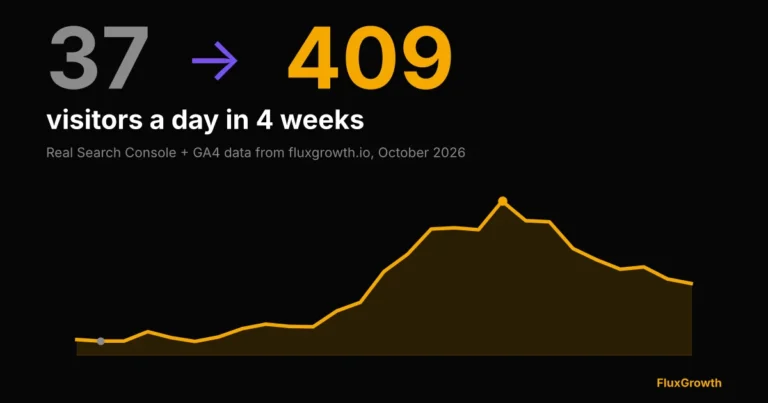
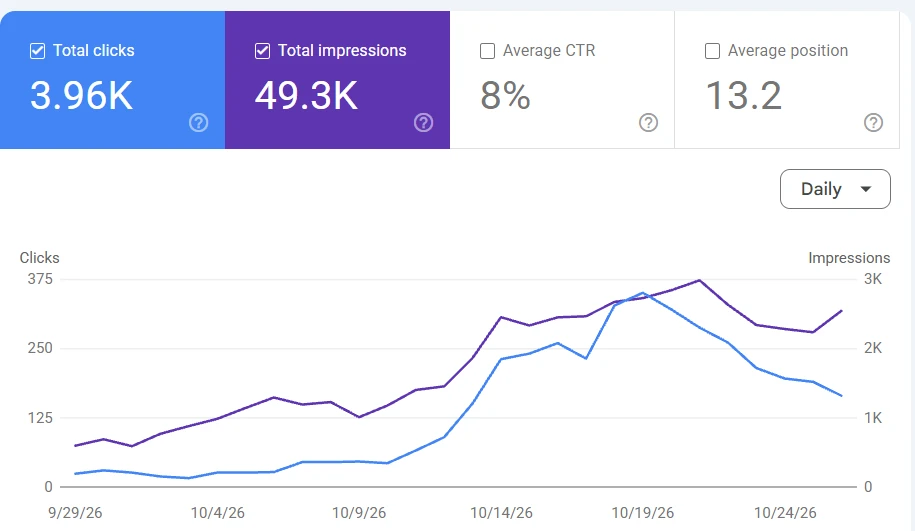
Do the dates line up? Roughly. The tools went live in September, and the Reels viewer became the only page for that job on October 2. Google traffic to it started climbing around October 12. AI traffic showed up on October 16. That’s a correlation, not proof.
What I’d be careful about
AI referral traffic swings hard. In 2025, ChatGPT’s referral traffic to websites fell 52% in about a month, according to data reported by MarTech. One model update can do that.
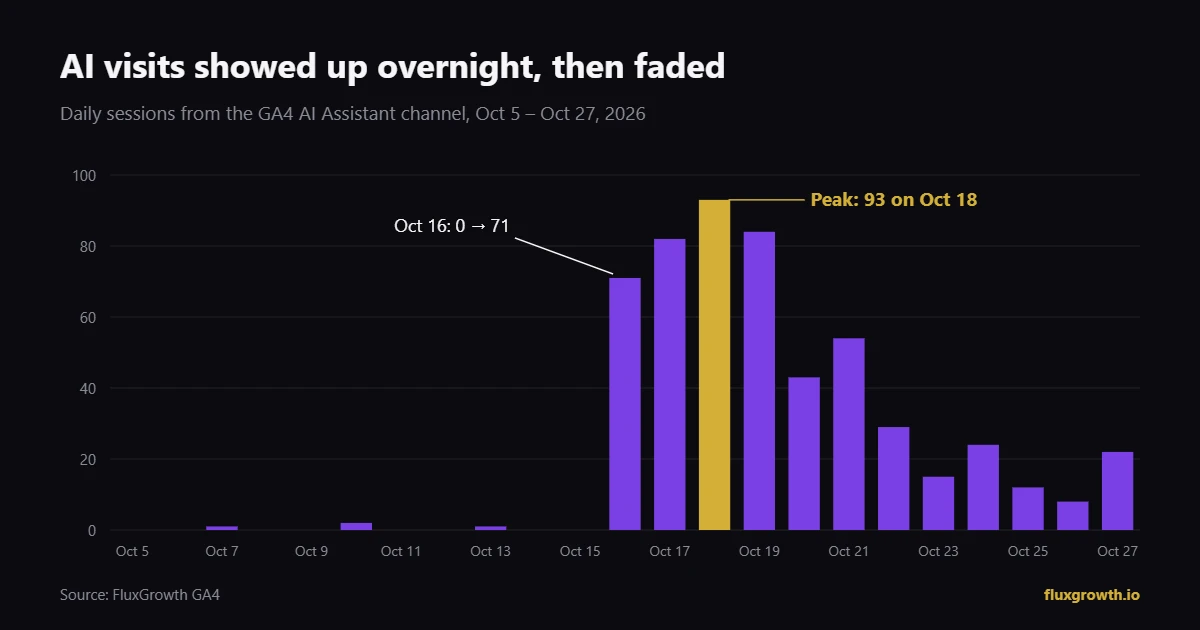
My own data shows the same thing in miniature. AI visits went from zero to 71 on October 16, peaked at 93 on October 18, and were down to 8 by October 26. So I’m not planning around this channel yet. I check it monthly and build pages that would still hold up if it disappeared.
What I’d do if I were starting a site today
If I were starting from scratch, I’d set up AI tracking on day one and build one really useful free tool before writing ten more articles. Here’s the order I’d go in:
- Set up the custom AI channel group first. It takes ten minutes, and every month you skip it is a month of data you’ll wish you had.
- Build one free tool that answers a question people ask AI. Pick a task, not a topic. “Format my caption” beats “what is a good caption.”
- Open every article with a 40–60 word answer. Write it so it still makes sense if someone copied only that paragraph.
- Put FAQ answers under real H3 headings. One question per heading, with a two- or three-sentence answer underneath.
- Check your AI landing pages every month, not just the total. The percentage is a vanity number. The page list tells you what to build next.
- Don’t block AI crawlers. Look at your robots.txt and make sure GPTBot, PerplexityBot, ClaudeBot and Google-Extended aren’t disallowed. If they’re blocked, those assistants can’t cite you at all.
If I started FluxGrowth again, I’d ship the tool pages before the listicles. In these 28 days, one tool page brought in more visits than the rest of the site combined.
FAQ
What counts as AI referral traffic?
Any visit that comes from a link inside an AI assistant like ChatGPT, Gemini, Claude, Perplexity or Copilot. In GA4 you’ll find it under the AI Assistant channel, or as a referral from domains like chatgpt.com or perplexity.ai.
Does GA4 track ChatGPT traffic automatically?
Yes, since May 13, 2026. GA4’s Default Channel Group now has an AI Assistant channel that picks up known assistants like ChatGPT, Gemini and Claude. It doesn’t cover older data, though, so set up a custom channel group if you need history.
Why doesn’t Google AI Overviews traffic show up as AI traffic?
GA4 counts clicks from AI Overviews and AI Mode as Organic Search, and there’s no way to split them out inside GA4. Search Console gets you closer, since AI Overview appearances show up there as regular search impressions.
Which AI assistant sends the most website traffic?
ChatGPT, and it isn’t close. In SE Ranking’s 2026 data it sent 74.78% of AI referrals, with Gemini at 11.56% and Perplexity at 7.23%. On FluxGrowth it was even more lopsided: 542 of 545 AI sessions came from ChatGPT.
Is 10% AI traffic normal?
Not really. Big studies put the average well under 1% of total visits. A share near 10% usually points to a small site, an AI-heavy niche, or pages built to get clicked from an AI answer.
The takeaway
Stop asking how much traffic AI sends you. Ask which pages it sends people to. That list is your next content plan.