Pew Research asked teens and their parents the same question about TikTok: are you spending too much time on this app? Just 28% of teens said yes. But 44% of their parents said yes about their kid, a 16-point gap, according to Pew’s 2026 survey of teens and parents.
That gap is the whole story here. The best social media apps for teens in 2026 changed dramatically this year with new age limits, new default settings, new state laws but the disconnect between how teens see their own habits and how parents see them hasn’t closed one bit.
This guide breaks down the eight platforms that actually matter to teens right now: TikTok, Instagram, Snapchat, YouTube, Discord, Be Real, Pinterest, and Reddit. You’ll get what changed in each app’s safety settings this year, the real numbers behind teen usage, and a straight answer on screen time. (The old “two hours a day” rule is gone, by the way.) Parents get specific settings to change tonight, not vague advice to “monitor more.” Teens get an honest look at what each app actually does with their time and their data.
Why Social Media Matters to Teens
It’s tempting to treat teen social media use as a problem to manage. For most teens, though, it’s just where their social life happens.
Communication and friendships
Texting and DMs replaced phone calls a decade ago. Now Snapchat streaks, group chats, and shared reels do a lot of the heavy lifting for staying close to friends, especially friends who moved, switched schools, or just keep different hours.
Entertainment and creativity
TikTok and YouTube aren’t just something teens watch. Plenty are also behind the camera, not just in front of it editing, scripting, and posting their own videos before they’re old enough to drive.
Learning and communities
Niche communities on Discord and Reddit let a teen who’s into competitive chess, a specific video game, or 3D printing find people who actually share that interest, which their school hallway often can’t offer.
Personal branding and future careers
Teens are watching creators build real careers from a phone camera, and a growing share want in, drawn by the same creator economy that’s creating new opportunities for creators of all ages. More on that later.
The Best Social Media Apps for Teens in 2026 (Platform by Platform)
For each app: minimum age, what it’s actually for, the upside, the downside, and what changed in 2026.
1.TikTok
Minimum age: 13, with a separate and more restricted Under 13 Experience in the United States for younger children.
TikTok is built around its algorithm-driven For You feed, a personalized stream of short videos. The platform also includes monetization features such as the Creator Rewards Program and TikTok Shop. Most monetization features, including TikTok Shop creator and seller access, are restricted to users who are at least 18 years old and may require additional eligibility checks and age verification.
Pros: low barrier to creating content, fast discovery, strong community-building around niches.
Cons: the algorithm is engineered to keep you scrolling, full stop, and that pull is harder for a developing brain to resist than adults sometimes give it credit for.
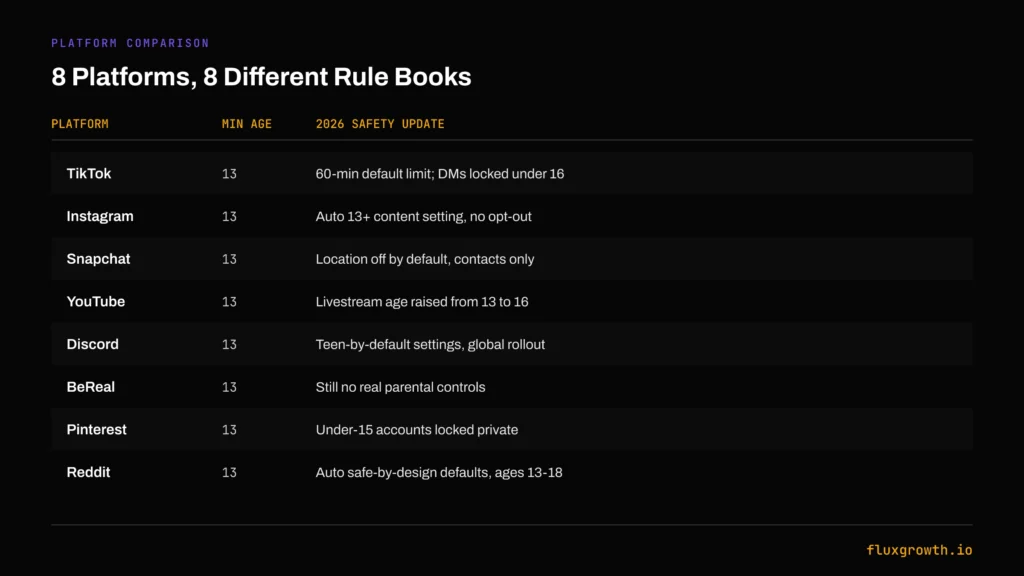
2026 safety update: according to TikTok’s own Guardian’s Guide, teen accounts now default to a 60-minute daily screen time limit, push notifications turn off at 9pm for 13-to-15-year-olds and 10pm for 16-and-17-year-olds, and accounts are private by default. Direct messaging requires being at least 16, and TikTok says it now applies more than 50 preset safety settings to teen accounts automatically.
2.Instagram
Minimum age: 13, automatically routed into Teen Accounts.
Instagram still runs on Reels, Stories, and DMs, but the content a teen actually sees changed substantially this year.
Parents who are not on Instagram can still check a public Reel their teen shared: paste the link into our free Instagram Reels Viewer, no account or app required.
Pros: strong for visual creativity and building an audience around a hobby, sport, or art style.
Cons: the comparison-and-appearance pressure on Instagram is well documented and hasn’t gone away just because the platform added guardrails.
2026 safety update: per Meta’s own announcement, teens under 18 are now automatically placed into an updated 13+ content setting modeled on movie ratings, and they can’t opt out without a parent’s permission. Instagram also now notifies supervising parents if a teen repeatedly searches terms related to suicide or self-harm.
3.Snapchat
Minimum age: 13 per the platform’s own terms, though Common Sense Media recommends waiting until 16 because of the disappearing-content model.
Snapchat’s whole identity is built around Snaps that vanish, Stories, the Snap Map, and a built-in AI chatbot called My AI.
Pros: feels lower-pressure than Instagram for a lot of teens, since there’s no permanent feed to curate.
Cons: disappearing messages cut both ways. They reduce the digital paper trail, but they also make it harder for a parent (or a teen) to document something that went wrong.
2026 safety update: according to Snapchat’s Family Center support pages, location-sharing on Snap Map is off by default, and contact is limited to friends and phone contacts only, with no way to expand that. My AI can be removed from the visible chat list, though it can’t be fully deleted from the account unless the family has Snapchat+.
4.YouTube
Minimum age: 13 for an independent account; YouTube Kids and supervised kid accounts exist for younger children.
YouTube remains the platform nearly every teen uses, whether they think of it as “social media” or not.
Pros: the widest range of educational content of any platform on this list, plus a real path into the creator economy.
Cons: algorithmic rabbit holes are real, and so are risky-challenge and unboxing-style consumerism videos that show up uninvited.
2026 safety update: YouTube raised the minimum age to livestream unaccompanied from 13 to 16; younger teens can still go live, but only with a visibly engaged adult co-streaming, per YouTube’s policy update. Take a Break and Bedtime reminders are now turned on by default for teen accounts, based on an age-estimation model YouTube uses to apply protections.
5.Discord
Minimum age: 13, though the App Store rates the app 17+, and the platform’s own culture still skews adult.
Discord is built out of servers, join one for your favorite game, and you’ve basically joined a clubhouse with its own voice channels, text chat, and inside jokes.
Pros: nothing else on this list builds a tight-knit niche community quite like Discord does, especially for gamers and creators.
Cons: moderation quality varies wildly from server to server. Some are tightly run. Others aren’t running at all. Drop a 13-year-old into a server built for adults, and they’re going to see adult-flavored content and conversation, no matter how good the platform-wide defaults are.
2026 safety update this is the one most teen-safety guides haven’t caught up to yet. Beginning in March 2026, Discord rolled out “teen-by-default” settings globally: content filters that blur sensitive images, age-gated channels, a separate inbox for messages from people a user doesn’t know, and friend-request warnings, all on by default until a user verifies they’re an adult.
6.BeReal
Minimum age: 13.
Be Real sends one randomly timed notification each day, and users have two minutes to post an unfiltered photo of whatever they’re doing at that moment. The platform is designed to encourage more authentic sharing and reduce the pressure to create highly curated content.
Pros: no filters, no follower count, less algorithmic pressure than almost anything else on this list.
Cons: the photo auto-attaches location unless a teen remembers to turn that off, and the public Discover feed exposes posts to strangers.
2026 safety note: BeReal still has no real parental controls beyond reporting and a three-strike removal policy for repeated violations.
7.Pinterest
Minimum age: 13, higher in some EU countries under GDPR’s age-of-consent rules.
Pinterest works more like a visual search engine than a social network. A teen builds a board around room decor, a workout split, or college outfit ideas, and the app just keeps feeding them more of whatever they clicked on first.
Pros: less social-comparison pressure than Instagram or Snapchat, and Pinterest actually has anti-body-shaming policies built into its guidelines, not just stated as a value.
Cons: the recommendation algorithm can still drift a teen toward repetitive content around dieting, beauty standards, or aesthetic perfectionism if they show early interest.
2026 safety update: per Pinterest’s own newsroom announcement, accounts for teens 13 to 15 are locked private with no option to go public, and younger teens can only message mutual followers who’ve connected through a time-limited profile link.
7.Reddit
Minimum age: 13 globally, 16 in Australia under local law, with no real age verification at signup.
Reddit lives in subreddits, tens of thousands of them, covering everything from competitive Magic: The Gathering to a single NBA team’s fanbase.
Pros: hard to beat for finding people who share a specific niche interest there’s a working, active community for almost anything. A lot of those subreddits are well-moderated, too.
Cons: content moderation differs by community, NSFW material is reachable, and strangers can message any user directly.
2026 safety update: according to Reddit’s own help documentation, users aged 13 to 18 now get protective, safe-by-design default settings automatically, and 18+ content requires age verification before it’s accessible.
Teen Social Media Statistics in 2026
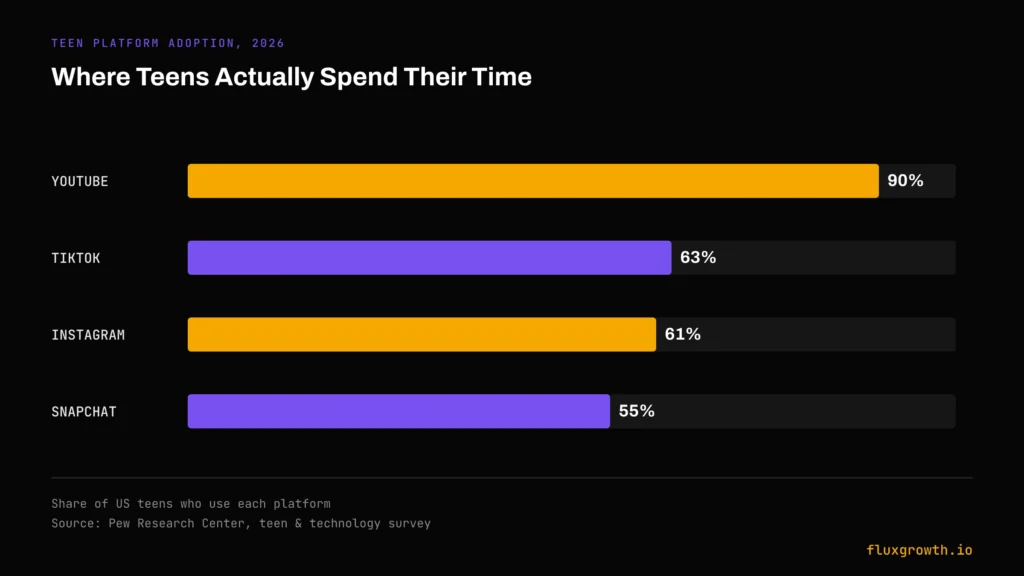
The numbers behind teen platform use shifted in a few directions worth knowing, based on Pew Research Center’s most recent teen-and-technology surveys.
Platform adoption: nearly nine in ten teens use YouTube, while majorities also use TikTok (63%), Instagram (61%), and Snapchat (55%). About one in five teens say they’re on TikTok and YouTube almost constantly, and 64% now use AI chatbots, with roughly three in ten doing so daily.
Usage by gender: Pew’s research shows teen girls lean more heavily into TikTok and Instagram, while teen boys dominate on YouTube, Reddit, and Twitch, a split with direct implications for which platforms show up most in mental-health research.
Sentiment is sliding: 48% of U.S. teens now say social media has a mostly negative effect on people their age, up sharply from 32% in 2022, per Pew’s 2025 mental health report.
Mobile-first, all day: most teen platform activity happens on a phone, in short bursts spread across the day rather than one long sitting, which is part of why simple hour-based limits struggle to capture real usage patterns.
Benefits of Social Media for Teens
Staying connected
For teens whose close friends live across town or across the country, social media is often the main way the friendship survives.
Self-expression and creativity
Editing videos, writing captions, and picking a visual style are real creative skills, even if a parent doesn’t immediately recognize them as such.
Educational opportunities
From history explainers to coding tutorials, teens are learning real things outside the classroom now, sometimes more than the classroom manages to teach.
Career exploration and content creation
Social media is increasingly shaping how teens think about future careers. A recent survey found that more than half of Gen Z view becoming a content creator as a legitimate career path, highlighting how seriously many young people now approach their online presence. For some teens, social media isn’t just entertainment, it’s also a place to build skills, explore interests, and experiment with digital entrepreneurship.
Building digital skills
Editing software, basic analytics, audience-building, even early brand-deal negotiation teens are picking up skills here that used to wait until a first job.
Risks of Social Media for Teens
Cyberbullying
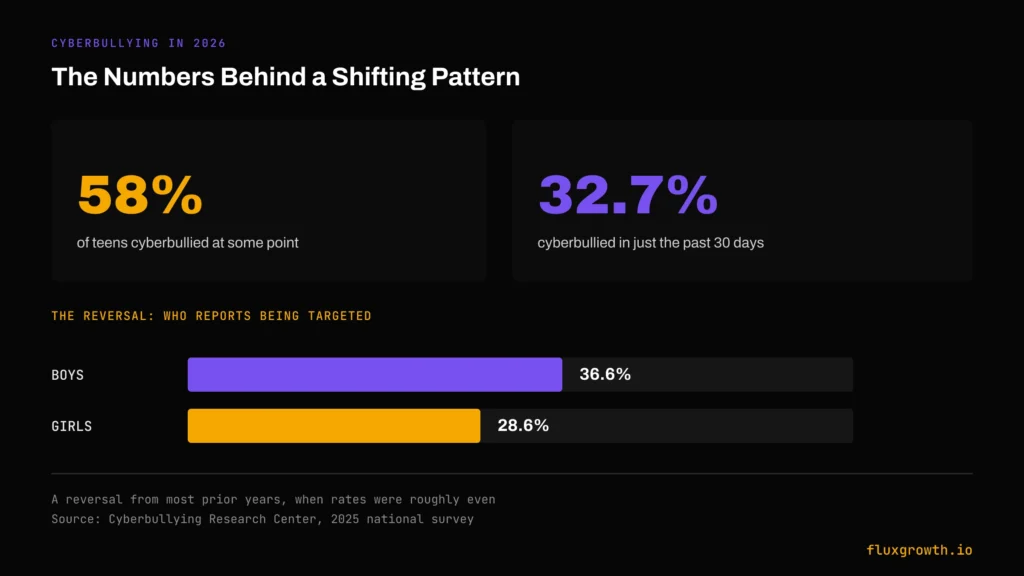
The Cyberbullying Research center’s 2025 national survey found that 58% of teens reported being cyberbullied at some point, and 32.7% in just the past 30 days, the highest figures the center has recorded in nearly two decades of tracking. The pattern shifted, too: boys are now more likely to report being targeted than girls, 36.6% versus 28.6%, a reversal from most prior years when the rates were roughly even.
Picture a 14-year-old quietly removed from a group chat with no explanation, no fight, nothing anyone could screenshot. Exclusion like that doesn’t show up as a hostile message, but it’s one of the most common forms reported.
Privacy concerns
Location tags, data collection for ad targeting, and oversharing in the moment (BeReal’s two-minute window is a good example) all add up to a digital footprint most teens don’t think about until it matters.
Mental health impacts
This deserves a straight answer, not a scare headline. Pew’s sentiment data shows teens increasingly believe social media hurts their peers.
Here’s the thing: the research on causation is genuinely mixed. A 2024 meta-analysis published in Professional Psychology: Research and Practice found no evidence that time spent on social media correlates with adolescent mental health problems. It depends heavily on what a teen is doing on the app, not just how long they’re on it.
Social media addiction
“Addiction” gets used loosely here, and it’s worth being precise. Compulsive use patterns are real and documented. A formal clinical addiction diagnosis is a different, narrower claim, one the current research doesn’t uniformly support. Treat heavy use as a signal worth a conversation, not automatically a diagnosis.
Online predators and scams
Every platform on this list tightened contact restrictions for minors in 2026 as a direct response to this risk. The practical move for families: keep direct messages restricted to known contacts (yes, even on the platforms with the “safest” reputation), and treat any request to move a conversation to a different app, or to keep a friendship secret from parents, as a reason to talk to a trusted adult immediately.
Misinformation
Teens get news through algorithmic feeds with zero editorial process behind them, no fact-checker, no editor, nothing standing between a doctored screenshot and a teen’s For You page. Source-checking matters more here than almost any other skill a parent can teach.
Social Media Safety Tips for Teens
- Protect personal information skip full name, school, and home address in bios and posts.
- Use strong, unique passwords. A password manager works for teens too.
- Enable two-factor authentication. Every platform on this list supports it.
- Review privacy settings regularly. Apps update their defaults often enough that a quarterly check is worth the five minutes.
- Be careful with strangers online. A request to move to DMs or a private app is a flag, not a compliment.
- Think before posting. If it would be uncomfortable for a teacher, coach, or future employer to see, it’s worth a second thought.
- Report bullying and harassment. Every platform here has a reporting tool, and using it actually does something in 2026, given how much moderation tech has improved.
Parent’s Guide to Teen Social Media Safety
Setting healthy boundaries
Boundaries that get set together, like phone-free dinners or a charging spot outside the bedroom, tend to stick better than rules handed down unilaterally.
Using parental controls
Every platform on this list ships some version of family oversight now TikTok has Family Pairing, Snapchat has Family Center, YouTube has supervised accounts, and Instagram, Discord, and Pinterest all have their own equivalents. None of them read message content. For that level of visibility, families typically turn to third-party tools.
Having open conversations
The single best predictor of whether a teen reports a bad experience isn’t which app they’re on. It’s whether they expect their parents to react with help instead of with a confiscated phone.
Monitoring without invading privacy
There’s a real difference between knowing who your teen is talking to and reading every message they send. Most platform tools, deliberately, only offer the first.
Recommended Screen Time for Teens
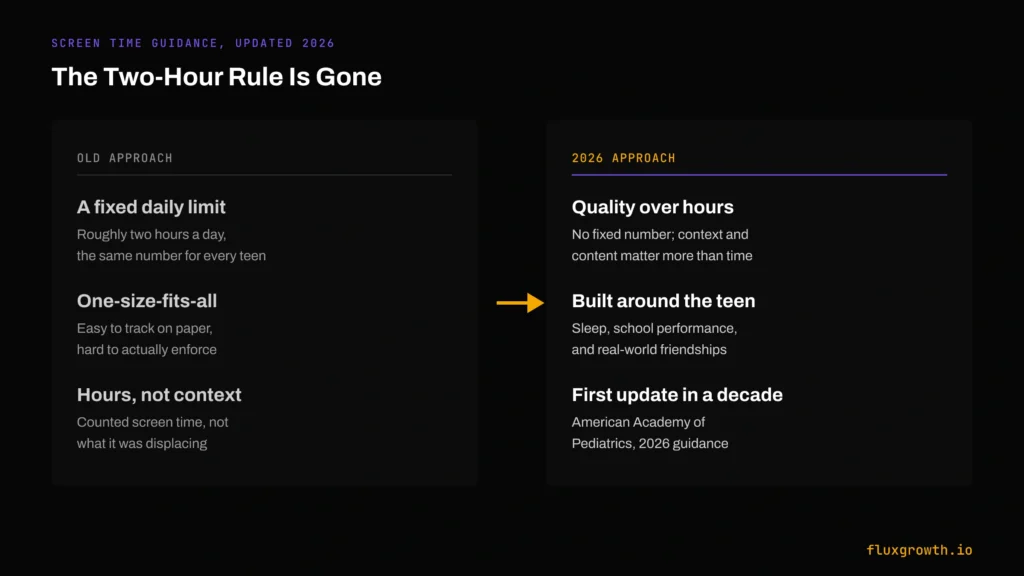
Here’s the update that changes this section entirely: the old “two hours a day” guideline is gone. For the first time in a decade, the American Academy of Pediatrics released updated screen time guidance in 2026 that moves away from a fixed time limit, prioritizing quality, context, and conversation instead.
In practice, that means a pediatrician is now more likely to ask whether a teen is sleeping well, keeping up at school, and maintaining real-world friendships than to ask exactly how many hours they spent on TikTok.
Signs of unhealthy use look less like “too many hours” and more like: school performance slipping, sleep getting cut short to keep scrolling, or visible anxiety when separated from the phone. The goal isn’t zero screen time. It’s screen time that isn’t quietly crowding out everything else.
How Teens Can Build a Positive Online Presence
What I’d tell a teen building a brand today: post less, but mean more of it. The creators who build lasting audiences are usually the ones who focus on quality, consistency, and authenticity rather than chasing every trend.
What I’d tell a teen building a brand today: post less, but mean more of it. What I’d tell a teen building a brand today: post less, but mean more of it. From analyzing creator accounts for Flux Growth, I’ve found that creators who consistently post high-quality content two to four times a week often build stronger, more engaged communities than those posting multiple low-effort updates every day. The accounts that actually build something lasting aren’t the ones chasing every trend. They’re the ones with a clear point of view that shows up consistently.
A few non-negotiables I’d give any teen starting out:
Create responsibly. Know the difference between an opinion and a claim you can’t back up, especially once an audience starts treating what you say as fact.
Avoid oversharing. Anything posted publicly at 15 can resurface at 25, in a college application review or a job search. That’s not a hypothetical anymore. It’s standard practice.
Respect others. The fastest way to lose an audience’s trust is one careless comment about someone else caught on camera.
Develop digital literacy. Understanding how an algorithm decides what to show you is, frankly, more useful than most of what gets taught about “internet safety” in a school assembly.
Future Trends in Teen Social Media
AI-powered social platforms
64% of teens already use AI chatbots, with about three in ten doing so daily, per Pew Research. This isn’t a future trend so much as a current one that’s about to get bigger. Expect more platforms to build chat-style AI features directly into the feed experience.
Creator economy opportunities
From what I’ve seen covering the creator economy at FluxGrowth, the biggest opportunity for teen creators isn’t becoming the next mega-influencer, it’s building a niche audience around a specific passion. Whether it’s gaming, fitness, study content, or tech, small but highly engaged communities often lead to brand partnerships, affiliate income, and even small online businesses. The line between “teen with a hobby account” and “teen running a small business” keeps getting blurrier, and platforms are building monetization tools earlier in a creator’s timeline than they used to.
Private communities
The pull toward smaller, closed spaces is partly a reaction to feeling too exposed on the big platforms; a 15-person Discord server beats a public TikTok comment section any day of the week. Expect this to keep growing as teens get more deliberate about who sees what.
Virtual and augmented reality experiences
Virtual and augmented reality experiences are worth watching, but they remain early-stage compared with mainstream social media platforms. While some teens are experimenting with VR headsets and immersive experiences, regular adoption is still limited relative to apps like TikTok, Instagram, and YouTube. For now, VR and AR look more like emerging opportunities than platforms teens should build an entire content strategy around.
Frequently Asked Questions
What is the best social media app for teens?
There isn’t one universal answer; it depends on what a teen wants. YouTube has the deepest educational value, Discord wins for niche community-building, and BeReal puts the least pressure on appearance and performance.
What is the safest social media platform for teenagers?
No social media platform is completely risk-free, but platforms with stronger parental controls, restricted messaging, and limited public exposure generally offer a safer experience for teens. Pinterest, YouTube’s supervised experiences, and family-supervised accounts on platforms like Instagram tend to provide more built-in protections than highly public, open-discovery platforms. Ultimately, the safest platform is one that combines strong privacy settings, parental guidance, and responsible use by the teen.
How much social media is too much for teens?
There’s no longer a single hour-based answer from the American Academy of Pediatrics. The better question is whether use is displacing sleep, school, or in-person relationships.
Is social media good or bad for teenagers?
Both, often at the same time. The research doesn’t support a flat answer; it depends heavily on what a specific teen is doing on a specific platform.
What age should teens start using social media?
Every major platform sets 13 as the floor, largely driven by the federal Children’s Online Privacy Protection Act. Several child-safety organizations recommend waiting longer, especially for platforms built around disappearing content or stranger contact.
How can parents keep teens safe online?
Combine the platform’s built-in family tools with regular, judgment-free conversation. The tools alone aren’t enough, and neither is conversation alone.
Which social media apps are most popular among teens?
YouTube, TikTok, Instagram, and Snapchat lead by a wide margin, while Discord, Reddit, Pinterest, and BeReal each pull a smaller, more specific crowd.