FluxGrowth is reader-supported. Some links in our guides are affiliate links — if you buy through one we may earn a commission, at no extra cost to you. It never changes which tools we recommend. How we test tools.
Most guides on how to become an AI software engineer are quietly teaching you the wrong job. They send you off to train neural networks from scratch and memorize backpropagation proofs that maybe 5% of open roles actually require. Meanwhile the role that’s hiring at scale looks a lot more like building production software around models you didn’t train.
That gap matters, because the demand is not subtle. LinkedIn’s 2026 Jobs on the Rise report ranked AI Engineer as the number one fastest-growing job title in the United States, with postings up 143% year over year in 2025. Get the definition right and the path gets a lot shorter.
I teach AI for a living, and I’ve coached career-switchers through this exact move. So I’ll do what most guides won’t flag the popular advice that quietly wastes your time. The job, the real skills, honest salary numbers, the first-job problem nobody warns you about. In that order.
What an AI Software Engineer Actually Does in 2026
Start here, because this is where most people go wrong before they write a single line of code.
An AI software engineer is a software engineer who specializes in integrating foundation models Claude, GPT, Gemini, and open-source models like Llama into real products. You’re working at the application layer. You’re not inventing new model architectures. As Dataquest put it in its 2026 roadmap, “It’s not research or model training. It’s building production software with AI at the core.”
That’s a different job than “machine learning researcher,” and the difference decides what you should learn.
A realistic day on the job
Picture a Tuesday. Your morning standup surfaces that the customer-support chatbot’s answer quality dropped over the weekend. You spend two hours in the retrieval pipeline and find a recent document update broke your chunking. You fix it.
After lunch you prototype a function-calling agent that lets the bot look up order status and start refunds, then you write evaluation tests to measure whether the new version is actually better before it ships.
Debugging, building, evaluating, deploying. That mix is the job. It has far more in common with software engineering than with academic research and that’s good news if you already write code.
Why the old definition is holding you back
Walk through almost any page-one article and you’ll see the same 2023-era checklist: deep learning theory, training models from scratch, heavy C++ and R. That was the AI engineer of a few years ago.
The job changed when foundation models got good enough to build on directly. Now the valuable skill is knowing how to wire those models into something reliable, measurable, and cheap to run. You still need to understand what embeddings and transformers do conceptually. You almost never need to derive math. Skip the proofs. Build the apps.
AI Software Engineer vs Machine Learning Engineer
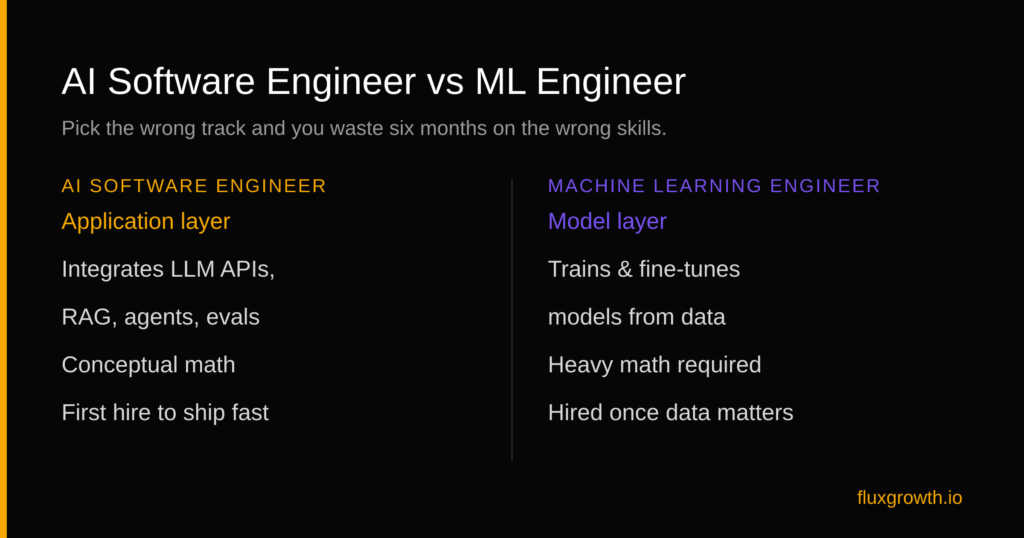
This is the comparison that saves you months, so don’t skim it. Pick the wrong track and you’ll spend half a year on skills the role you want doesn’t test for.
The cleanest way to think about it: AI engineers work at the application layer, ML engineers work at the model layer. AI engineers connect pre-trained models to product features and obsess over reliability, evaluation, and cost. ML engineers build, train, and fine-tune models on proprietary data fraud detection, recommendation engines, forecasting which demands deeper statistics, linear algebra, and calculus.
The market treats them differently too. According to LinkedIn data cited by Research.com, AI engineer postings grew 74% year over year while ML engineer roles grew 33%. ML engineering is still the larger base. Ravio’s 2026 data pegs ML Engineer at roughly 45% of all AI/ML job titles but AI engineering is the steeper growth curve.
| AI Software Engineer | Machine Learning Engineer | |
| Center of gravity | Production systems, delivery | Model development, learning performance |
| Core work | Integrate LLM APIs, RAG, agents, evals | Train, fine-tune, deploy models |
| Math depth | Conceptual (embeddings, attention) | Heavy (stats, linear algebra, calculus) |
| Typical first hire? | Yes to ship LLM features fast | Later once proprietary data matters |
| Day-one stack | OpenAI/Anthropic APIs, LangChain, a vector DB | PyTorch, training pipelines, MLflow |
One more thing worth knowing: these aren’t locked boxes. Plenty of ML engineers move into AI engineering after picking up deployment skills, and AI engineers circle back to ML fundamentals when they need to squeeze more out of a model. Start where the hiring is, then expand.
The Skills That Actually Get You Hired
Here’s the thing: the “LangChain plus Pinecone” resume that screamed AI-ready in 2024 is now table stakes. According to a 2026 hiring breakdown from Digital Applied, listing only LangChain, Pinecone, and the ChatGPT API now reads as a 2024 mindset. So let’s separate what gets you in the door from what just looks busy.
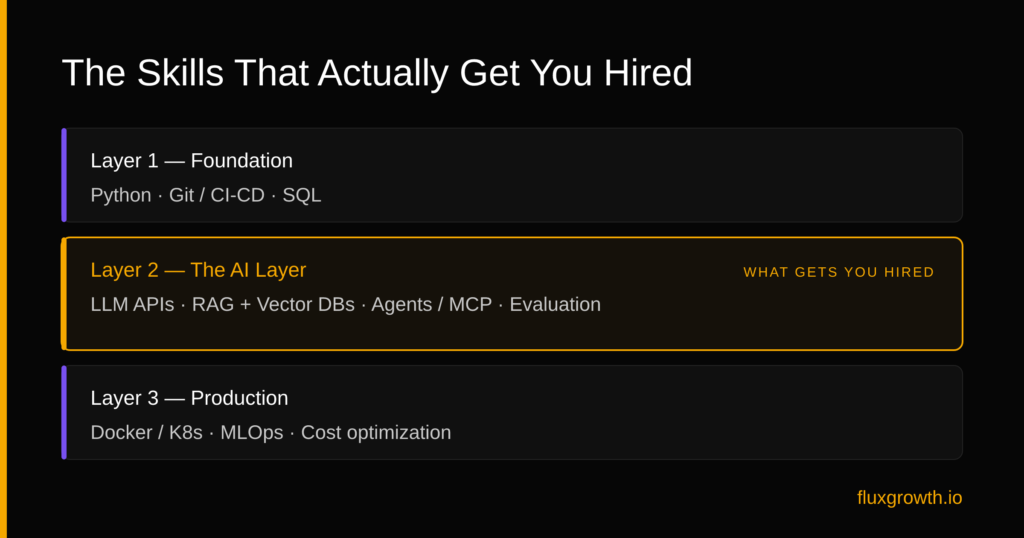
I group it into three layers.
Layer 1: The software foundation
You can’t skip this, and people who do get found out fast.
- Python. Non-negotiable. It shows up in 71% of AI engineering job postings (TripleTen, 2026), and the entire ecosystem LangChain, PyTorch, vLLM, FastAPI is Python-first.
- Git, CI/CD, and deployment basics. A surprising number of aspiring engineers jump straight to agent frameworks without knowing how to ship a service. That’s the line between “developer who uses ChatGPT” and “engineer who builds AI products.”
- SQL. Essential for the data work that feeds every real system. TypeScript is a useful secondary for AI web apps; Rust is emerging for performance-critical inference but isn’t required for most roles.
Notice what’s not on this list: a deep dive into Java, C++, and R. They’re not central to applied AI engineering in 2026, whatever the older guides tell you.
Layer 2: The AI layer (this is what gets you hired)
This is the part that actually separates candidates.
- LLM APIs and prompt engineering. Not just writing prompts systematic design: few-shot patterns, chain-of-thought, structured outputs, and the eval frameworks that prove a prompt works.
- RAG and vector databases. Retrieval-augmented generation is still the single most-deployed production pattern. The hard skill isn’t “build a RAG” it’s building one that survives messy data and 18 months of corpus drift. Know at least two vector DBs (Pinecone, pg vector, Qdrant) and their tradeoffs.
- Agents and orchestration. LangGraph and CrewAI replaced the ad-hoc loops everyone wrote in 2024. MCP (Model Context Protocol) is becoming the standard for connecting agents to external tools.
- Evaluation. This is the one to over-invest in. Per Digital Applied’s 2026 survey, eval design is the single best signal that someone has actually built with LLMs rather than watched tutorials. If you can walk an interviewer through a real eval you designed and quote a metric like recall@10 you’re ahead of most of the field.
Layer 3: The production layer
Once it works on your laptop, can you run it for real?
Docker and a little Kubernetes, basic MLOps, and the underrated one cost optimization. Caching and smart model routing can cut a production LLM bill by 40–70% (AY Automate, 2026). Most engineers can build a working RAG. Very few can halve the bill while keeping quality flat, and the ones who can tend to pay for their own salary inside a quarter.
And the math question, since it’s the first thing everyone asks. For applied AI engineering, you don’t need to train models at a research level. You need to know what an embedding is, how to run an eval, and how to read a benchmark without fooling yourself. That’s it. Research and ML-from-scratch roles are the exception and they’re maybe 5% of the open headcount.
The Roadmap: A Realistic 8–12 Month Path
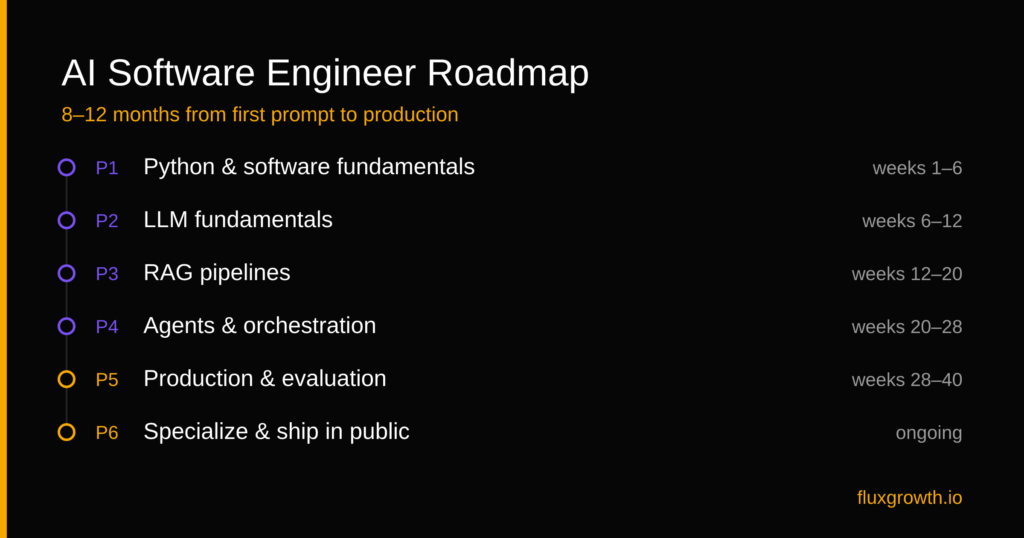
You can do this in 8 to 12 months of consistent work if you’re already comfortable coding, longer if you’re starting from zero. The order matters more than the speed.
Phase 1 — Python and software fundamentals (weeks 1–6). Get genuinely fluent in Python. Learn Git, write a small API with FastAPI, deploy it somewhere. If you already code professionally, compress this hard.
Phase 2 — LLM fundamentals (weeks 6–12). Talk to models programmatically. Learn the OpenAI and Anthropic SDKs, structured outputs, function calling, and prompt patterns. Build a small chatbot that does one useful thing.
Phase 3 — RAG pipelines (weeks 12–20). This is where the salary jumps start. Build a knowledge-base search system with a vector database. Then make it good: chunk by meaning, not character count; add a reranker; measure retrieval quality before you measure answer quality.
Phase 4 — Agents and orchestration (weeks 20–28). Move from single calls to multi-step systems with LangGraph. Add tool calling, design the tools like real APIs (clear names, structured errors), and wire in MCP.
Phase 5 — Production and evaluation (weeks 28–40). Deploy with Docker. Add logging, tracing, and an eval harness (RAGAS or a custom one). Learn to cut costs with caching and routing. This phase is what turns a portfolio of demos into a portfolio of systems.
Phase 6 — Specialize and ship in public (ongoing). Pick one edge RAG depth, agents, or fine-tuning and go deeper than a tutorial takes you. Publish what you build.
One trap to name out loud: the “tutorial stack” plateau. A lot of people loop through Phases 2 and 3 forever because each new framework feels like progress. It isn’t. Shipping one deployed, evaluated project beats collecting five half-built ones.
AI Software Engineer Salary in 2026
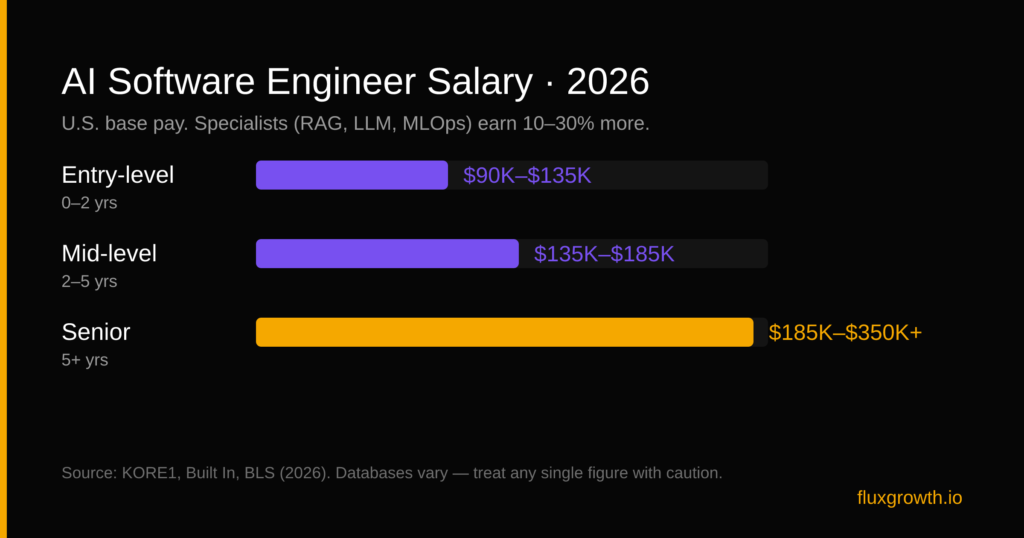
Let’s talk numbers with the caveat that salary databases disagree wildly here, so treat any single figure with suspicion.
The averages land in a wide band, and the sources don’t agree. KORE1’s 2026 placement data puts average base pay between $140,000 and $185,000. Built In says $184,757 (the suspiciously exact number is doing some work there). The BLS median for the broader software category sits lower, near $130,000. Same title, $50K of disagreement and most of it comes down to specialty, company stage, and city.
| Experience level | Typical base salary (2026) |
| Entry-level (0–2 yrs) | $90,000–$135,000 |
| Mid-level (2–5 yrs) | $135,000–$185,000 |
| Senior (5+ yrs) | $185,000–$350,000+ |
A few honest footnotes on that table. In San Francisco and New York, entry offers routinely start at $115K–$135K base, while mid-sized markets run lower (KORE1, 2026).
Senior LLM and generative-AI specialists are the top of the applied market, with base pay hitting $240K–$350K+ and total comp climbs well past that once equity is in the mix. Frontier labs are a separate universe most people will never touch.
Specialization pays a measurable premium on top of the base. Per KORE1’s 2026 data, RAG architecture adds roughly 10–15% at mid-level, LLM fine-tuning adds another 10–15%, and MLOps capability adds $15K–$30K over notebook-only candidates.
And the macro tailwind is steep: PwC’s 2025 AI Jobs Barometer found a 56% wage premium for roles requiring AI skills versus the same roles without up from 25% a year earlier. That premium roughly doubling in twelve months is the clearest signal you’ll find that the market is bidding for these skills faster than people can acquire them.
How to Land Your First AI Engineering Job
The hard truth first, because no one says it plainly: “entry-level” in AI engineering is a bit of a misnomer. Most entry offers still go to people with a CS degree or real project work training and deploying models (KORE1, 2026). A degree itself isn’t the gate startups and mid-size companies openly prioritize a portfolio of shipped projects over credentials. The gate demonstrated ability. So build proof.
Ship three real projects, not five tutorials. A production RAG application with evaluation metrics. A multi-agent system that does something genuinely useful. A deployed service with monitoring.
Three projects that work beat a master’s degree at most companies. And a working AI assistant deployed on Vercel or AWS, with the link in your LinkedIn bio, pulls more recruiter messages than any certificate.
Make your GitHub tell the story. Clean repos, real READMEs, commits that show iteration. Recruiters and hiring managers actually read these.
Contribute to open source. Even small PRs to LangChain, LlamaIndex, or vLLM put your name where the field’s eyes are.
Optimize LinkedIn for the keywords that get you found. Lead with your specialization. Write experience bullets in Context-Action-Result form (“Reduced inference latency by 120ms through optimized model architecture”), and salt the profile with the terms recruiters search “RAG pipelines,” “vector DBs,” “MLOps,” “LLM evaluation.”
Prepare for the interview that exists now. The 2026 AI engineer interview is a hybrid: part software architecture, part data engineering, part model optimization. Expect questions on systemic retrieval failures, hybrid search, reranking, and every time an eval you designed. If you can quote a real metric from a real project, you’ve cleared the bar most candidates trip over.
The candidates who get hired fastest are usually the ones who build real projects, not just complete courses. A single production-ready AI application deployed publicly with strong documentation often impresses recruiters more than multiple tutorial-based projects.
What I’d Do If I Were Starting Today
If I were starting over from a non-traditional background today, I’d ignore most of the “learn AI in 30 days” content and do four boring things.
Get Python and deployment genuinely solid first before touching a single LLM framework. That’s the layer everyone skips and every interviewer probes. Then build one RAG project and refuse to move on until I could prove it worked (a recall number, not a vibe). Specialize in agents early, because that’s where the steepest demand and the thinnest talent pool overlap right now. And build in public from week one, so the portfolio grows while you learn instead of after.
My advice to anyone asking “Where do I start?” is simple: start with Python, learn the fundamentals of machine learning, and build projects as early as possible. The biggest mistake I see beginners make is spending months watching tutorials without building anything. In AI engineering, projects are your proof of skill and they matter far more than certificates alone.
The people I’ve watched make this transition fastest had one thing in common, and it wasn’t talent. It was that they shipped small things constantly instead of waiting to feel ready.
Frequently Asked Questions
What does an AI software engineer do?
They integrate foundation models like Claude and GPT into production software, building things like RAG-powered search, support chatbots, and AI agents, then evaluating and deploying them. The work is closer to software engineering than to research.
How long does it take to become an AI software engineer?
Plan on 8 to 12 months of consistent work if you can already code, moving through Python, LLM fundamentals, RAG, agents, and deployment. Starting from zero programming experience pushes that timeline longer.
Is AI software engineering a good career?
By the numbers, yes. It was LinkedIn’s number one fastest-growing US job title in 2026, postings rose 143% year over year, and AI-skill roles carry a 56% wage premium (PwC, 2025). The main caveat is that “entry-level” roles still expect real, demonstrated project work.
What degree do you need to become an AI engineer?
A degree helps but isn’t required for most roles. Startups and mid-size companies prioritize a portfolio of shipped projects, though some FAANG roles prefer a CS background. Demonstrated skill beats credentials at the majority of employers.
What programming language is best for AI engineering?
Python, and it isn’t close, it appears in 71% of AI engineering postings (TripleTen, 2026) and the whole ecosystem runs on it. TypeScript is a useful secondary for AI web apps; SQL is essential for data work.
Do AI engineers need math?
For applied roles, only conceptually you need to understand evaluation, embeddings, and benchmarks, not derive proofs. Deep math matters for ML engineering and research roles, where you train models from scratch.
What is the average AI software engineer salary?
Estimates vary by source, but average base pay lands roughly between $140,000 and $185,000 in 2026 (KORE1; Built In), with senior specialists reaching $240K–$350K+ base before equity.
The One Thing to Remember
Nobody becomes an AI software engineer by collecting courses. You do it by getting the definition right, building three projects you can actually measure, and shipping them where people can see a shorter list than the internet wants you to believe. Demand is high, the talent pool is thin. So the question was never whether there’s room for you. It’s what you’ll build first.
Explore our latest Articles on Fluxgrowth