FluxGrowth is reader-supported. Some links in our guides are affiliate links — if you buy through one we may earn a commission, at no extra cost to you. It never changes which tools we recommend. How we test tools.
Yes but only through a small, invitation-only test called the AI Contribution pilot, and only when Google decides your content “significantly” shaped an AI answer. It’s not the upfront licensing deal OpenAI signed with News Corp. As of September 2026, it’s a limited experiment with payouts Google hasn’t explained.
This guide is part of our GEO & AI Search hub – everything we have published on getting cited by AI search engines, in one place.
That’s the short version. The longer one matters more. This pilot showed up right as three separate pressures hit Google at once: a search product sending fewer clicks to websites, an antitrust lawsuit over exactly that, and depending on who you ask either a good-faith payment or a legal shield. What follows keeps those three sorted: confirmed, reported, and genuinely unknown.
What is Google’s AI Contribution pilot?
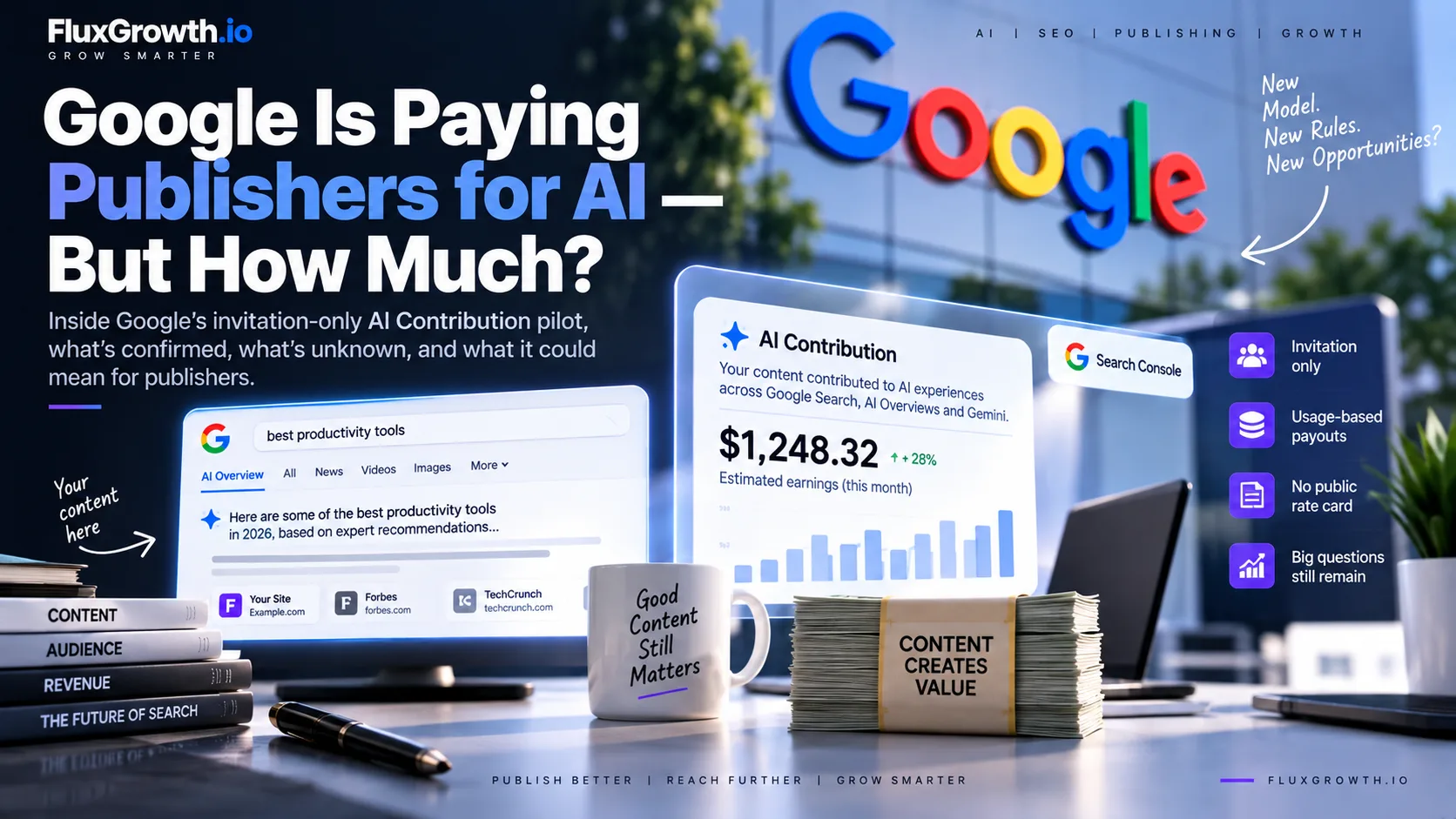
The AI Contribution pilot is a program that pays a limited group of publishers when their content contributes to Google’s AI-generated answers across AI Overviews, AI Mode, and Gemini. It runs inside Google Search Console as an extra earnings widget, it’s usage-based with no upfront fee, and publishers can leave at any time. Access is by invitation only.
The story went public on September 14, 2026, when Digiday reported that Google had been “quietly scaling a pay-per-value AI licensing scheme for publishers.” Search Engine Land and other trade outlets confirmed the same details that day. Google acknowledges the pilot exists and describes it as an early-stage way to reward high-quality content.
Here’s what’s confirmed about the mechanics. Google only pays when it judges that a publisher’s content made a meaningful — its word is “significant” contribution to an AI response. Participants see a monthly earnings figure inside Search Console, with some history attached. Reporting suggests the program has been more attractive to small and mid-sized publishers than to large ones, which fits how Google built it.
If you were expecting a headline number, there isn’t one. And that absence is the whole point of the next section.
How does “pay-per-value” AI licensing actually work?
Google’s model is “pay-per-value,” not pay-per-crawl or pay-per-use. Google decides how valuable a piece of content was to an AI response, then pays accordingly. Publishers don’t get a rate card, a per-query fee, or a formula. They get a number in a dashboard.
This is a real departure from how content licensing has usually worked. Most deals involve a negotiated sum fixed, upfront, or tied to clear usage. Google flipped that. Instead of paying every time it crawls your content, or every time that content appears in an answer, it pays only when it decides the contribution crossed some threshold of significance. What that threshold is, Google hasn’t said.
The transparency gap is the sharpest criticism. According to Digiday, the widget shows a monthly payout but never shows the work behind it (you see the number; you don’t see the formula). One executive quoted in the report called it better suited to smaller publishers who can’t negotiate a bigger deal a way in, not a windfall. Others were blunter, calling it closer to a legal hedge than a real revenue stream.
So the confirmed picture is narrow: the pilot exists, it pays through Search Console, it’s opt-out, and it rewards “significant” contribution. Everything about the actual math rates, totals, how “value” is measured sits behind the dashboard. If you’re weighing whether this matters for your business, treat the mechanics as a black box until Google opens it.
Why is Google doing this now?
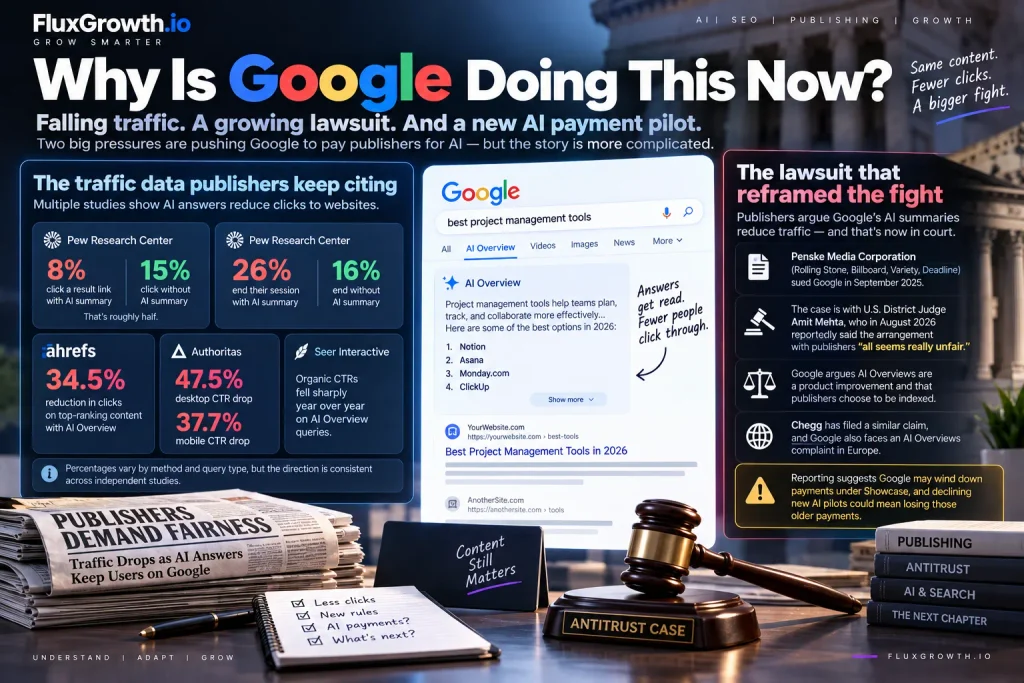
Timing matters here, and there are two pressures pushing on Google at the same time: a growing body of research showing AI answers cut clicks to websites, and a lawsuit built around exactly that claim.
The traffic data publishers keep citing
The cleanest number comes from the Pew Research Center, which analyzed the real browsing behavior of about 900 U.S. adults in March 2025. Pew found that when a Google search produced an AI summary, users clicked a traditional result link 8% of the time compared with 15% when no summary appeared. That’s roughly half. Clicks on the source links inside the summaries were rarer still, at about 1% of visits.
Pew also found that users were more likely to end their browsing session entirely after a page with an AI summary (26%) than one without (16%). In plain terms: the summary often answers the question, and the visit stops there.
Independent studies point the same direction, though the magnitudes vary with method and query type. Ahrefs, analyzing large volumes of search data, reported a 34.5% reduction in clicks on top-ranking content when an AI Overview was present. Authority, in a complaint submitted to the UK’s competition regulator, measured a per-query clickthrough drop of 47.5% on desktop and 37.7% on mobile. Seer Interactive found organic clickthrough rates on AI Overview queries fell sharply year over year, noting those queries skew informational and historically had lower rates to begin with.
Take the direction as solid and the exact percentages as directional. Pew itself is careful about this: the panel is a slice of U.S. adults, the product keeps changing, and the study measures clicks, not revenue. Still, the trend is consistent across independent researchers who don’t agree on much else.
The lawsuit that re-framed the fight
In September 2025, Pensive Media Corporation, owner of Rolling Stone, Billboard, Variety, and Deadline sued Google over its AI summaries. What made the suit notable was the legal theory. Rather than argue copyright, Pensive built an antitrust case: that Google uses its search dominance to take publisher content for AI answers while sending back less and less traffic, and that publishers can’t realistically opt out without disappearing from search entirely.
The case has real weight behind the bench. It landed with U.S. District Judge Amit Meta, the same judge who ruled in 2024 that Google holds an illegal monopoly in general search. In an August 2026 hearing on Google’s motion to dismiss, Meta reportedly said the arrangement with publishers “all seems really unfair.” Google’s lawyers countered that AI Overviews are simply a product improvement, that publishers choose to be indexed, and that offering an extra feature can’t be coercive.
Pensive isn’t alone. The education company Chegg filed a similar claim, and Google faces a separate AI Overviews complaint in Europe. A voluntary payment pilot launching while that pressure builds is, at minimum, convenient timing. Whether it’s a good-faith first step or a defensive move is exactly the kind of thing reasonable people can read both ways and the sources support both readings.
One more wrinkle worth naming: reporting suggests Google has told some publishers it plans to wind down payments under Showcase, an older news program, and that declining the newer AI pilots could mean losing those older payments. That complicates the word “voluntary.”
How does this compare to other AI licensing deals?
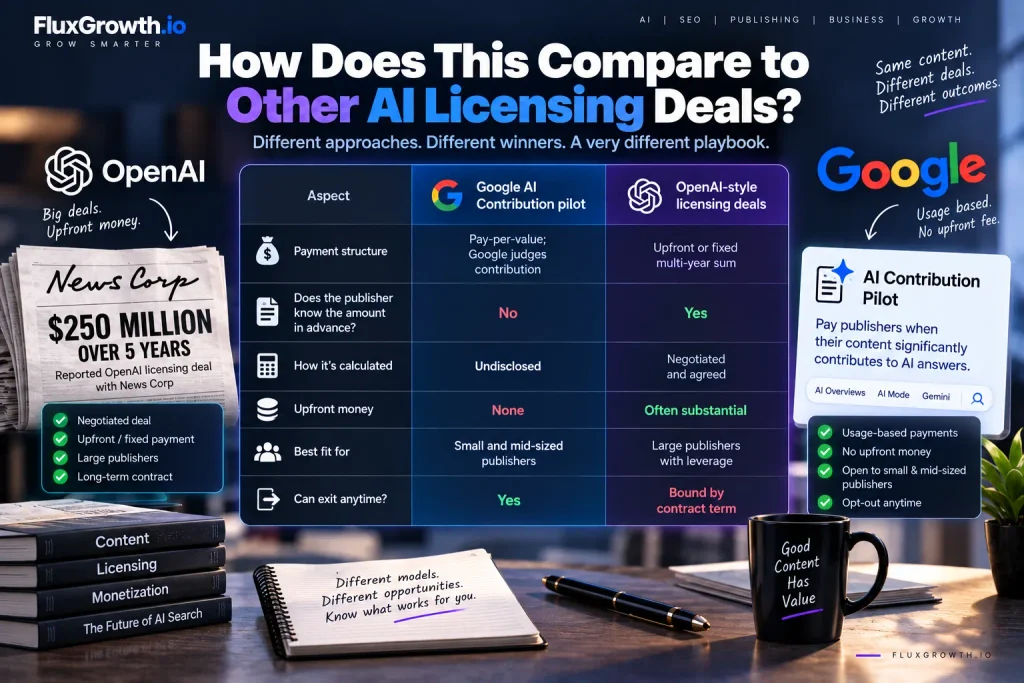
Google chose a different path from its AI rivals, and the contrast tells you a lot about who benefits.
Other AI companies have mostly signed negotiated, upfront licensing deals with major publishers. The largest reported example is OpenAI’s arrangement with News Corp, reported at roughly 250 million dollars over five years. Those deals are lump sums or fixed commitments the publisher knows the number.
Google went the other way: usage-based, value-judged, no upfront money, opt-out anytime. Here’s the practical difference.
| Google AI Contribution pilot | OpenAI-style licensing deals | |
| Payment structure | Pay-per-value; Google judges contribution | Upfront or fixed multi-year sum |
| Does the publisher know the amount in advance? | No | Yes |
| How it’s calculated | Undisclosed | Negotiated and agreed |
| Upfront money | None | Often substantial |
| Best fit for | Small and mid-sized publishers | Large publishers with leverage |
| Can exit anytime? | Yes | Bound by contract term |
Neither model is simply better — they serve different publishers. A large outlet with leverage, say a Pensive or a News Corp, can negotiate a real number upfront. A one-person site can’t. For that site, an opt-out pilot with no upfront cost might be the only door open, even if the payout is small and the math stays hidden. Which is probably why the reporting shows smaller publishers warming to it faster than the big ones.
What’s confirmed, what’s reported, and what’s still unknown?
This is the part most coverage skips, and it’s where an analysis earns its keep. Here’s the same story sorted by how solid each piece actually is.
| Claim | Status |
| Google runs an “AI Contribution” pilot paying some publishers | Confirmed — Google acknowledges it; reported by Digiday, Search Engine Land, others |
| Payment is “pay-per-value,” via a Search Console widget, opt-out | Confirmed — consistent across all reporting |
| Google says total organic clicks are “relatively stable,” with higher “quality” | Confirmed as Google’s position — stated by VP of Search Liz Reid on Google’s blog; Google has not released the underlying data |
| AI summaries cut clickthroughs roughly in half (15% to 8%) | Reported / researched — Pew Research Center, March 2025 browsing data |
| Independent CTR-drop figures (34.5%, 47.5%, etc.) | Reported / researched — Ahrefs, Authoritas, Seer; magnitudes vary by method |
| Penske’s antitrust suit; judge called the setup “really unfair” | Reported — court hearing coverage; case is ongoing, not decided |
| How Google calculates a payout | Unknown — not disclosed |
| How much money publishers actually earn | Unknown — no figures released |
| Whether the pilot expands, and on what terms | Unknown / speculation — Google calls it an early test |
Notice where the certainty runs out. The existence of the pilot and Google’s public stance are solid. The traffic research is strong and consistent in direction. But the two questions publishers care most about how payouts are calculated and how much they’re worth are exactly the ones with no answer. Any article that hands you a compensation figure right now is guessing.
There’s also a genuine, unresolved dispute at the heart of this: independent researchers say AI summaries reduce clicks, and Google says aggregate clicks are stable with higher quality. Google has made its case for over a year without publishing supporting data, which is why publishers keep leaning on outside studies. You don’t have to pick a winner to plan around the disagreement.
What should publishers do right now?
There’s no single fix here, so don’t look for one. The goal is to lower your exposure to a channel you don’t control. Here’s the thing: the moves that work don’t depend on how the pilot turns out.
Watch the pilot, don’t bet on it. If you’re invited, there’s little downside to testing it; it’s opt-out and costs nothing upfront. But treat any earnings as a bonus, not a line item you can forecast. Until Google explains the math, you can’t model it.
Measure your own reality. Google’s “quality clicks” argument and the independent CTR studies can’t both be fully right for your specific site. So check. Compare your Search Console impressions against clicks over the last 12 to 18 months, segment by query type, and watch for the pattern researchers describe impressions holding or rising while clicks flatten or fall. Your own data beats anyone’s aggregate.
Reduce single-source dependence. If Google referral is 70% of your traffic, that concentration is your real risk not AI, specifically. An email list, a Substack, a Reddit community you actually participate in: none of those get intercepted by a 67-word summary box. You already knew this. It just stopped being optional.
Optimize to be in the answer, not just under it. Since a shrinking share of searches end in a click, how to get cited in AI search is becoming its own goal. Learn how to get cited in ChatGPT and Perplexity Clear, well-structured, genuinely sourced content is what these systems tend to surface. That work also happens to be what earns the pilot’s “significant contribution” credit, if you’re in it.
None of that is a rescue plan. It’s damage control while the ground keeps shifting. The trick everyone wants, the one clever workaround, doesn’t exist. What’s left is unglamorous: stop betting the business on a single channel behaving the way it used to.
Frequently asked questions
Does Google pay publishers for AI Overviews?
Only through the limited AI Contribution pilot, and only for content Google judges made a “significant” contribution to an AI response. It’s invitation-only and still a test, so most publishers currently receive nothing for AI Overviews.
How much does Google pay publishers?
Google hasn’t disclosed any figures, and the earnings widget doesn’t explain how payouts are calculated. Any specific dollar amount you see quoted for this pilot is not confirmed by Google.
Can I sign up for the AI Contribution pilot?
Not directly. Reporting indicates there’s no open sign-up access is by invitation, and Google has approached a limited set of publishers. You’d see it appear as a widget inside the Search Console if you were included.
Is this the same as OpenAI’s publisher deals?
No. OpenAI-style deals are usually negotiated, upfront sums with major publishers. Google’s model is usage-based and value-judged, with no guaranteed amount, and it appears aimed more at small and mid-sized publishers.
Can I stop Google from using my content in AI answers?
You can restrict crawling and indexing at the technical level, but doing so can also remove you from Google Search entirely which is the core tension in Pensive Media’s lawsuit. There’s no simple toggle that keeps you in search while excluding you from AI answers.
The pilot settles whether Google will pay publishers. It says nothing yet about how much, or how fairly. Until it does, skip both the celebration and the panic and stop letting one channel decide whether your business makes it.
The bottom line
Google has started paying some publishers for AI content but only through a small, opt-out pilot with payouts it won’t explain, and only when it decides your content mattered “significantly” to an answer. It’s not OpenAI money, and it arrives just as AI Overviews cut clicks (Pew measured 15% down to 8%) and Pensive’s antitrust suit tests whether any of this is legal. What’s confirmed: the pilot is real. What’s unknown: how much it pays, and how fairly. Plan around that gap, not around the headline.