FluxGrowth is reader-supported. Some links in our guides are affiliate links — if you buy through one we may earn a commission, at no extra cost to you. It never changes which tools we recommend. How we test tools.
You can hold the number one spot on Google and still lose the click. Above your link sits an AI-generated answer that resolves the query before anyone scrolls. If your page isn’t part of that answer, the ranking barely matters.
This guide is part of our GEO & AI Search hub – everything we have published on getting cited by AI search engines, in one place.
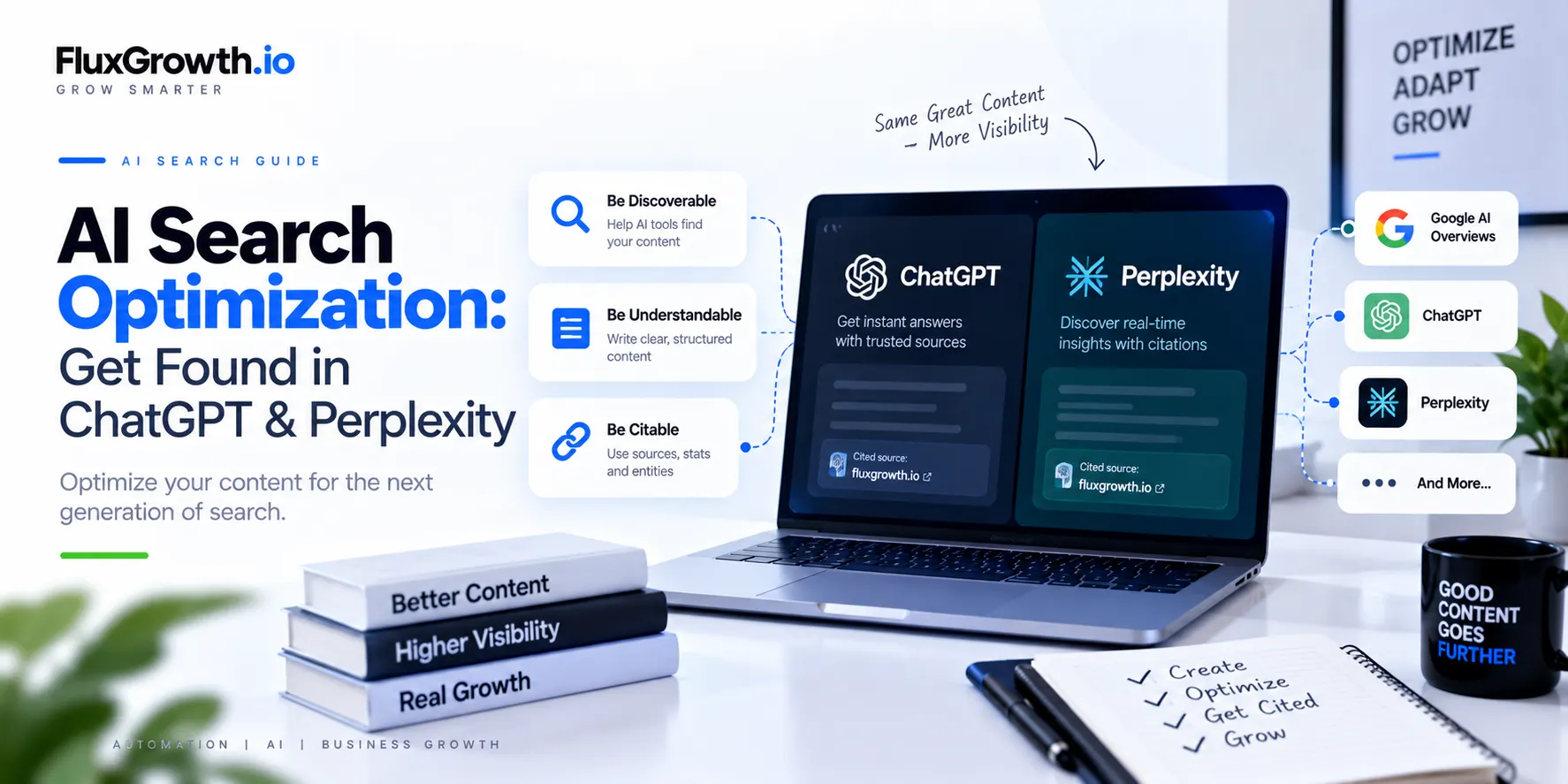
That’s the gap AI search optimization closes. In other words, it’s the practice of structuring your content so search systems like ChatGPT, Perplexity, and Google AI Overviews can find it, make sense of it, and quote it accurately. It doesn’t replace SEO; instead, it builds on top of it.
To begin with, this guide covers how AI search actually works, how it differs from the SEO you already know, and the specific moves that make your pages easier for these systems to pull from. In addition, it’s built for developers and SaaS teams, so the examples are technical and practical rather than theoretical.
What is AI search optimization?
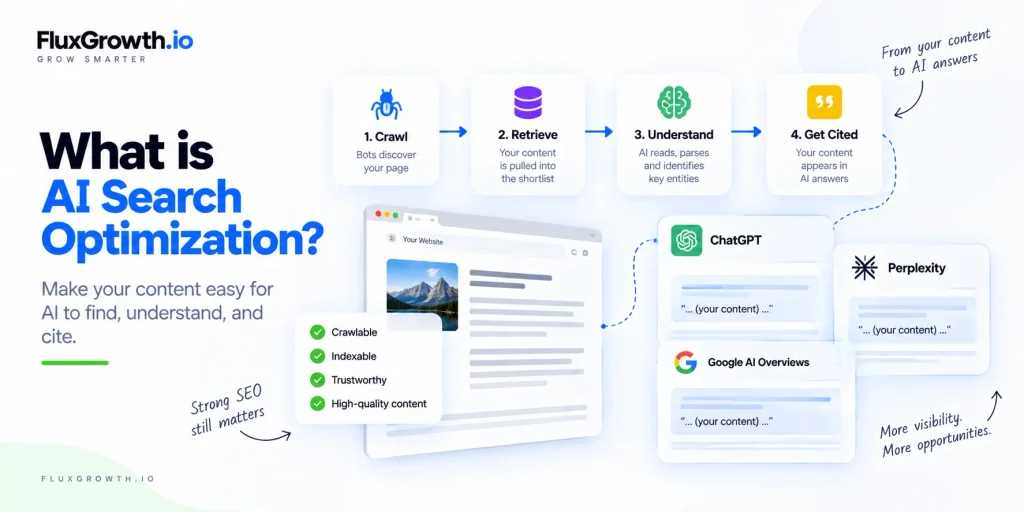
AI search optimization is the practice of structuring and improving your content so AI-powered search and answer systems can discover, understand, retrieve, and accurately represent it.
It runs as a chain, and your page can drop out at any link. A bot has to crawl the page. A retrieval layer has to pull it into the shortlist when someone asks a relevant question. Then a model parses what the page says and which entities it’s about, and decides whether you’re worth quoting. Miss the first step and the other three never happen.
Traditional SEO fundamentals feed every link in that chain. That’s why crawlable, indexable, trustworthy pages don’t stop mattering—they become the entry ticket. If you’re looking to put these principles into practice, our guide to the best GEO tools in 2026 compares the options worth considering. AI search optimization just adds a second question on top of “does this rank?” namely, “can a machine lift a clean, correct answer out of this page?”
AI search optimization vs. traditional SEO
The core difference, however, is the unit of value.Traditional SEO optimizes a page to rank as a link. In contrast, AI search optimization optimizes a passage to be extracted and cited inside a generated answer.
What stays the same
Almost everything technical. Google’s own documentation is direct about this: there are no additional requirements to appear in AI Overviews or AI Mode, and no special optimizations necessary beyond being indexed and eligible to show with a snippet (Google Search Central). Keyword research, search intent, crawling, indexing, links, site speed, content quality all still load-bearing.
What’s genuinely new
Here’s the thing: AI systems reward what classic ranking mostly shrugs at. A clean answer in the first two sentences of a section. Writing “Stripe” instead of “the platform.” A stat with a source hanging off it. Paragraphs that still make sense after they’ve been lifted out and dropped into a chat window. You can sit at position five in the results and still get quoted, as long as your passage is the cleanest one on the topic.
GEO vs. AEO vs. AI search optimization — the terminology, honestly
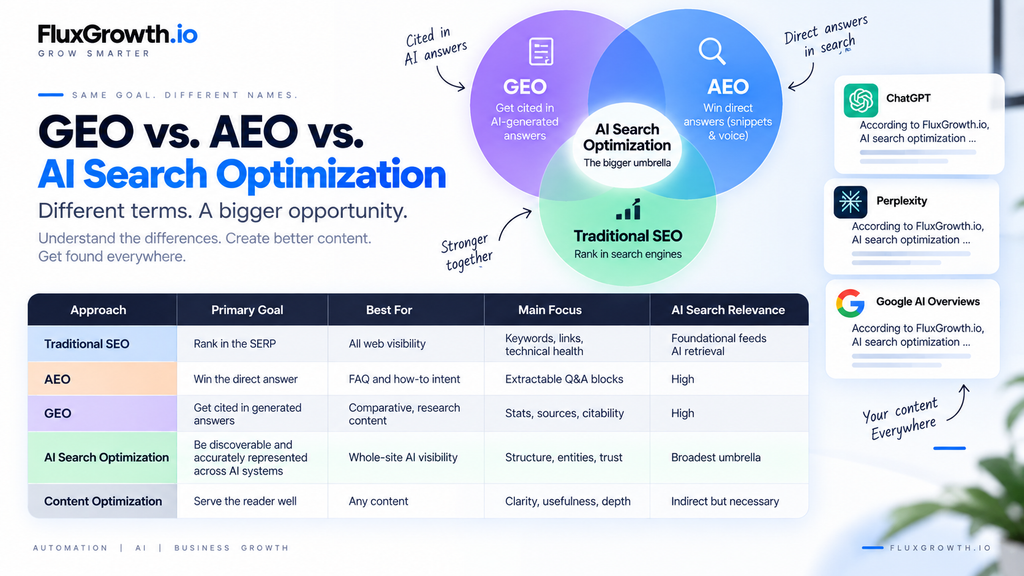
Here’s the honest version: the industry hasn’t agreed on these terms, and people use them differently. Definitions that help anyway:
Generative Engine Optimization (GEO) means shaping content so AI-generated answers cite it. The term comes from a 2024 Princeton research paper — more on that shortly.
Answer Engine Optimization (AEO) is older and narrower: structuring content to win direct-answer slots like featured snippets and voice results.
AI search optimization is the broadest umbrella. It covers both, plus the technical and entity work that makes your whole site legible to AI systems.
They overlap heavily. GEO and AEO are really the same goal seen from different angles. Don’t get stuck on which label a vendor uses — the underlying work is mostly shared.
Approach | Primary Goal | Best For | Main Focus | AI Search Relevance |
| Traditional SEO | Rank in the SERP | All web visibility | Keywords, links, technical health | Foundational feeds AI retrieval |
| AEO | Win the direct answer | FAQ and how-to intent | Extractable Q&A blocks | High |
| GEO | Get cited in generated answers | Comparative, research content | Stats, sources, citability | High |
| AI Search Optimization | Be discoverable and accurately represented across AI systems | Whole-site AI visibility | Structure, entities, trust | Broadest umbrella |
| Content Optimization | Serve the reader well | Any content | Clarity, usefulness, depth | Indirect but necessary |
Which approach should you use?
Don’t replace traditional SEO with any of them. Build AI search optimization on top of a strong technical SEO and content foundation. The right emphasis depends on your site: a docs-heavy SaaS product leans into extractable structure and entities, while a comparison-driven blog leans into GEO tactics like sourced stats and tables.
How AI search actually finds and uses your content
At a high level, most AI search systems run a version of the same pipeline: interpret the query, retrieve candidate sources, select which ones to trust, extract the relevant passages, synthesize an answer, and present citations. The implementations differ, and none of these companies publishes its full ranking system so treat platform specifics as informed observation, not gospel.
Google AI Overviews and AI Mode
Both pull from the same Google Search index that classic ranking uses. They may use a “query fan-out” technique issuing multiple related searches across subtopics to build a response (Google Search Central). AI Overviews appear automatically on a large share of queries; Google’s own disclosure put that near 50% of U.S. queries in early 2026, with third-party trackers estimating closer to 43–48%. AI Mode is opt-in and runs on Gemini.
ChatGPT search
ChatGPT decides whether a question needs live data. When it does, a retrieval layer hands the model a shortlist of pages, which it summarizes with inline citations and a Sources panel (OpenAI). When search doesn’t trigger, answers come from training data with no sources at all. Its index started on Bing infrastructure and is now a blended stack that includes OpenAI’s own crawler.
Perplexity
Perplexity searches the live web on nearly every query and always cites. Independent testing suggests it retrieves roughly ten pages per query and cites three to four, weighting relevance, freshness, authority, and clarity. But Perplexity doesn’t publish the formula, so those are observed patterns, not confirmed weights.
What makes content more likely to be cited
Direct answers win. If a section opens by resolving its own question in two or three sentences, an AI system can lift that block cleanly. Bury the answer in the fourth paragraph and it may extract the wrong thing, or nothing.
The strongest evidence we have is the Princeton GEO study (Aggarwal et al., KDD 2024), which tested content tweaks across roughly 10,000 queries. It found some optimizations could lift visibility by up to 40% in AI-generated answers. Read that number carefully, though it’s a ceiling under favorable conditions, not an average, and low-ranked pages benefited most.
The moves that worked: adding statistics, and citing sources. The move that flopped: keyword stuffing, which measurably hurt. Treat all of it as third-party research, not a promise.
Write for extraction
A few rules that follow from it:
- Lead every paragraph with the claim, not the setup.
- Keep core answers to roughly 40–60 words complete, but short enough to quote whole.
- Name the entity instead of “it.” “Stripe’s API handles…” survives extraction; “it handles…” breaks.
- Back claims with a number and a named source, not an adjective.
None of this guarantees a citation. It improves the odds that a machine can actually use you.
How to structure content for AI search
Structure does double duty here: it helps readers scan and helps machines parse. The pattern that works:
- A clear H1 stating the topic, and descriptive H2s and H3s phrased the way people ask them (“How does X compare to Y?” beats “X vs Y”).
- A direct answer in the first two or three sentences under each heading.
- Short paragraphs, one idea each.
- Definitions before you expand on a term.
- Lists and tables for anything comparative — tables especially, since they’re easy to extract.
- An FAQ block for the natural-language questions that don’t fit the main flow.
- Internal links that connect related pages.
Each element gives an AI system a cleaner handle on your content. It also makes the page better for the human who landed on it, which is the actual point.
Technical SEO, structured data, and entities
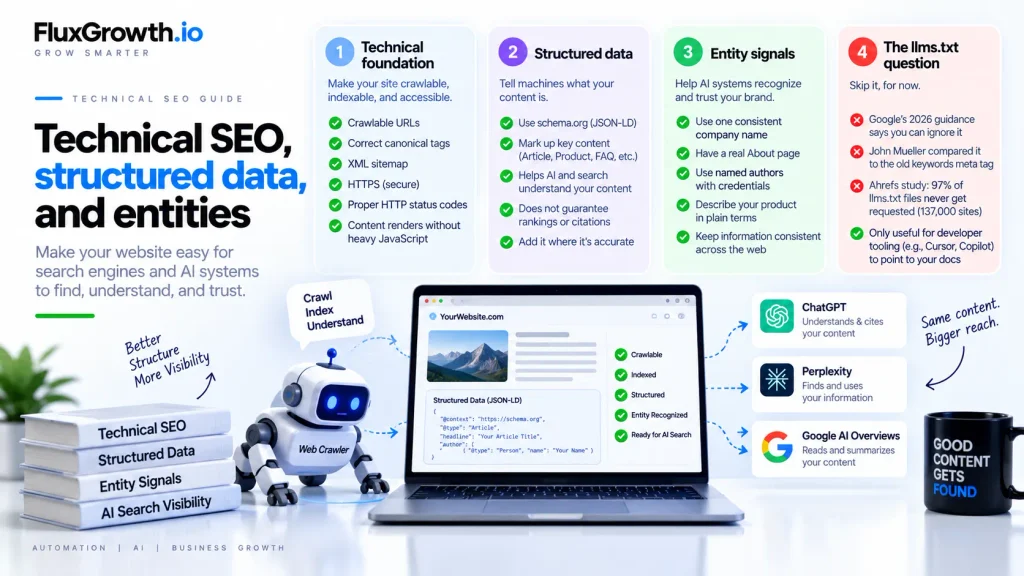
Technical foundation
If a bot can’t crawl and index the page, nothing else matters. The non-negotiables: crawlable URLs, correct canonical tags, an XML sitemap, HTTPS, sane HTTP status codes, and content that renders without requiring heavy client-side JavaScript. If your SaaS site ships critical content only after a JS bundle loads, test how it looks to a crawler that’s a common place AI retrieval quietly fails.
Structured data — what it does and doesn’t do
Structured data (schema.org markup, usually in JSON-LD) tells machines what a page is: an Organization, an Article, a Product, an FAQ, a Breadcrumb trail. It helps systems understand your content with less guesswork. It does not guarantee rankings or AI citations Google treats markup as an eligibility and understanding signal, not a ranking boost. Add it where it’s accurate; skip it where it’s decorative.
Entity signals
AI systems reason about entities, companies, people, products. Help them. Use one consistent company name everywhere, keep a real About page, attach named authors with credentials, and describe your product in plain terms. Consistency is the whole game. If your brand name shows up three different ways, you’ve made yourself harder to pin down.
The llms.txt question
Skip it, for now. Google’s 2026 guidance lists llms.txt among tactics you can ignore, and Google’s John Mueller compared it to the discredited keywords meta tag. An Ahrefs study of 137,000 sites found 97% of llms.txt files never get requested. Its one real use is developer tooling — pointing AI coding assistants like Cursor or Copilot at your docs to save tokens not earning citations.
Internal linking and topical authority
Internal links show search systems how your pages relate, which builds topical authority the signal that you cover a subject thoroughly rather than in one-off posts.
The model is pillar and cluster. One comprehensive pillar page anchors a topic, supporting pages go deep on subtopics, and they all link to each other. For a site like FluxGrowth, an AI-search cluster might look like this: a pillar on AI search optimization linking out to supporting posts on GEO, AEO, AI SEO, AI visibility, and technical SEO each linking back to the pillar and across to its siblings.
When it works, one strong page pulls the weaker ones up with it. Google and the AI systems reading Google’s index start treating the cluster as one authoritative block on the topic, instead of five posts that happen to share a tag.
Optimize an existing page: a prioritized audit
Don’t run down a 20-item list in order. Fix the high-impact things first.
Highest impact:
- Match the search intent is the page actually answering the question people ask?
- Add a direct-answer opening under the H1 and each H2.
- Make authorship and entity info clear real byline, consistent brand name.
- Update anything stale, and show a visible “last updated” date.
Then hygiene:
- Fix broken links and redirect chains.
- Resolve duplicate or thin content and set correct canonical.
- Confirm the page is index-able, fast, mobile-usable, and on HTTPS.
- Check it’s in your sitemap and not blocked in robots.txt.
Quick per-page checklist: clear intent match · direct answer up top · named author and consistent entity · fresh, dated content · index-able, fast, HTTPS · internal links to related pages · accurate structured data · no broken links or duplication.
AI search optimization for developers and SaaS sites
This is where technical teams have an edge you already produce the content AI systems love to cite.
- Product pages: state what the product does in the first line, name the entity, add Organization and Product schema.
- Developer and API docs: these are citation magnets. Clear headings, one concept per section, working code examples, stable URLs. This is also the one place llms.txt earns its keep, for coding assistants.
- Tutorials and how-to guides: numbered steps, one action each, expected result stated.
- Comparison, feature, and integration pages: tables win here, because AI systems extract them cleanly.
- Troubleshooting guides and knowledge bases: phrase headings as the literal error, not a category. “Why am I getting a 429 rate limit error?” is what a developer pastes into ChatGPT “Handling API errors” isn’t.
None of this is new work for a technical team. You already write docs, structure them, and link between them. The gap is usually small and dumb an auth page that answers “How do I authenticate?” three paragraphs in instead of the first line, or an integration page with no comparison table on it. Close those and you’re most of the way there.
How to measure it — and what it can’t guarantee
Measurement here is immature, and it differs by platform. There’s no single “AI visibility score” that everyone agrees on, so be skeptical of any tool that sells you one.
What you can actually watch:
- Google Search Console and analytics, for impression and referral-traffic shifts.
- Referral traffic from AI platforms like ChatGPT and Perplexity, in your analytics.
- Brand mentions and citations, tracked manually or with third-party AI-visibility tools useful as examples, not as official metrics.
- Manual query testing: ask the AI systems the questions you want to own, and see who they cite.
Common mistakes that quietly hurt you: keyword stuffing (which measurably backfires in AI systems), publishing generic AI-generated filler, faking expertise, citing stats with no source, ignoring traditional SEO, and bolting on schema you don’t need.
And the honest limit: no technique guarantees inclusion or citation in an AI answer. These systems change often and choose sources on criteria they don’t fully disclose. You’re improving odds, not buying a slot.
Frequently asked questions
What is AI search optimization?
AI search optimization is the practice of structuring your content so AI-powered search systems can discover, understand, and cite it accurately. It spans technical SEO, content structure, and entity clarity. It builds on traditional SEO rather than replacing it.
Is AI search optimization the same as SEO?
No, but they overlap heavily. Traditional SEO aims to rank a page as a link; AI search optimization also aims to get a passage extracted and cited inside a generated answer. Strong SEO is the foundation AI search optimization is built on.
What’s the difference between GEO, AEO, and AI search optimization?
GEO (generative engine optimization) targets citations inside AI-generated answers. AEO (answer engine optimization) targets direct-answer slots like featured snippets. AI search optimization is the broader umbrella covering both, plus the technical and entity work behind them. The terms aren’t standardized across the industry.
How do I get my website cited by ChatGPT or Perplexity?
Publish accurate, well-structured content with direct answers, named sources, and clear entity naming, and make sure the page is crawlable and indexed. Perplexity favors fresh, authoritative, clearly written pages; ChatGPT retrieves from a web index and cites what it pulls. Neither citation can be guaranteed.
How do I optimize for Google AI Overviews?
Follow strong SEO fundamentals. Google states there are no special requirements or optimizations for AI Overviews beyond being indexed and eligible to show with a snippet. Clear, helpful, well-structured content that ranks is what feeds them.
Does structured data help with AI search?
Structured data helps machines understand what your page is and which entities it covers, which can improve how accurately you’re represented. It does not guarantee rankings or AI citations. Add it where it accurately describes real content on the page.
Do I need an llms.txt file?
For most sites, not yet. Google doesn’t use it, major AI providers haven’t committed to it as a citation signal, and studies show AI crawlers rarely request it. Its clearest current value is helping AI coding assistants parse developer documentation.
The one thing to take with you
AI search optimization isn’t a separate discipline you bolt on at the end. The stuff that gets you cited by AI pages a crawler can reach, answers a reader finds fast, sources you can actually point to, a brand name spelled the same way everywhere — is the same stuff that got you ranking in the first place. You’re mostly just tightening what’s already there.
So start small. Pick one existing page that matters, and audit it for two things: does it answer its core question in the first few sentences, and does it name its entities clearly instead of leaning on “it” and “this”? Fix those, add a source to your biggest claim, and see how it gets used.
These systems will change how they behave again next quarter. They always do. The pages that keep getting pulled are the ones a real person would’ve wanted to read anyway.