FluxGrowth is reader-supported. Some links in our guides are affiliate links — if you buy through one we may earn a commission, at no extra cost to you. It never changes which tools we recommend. How we test tools.
An Instagram marketing strategy in 2026 is a written plan that ties every post to one business goal, one audience, and one number you check each month. Without that plan, posting five times a week mostly produces activity, not customers.
Picture a candle shop in Denver that posts every day. Its Reels pull 2,000 views apiece, and its link in bio gets maybe six taps a week. The owner isn’t lazy (she’s exhausted, honestly). She has a posting habit, not a plan.
This guide turns the habit into a plan. You’ll build it in 10 steps, match each format to a job, get found in both Instagram and Google search, and avoid the measurement mistake that makes most benchmark comparisons useless.
What Is an Instagram Marketing Strategy?
An Instagram marketing strategy is a plan that decides who you’re trying to reach on Instagram, what you’ll post to reach them, and which result proves it worked. An Instagram account is just a place to post. The strategy is what turns posts into followers, leads, and sales.
Most strategies serve one of five goals: awareness, engagement, leads, website traffic, or sales. Pick one primary goal per quarter. A bakery chasing weekend preorders and a SaaS company chasing demo bookings shouldn’t post the same way, and they definitely shouldn’t measure the same thing.
A few terms people mix up
- Reach vs. Views: Reach counts unique accounts; views count how many times content is played or displayed, including repeats.
- Followers vs. Leads: Followers follow your account; leads are potential customers who show interest in your product or service.
- Business vs. Creator Accounts: Business accounts suit companies, while Creator accounts suit influencers and content creators. Both offer professional tools and Insights, though features may vary.
Official source: Instagram Help Center
Why Does Instagram Marketing Still Matter in 2026?
Instagram matters in 2026 because it’s both a discovery app and a search engine now. Reels reach people who’ve never heard of you. DMs and Stories handle the follow-up. And since July 2025, public posts from professional accounts can rank in Google too.
In January 2025, Instagram head Adam Mosseri identified watch time, likes per reach, and sends per reach as three key ranking signals, as reported by Social Media Today. His end-of-2025 memo also highlighted improving originality in ranking as a priority for 2026.
Other changes matter too. In December 2025, Instagram introduced a five-hashtag limit for posts, as reported by The Verge. Trial Reels later gained scheduling options in February 2026, and the free Edits app added a carousel editor in October 2026.
The catch: you don’t own your reach. Socialinsider’s 2026 benchmarks show Instagram’s average engagement rate down 24% year over year. Treat Instagram as the top of your funnel, then move people somewhere you control, like an email list, a DM conversation, or a booking page.
How to Build an Instagram Marketing Strategy Step by Step
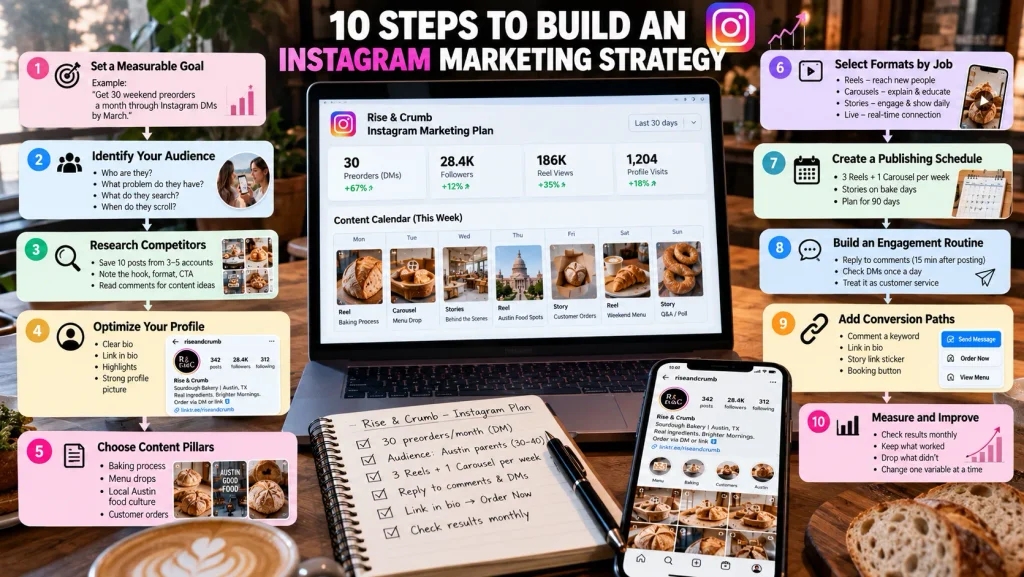
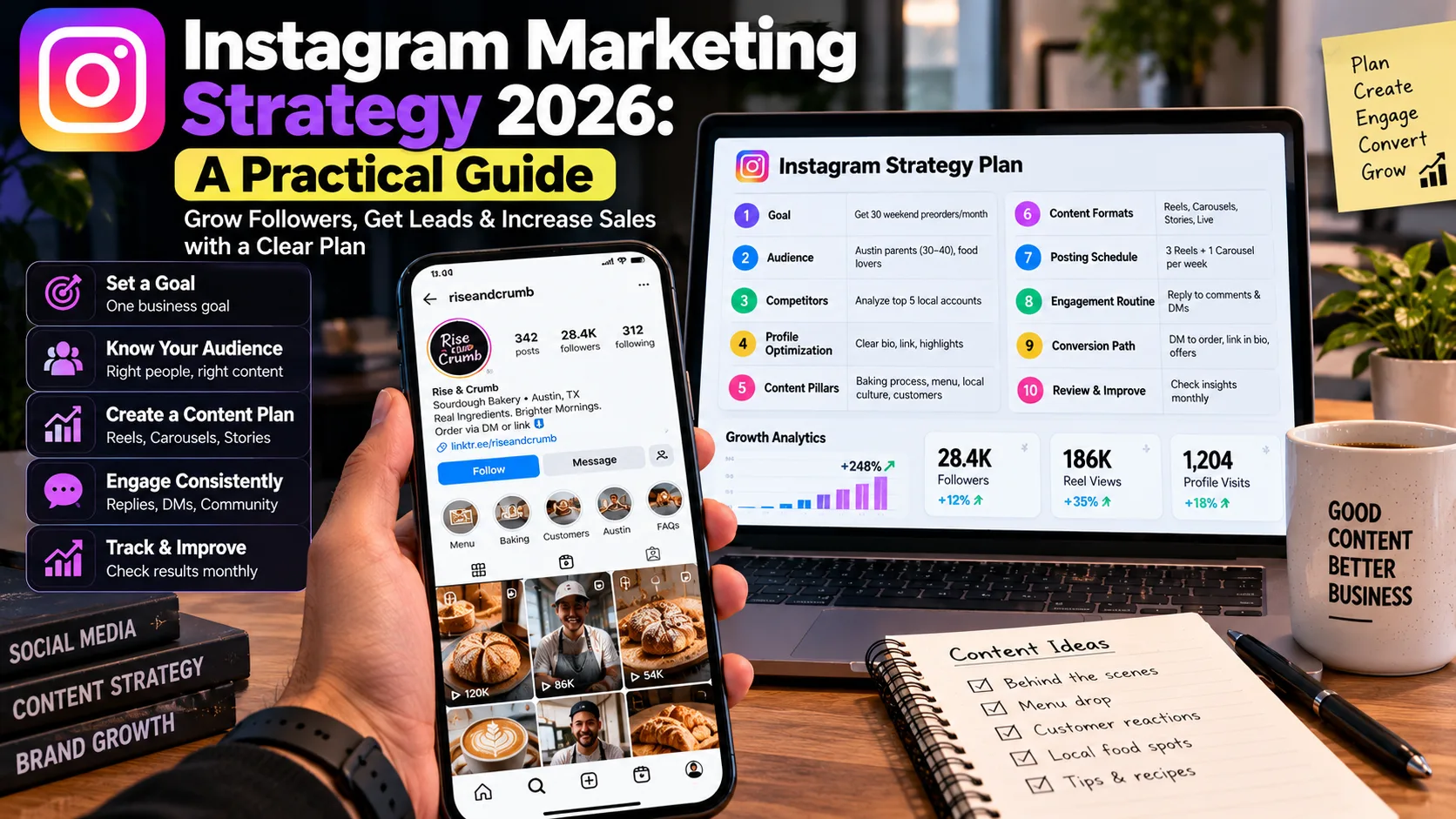
Building an Instagram marketing strategy takes 10 steps: set a goal, define your audience, research competitors, fix your profile, choose content pillars, pick formats, set a schedule, build an engagement routine, add conversion paths, and review monthly. Each step depends on the one before it, so do them in order.
I’ll run one fictional business through every step: Rise & Crumb, a small sourdough bakery in Austin, Texas.
- Define a measurable goal. “Get more followers” isn’t a goal. “Get 30 weekend preorders a month through Instagram DMs by March” is. Rise & Crumb’s number is preorders, so that’s what every decision answers to.
- Identify your target audience. Write one paragraph: who they are, what problem they have, what they’d type into search, and when they scroll. Rise & Crumb’s buyer is a 30-something Austin parent planning weekend brunch on Thursday night.
- Research competitors and audience interests. Save 10 posts from three to five accounts your audience already follows. For each, write down the hook, the format, and the call to action. Then read the comments, because the questions people ask there are free content ideas.
- Optimize your profile. It’s where a curious viewer decides to follow or leave (full breakdown in the next section).
- Choose three to five content pillars. Pillars are the recurring topics you post about. Rise & Crumb picks the baking process, menu drops, local Austin food culture, and customer orders.
- Select formats by job. Covered in the formats section below.
- Create a realistic publishing schedule. Instagram doesn’t publish a required posting frequency, so pick a cadence you can hold for 90 days. Rise & Crumb commits to three Reels and one carousel a week, plus Stories on bake days.
- Build an engagement routine. Block 15 minutes after each post to reply to comments, and check DMs once a day. Treat this as customer service, not a ranking trick.
- Add conversion paths. Every post needs one next step: comment a keyword, tap the link in bio, use the Story link sticker, or hit the booking button.
- Measure and improve. Once a month, compare results to your goal. Keep making what worked, drop what didn’t, and change one variable at a time.
How to Optimize Your Instagram Profile for Marketing
An optimized Instagram profile tells a new visitor in a few seconds who you help, what they’ll get, and what to do next. Most people land on your profile right after one Reel, so it has to do the selling the Reel started.
Name field and username
Your name field is separate from your @username, and both can help people find your profile through Instagram Search. Add a relevant keyword or location—for example, “Rise & Crumb | Austin Bakery”—to make your business easier to identify. Keeping your username consistent across platforms also helps people recognize your brand.
Source: How Instagram Search Works
Profile photo
Logo for a business, face for a personal brand. Check it at thumbnail size, because that’s how most people see it.
Bio formula
Use this structure: who it’s for, what they get, what to do next. For example: “Small-batch sourdough for Austin brunch people. Fresh Friday–Sunday. DM ‘PREORDER’ to reserve a loaf.” That’s three lines, and a stranger knows exactly what to do.
Links, buttons, pinned posts, and Highlights
Put your most important link first. Instagram allows up to five external links in your profile. Professional accounts may also display contact options or action buttons, depending on availability.
Pin three posts to guide visitors through a simple funnel: Introduction, Customer Proof, and Current Offer. Organize Story Highlights like a website menu with labels such as Start Here, Menu, Reviews, and FAQ.
Screenshot suggestion: a before-and-after of the same bio, with the three-part formula labeled.
Best Instagram Content Formats for Marketing
Choose formats based on your goal. Reels can reach new audiences, carousels educate users, and stories engage existing followers.
- Reels: Short videos for discovery and awareness.
- Carousels: Up to 20 photos or videos for guides and tutorials.
- Single-image posts: Product photos and announcements.
- Stories: Polls, links, and daily updates.
- Instagram Live: Real-time Q&As and interviews.
- Collab posts: Share content with collaborators to reach both audiences.
Source: Instagram Help Center
| Instagram Marketing Approach | Best For | Main Advantage | Main Limitation | Primary Metric |
| Instagram Reels | Reaching non-followers | Largest discovery surface on the app | Needs a strong hook and real editing time | Views, sends per reach |
| Carousel posts | Teaching and saves | Holds attention swipe by swipe | Slower to design and write | Saves, shares |
| Instagram Stories | Selling to existing followers | Polls, replies, and link stickers | Disappears in 24 hours unless saved to Highlights | Link taps, replies |
| Collab posts and creator partnerships | Borrowing an audience’s trust | Instant reach into a relevant audience | Needs vetting, contracts, and disclosure | New followers, reach |
| Paid Instagram ads | Predictable traffic and sales | Precise targeting and scale | Costs money and needs tracking set up | Cost per result, ROAS |
The takeaway: lead with Reels for awareness, carousels for authority, and Stories or ads for sales from people who already know you. Most accounts need two or three working together.
Repurpose without cloning
Repurposing means rebuilding one idea for each format, not reposting the same file. Rise & Crumb’s “how we score sourdough” idea becomes a 20-second Reel, a carousel of five scoring patterns, and a Story poll on which pattern to bake Friday. With originality on Instagram’s 2026 priority list, that rebuild matters.
How to Create an Instagram Content Strategy
An Instagram content strategy is the repeatable mix of topics (pillars) and formats you post, with each piece assigned a job. Pillars stop you from deciding what to post from scratch every morning.
Choose your content pillars
Pick three to five from this list, based on your goal:
- Educational: tips and tutorials your audience can use today.
- Entertaining or relatable: the “this is so me” moments in your niche.
- Product or service: what you sell, shown in use rather than in a catalog photo.
- Behind the scenes: your process and your messy middle.
- Customer stories and UGC: reviews and user-generated content, posted with permission and credit.
- Promotional: offers and deadlines. Keep these a minority, or your feed reads like a flyer.
A sample weekly framework
This is a starting point, not an Instagram requirement. Adjust it to the time you actually have.
| Day | Format | Pillar | Call to action |
| Monday | Reel | Educational | “Send this to a friend who…” |
| Wednesday | Carousel | Educational or customer story | “Save this for later” |
| Thursday | Stories | Product | Poll plus link sticker |
| Friday | Reel | Behind the scenes | “Comment ‘MENU’ for the list” |
| Saturday | Stories | Promotional | Link sticker to preorder |
Instagram SEO and Content Discovery
Instagram SEO means making your profile and posts easy to find in two places: Instagram’s own search, and search engines like Google and Bing. Since July 10, 2025, public posts from professional accounts can be indexed by search engines, so one well-written caption can now work in both.
Instagram search
Put your main keyword in your name field and bio, then use natural keywords in the first line of your captions and in your on-screen text. Add up to five specific hashtags. Since Instagram capped posts at five hashtags in December 2025, “#austinbakery” earns its slot; “#food” mostly doesn’t.
Google and Bing search
Google and Bing can index eligible public posts and Reels from professional Instagram accounts owned by adults. Eligible content posted from January 1, 2020 onward may appear in search results. You can disable this through Instagram’s privacy settings.
Write captions that clearly describe your content. For example, “Gluten-free sourdough in Austin: here’s how we bake it” is more descriptive than “Happy Friday!” and may help search engines understand the topic.
Alt text and accessibility
Instagram lets you add custom alt text to photos through Advanced settings → Accessibility → Write alt text when creating a post. Describe the image clearly for people using screen readers, and include keywords only when they naturally describe what’s shown.
What’s confirmed and what isn’t
Confirmed by Instagram: search engine indexing for eligible accounts, the five-hashtag cap, and the ranking signals Mosseri named. Not confirmed: exactly how much captions, alt text, or on-screen text weigh in ranking. Anyone giving you a precise keyword formula for Instagram is guessing.
How to Grow Instagram Engagement and Reach
You grow Instagram reach by making content people watch to the end and send to a friend, then replying quickly enough that the conversation keeps going. In January 2025, Mosseri said sends per reach is slightly more important for reaching people who don’t follow you yet, while likes matter slightly more with existing followers.
Design for the send
The strongest test for an idea: would someone DM this to a specific person? “Three brunch spots in Austin that take preorders” gets sent. “Our new menu is live” usually doesn’t. A “send this to…” line helps, but only when the content already deserves it.
Reply, then start conversations
Answer comments with a follow-up question, not a heart emoji. Price questions go to DMs.
Test with Trial Reels
Trial Reels go to non-followers first, so you can test two hooks on one idea without cluttering your grid. Compare watch time and send, then publish the winner.
Collaborate with relevant creators
Partner with accounts whose audience overlaps yours without competing with you. A bakery and a local coffee roaster? Natural Collab post.
Skip the shortcuts
Here’s the thing — bought followers look great for exactly one screenshot. They never buy, they never send your Reels to anyone, and they drag your engagement rate down every month after. Engagement pods and follow-unfollow have the same problem on a smaller scale. Skip all three.
Instagram Marketing for Different Business Types

Every business type uses the same 10 steps. What changes is the content mix and the call to action.
Small businesses and local services
Put your city or neighborhood in your name field and captions, because local searches are where Google indexing helps most. A Plano dog groomer posting before-and-after carousels with “Plano dog grooming” in the first caption line gives both Instagram and Google a clear match. Use Stories for same-week availability.
E-commerce brands
A candle on a white background is a catalog photo. The same candle flickering on someone’s nightstand while they read? That’s a reason to buy.
Film products in use, repost customer clips with permission, and let product tags handle checkout. Add UTM parameters to every link so Google Analytics shows which posts drive purchases.
Coaches and consultants
Teach one piece of your framework per carousel (say, seven slides on the three pricing mistakes new coaches make), then offer the deeper version in exchange for a DM. “Comment ‘PLAN’ and I’ll send you the template” turns a save into a lead you can follow up with.
Content creators and influencers
Brands buy predictable audiences, so niche consistency matters more for you than anyone. Test new formats with Trial Reels and keep a simple media kit with reach, views, and audience location.
Freelancers and personal brands
Your pinned posts are your portfolio. Show your process (the draft, the revision, the result) and end posts with one service-specific next step, like “DM me ‘AUDIT’ for a free profile review.”
B2B and SaaS companies
For B2B, Instagram is usually a trust channel, not a demo machine. A founder explaining a product decision on camera does more than a polished feature graphic. Measure profile visits and website clicks, then judge demos in your CRM.
Instagram Ads vs. Organic Marketing
Organic Instagram marketing is content you post for free and let Instagram distribute; paid Instagram advertising is content you pay Meta to show to an audience you choose. In practice, they work as a pair. Organic posts are your free test lab, and ads put money behind whatever passed the test.
When organic is enough
Organic makes sense when you’re early or still testing your message.
When paid campaigns help
Paid ads help when you have a proven offer, a launch, a tight local radius, or site visitors to retarget. If you can’t say what a new customer is worth, wait.
Boosted posts vs. Ads Manager campaigns
Boosted posts promote existing content with simple goals, such as profile visits, website visits, or messages. Meta Ads Manager offers more control over campaign objectives, placements, testing, and conversion tracking using the Meta Pixel or Conversions API.
Rule of thumb: Boost a post to quickly expand its reach; use Ads Manager when you need to optimize and measure leads or sales.
Sources: Meta Business Help Center · Meta Ads Manager guide
Budget and measurement
Promote posts that already won organically. You already know the hook works, so the ad budget goes to reach, not guessing.
Set a fixed test budget you can afford to lose, run it for a set window, and compare cost per result to what a customer is worth. If a Rise & Crumb preorder is worth $40, paying $8 to get one is fine. Paying $60 isn’t.
Point the ad at a matching landing page with a tagged link. And ignore anyone quoting you a “typical” cost per click; your audience and offer set that, not an industry average.
AI Tools and Automation for Instagram Marketing
AI tools help Instagram marketing in two different ways: assistants that draft and design content for you to review, and automation tools that take actions on your account. Assistants are low-risk because you approve everything. Automation is where accounts get restricted, so it needs more care.
Content-assistance tools
Use a chatbot like Claude or ChatGPT to draft caption variations, turn your pillars into a month of ideas, or summarize recurring questions from a batch of comments you paste in. Canva handles graphics and carousel templates. Meta’s free Edits app handles video editing and, as of October 2026, carousel editing on iOS.
Source: Anthropic — What You Can Use Claude For
A prompt that actually works: “Here are my three content pillars and my audience. Give me 12 Reel ideas, each with a hook under 10 words and a ‘send this to’ angle. Avoid generic tips.”
Automation tools
Use Instagram or Meta Business Suite to schedule posts. For automated replies and reporting, choose trusted tools that use Meta’s official API.
Guardrails
- Review AI content before publishing and protect customer data.
- Avoid bots that automate likes, follows, comments, or unauthorized scraping.
- Follow Meta’s AI disclosure rules for realistic AI-generated content.
Sources: Meta Business Suite · Instagram Terms of Use · Meta AI labeling policy
How to Measure Instagram Marketing Performance
Measure Instagram performance with the metric that matches your goal: reach and views for awareness, engagement rate for content quality, profile visits and link taps for interest, and leads and conversions for business results. Track three or four metrics consistently instead of twenty occasionally.
Here’s what each core metric means:
- Reach: unique accounts that saw your content.
- Views: total plays or displays, repeats included. Views replaced impressions in Instagram Insights in April 2025; impressions still exist in Meta Ads Manager.
- Engagement rate: interactions (likes, comments, saves, shares) divided by a base number.
- Profile visits and link taps: signs someone wants more than one post.
- Follower growth rate: new followers in a period ÷ followers at the start × 100.
- Leads and conversions: DMs, sign-ups, bookings, or purchases traced to Instagram.
- Cost per result and ROAS: what you spent per outcome, and revenue per ad dollar.
Why engagement rate depends on the denominator
Engagement rate isn’t one formula; it’s three, and each gives a different answer for the same post. Say a Reel gets 120 interactions, reaches 3,000 accounts, gets 4,000 views, and your account has 10,000 followers:
- By reach: 120 ÷ 3,000 × 100 = 4.0%
- By views: 120 ÷ 4,000 × 100 = 3.0%
- By followers: 120 ÷ 10,000 × 100 = 1.2%
Same Reel. Three different numbers. Meta’s Instagram Insights resources help readers understand performance metrics.
Here’s what most benchmark posts skip: this is exactly why published benchmarks disagree so wildly. Socialinsider reports a 0.48% average for Reels in Q3 2026, while Dash Social’s 2026 benchmark report puts Reels at 2.7%, because Dash Social divides by views. Both figures are accurate; you just can’t hold one up against the other.
For organic content, I’d use engagement by reach, because it judges the post by the people who actually saw it. Whatever you pick, use the same formula every month.
Business metrics with simple math
Conversion rate is conversions divided by link taps, times 100. If 200 people tap your link and 10 buy, that’s 5%. ROAS is revenue divided by ad spend: spend $200, trace $600 in sales, and your ROAS is 3.0. Both examples are hypothetical. Source: Meta Ads Manager
| Goal | Primary metric | Supporting metric |
| Awareness | Reach | Views from non-followers |
| Engagement | Engagement rate by reach | Saves and sends |
| Leads | DM leads or sign-ups | Profile visits |
| Sales | Conversions | Cost per result, ROAS |
Common Instagram Marketing Mistakes to Avoid
Most Instagram marketing mistakes come from skipping the plan and jumping straight to posting. Each one below has a fix you can apply this week.
- Posting without a clear goal. Fix: write one measurable goal for the quarter before you plan a single post.
- Targeting everyone. Fix: write a one-paragraph audience snapshot and test every idea against it.
- Ignoring the profile. Fix: rewrite your bio with the three-part formula and pin three funnel posts.
- Publishing without a plan. Fix: batch a week of content from your pillars every Sunday.
- Relying on hashtags. Fix: use up to five specific hashtags and put real effort into captions and on-screen text instead.
- Buying followers. Fix: don’t. Grow slower with real people who might buy.
- Chasing irrelevant trends. Fix: only use a trend if you can tie it to one of your pillars in a sentence.
- Ignoring comments and DMs. Fix: schedule 15 minutes after each post and a daily DM check.
- Measuring likes instead of outcomes. Fix: track the one business metric tied to your goal.
- Publishing AI content without review. Fix: read every AI draft out loud and fact-check its claims.
- Skipping sponsorship disclosures. Fix: use Instagram’s Paid Partnership label and also say “ad” or “sponsored” clearly in the caption. The FTC’s 2023 Endorsement Guides warn that a platform’s built-in disclosure tool may not be enough on its own.
What I’d Do If I Were Starting Today
If I were rebuilding my Instagram strategy today, I’d start with a clear audience, one goal, an optimized bio, and three pinned posts.
In week two, I’d choose three content pillars and plan 12 ideas. Then I’d publish three Reels and one carousel each week, test different hooks, and spend 15 minutes engaging with my audience after posting.
At day 30, I’d review reach, engagement rate, profile visits, and leads to identify what worked. I’d repeat the strongest content formats and consider a small ad budget only after identifying a promising post.
As I grow FluxGrowth, I can use this process to test what works, learn from real analytics, and share the results instead of relying on guesswork.
Frequently Asked Questions
What is the best Instagram marketing strategy in 2026?
The best Instagram marketing strategy in 2026 is built around one measurable goal, a defined audience, and three to five content pillars, reviewed monthly. Use Reels for reach, carousels for saves, and Stories for sales, weighted toward whichever goal matters most.
How often should a business post on Instagram?
Instagram doesn’t publish a required posting frequency. Pick a schedule you can keep for 90 days, like three Reels and one carousel a week plus Stories. A pace you can maintain beats a daily one you abandon.
How many hashtags should you use on Instagram in 2026?
You can use up to five hashtags per post or Reel, the cap Instagram announced in December 2025. Choose specific hashtags that describe the post, like a location or niche tag. Captions, on-screen text, and your name field matter more for discovery than a long hashtag list.
Are Instagram Reels better than carousel posts for marketing?
Neither is better across the board. Reels reach people who don’t follow you; carousels teach and earn saves. Socialinsider’s Q3 2026 data shows nearly identical engagement rates for both, so most accounts should use both.
How much should a small business spend on Instagram ads?
There’s no single right number, because costs depend on your audience, offer, and creativity. Start with a fixed test budget you can afford to lose, promote a proven organic post, and compare cost per result to what a customer is worth.
How can I use AI for Instagram marketing?
Use AI to draft captions, brainstorm Reel hooks, and turn your pillars into a content calendar, then review every draft before posting. Avoid tools that auto-follow, auto-comment, or scrape accounts, since that automation breaks Instagram’s rules.
How do I measure Instagram marketing success?
Measure the metric that matches your goal: reach for awareness, engagement rate by reach for content quality, and leads or conversions for business results. Check Insights monthly with the same formula each time.
The Bottom Line
The best Instagram marketing strategy for 2026 is the one you can measure: one goal, one audience, and one number you check every month. Let your own data pick your formats and posting pace, not a viral Reel from someone running a completely different business.
Start today, and keep it small. Rewrite your bio with the three-part formula, pick three content pillars, and decide which single number you’ll check 30 days from now.
If you looked at your profile right now as a total stranger, would you know what to do next?