FluxGrowth is reader-supported. Some links in our guides are affiliate links — if you buy through one we may earn a commission, at no extra cost to you. It never changes which tools we recommend. How we test tools.
Introduction
Research used to mean hours in a library, digging through databases, and manually cross-referencing dozens of sources. Today, that picture looks very different.
AI tools for research have changed how students, academics, marketers, and scientists gather and analyze information. What once took days can now be done in hours sometimes minutes.
But here’s the thing there are hundreds of AI research tools out there, and most of them aren’t worth your time. The wrong tool doesn’t just slow you down. It creates more noise than signal.
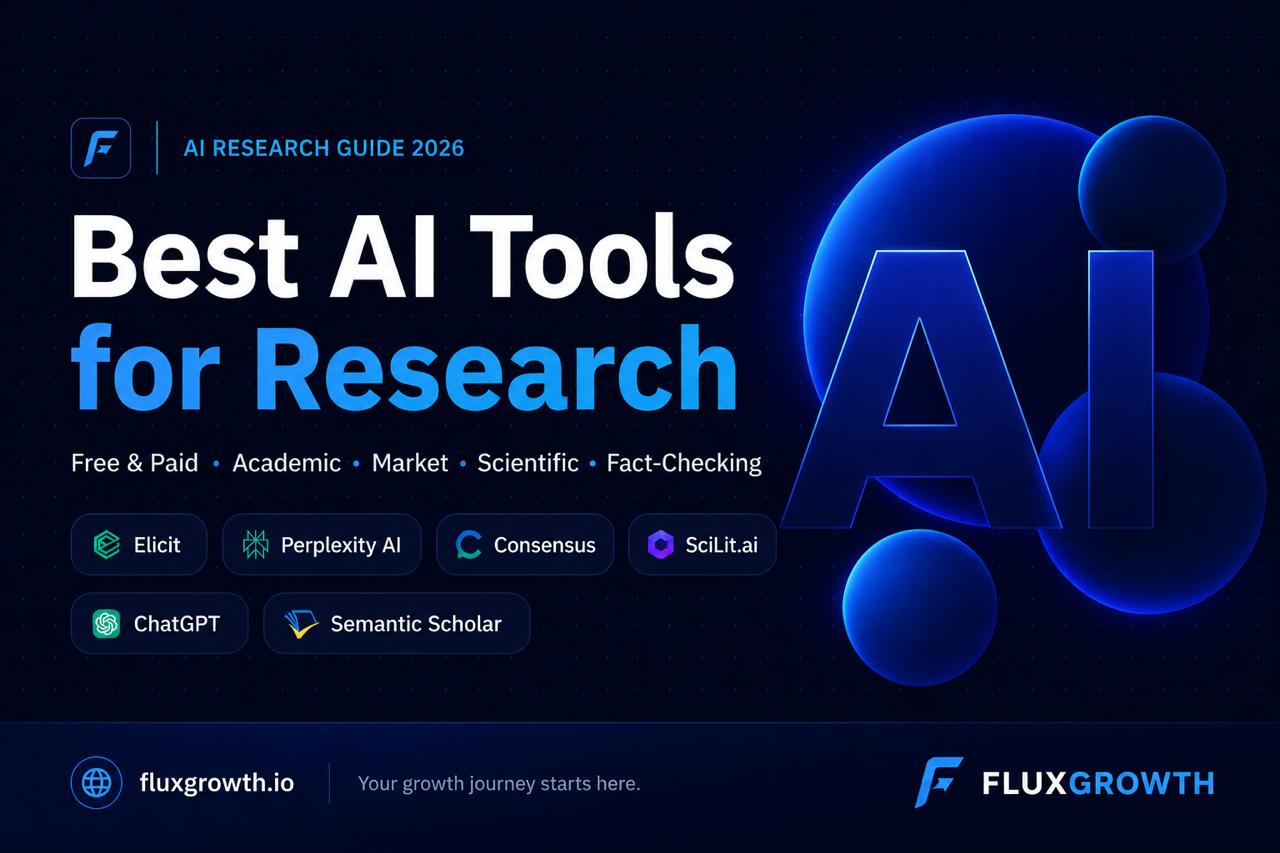
In this guide, we break down the best AI tools for research in 2026 across academic work, data analysis, market research, fact-checking, and more. Whether you’re a student writing your first paper or a professional building a competitive strategy, this list helps you find the right tool, fast.
Why Are Researchers Turning to AI Tools?
The Challenge of Traditional Research Methods
Traditional research is slow by design. You search a database, scan abstracts, download papers, read through dense text, and repeat.
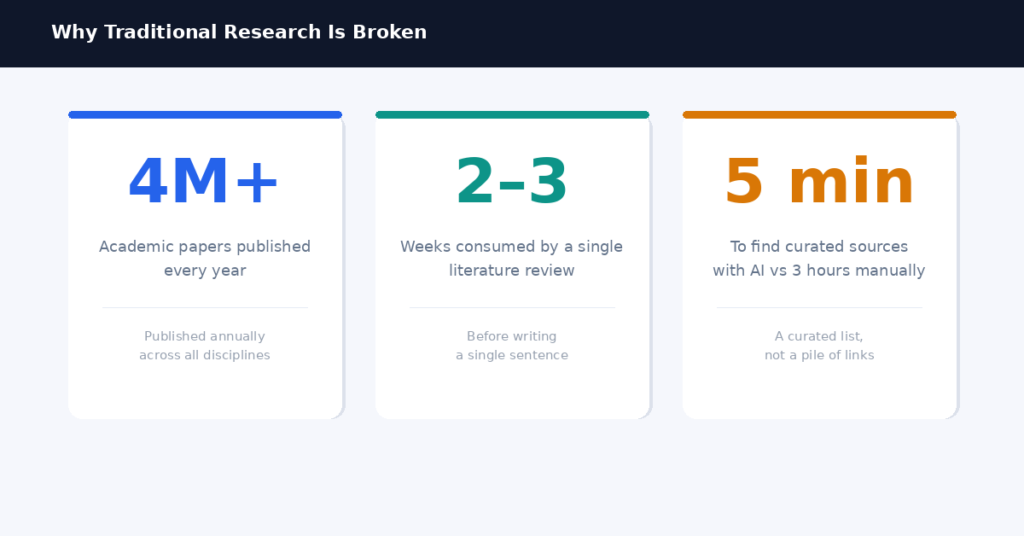
For a single literature review, that process can eat two to three weeks. And that’s before you’ve written a single sentence.
Beyond the time cost, there’s the problem of volume. Over 4 million academic papers are published every year. No one can manually track all of it. Important studies get missed. Relevant data goes unnoticed.
There’s also the cognitive load problem managing citations, organizing notes, cross-referencing sources, and trying to write clearly at the same time. Something always slips.
How AI Speeds Up the Research Process?
AI research tools cut through that. They scan thousands of papers in seconds, extract key findings, summarize complex content, and suggest related studies you’d never have found on your own.
Instead of spending three hours hunting for sources, you get a curated list in under five minutes. Instead of manually formatting 40 citations, AI handles it automatically.
The result isn’t just speed it’s better research. When you’re not stuck in logistics, you actually have time to think.
Who Can Benefit from AI Research Tools?
A PhD student in the US using Elicit to map two years of climate research in an afternoon. A startup founder using Exploding Topics to catch a market shift three months before anyone else writes about it. A journalist using Perplexity to verify a quote in under 90 seconds.
That’s the range. If your job involves processing information any kind of information there’s a tool in this list for you.
Best AI Tools for Academic Research & Literature Review
1.Consensus – AI Tool for Evidence-Based Research
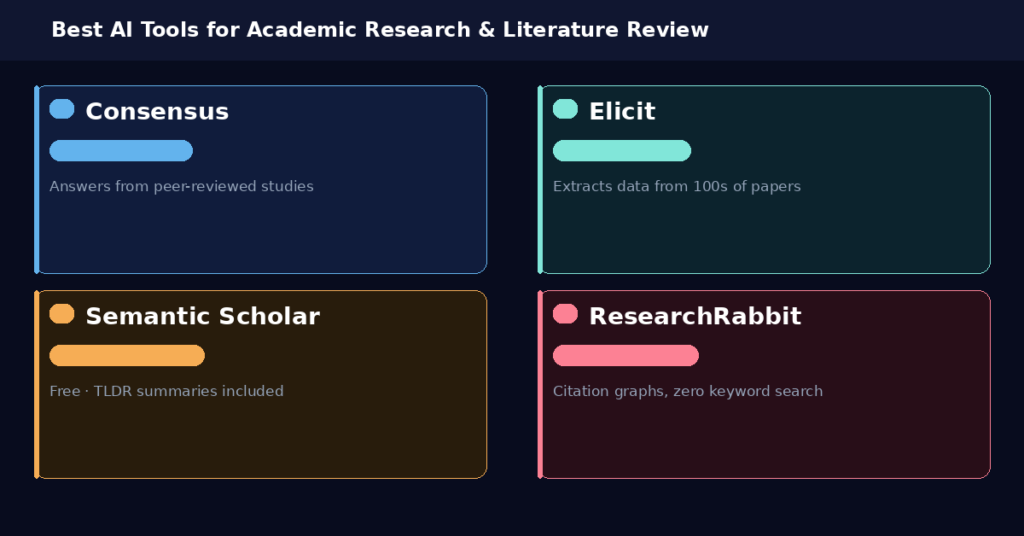
Consensus is built specifically for academic research. You type in a research question — something like “does intermittent fasting improve cognitive performance?” — and it pulls answers directly from peer-reviewed studies, with citations included.
Unlike a standard search engine, it doesn’t just return links. It surfaces the actual conclusions from studies and tells you whether the evidence supports, contradicts, or is inconclusive on your question.
For anyone who needs evidence-backed answers without spending an hour digging through Google Scholar, it’s one of the most practical AI tools for academic research right now.
Best for: Answering specific research questions with cited academic sources.
Pricing: Free tier available; paid plans start at $9.99/month.
2.Elicit – Best for Literature Review Automation
Elicit automates the most tedious part of academic research. You enter a research question, and it finds the most relevant papers, extracts specific data points sample size, methodology, key findings — and organizes everything into a table.
You don’t have to read each paper in full to get the overview. That’s the point.
It’s especially valuable for systematic reviews or meta-analyses where you’re processing 50+ studies and need to compare them side by side without losing your mind.
Best for: Systematic literature reviews and large-scale paper analysis.
Pricing: Free tier available; Elicit Plus for heavier usage.
3.Semantic Scholar – AI-Powered Academic Search Engine
Semantic Scholar is a free search engine built by the Allen Institute for AI. It indexes over 200 million papers and uses AI to surface the most relevant results, highlight influential citations, and flag emerging research trends.
The most useful feature for busy researchers: the TLDR. One AI-generated sentence summarizing the paper, so you can decide in five seconds whether it’s worth opening.
Free. No login required. Just use it.
Best for: Broad academic searches and finding influential papers in any field.
Pricing: Free.
4.ResearchRabbit – Mapping Research Papers with AI
ResearchRabbit doesn’t do keyword search. Instead, it builds a visual map you start with one paper, and it expands outward to show everything connected to it by citation and topic.
What papers cite it. What it cites. What’s closely related but not directly linked.
For researchers entering a new field, this visual approach surfaces papers that standard searches completely miss. It’s how you find the study that changes your entire argument.
Best for: Exploratory research and understanding the relationships between papers.
Pricing: Free.
Best AI Tools for Writing & Research Papers
1.Perplexity AI – Real-Time Research Assistant
Perplexity works like a search engine that actually explains things. Ask a question, get a direct answer — with citations from real web sources, pulled in real time.
No tab-hopping. No piecing together fragments from five different pages.
It’s particularly useful when you’re getting up to speed on an unfamiliar topic and need a sourced starting point before going deeper. Think of it as a smarter first stop before you open the academic databases.
Best for: Quick research with cited real-time sources.
Pricing: Free; Perplexity Pro at $20/month.
2.ChatGPT – Drafting, Summarizing & Structuring Papers
ChatGPT is still one of the most versatile AI tools for research papers — not because it finds sources, but because it thinks alongside you.
Strong for drafting outlines, restructuring arguments, summarizing uploaded documents, and generating research questions you hadn’t considered. You can paste in a dense paragraph and ask it to explain it simply. You can upload a 40-page PDF and ask for the three most important takeaways.
One honest caveat: ChatGPT makes up citations. Confidently and convincingly. Always verify any source it mentions before you use it.
Best for: Writing, drafting, summarizing, and brainstorming.
Pricing: Free; ChatGPT Plus at $20/month for GPT-4o access.
3.Jenni AI – Purpose-Built for Research Paper Writing
Jenni is built for one thing: academic writing. It offers in-line AI suggestions as you type, auto-citation in APA, MLA, and Chicago formats, and a built-in research library.
Unlike general writing tools, Jenni understands academic structure — it helps you maintain the logic of an argument across sections, not just fix grammar at the sentence level.
If you’re regularly writing research papers and tired of juggling Google Docs, Zotero, and a separate AI tool, Jenni pulls all of that into one place.
Best for: Academic writing with proper citations and structure.
Pricing: Free starter plan; paid plans from $20/month.
4.Grammarly – Refining Research Writing
Grammarly isn’t an AI research tool in the traditional sense, but it earns its place in any researcher’s workflow.
For research papers specifically, the plagiarism checker matters — especially when you’re working across multiple sources and paraphrasing heavily. It’s easy to accidentally mirror the phrasing of a paper you read three days ago. Grammarly catches that.
The clarity suggestions are useful too, particularly when you’ve been staring at a dense paragraph so long you can’t tell if it actually makes sense anymore. (It usually doesn’t. That’s fine.)
Best for: Editing, proofreading, and plagiarism checking.
Pricing: Free; Grammarly Premium from $12/month.
Best AI Tools for Scientific Research
1.Scite.ai – Smart Citation Analysis
Scite is one of those tools that makes you wonder how you researched without it.
It doesn’t just count how many times a paper has been cited — it tells you whether those citations supported, contradicted, or simply mentioned the findings. A paper with 500 citations sounds solid, until you see that 180 of them are contradicting its core claim. That context changes everything.
For scientists evaluating the strength of existing evidence, this is essential.
Best for: Citation quality analysis and evaluating scientific credibility.
Pricing: Free limited access; paid plans from $20/month.
2.IBM Watson – AI for Scientific Data Processing
Watson is not a tool you open in a browser and start using in an afternoon. It’s an enterprise platform — the kind hospitals and research institutions deploy to process thousands of clinical trial records or unstructured patient data at scale.
Individual researchers and students: skip it for now. But if you’re part of a team running large-scale data pipelines, it belongs on your radar.
Best for: Large-scale scientific data processing and enterprise research workflows.
Pricing: Usage-based via IBM Cloud.
3.AlphaFold by DeepMind – AI in Life Sciences Research
AlphaFold is probably the most consequential AI tool in scientific research, full stop.
Developed by Google DeepMind, it predicts the 3D structure of proteins from amino acid sequences. Protein structure prediction used to take years of experimental work. AlphaFold does it computationally. The AlphaFold Protein Structure Database now holds predictions for over 200 million proteins and is publicly available.
If you work in structural biology, biochemistry, or drug discovery, this changed your field. Permanently.
Best for: Life sciences and structural biology research.
Pricing: Free via the AlphaFold Protein Structure Database.
4.Connected Papers – Visual Research Mapping
Similar to ResearchRabbit, Connected Papers builds a visual graph of related academic papers based on citation connections. Drop in one paper, and it maps the neighborhood around it — showing you foundational studies, parallel research, and recent work in the same area.
Especially useful for finding the two or three “seminal papers” in a field that everything else references. Those are the ones you need to read first.
Best for: Discovering related papers and understanding research lineage.
Pricing: Free for 5 graphs/month; paid plans for heavier use
Best AI Tools for Market Research
1.Crayon – Competitive Intelligence with AI
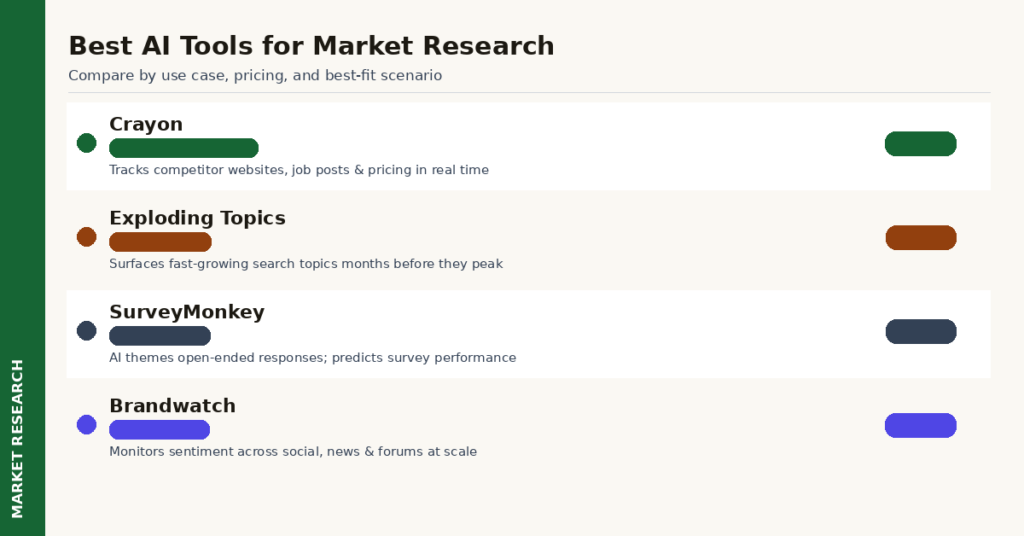
Crayon monitors competitor activity across websites, social media, press releases, job listings, and pricing pages then uses AI to surface what actually matters.
Instead of manually checking a competitor’s site every week, you get alerts when something meaningful changes. A pricing update. A new product page. A shift in messaging. Real-time and automatic.
Best for: Ongoing competitive intelligence and market monitoring.
Pricing: Custom pricing based on team size.
2.Exploding Topics – Trend Discovery for Market Research
Exploding Topics surfaces trends before they go mainstream. Its AI analyzes search data, social signals, and online discussions to identify topics growing rapidly in interest — often months before mainstream coverage catches up.
Think: a content team that spotted “AI coding assistants” as an exploding search trend in early 2023, six months before every major tech publication ran that exact story. That’s the edge this tool exists to give you.
Best for: Spotting emerging trends early for market positioning.
Pricing: Free limited access; Pro plans from $39/month.
SurveyMonkey Genius – AI-Enhanced Survey Analysis
SurveyMonkey’s built-in AI features help researchers design better surveys and read results faster. The Genius feature predicts survey performance before you launch flagging questions that are likely to confuse respondents or skew results.
The AI analysis of open-ended responses is the real time-saver: it automatically identifies themes across hundreds of written answers so you’re not reading each one manually.
Best for: Survey design, distribution, and response analysis.
Pricing: Free basic plan; paid plans from $25/month.
Brandwatch – AI Social Listening for Market Insights
Brandwatch monitors social media, forums, news sites, and review platforms in real time — and uses AI to analyze sentiment, surface trends, and track how conversations around a brand or topic are shifting.
For market researchers, it replaces hours of manual social monitoring with a live dashboard. Less scrolling, more insight.
Best for: Social listening, brand monitoring, and audience sentiment analysis.
Pricing: Custom pricing; enterprise-focused.
Best AI Tools for Fact-Checking & Online Research
1.Perplexity AI – Cited Answers in Real Time
Perplexity earns a second mention here specifically for fact-checking. Every answer includes direct citations from the web — you can see the source, click through, and verify it yourself in under a minute.
That transparency makes it significantly more useful for research than tools that generate confident-sounding answers with no attribution.
Best for: Quick fact verification with source transparency.
2.FullFact & ClaimBuster – Automated Fact Verification
FullFact is a UK-based fact-checking organization that uses AI to automatically identify and check factual claims in public discourse. ClaimBuster, developed at the University of Texas at Arlington, scores statements by how likely they are to contain a checkworthy factual claim — useful for triaging a large volume of content.
Both are free. Both are worth bookmarking if you work with public data, political content, or anything that needs verification.
Best for: Automated claim detection and fact-checking.
Pricing: Free.
3.Google Fact Check Explorer
Google’s Fact Check Explorer pulls together fact-checks from verified organizations worldwide. Search any claim and see whether credible outlets have examined it — and what they found.
Simple. Fast. A good first stop before going deeper.
Best for: Checking whether a specific claim has already been fact-checked.
Pricing: Free.
4.Factiverse – AI-Powered Fact Checking for Journalists
Factiverse is built for media teams and editorial workflows. It scans text in real time, flags claims that may need verification, and surfaces relevant fact-checks from trusted sources — without the researcher having to manually check each claim.
For newsrooms publishing at high volume, this kind of automated layer catches things that would otherwise slip through.
Best for: Journalists and content publishers who need built-in fact-checking.
Pricing: Available on request.
Best Free AI Research Tools for Students
1.Elicit (Free Tier) – Great for Literature Reviews
Elicit’s free tier gives access to its core features: paper search, automated data extraction, and summary tables. For most student research needs, the free version is enough — you don’t need a paid plan to run a solid literature review.
2.Perplexity AI (Free) – Quick Research Summaries
The free version of Perplexity is one of the most capable free research tools available today. Cited answers, real-time sources, no meaningful usage cap for everyday research. Start here before opening anything else.
3.Google NotebookLM (Free) – Upload & Chat with Research Sources
NotebookLM lets you upload your own research materials — PDFs, notes, articles — and ask questions about them. It only answers from what you’ve uploaded, which means it won’t hallucinate facts from outside your source material.
For a student working through a set of course readings or a fixed collection of papers, that’s genuinely useful. It keeps the AI grounded in your actual sources.
Pricing: Free.
4.ChatGPT Free Version Brainstorming & Research Help
The free version of ChatGPT is still capable enough for brainstorming research questions, building outlines, and getting plain-English explanations of complex concepts.
It doesn’t have real-time web access on the free tier, so don’t rely on it for current sources. But as a thinking partner for structuring your ideas? More than good enough.
How to Choose the Right AI Research Tool
Define Your Research Goal First
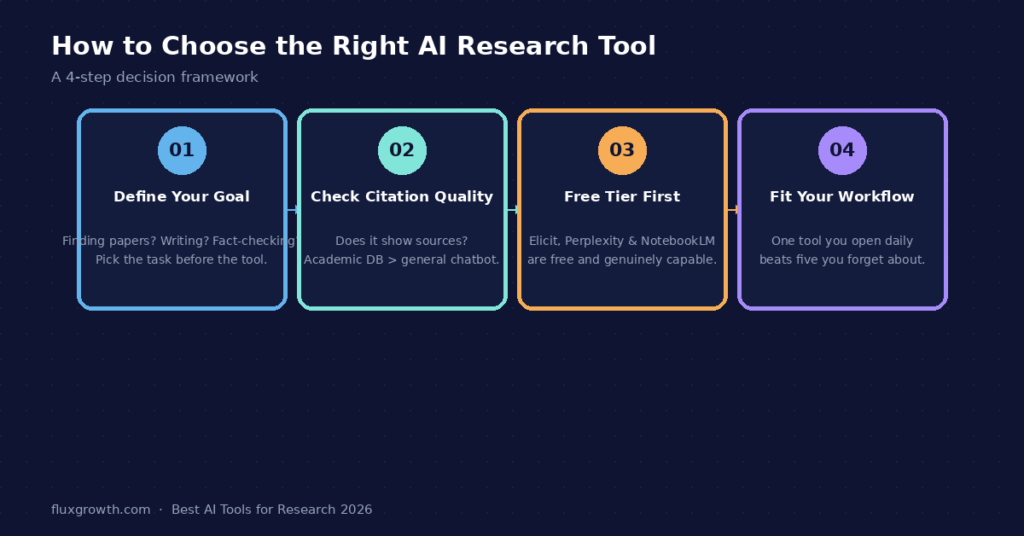
Before picking any tool, get specific about what you actually need. Finding papers? Writing faster? Analyzing data? Verifying claims?
Each of those tasks has tools built specifically for it. A student writing a literature review needs Elicit or Consensus not Brandwatch. A market researcher tracking competitors needs Crayon not Jenni AI.
Start with the task. Then find the tool.
Consider Accuracy & Citation Quality
Here’s where most people get burned. Not all AI tools treat accuracy the same way.
Consensus and Elicit pull from verified academic databases. Semantic Scholar indexes peer-reviewed papers. These tools are built around source quality.
General-purpose chatbots are different. They can generate plausible-sounding claims with no factual basis. For any research where accuracy matters, prioritize tools that show their sources.
Free vs Paid: What’s Worth the Investment?
A lot of the best AI tools for research are free or have free tiers that cover most needs. Elicit, Perplexity, Semantic Scholar, ResearchRabbit, and Google NotebookLM all work well without paying anything.
Paid plans make sense when you’re doing high-volume research, need exports, or keep hitting free tier limits. A $20/month tool that saves you five hours of research per week pays for itself on the first day of the month.
Integration with Your Existing Workflow
The best tool is the one you’ll actually open every time you sit down to research. That usually means the one that fits into what you’re already doing.
Does it export citations in your format? Does it work with your note-taking app? Can you get to it in two clicks?
One well-integrated tool you use daily beats five tools you open occasionally and forget about.
Frequently Asked Question?
What is the best AI tool for research?
It depends on your use case. For academic research, Consensus and Elicit are the strongest options. For writing research papers, Jenni AI or ChatGPT. For market research, Exploding Topics and Crayon. There’s no single best but there’s almost always a best one for your specific task.
Are AI tools for academic research reliable?
Tools like Consensus, Elicit, and Semantic Scholar are built on peer-reviewed academic databases — they’re highly reliable for academic use. General-purpose AI chatbots are less reliable for factual claims and should always be independently verified before you cite anything.
Can AI replace traditional research methods?
No. AI speeds up the process significantly, but it doesn’t replace domain expertise, critical thinking, or primary data collection. The researchers getting the best results use AI to handle the logistics — finding and organizing sources while they focus on the actual analysis.
What AI tools do researchers use most in 2026?
Perplexity AI, Elicit, Semantic Scholar, and ChatGPT are among the most widely used. For specialized scientific research, Scite.ai and AlphaFold have become standard tools in their fields.
Which free AI tools are best for student research?
Elicit (free tier), Perplexity AI (free), Google NotebookLM (free), Semantic Scholar (free), and ResearchRabbit (free) are all strong starting points. Most students can build a solid research workflow without spending anything.
Can AI tools help with literature review?
Yes and this is where AI tools for research show their clearest advantage. Elicit and Research Rabbit are specifically designed for literature reviews. They find relevant papers, extract key data, and map the research landscape around a topic in a fraction of the time it takes manually.
Conclusion
Here’s what’s changed: research used to be a bottleneck. Now the bottleneck is knowing which tool to actually use.
Most people waste the first month switching between five different tools, never going deep enough on any of them to see real results. (Been there. It’s not a good use of time.)
Match the tool to the task. Elicit and Consensus for literature reviews. Perplexity and Jenni AI for writing and sourcing. Exploding Topics and Brandwatch for market intelligence. And if budget is a concern, the free tiers here are genuinely capable you don’t need to spend anything to get started.
At FluxGrowth, the pattern I’ve seen consistently is this: the researchers who get the most out of AI aren’t the ones with the most subscriptions. They’re the ones who pick two or three tools that fit their workflow and actually use them.
Pick one tool from this list. Use it seriously for a week. Then build from there.