Two things are true about social media jobs right now, and they don’t sound like they belong together. The U.S. The Bureau of Labor Statistics expects marketing-related management roles to grow about 6% through 2034 faster than the average job. At the same time, a Stanford study updated with Anthropic’s data found that early-career marketers aged 22 to 25 have lost roughly 20% of their headcount to AI since 2023.
So the field is expanding and the bottom rung is getting narrower, at the same time. That’s the real story almost nobody on page one of Google is telling you.
So this guide does two jobs. It shows you what these roles actually pay in 2026 with honest notes on which Glassdoor numbers to trust and which are built on four salaries and a prayer. And it shows you how to get hired now that “I’ll just write captions” stopped being a career path. No hype. Just the map.
What “Social Media Jobs” Actually Means in 2026?
A social media job is not one job. It’s a ladder, and the rungs look almost nothing alike.
At the bottom, a coordinator schedules posts, replies to comments, and keeps the content calendar from falling apart. Near the top, a director owns the budget, sets the strategy, and answers to a CMO who wants to see revenue, not likes. Same department. Completely different work.
Where you do that work matters as much as the title. Go in-house and you learn one brand inside out deep, slow, occasionally a little stifling. Agency is the opposite: ten clients at once, faster pace, broader reps, and the burnout to match. Freelance? Then you’re the strategist, the salesperson, and the one chasing an unpaid invoice usually before lunch.
Then there’s the format: full-time, part-time, contract, or remote. A lot of these roles blend now. You might see a “contract-to-hire social media manager, fully remote” posting sitting right next to a “hybrid, three days in office” one for nearly the same pay.
Here’s the thing to hold onto. The title is a starting point, not a job description. Two “social media manager” listings can mean wildly different things: one is glorified posting, the other is running paid campaigns with a five-figure monthly budget. Read the responsibilities, not the headline.
Why Is the Field Growing and Getting Harder to Break Into?
The demand is real. Brands keep shifting money toward social media because that’s where attention lives.
The numbers back it up. The BLS counted about 407,000 marketing-manager jobs in 2024, and it expects roughly 36,400 openings a year through 2034. Steady, not explosive but steady is a career.
Underneath that sits the creator economy, worth around $191.55 billion in 2025, with influencer marketing alone pulling in $32.55 billion (Demandsage). Every one of those brand deals needs a human to run it. That human could be you.
But here’s the part the cheerful career guides skip. AI ate the easy entry-level work first.
The tasks that used to define a junior role drafting captions, scheduling, pulling weekly reports are exactly what a tool like ChatGPT or Later’s built-in AI now does in minutes.
That Stanford “Canaries in the Coal Mine” study, updated with Anthropic’s research in late 2025, put the early-career marketing headcount drop at about 20%. And the Social Media Examiner heard the same thing from the agency side. One owner said they’d have to cut their team 60% in 2026 just to stay profitable, because AI reset what clients expect to pay for.
So what does that mean for you? Demand is strong, but it’s tilted. Companies still hire, they just want people who can think, not only execute. The gap between “I can post” and “I can decide what to post and why” is now the whole ballgame.
Here’s the flip side, though. The same AI wave is creating roles that didn’t exist three years ago “AI content lead,” “social AI operator,” the prompt-savvy strategist who steers the tools instead of being replaced by them. Listings asking for AI skills in marketing jumped more than 35% in three years, per Research.com. The work isn’t vanishing. It’s moving toward whoever can direct the machine.
The Main Social Media Roles and What They Pay?
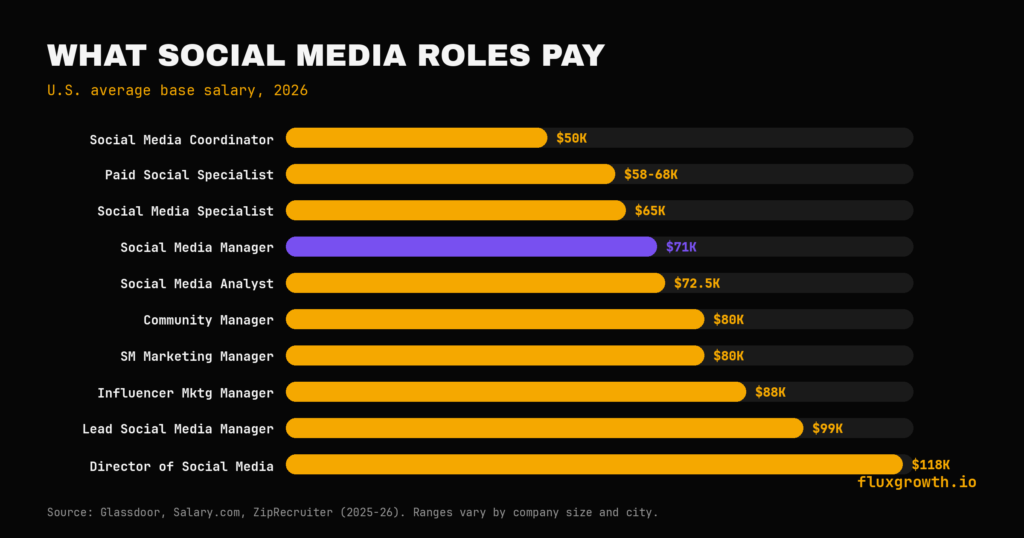
Let’s talk about money carefully. The figures below come from Glassdoor, Salary.com, and ZipRecruiter as of late 2025 and early 2026, and they’re U.S. base salaries. One caveat I won’t bury: a couple of senior titles rest on small self-reported samples, so treat those as directional, not gospel. I’ve noted the sample strength for each.
| Role | Avg U.S. base | Typical range | Data strength |
| Social Media Coordinator (entry) | ~$50,000 | $39K–$63K | Strong |
| Social Media Specialist | ~$65,000 | $50K–$86K | Strong |
| Paid Social Media Specialist | ~$58K–$68K | $47K–$73K | Mixed (sources differ) |
| Social Media Analyst | ~$72,500 | $55K–$96K | Strong (448 salaries) |
| Social Media Manager | ~$71,000 | $53K–$96K | Strong (12,000+ salaries) |
| Community Manager | ~$80,000 | $62K–$104K | Strong (284 salaries) |
| Social Media Marketing Manager | ~$80,000 | $60K–$106K | Strong |
| Influencer Marketing Manager | ~$88,000 | $66K–$124K | Moderate (related title) |
| Lead Social Media Manager | ~$99,000 | $77K–$127K | Thin sample |
| Director of Social Media | ~$118,000 | $89K–$161K | Strong (183 salaries) |
A few roles deserve more than a table row.
1.Social Media Coordinator — the entry door
This is where most people start. You’re scheduling, monitoring, replying, and learning the brand voice. Coursera, citing Glassdoor in May 2026, puts the base near $50,000, starting closer to $45,000 in year one. It isn’t glamorous. But it’s the rung where you prove you can be trusted with a brand’s voice and it’s also the rung AI is squeezing hardest, so a portfolio matters more here than it used to.
2.Social Media Specialist — the step up
One rung above coordinator, and the title where you start owning outcomes instead of tasks. You’re running content, handling light analytics, sometimes managing a channel of your own. Glassdoor pegs the average near $65,000, with Salary.com close behind around $68,000 as of May 2026. It’s the sweet spot for someone with a year or two of reps who isn’t ready to own a budget yet.
3.Social Media Manager — the workhorse
The most common “real” title. You own strategy for one or more channels, plan content, manage a small budget, and report on what worked. Glassdoor’s average sits near $71,000 off more than 12,000 salaries, with a typical band of $53K to $96K. The spread is huge because a “manager” at a 10-person startup and one at a Fortune 500 are paid for very different scopes.
4.Paid Social Media Specialist
You run the ads Meta, TikTok, LinkedIn and you live or die by return on ad spend. Pay here is oddly inconsistent across sources: Glassdoor shows about $58,000 on a small sample, while Salary.com lands closer to $68,000. The skill commands more once you’ve got a track record of profitable campaigns, because you’re tied directly to revenue.
5.Social Media Analyst — the data seat
If you like numbers more than captions, this is the lane. You measure campaign performance, build the reports, and tell the team what the data actually says. Glassdoor’s average is about $72,500 across 448 salaries (June 2026), ranging from $55K to $96K. It’s one of the more AI-resistant roles, because interpretation, not just pulling the chart, is the job.
6.Community Manager — the relationship seat
Less broadcasting, more back-and-forth: replies, DMs, Discord and Reddit threads, the human texture of a brand. Glassdoor puts the average near $80,000 across 284 salaries (June 2026). It’s quietly one of the safer bets against automation, since a “corporate sympathy bot” answering a frustrated customer is exactly what AI still gets wrong.
Related: which social media apps teens actually use in 2026
Influencer Marketing Manager — the partnerships seat
You find creators, negotiate the deals, and run the campaigns. With brand deals making up roughly 70% of creator income, this role sits on top of a lot of money. Glassdoor’s nearest comparable title averages about $88,000 (range $66K–$124K), though it’s a smaller sample treating it as a ballpark, not a promise.
7.Director of Social Media — the ceiling for most
Budget, team, strategy, and a seat in the rooms where money gets decided. Glassdoor’s average is about $118,000 across 183 salaries, reaching past $160,000 at the top quartile. The messier “global” and “senior” director titles can show $140K–$190K, but those samples are thin; don’t quote them to yourself as a target.
8.Social Media Content Creator — a different animal
This one’s rarely a salary. Income comes from brand deals (which make up roughly 70% of creator revenue), ad-share, affiliates, and your own products. And the reality is sobering: more than half of creators earn under $15,000 a year, per multiple 2025 reports. The top is enormous. The middle is thin.
Skills That Actually Get You Hired
The skill list changed. What used to be “nice to have” is now the screen.
Start with the hard skills: short-form video editing (CapCut is the default), basic graphic design (Canva), copywriting that sounds like a human, and reading analytics without glazing over. Paid ads knowledge bumps you up a tier and a pay bracket, fast.
Then there’s the one that flipped from bonus to baseline AI fluency. Over 70% of marketing and social media roles now expect comfort with AI tools, according to Research.com, and listings asking for AI skills jumped more than 35% in three years. “Comfort” doesn’t mean typing “write me a caption.” It means knowing what to feed a model, what to throw away, and where its output will quietly embarrass your brand.
The soft skills are where you actually win, though. Judgment. Taste. Reading a cultural moment before it tips. Writing a reply to an angry customer that sounds like a person instead of a policy. None of that shows up on a tools list, and it’s exactly what AI can’t fake.
One trade-off worth naming: chasing every new platform skill is a trap. Going deep on one channel and the analytics behind it beats being mediocre on six. Depth reads as expertise. Breadth reads as a résumé trying too hard.
There’s a shape hiring managers reward, even if they don’t name it T-shaped. Broad literacy across the basics, plus one spike you’re genuinely known for, whether that’s paid ads, short-form video, or community. The spike gets you shortlisted. The broad base keeps you employed once you’re in.
The Tools You’re Expected to Know
Nobody expects you to master 30 tools. They expect fluency in a handful, by category.
For making things: Canva for graphics, CapCut for video, Adobe Express if the brand lives in the Adobe world. For scheduling and publishing: Buffer and Later for leaner teams, Hootsuite or Sprout Social for bigger ones. Sprout doubles as an analytics layer, and you’ll lean on native platform insights plus Google Analytics 4 for anything tied back to the website.
Then the AI layer, which now sits across all of it. ChatGPT and Claude for drafting and ideation, Jasper if the company wants a marketing-specific workflow, and AI features baked right into tools you already use Later’s caption writer, Sprout’s listening, Canva’s generators.
A practical tip: in interviews, don’t list tools. Show outcomes. “I used Later’s best-time-to-post data to shift our schedule and lifted reached 18% over two months” beats “proficient in Later, Buffer, and Hootsuite” every single time. Tools are table stakes. Results are the story.
How AI Is Reshaping Social Media Jobs?
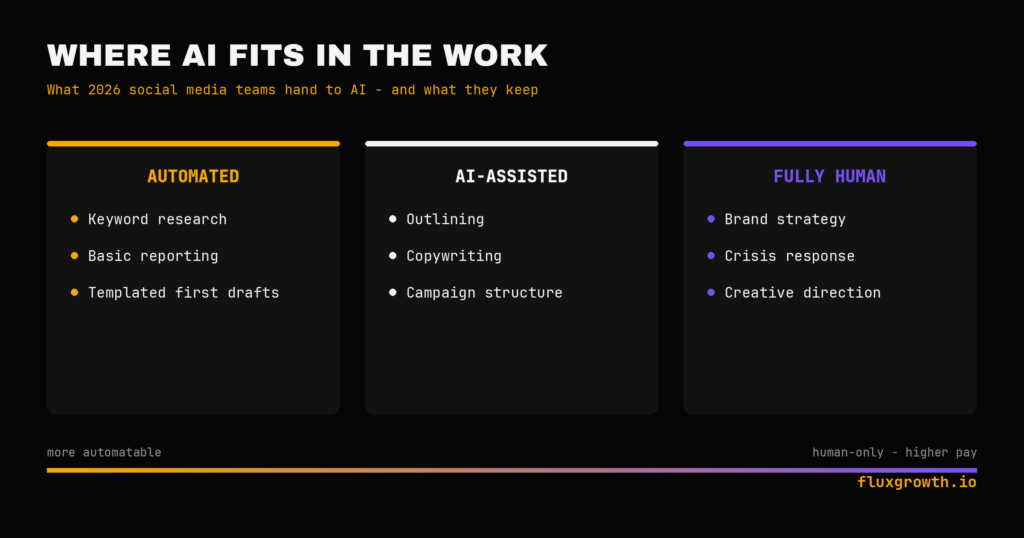
This is the part everyone’s anxious about, so let’s be straight: AI isn’t erasing the job. It’s redrawing where the human adds value.
The cleanest way to think about it is three buckets a split that’s become standard on 2026 marketing teams. Bucket one, fully automated: keyword research, basic reporting, the first draft of a templated post. Bucket two, AI-assisted, where you steer and the tool drafts outlining, copywriting, structuring a campaign. Bucket three is the one that pays: fully human work like brand strategy, crisis response, and the creative call no dataset will ever make for you.
So where does that leave the job? Compressed, not deleted. A social media manager who once spent three hours generating ideas and drafting captions can do it in 45 minutes now, per Later’s own 2026 breakdown. The hours don’t vanish; they move to strategy, relationships, and the creative judgment that wins.
The honest risk sits at the entry level, and I won’t pretend otherwise. If your whole value is execution AI can replicate, you’re exposed. The people getting raises in 2026 aren’t producing the most content they’re producing the most distinctive content and making the sharpest calls. They treat AI the way they treat Photoshop: infrastructure, not a threat.
How to Land One With No Experience?
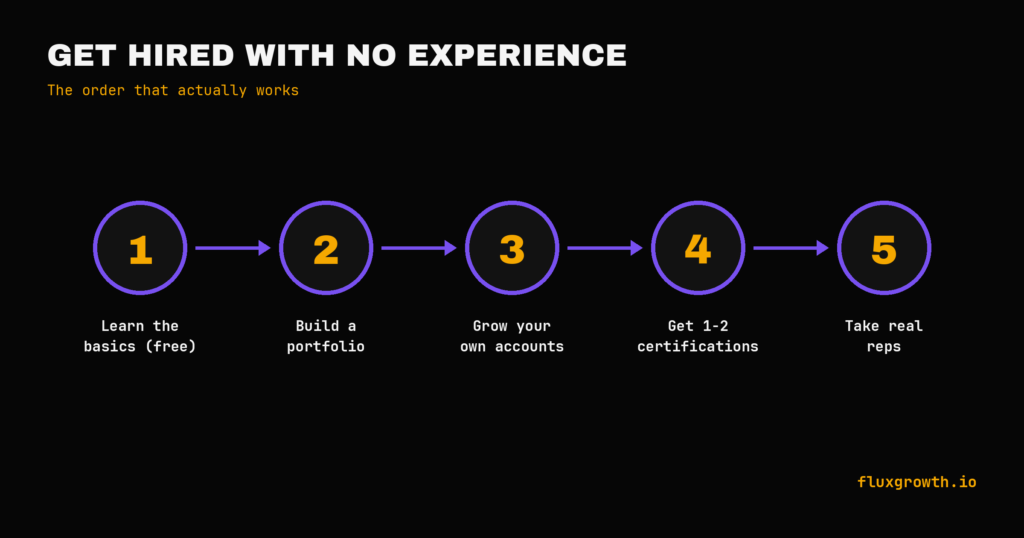
You don’t need a degree or a connection. You need proof. Here’s the order that actually works.
First, learn the fundamentals fast and free. Google’s Digital Marketing certificate, HubSpot Academy’s social media course, Meta’s Blueprint. A week or two, not a semester. These won’t get you hired on their own, but they give you the vocabulary to sound like you belong.
Second and this is the one that matters: build a portfolio, not a résumé. Pick three real or realistic brands and show actual work: the strategy, the posts, the before-and-after on a metric. Hiring managers skim résumés. They study portfolios.
Third, run your own accounts as the proof. The fastest credibility builder in this field is growing something yourself. A niche Instagram, TikTok, or LinkedIn presence that went from zero to a few thousand engaged followers says more than any certificate. You’re not claiming you can do it. You did it.
Fourth, get one or two certifications to clear automated filters, then stop collecting them. Diminishing returns hit quickly.
Fifth, take the reps of a freelance gig on Upwork, a free project for a local business, and an internship. One real client with a result you can point to beats six certificates. The whole game at this stage is turning “trust me” into “look what I did.”
Mistakes That Get Applications Tossed
A few patterns get people screened out before anyone reads the good part.
No portfolio is the big one. If your application is a résumé and a cover letter with zero examples of work, you’re competing on claims while the next person competes on proof. You lose that every time.
The generic résumé is close behind. “Managed social media accounts and increased engagement” tells a hiring manager nothing. Which accounts? Increased it from what to what? Put a number on it or leave it off.
Then there’s ignoring analytics. Plenty of applicants can make a clean-looking post but freeze when asked what a 2% engagement rate means or whether it’s any good. In 2026, not being able to read your own numbers is disqualifying on its own.
And the quiet one has no presence of your own. If you want to run brands’ social accounts and yours are empty, that’s a tell. You don’t have to be famous. You just have to show you actually use the thing you’re asking to be paid for.
Where to Find Social Media Jobs (Including Remote)?
The boards you already know still work, but they’re not equal.
For full-time roles, LinkedIn is first. It’s also where you get found if your own profile is sharp. Indeed, Glassdoor has the volume. For remote-specific work, We Work Remotely and FlexJobs filter out the in-office noise, and FlexJobs vets its listings (it’s paid, which is the trade-off). For freelance and contract, Upwork and Fiverr are the obvious start, though you’ll wade through low-rate listings before you reach the good ones.
Remote is a real chunk of this market now, since the work is digital by nature. Recent labor-market data shows that fully remote jobs account for roughly 8–12% of U.S. job postings, while hybrid roles make up another 20–30%, with marketing among the industries most likely to offer flexible work arrangements. What I can say plainly: searching a specific title plus “remote,” filtered to “posted this week,” beats scrolling a generic feed.
One tactic punches above its weight. Stop only applying, and start showing up. Comment usefully on posts from people who hire in your niche. Publish a teardown of a brand’s social you’d improve. The job you want is often handed to the person who was already visibly good at it in public, not the 200th name in the applicant pile.
Don’t sleep on the smaller channels, either. Niche job boards and marketer-specific newsletters often surface roles before they hit LinkedIn, and you’re up against dozens of applicants instead of thousands. Marketing Slack and Discord communities post openings that never get listed publicly at all sometimes the only way in is to already be in the room.
Freelance vs. Full-Time
There’s no right answer here, only a right fit.
| Freelance | Full-Time | |
| Flexibility | High — you pick clients and hours | Lower — set schedule |
| Income stability | Lumpy, especially early | Steady paycheck |
| Benefits | You buy your own | Usually included |
| Upside | Uncapped if you scale | Structured raises |
| Risk | All on you | Cushioned by the company |
Freelance suits people who want control and can stomach uneven income while they build a roster. Full-time suits people who want to go deep, learn inside a team, and never think about invoices. Plenty of people do full-time first learning on someone else’s dime then go freelance once they’ve got the skills and a network. That path is underrated.
What I’d Do If I Were Starting Today
If I were starting a social media career in 2026, I wouldn’t spend months collecting certificates or watching endless tutorials. I’d pick one platform TikTok, Instagram, LinkedIn, or YouTube and one niche I genuinely understand, then post consistently for at least six months. Your own account should become your portfolio.
I’d also use AI from day one, but only as an assistant. Tools like ChatGPT can help brainstorm ideas, write first drafts, analyze competitors, and speed up research. They can’t replace creativity, judgment, or understanding your audience. The people who’ll stand out in the next few years won’t be the ones using AI the most; they’ll be the ones who know how to combine AI with original thinking.
Most importantly, I’d obsess over analytics. Anyone can publish content. Far fewer people can explain why one post reached 500 people while another reached 500,000. Learn how platforms distribute content, study audience behavior, track performance metrics, and constantly experiment. Social media changes fast, but understanding human psychology and what makes people stop scrolling remains valuable on every platform.
Finally, don’t wait for permission. Build something publicly, even if it’s small. A personal brand with six months of consistent content is often more valuable to employers than a resume that says “passionate about social media.”
Frequently Asked Questions
What qualifications do I need for a social media job?
Less than you’d think. Most roles care about demonstrated skill over formal credentials, a portfolio, real results, and fluency with the main tools. A degree helps for some corporate roles but isn’t required for most.
Can I get a social media job without a degree?
Yes, and plenty of people do. The field rewards proof over paper. A strong portfolio, your own grown accounts, and one or two certifications (Google, HubSpot, Meta) clear most hiring filters.
Are social media jobs in demand in 2026?
Overall, yes the BLS projects steady growth in marketing management roles through 2034. The catch is that demand has shifted toward strategic and creative skills, while purely execution-based entry roles are getting squeezed by AI.
How much do social media managers make?
In the U.S., the average is around $71,000, with a typical range of roughly $53,000 to $96,000 (Glassdoor, late 2025). Pay rises sharply with budget responsibility and paid-ads skill, and directors average about $118,000.
What are the best remote social media jobs?
Manager and specialist roles are the most commonly remote, since the work is digital. We Work Remotely and FlexJobs are the cleanest places to find vetted remote listings; LinkedIn carries the most volume.
Is social media management a good career?
For the right person, yes. The pay’s decent, the work is genuinely creative, and demand isn’t going anywhere. The catch is that it’s high-pressure and always-on and the skills that matter keep shifting, so you never quite stop learning.