
Most companies don’t fail at AI because the technology doesn’t work. They fail because they hired the wrong builder, a firm that shipped an impressive demo, billed for six months, and left behind something nobody in production trusts.
That’s the real risk when you’re shopping for AI software development services. The market is loud, every vendor claims to be “AI-first,” and the pricing is deliberately fuzzy. This guide cuts through it. You’ll get a straight comparison of eight firms worth considering in 2026, what they actually cost, where each one falls short, and a checklist for choosing without getting burned.
The money backing this market is real, by the way. The global AI market was worth about $390 billion in 2025 and is forecast to hit roughly $3.5 trillion by 2033, growing around 30% a year (Grand View Research, 2025). So you’re not imagining the pressure to move. The question is who you move with.
What Are AI Software Development Services?
AI software development services are exactly what they sound like: a firm builds custom AI systems for you instead of you building them in-house. That can mean a single chatbot or a multi-agent platform wired into your CRM, ERP, and data warehouse.
The work usually spans a few categories. Consulting and strategy comes first figuring out where AI actually saves money versus where plain automation would do. Then there’s model work (training, fine-tuning, or adapting an existing foundation model), application development, integration with your existing systems, and ongoing maintenance once the thing is live.
Who buys this? Banks and insurers lead, mostly for fraud detection and claims work. Healthcare uses it for diagnostics and patient intake. Retail leans on personalization and demand forecasting. Manufacturing runs predictive maintenance and computer-vision inspection. The use cases differ, but the buyer’s problem is the same: AI matters, building the capability internally is slow and expensive, and a specialist partner gets you there faster.
Why Businesses Need AI Software Development Services
Automate repetitive tasks
The fastest payback usually comes from boring work. Invoice processing, ticket triage, document summarization, data entry tasks that eat thousands of hours and follow predictable rules. A well-scoped agent handles the volume so your team stops doing it. One healthcare client of ScienceSoft’s reported managers spending far less time on routine hiring steps after an HR agent went live. That’s the pattern: narrow tasks, measurable hours saved.
Improve decision-making
AI is good at finding signals in piles of data that humans can’t read fast enough. Predictive models flag which customers are about to churn, which shipments will be late, which transactions look fraudulent. The point isn’t to replace the decision, it’s to put a sharper recommendation in front of the person making it, faster than a quarterly report ever could.
Enhance customer experience
Customer-facing AI has grown up. We’re past the dumb FAQ bot. Modern systems handle scheduling, claims filing, and tier-one support with real context, then hand off cleanly to a human when they hit their limit. Done right, customers get answers at 2 a.m. and your support team stops drowning in repetitive questions.
Reduce operational costs
This is the line every vendor leads with, so treat it carefully. Cost reduction is real, but it’s lumpy. You’ll spend money up front sometimes a lot before you see savings. The firms that deliver here are the ones that scope tight, prove value on a small workflow first, and scale what works instead of boiling the ocean. More on that trap later.
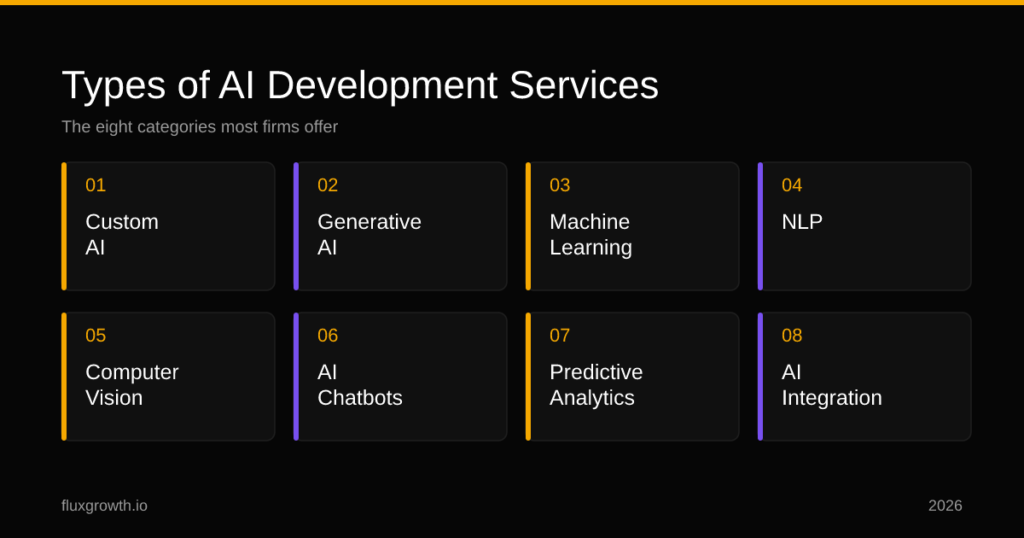
Types of AI Software Development Services
Custom AI software development
Building a system from scratch around your specific problem. The most flexible option and the most expensive. Right when off-the-shelf tools can’t fit your data or workflow.
Generative AI development
Chatbots, copilots, content generators, and agents built on large language models. This is where most 2026 budgets are going. The work ranges from a simple RAG-based assistant to a multi-agent system that executes real workflows.
Machine learning development
The classic stuff that still drives huge value: predictive models, recommendation engines, anomaly detection. Less hyped than generative AI, often higher ROI, because the use cases are well understood and the accuracy is measurable.
Natural language processing (NLP)
Sentiment analysis, text summarization, intent detection, document intelligence. Powers everything from support routing to mining 10,000 customer reviews for what people actually complain about.
Computer vision solutions
Image recognition, object detection, video analysis. Manufacturing uses it for defect inspection, healthcare for medical imaging, retail for shelf monitoring. If the data is visual, this is the toolset.
AI chatbot development
A subset big enough to be its own line item. Scripted bots are cheap; genuinely useful conversational agents that pull from your systems cost more and deliver more. Know which one you’re actually buying.
Predictive analytics solutions
Forecasting demand, revenue, risk, and behavior from historical data. The backbone of supply-chain and finance use cases. Boring, reliable, valuable.
AI integration services
Often the part nobody budgets for. Connecting AI to your CRM, ERP, ticketing, and data sources with security, access controls, and audit trails is frequently harder than building the model. Ask any vendor how they handle ai integration before you sign.
Top AI Software Development Companies in 2026
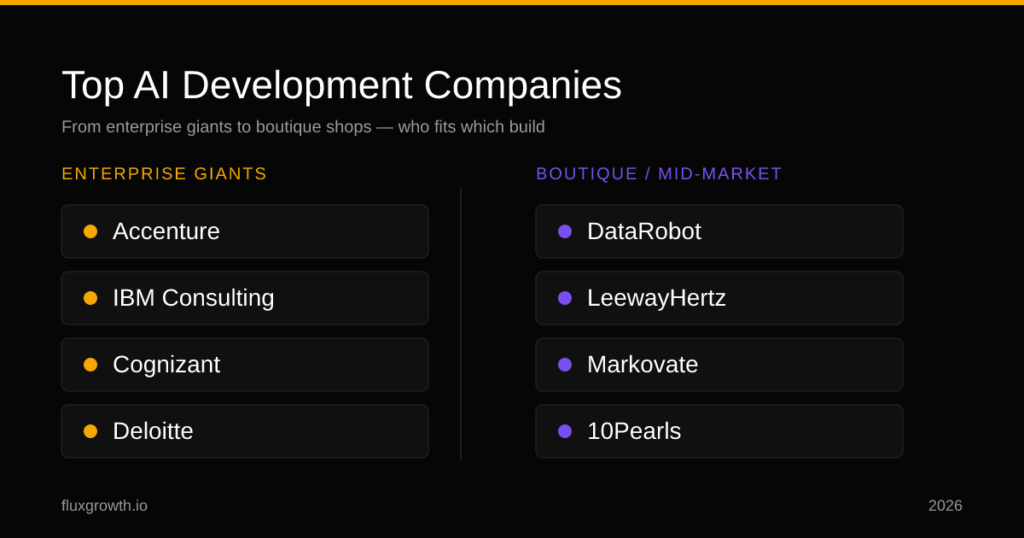
A note before the list: these aren’t ranked one-through-eight, because the “best” firm depends entirely on your size and problem. A 200-person enterprise build and a startup MVP need completely different partners. I’ve grouped them roughly from largest to most boutique, and flagged who each one is actually for.
One more honesty note. The big system integrators don’t publish pricing at all. Every engagement is custom-quoted and scoped, so any specific dollar figure you see attributed to them online is a guess. Where I have real, sourced numbers (mostly the boutique firms on Clutch), I’ve used them. Where I don’t, I’ve said so rather than inventing a range.
1.Accenture
The biggest name in the room. Accenture generated roughly $70 billion in FY25 revenue and has delivered more than 11,000 AI projects worldwide (Accenture, 2026). Its AI Refinery platform and Reinvention Services wrap strategy, build, and operations into one engagement.
Services: Full-stack strategy, custom development, agentic AI, data foundations, managed operations.
Industries: Banking, healthcare, telecom, public sector, retail basically all of them.
Pricing model: Custom-quoted, project-scoped. Increasingly outcome-based. No public rates. Pros: Unmatched scale, deep industry benches, Gartner Leader status.
Cons: Premium pricing, and the bigness cuts both ways slower, more layers, and you may not be the priority client. Worth noting that consulting firms broadly are under pressure as AI tools compress the billable-hours model they’re built on.
2.IBM Consulting
IBM’s pitch is governance and control. Its 2026 launches Enterprise Advantage and the updated Consulting Advantage platform focus on helping clients build and run their own AI platforms rather than renting IBM’s forever (IBM, May 2026). More than 20,000 AI specialists on staff.
Services: AI strategy, build, integration, governance, and managed operations, heavy on Watson and hybrid-cloud.
Industries: Banking, insurance, healthcare, government (now FedRAMP-authorized).
Pricing model: Custom-quoted, asset-based consulting. No public rates.
Pros: Strong on governance, compliance, and sovereignty the things regulated industries lose sleep over.
Cons: Heavily tied to the IBM/Watson ecosystem; less appealing if you want model-agnostic flexibility.
Own Take: IBM Consulting is a strong choice for large enterprises that prioritize security, compliance, and governance. However, startups and small businesses may prefer more flexible and cost-effective AI providers.
3.Cognizant
Cognizant has repositioned itself as an “AI builder.” Its Neuro AI platform line including a 2026 Secure AI Services launch leans hard into agentic systems and multi-agent orchestration (Cognizant, May 2026). It works with 250+ enterprises across regulated industries.
Services: AI engineering, agentic AI, multi-agent orchestration, IT-ops automation, AI security. Industries: Healthcare, financial services, insurance, retail.
Pricing model: Custom-quoted. No public rates.
Pros: Strong delivery muscle and cost arbitrage; real focus on the security/governance layer. Cons: More implementation-and-scale than blue-sky strategy; you bring the vision. [ADD: own take]
4.Deloitte AI Services
Deloitte’s differentiator is its Zora AI agent platform plus the Trustworthy AI framework agents for finance, procurement, HR, and more, built on the NVIDIA stack (Deloitte, 2025–26). Close to 80% of organizations Deloitte surveyed plan to raise AI spending next fiscal year.
Services: Agentic AI, GenAI strategy, industry solutions, risk and governance, full SDLC. Industries: Finance, life sciences, consumer, public sector. Pricing model: Custom-quoted, consulting-led. No public rates. Pros: Deep functional expertise (especially finance and risk), strong governance posture. Cons: Consulting-first DNA means premium rates and a heavier process than a product shop.
Own Take: Deloitte is a great choice for large enterprises that need AI strategy, governance, and industry expertise. However, its consulting-led approach can be expensive for startups and small businesses.
5.DataRobot
The odd one out and I’m including it on purpose. DataRobot isn’t a project-based dev agency; it’s an enterprise AI/ML platform with a services arm. If you have a data team that wants to build and govern models themselves, this is the tooling. A 3x Gartner Magic Quadrant Leader for data-science platforms.
Services: AutoML, MLOps, agentic-workforce platform, model governance, plus an architect/consulting team.
Industries: Financial services, healthcare, manufacturing, retail.
Pricing model: Custom-quoted annual subscription. DataRobot does not publish public pricing, and costs vary based on deployment size, users, infrastructure, and usage. Industry estimates suggest enterprise contracts typically range from $100,000 to $1 million+ per year, with larger deployments costing significantly more.
Pros: Buy a platform once instead of paying for endless bespoke builds; enables fast experimentation and iteration for in-house AI teams.
Cons: Expensive, opaque pricing, and the platform assumes you already have data science talent in-house. Without that expertise, you may still need an external AI services partner.
Own Take: DataRobot is best suited for enterprises with established data teams that want to scale AI quickly. Smaller companies without dedicated AI talent may struggle to extract full value from the platform.
6.LeewayHertz
Where the list shifts from giants to specialists. LeewayHertz (now a Hackett Group company) is an AI consulting and development firm with 15+ years of history and its own ZBrain enablement platform. Good fit for startups through mid-market.
Services:
AI strategy, generative AI, AI agents and multi-agent systems, custom builds, integration.
Industries:
Finance, healthcare, retail, logistics, legal.
Pricing model: Published on Clutch $50–99/hr average, projects from $50,000 to $180,000+ (Clutch, verified reviews).
Pros: Transparent-ish pricing, broad AI portfolio, strong client-collaboration reviews.
Cons: Clutch reviews flag occasional project-management and bug-resolution gaps quality varies by engagement.
Own Take: LeewayHertz is a good option for startups and mid-sized businesses that want custom AI solutions at a lower cost than large consulting firms. However, project quality can vary depending on the team assigned.
7.Markovate
Markovate is a boutique AI development company founded in 2015, with headquarters in Toronto and a growing North American presence. The firm focuses on helping startups and mid-market companies build AI-powered products and move quickly from concept to deployment.
Services: AI PoC, AI solution development, AI consulting, mobile/web AI apps, generative AI products.
Industries: Healthcare, SaaS, retail, fintech, fitness.
Pricing model: Project-based; specific ranges not consistently published. One verified Clutch case reported quote-generation time cut by 70% on an AI quoting engine.
Pros: Fast, product-focused, good for getting from idea to working prototype.
Cons: Smaller team means less capacity for large enterprise programs; verify they can scale with you.
Own Take: Markovate is a good fit for startups that need to launch AI products quickly, though larger companies should verify its ability to scale enterprise projects.
8.Pearls
Pearls larger digital-transformation firm (1,000–5,000 people, founded 2004, Vienna VA) with a mature AI practice. The most “enterprise-ready” of the boutique group.
Services: Custom AI/ML, NLP, computer vision, AI-driven enterprise apps, plus full software engineering and QA.
Industries: Healthcare, finance, enterprise, startups.
Pricing model: Published on Clutch $25 49/hr average, projects from $11,750 to over $2 million (Clutch, verified reviews).
Pros: Wide price range fits both small and large projects; strong delivery track record; offshore cost efficiency.
Cons: Reviews note time-zone friction with offshore teams manage communication expectations up front.
Own Take: 10Pearls is a strong choice for companies that need both AI expertise and full-scale software development. Its combination of enterprise experience and offshore delivery can provide good value, but clear communication is essential for distributed teams.
How Much Do AI Software Development Services Cost?
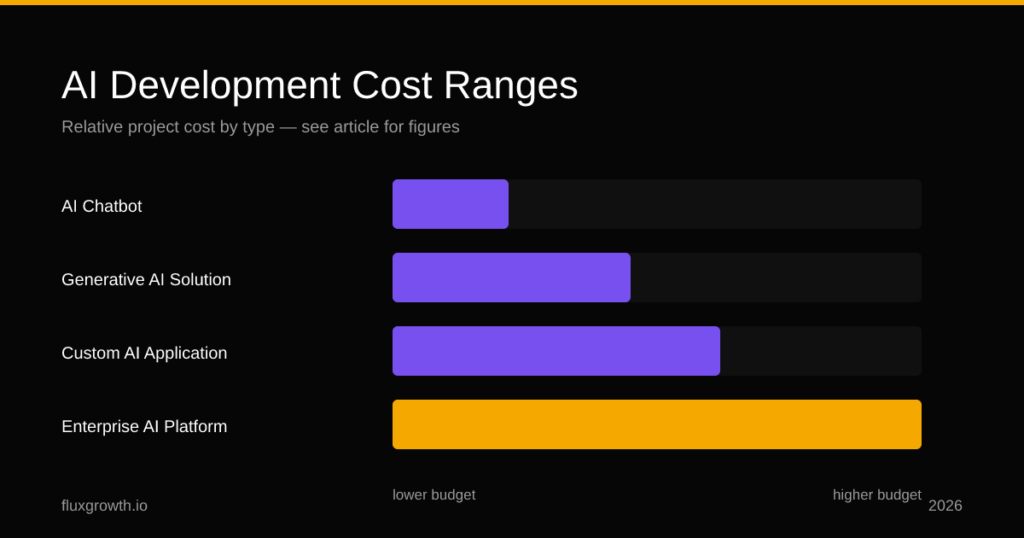
Here’s the honest version: nobody can quote you a real number without scoping your project, and the big firms won’t publish one at all. What follows are realistic market ranges, useful for budgeting not quotes.
| Project type | Estimated cost |
| AI chatbot / conversational agent | $10,000–$50,000 |
| Custom AI application | $30,000–$300,000+ |
| Enterprise AI platform | $100,000–$1,000,000+ |
| Generative AI solution | $25,000–$250,000+ |
Those ranges line up with what ScienceSoft publishes openly: AI software work spanning roughly $10,000 to over $1,000,000 depending on autonomy level, integrations, data readiness, and security requirements (ScienceSoft, 2026).
Why so wide? Four things move the number. Autonomy a scripted bot is cheap, a fully agentic system that takes actions is not. Integrations connecting to five enterprise systems costs far more than a standalone tool. Data readiness if your data is a mess, budget for cleanup before any model gets built. And compliance with HIPAA, GDPR, or SOC 2 requirements add real engineering work.
One shift worth knowing: buyers are pushing back on hourly billing. In 2026, preference for outcome-based pricing climbed to 21.7%, reaching parity with per-user/per-month models for the first time (Futurum Group, 2026). If a vendor will tie price to results, that’s often a good sign they believe in the work.
How to Choose an AI Development Company
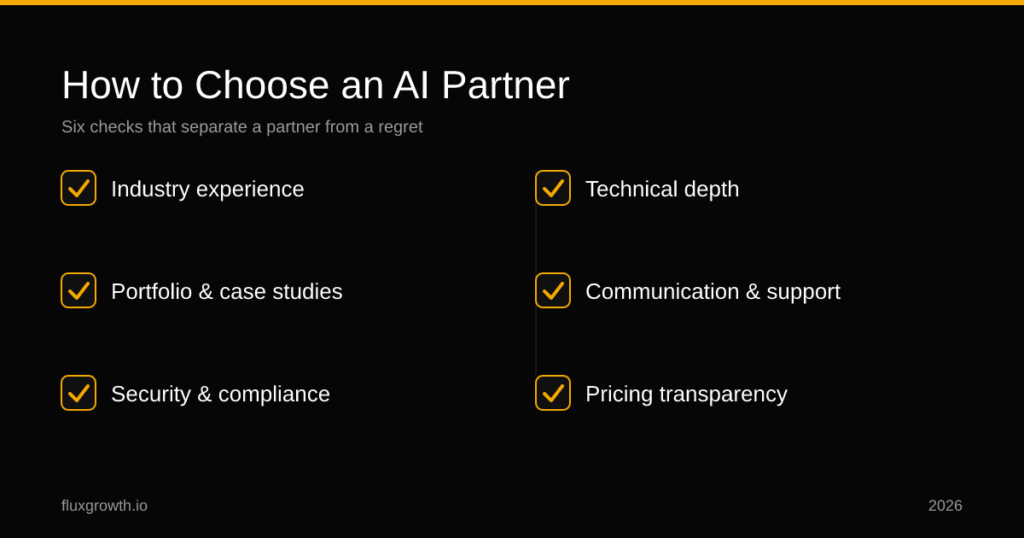
Six things separate a partner from regret.
Industry experience. Have they shipped AI in your sector? Healthcare and finance AI carry regulatory weight that a generalist will underestimate.
Technical depth. Ask what they’d actually build: foundation model plus RAG, fine-tuning, or full custom training. The right answer is usually “the cheapest approach that meets the bar,” not the flashiest.
Portfolio and case studies. Demos lie. Ask for production deployments with measurable outcomes and, ideally, a reference you can call.
Communication and support. This kills more projects than bad code. Offshore teams can be excellent and cost-efficient, but confirm overlap hours and a clear escalation path before you commit.
Security and compliance. How do they handle your data? What certifications do they hold? For regulated work, this is a gate, not a nice-to-have.
Pricing transparency. A vendor who won’t explain how they price even roughly is a vendor who’ll surprise you on the invoice. Watch for compute overages and support fees buried in the contract.
AI Software Development Process
Most credible firms follow a similar arc. Knowing it helps you spot one who’s winging it.
Discovery and planning. They learn your business problem and translate it into technical requirements. If a vendor jumps to a model recommendation before understanding your problem, that’s a flag.
Data collection and prep. Gathering, cleaning, and structuring data. Usually the least glamorous and most time-consuming phase and the one that quietly determines whether the whole thing works.
Model development. Building, training, or adapting the model. Good teams start with a foundation model and only build custom when accuracy, latency, or privacy truly demands it.
Testing and validation. Accuracy, edge cases, regression testing. For agents specifically, this means checking for hallucinations and workflow failures before anything touches production.
Deployment. Pushing to production with monitoring and guardrails. Often a proof-of-concept or MVP comes first to de-risk the full build.
Ongoing maintenance. Models drift. Data changes. Without monitoring and retraining, accuracy decays so maintenance is a line item, not an afterthought.
Common Challenges in AI Development
Data quality. The number-one blocker. Garbage in, garbage out is not a cliché here over half of organizations cite data quality as their biggest deployment obstacle (industry surveys, 2026). If your data isn’t ready, no vendor can save the project.
Integration complexity. Wiring AI into legacy systems with proper security and audit trails is routinely harder and slower than building the model itself.
High development costs. Budgets balloon when scope creeps. The fix is discipline: prove value on one narrow workflow, then expand.
Regulatory compliance. HIPAA, GDPR, the EU AI Act regulated industries carry real legal exposure, and retrofitting compliance is expensive.
Model accuracy. Demos hit 95% on clean data; production is messier. And accuracy decays over time without retraining. Set realistic expectations early or you’ll be disappointed later.
Future Trends in AI Software Development
Agentic AI. The defining trend of 2026 and the one to be most skeptical about. Gartner found only 17% of organizations had deployed AI agents so far, yet more than 60% expect to within two years (Gartner, 2026 CIO Survey). Separately, Gartner forecasts 40% of enterprise applications will embed task-specific agents by the end of 2026, up from under 5% in 2025. Huge momentum but Gartner also predicts more than 40% of agentic AI projects will be canceled by 2027. Read that twice before you greenlight an autonomous-agent program.
Generative AI. Past the novelty stage and into core workflows copilots, content pipelines, document intelligence. The baseline expectation now, not the differentiator.
Multi-agent systems. Single agents are already old news to the analysts. The 2026 story is specialized agents collaborating under central orchestration: one qualifies a lead, another drafts outreach, a third checks compliance.
Multimodal AI. Models that handle text, image, audio, and video together, opening use cases that single-mode systems can’t touch.
Edge AI. Running models on-device or on-prem for speed, privacy, and data residency increasingly important where latency or compliance rules out the cloud.
What I’d Do If I Were Starting Today
If I were choosing an AI development partner today, I wouldn’t start with a massive enterprise project. I’d begin with one specific business problem whether that’s automating customer support, building an internal AI assistant, or reducing repetitive manual work and measuring the results from there.
From researching dozens of AI platforms and companies for FluxGrowth, one thing has become clear: flashy demos don’t always translate into successful real-world deployments. Before committing to any vendor, I’d run a small paid proof of concept lasting two to four weeks to see how the team communicates, delivers, and handles unexpected challenges.
I’d also ask for real case studies and speak with existing customers whenever possible. Marketing pages can tell you what a company promises; customer conversations tell you what it’s actually like to work with them.
Most importantly, I’d focus on business outcomes rather than features. The right AI partner isn’t the company with the longest feature list, it’s the one that can solve a real problem and deliver measurable ROI.
Frequently Asked Questions
What are AI software development services?
They’re services where a specialist firm designs, builds, and maintains custom AI systems for your business from a single chatbot to a full multi-agent platform covering strategy, model development, integration, and ongoing support.
How much do AI software development services cost?
It depends heavily on scope. A simple chatbot might run $10,000–$50,000, a custom AI application $30,000–$300,000+, and an enterprise platform anywhere from $100,000 into the millions. Autonomy, integrations, data readiness, and compliance are the biggest cost drivers.
Which company offers the best AI development services?
There’s no single winner, it depends on your size and problem. Accenture, IBM, Cognizant, and Deloitte fit large enterprise programs; LeewayHertz, Markovate, and 10Pearls suit startups and mid-market; DataRobot is a platform for teams who want to build in-house.
How long does it take to build AI software?
A proof-of-concept can take 2–6 weeks. A production application typically runs 3–9 months, and a full enterprise platform can take a year or more, depending on data readiness and integration complexity.
What industries benefit most from AI?
Banking and insurance lead (fraud detection, claims, risk), followed by healthcare (diagnostics, intake), retail (personalization, forecasting), and manufacturing (predictive maintenance, vision inspection).
What’s the difference between AI consulting and AI development?
Consulting figures out what to build and whether it’s worth it strategy, use-case selection, and roadmap. Development builds it. Most strong engagements include both, starting with consulting so you don’t build the wrong thing.
Conclusion
The best AI software development services in 2026 aren’t the ones with the slickest demo, they’re the ones who scope tight, price honestly, and ship something your team still trusts a year later. Start with one narrow workflow, demand a real production reference, and treat any vendor who won’t explain their pricing as a warning sign.
1 thought on “Best AI Software Development Services in 2026”