FluxGrowth is reader-supported. Some links in our guides are affiliate links — if you buy through one we may earn a commission, at no extra cost to you. It never changes which tools we recommend. How we test tools.
You’ve probably noticed the same thing I have: every sales tool now slaps “AI-powered” on its homepage. Most of them just added a summarize button and called it a day. That’s a real problem if you’re a small business owner trying to spend your budget on something that actually saves hours, not adding a chatbot nobody asked for.
This guide is part of our AI Automation hub – everything we have published on automating a small business with AI, in one place.
This guide breaks down five AI sales tools by what they’re actually good at: prospecting, conversation intelligence, data enrichment, all-in-one CRM, or free call notes. If you’re also looking for more budget-friendly options, explore our guide to the Best AI Tools in 2026 before choosing a paid sales platform. Real pricing, real limitations, no marketing-page fluff.
What Makes a Sales Tool “AI-Powered” in 2026?
An AI sales tool is software that uses machine learning or generative AI to automate part of the sales process writing outreach, transcribing calls, scoring leads, and enriching contact data. That’s the whole definition. Everything else is marketing.
The real split worth understanding is AI-assisted versus AI-autonomous. Assisted tools draft an email or summarize a call, and a human still hits send.
Autonomous tools sometimes called AI SDRs or AI agents run parts of the workflow on their own: finding leads, sending sequences, even booking meetings without a rep touching it. Most of the tools below sit closer to assisted, with autonomous features rolling out as add-ons.
How I Evaluated These Tools
I evaluated each AI sales tool using five criteria: whether it solves a genuine sales bottleneck, how transparent its pricing is, how quickly a small business can see value, what it costs beyond the free tier, and where its limitations become apparent. No tool on this list is perfect, and the best choice depends on your sales process, budget, and existing tech stack. Rather than relying solely on vendor claims, I compared official product documentation, pricing pages, feature releases, and independent reviews to understand where each platform performs well and where it doesn’t. As I continue testing these tools in real-world workflows, I’ll update this guide with first-hand implementation notes and measurable results to make the recommendations even more useful.
The 5 Best AI Sales Tools in 2026
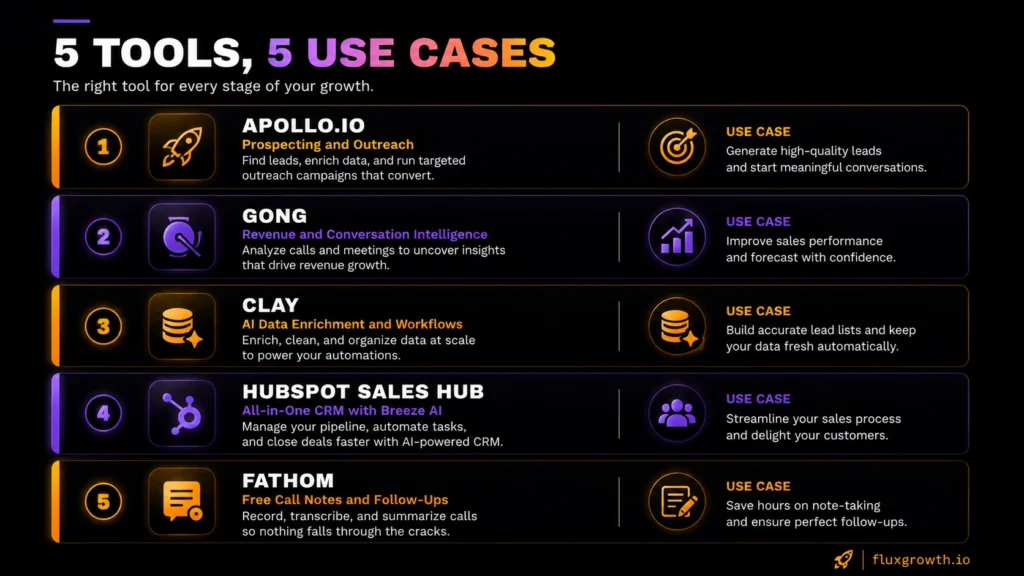
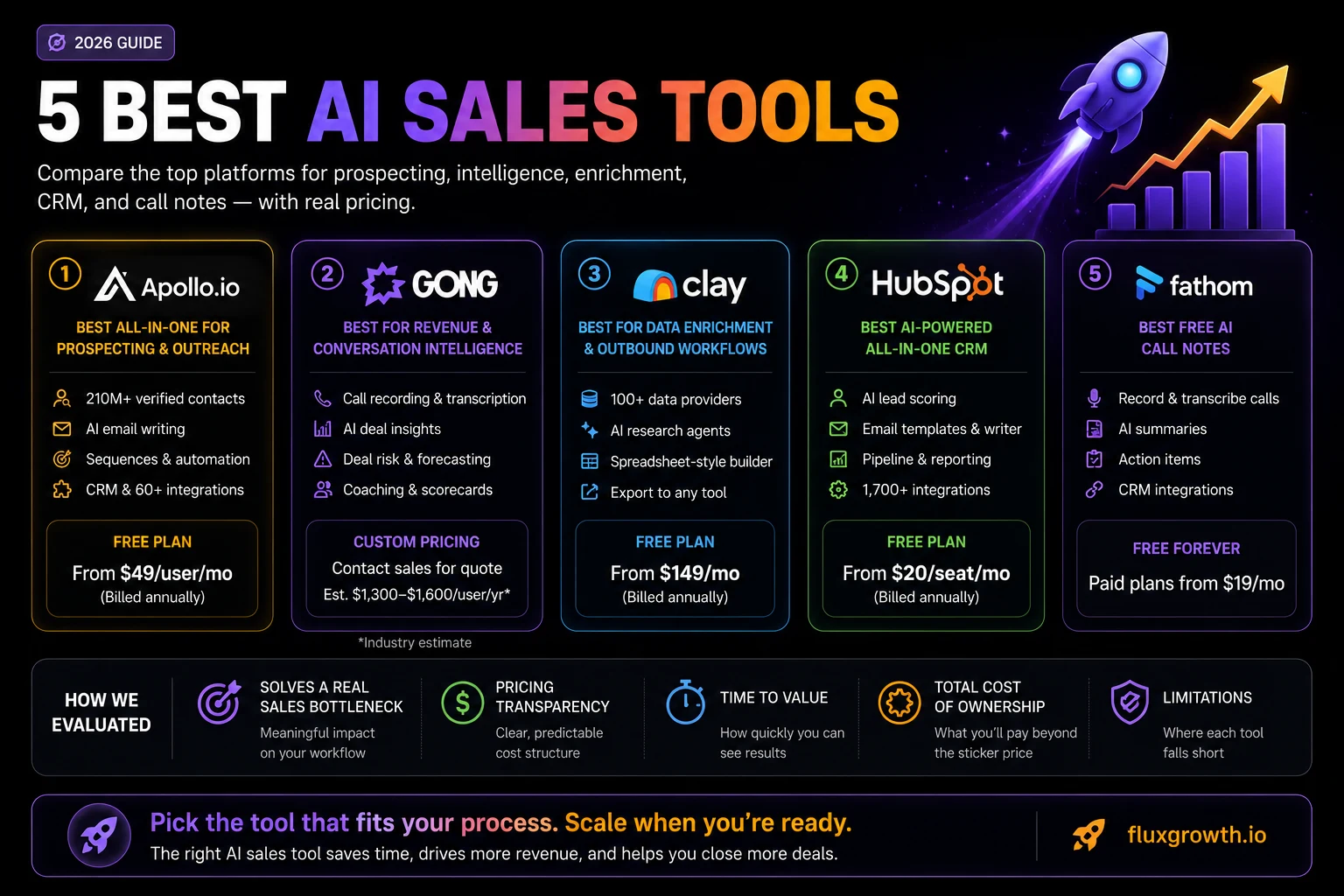
1. Apollo.io — Best All-in-One for Prospecting and Outreach
Apollo.io combines B2B contact data, sales engagement, and AI-powered prospecting into a single platform, making it one of the most complete AI sales tools for small businesses and growing sales teams. According to Apollo, the platform provides access to more than 210 million verified contacts and over 35 million companies, along with AI features for email drafting, lead research, and prospecting. Because data accuracy varies by industry and region, it’s still worth validating a sample of contacts before launching a large outbound campaign.
One advantage is that Apollo’s AI capabilities extend beyond its web app. The platform integrates with tools such as ChatGPT, Claude, browser extensions, and major CRMs, allowing sales teams to research prospects and draft outreach without constantly switching between applications.
Pricing: Apollo.io offers a Free plan, with paid plans starting at Basic ($49 per user/month), Professional ($79 per user/month), and Organization ($119 per user/month, annual billing, minimum three users). One important consideration is Apollo’s credit-based pricing model. While the subscription prices are competitive, activities such as mobile number lookups, contact exports, and high-volume prospecting consume credits quickly. If your sales team runs large outbound campaigns, you may need to purchase additional credits, increasing the total cost beyond the advertised plan price. Estimating your expected usage before choosing a plan can help you avoid unexpected expenses.
Best for: Solo founders and small sales teams that need contact data plus outreach automation in one place.
2. Gong — Best for Revenue and Conversation Intelligence
Gong records sales calls, transcribes them, and surfaces AI-generated insights about what’s actually happening in your pipeline objections, competitor mentions, deal risk. It’s the category leader here, and it shows in the depth of the analysis.
Pricing: Gong does not publicly disclose its pricing. Businesses must contact the sales team for a custom quote based on the number of users, products, and implementation requirements. Industry estimates suggest pricing can range from approximately $1,300–$1,600 per user/year for core functionality, with additional products such as Engage and Forecast increasing the overall cost. Many customers also pay a separate platform or implementation fee, though these costs vary by contract and are not officially published. Always request a personalized quote directly from Gong before making a purchasing decision.
On top of the per-user licensing cost, Gong also charges a platform fee based on the size of your deployment, and many organizations incur additional onboarding or implementation costs. Because these fees are quote-based and not publicly disclosed, the total investment can be significantly higher than the per-user price alone. Contact Gong directly for a customized quote.
That’s a lot of tools for a five-person startup. Gong makes more sense once you have a real sales team and a manager who needs to coach off real call data not for a founder still closing deals solo. If you’re small, you can get 80% of the value from a lighter-weight call recorder and revisit Gong once you scale.
Best for: Mid-market and larger sales teams that need conversation-level coaching and forecasting, not just contact data.
3. Clay — Best for AI-Powered Data Enrichment and Outbound Workflows
Clay isn’t a CRM or an outreach tool by itself; it’s closer to a spreadsheet-style workflow builder that pulls data from 100+ providers, runs AI research agents against it, and outputs a clean, enriched lead list ready for your outreach tool of choice. Think of it as the engine that feeds Apollo or HubSpot, not a replacement for either.
Pricing: Clay introduced a new pricing model in March 2026. The platform offers a Free plan (100 Data Credits and 500 Actions/month), Launch starting at $185/month, Growth starting at $495/month, and Enterprise with custom pricing. Instead of a single credit system, Clay now separates Data Credits (used for enrichment) from Actions (used for workflow execution), making costs more transparent but also more dependent on usage.
The biggest advantage is that pricing scales by workflow usage rather than per user, which can make Clay more economical for teams where one or two operators build automations used across the organization. The trade-off is complexity. Clay has a steeper learning curve than traditional sales tools because it relies on spreadsheet-style logic, data enrichment workflows, and AI-powered automation. It’s an excellent fit for RevOps teams and experienced outbound operators, but it isn’t the easiest platform to hand to a brand-new SDR on day one.
Best for: Agencies and SaaS teams doing custom outbound research at scale, or anyone tired of stitching together five separate data tools.
4. HubSpot Sales Hub (Breeze AI) — Best AI-in-CRM for Growing Teams
If you already run or want to run your whole sales process in one CRM, HubSpot Sales Hub with its Breeze AI layer is the strongest option.
Pricing: HubSpot Sales Hub offers a Free plan, with Starter starting at $15 per seat/month (annual billing). Professional starts at $100 per seat/month, and Enterprise starts at $150 per seat/month. Higher-tier plans typically require annual billing, and some plans may include one-time onboarding fees depending on the subscription and implementation. Always verify the latest pricing on HubSpot’s official pricing page before purchasing.
One of HubSpot’s biggest recent changes is its Breeze AI pricing model. Instead of charging a flat monthly fee for some AI capabilities, HubSpot now prices certain AI agents based on usage or outcomes. For example, the Customer Agent is priced per resolved conversation, while the Prospecting Agent charges per qualified lead generated. This usage-based approach can be more cost-effective for businesses that only need AI assistance occasionally, though pricing and availability may vary by plan and region.
The main limitation is that many of Breeze AI’s advanced features are reserved for Professional and Enterprise customers. Smaller businesses using the Free or Starter plans won’t have access to the platform’s full AI capabilities. However, if you want an established CRM with AI built directly into your sales workflow, HubSpot remains one of the best long-term choices.
Best for: Small businesses that want CRM, marketing, and AI sales assistance under one roof instead of five separate subscriptions.
5. Fathom — Best Free Tool for Call Notes and Follow-Ups
Not every business needs a full sales stack on day one. Fathom is an AI meeting assistant that automatically records, transcribes, and summarizes sales calls, then helps generate follow-up emails and action items. Its Free plan (link this text to: https://www.fathom.ai/pricing) includes unlimited meeting recordings, unlimited transcriptions, and instant AI meeting summaries, making it one of the most generous free offerings in the AI meeting assistant category. More advanced AI features including unlimited advanced summaries, AI-generated action items, custom summaries, and conversational AI are available on paid plans starting at $16/user/month (annual billing) (optionally link this pricing claim to the same pricing page: https://www.fathom.ai/pricing).
The biggest limitation is that the free plan restricts some advanced AI capabilities. After your monthly allowance of advanced summaries is used, you’ll still receive standard AI summaries, but premium features such as custom summary templates, AI action items, and advanced follow-up tools require a paid subscription.
Best for: Solo founders and very small teams who need better call follow-up before they’re ready to pay for anything else on this list.
Comparison Table Which AI Sales Tool Fits Your Team?
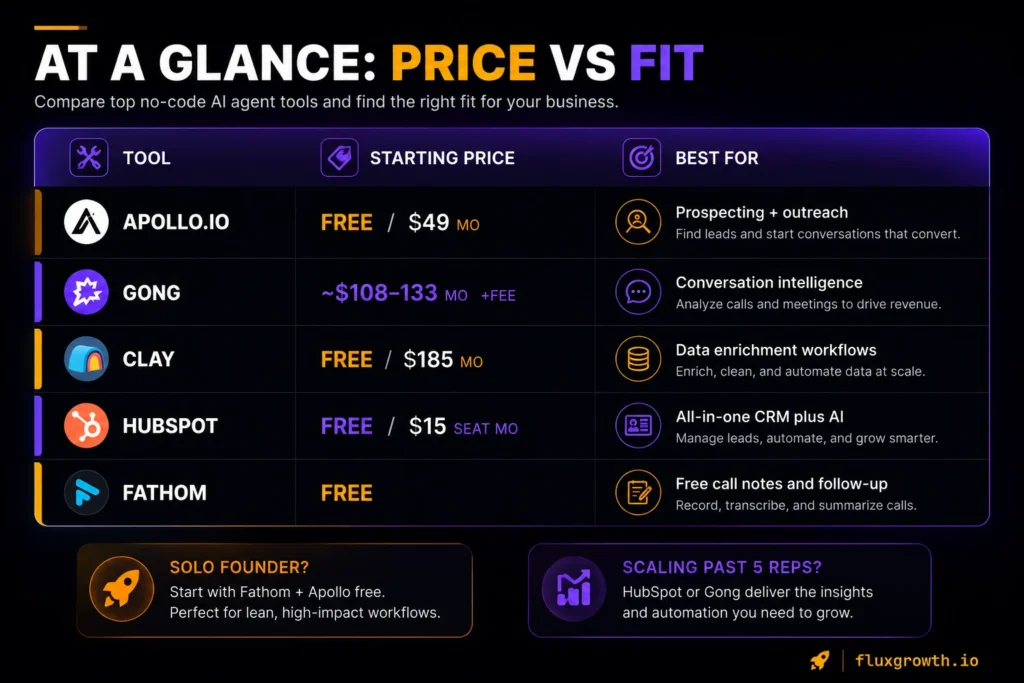
| Tool | Best For | Starting Price | Key AI Feature | Notable Limitation |
| Apollo.io | All-in-one prospecting + outreach | Free / Basic from $49/user/month (annual billing) | AI email writing + 230M+ contact database | Credit overages inflate real cost fast |
| Gong | Revenue & conversation intelligence | Custom pricing (quote required) | AI call analysis & deal risk scoring | Opaque, enterprise-heavy pricing |
| Clay | Data enrichment & outbound workflows | Free / Launch from $185/month | AI research agents across 100+ data sources | Steep learning curve |
| HubSpot Sales Hub | All-in-one CRM with built-in AI | Free CRM / Starter from $15/seat/month (annual billing) | Outcome-based Breeze AI agents | Best AI features gated to Pro/Enterprise |
| Fathom | Free call notes & follow-ups | Free / Premium from $16/user/month (annual billing) | Automatic call transcription & summaries | Not a CRM or outreach tool |
If you’re a solo founder or small business, start with Fathom’s Free plan for AI meeting notes and Apollo.io’s Free tier for prospecting and outreach. As your sales process becomes more complex, HubSpot Sales Hub is a strong choice for an all-in-one CRM with built-in AI, while Gong is better suited for larger sales organizations that need advanced conversation intelligence and revenue forecasting. Clay is the best fit for teams focused on large-scale outbound prospecting and AI-powered data enrichment.
How to Choose the Right AI Sales Tool for Your Business
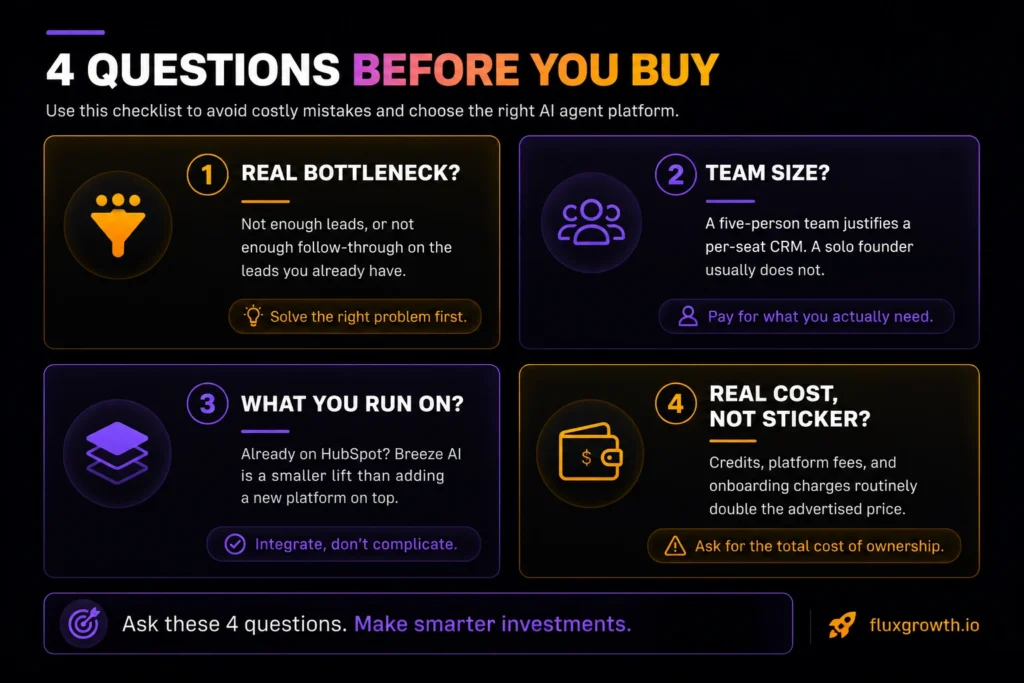
Most roundups stop at “here’s a list, good luck.” The actual decision comes down to four questions:
- What’s your real bottleneck? Not enough leads, or not enough follow-through on the leads you have? Pick the tool that fixes that specific gap first.
- What’s your team size? A five-person team justifies a per-seat CRM. A solo founder usually doesn’t.
- What do you already run on? If you’re already in HubSpot, Breeze AI is a smaller lift than adding Gong on top.
- Can you actually afford the real cost, not the sticker price? Credit systems, platform fees, and onboarding charges routinely double the advertised number. Budget for that before you sign.
Start with the bottleneck, not the tool list. That’s the one thing most “best AI sales tools” articles skip, and it’s the difference between a tool that gets used and one that gets abandoned by month two.
What I’d Do If I Were Starting Today
If I were starting a small business or solo consulting practice today, I’d keep the sales stack as simple as possible. I’d use Apollo.io’s Free plan for prospecting and outreach, Fathom for AI meeting notes and follow-up emails, and HubSpot’s Free CRM to organize contacts and manage the sales pipeline. That combination covers the core sales workflow without adding unnecessary costs or complexity. I wouldn’t invest in enterprise platforms like Gong until I had a larger sales team generating enough call data to benefit from conversation intelligence, and I’d only adopt Clay once outbound prospecting became a repeatable process that justified advanced data enrichment and workflow automation. For most small businesses, the priority should be building a consistent sales process first—then adding more specialized AI tools as the team and pipeline grow.
FAQ
What is the best AI sales tool for small businesses in 2026?
For most small businesses, Apollo.io or HubSpot Sales Hub offer the best mix of price and features. Apollo works well if prospecting and outreach are your main gap; HubSpot Sales Hub is the stronger pick if you want AI built into a full CRM.
Are AI sales tools worth it for solo founders?
Yes, but start free. Fathom’s free plan and Apollo’s free tier cover call notes and basic prospecting without any spend. Upgrade only once you can point to a specific bottleneck those free tiers don’t solve.
What’s the difference between Gong and Apollo.io?
Gong analyzes sales calls and forecasts deals using AI, while Apollo.io focuses on finding contacts and automating outreach. They solve different problems and are often used together at larger companies, not as substitutes for each other.
How much do AI sales tools cost per month?
AI sales tools range from free (such as Fathom and Apollo.io’s Free plan) to around $15–$150+ per user/month for platforms like HubSpot Sales Hub, while enterprise tools such as Gong use custom pricing. Keep in mind that usage-based credits, AI add-ons, and data enrichment can increase the total monthly cost beyond the advertised starting price.
Can AI sales tools replace a human SDR?
Not fully, at least not yet. Current AI sales tools automate research, drafting, and follow-up, but closing deals still depends on human judgment and relationship-building. Autonomous AI SDR tools exist, but most teams still use AI as an assistant, not a replacement.
What is Clay used for in sales?
Clay is used to enrich and research prospect lists using AI agents that pull data from over 100 providers, then output a clean list ready for outreach. It’s typically used alongside a CRM or outreach tool, not instead of one.
Do AI sales tools integrate with Salesforce and HubSpot?
Yes. Most leading AI sales tools including Apollo.io, Gong, Clay, and Fathom offer native integrations with Salesforce and HubSpot. However, some advanced integrations or features may only be available on higher-tier plans, so it’s worth checking each vendor’s official integrations page before purchasing.
The Bottom Line
The best AI sales tool in 2026 isn’t the one with the longest feature list, it’s the one that fixes your actual bottleneck without adding a bill you’ll regret in three months. Start with a free tier that matches your biggest gap, run it for a month, and only upgrade once you can point to real time saved. If you’re not sure where to start, Fathom and Apollo’s free plan costs nothing and covers the two problems most small teams hit first: forgetting what prospects said, and not following up fast enough.