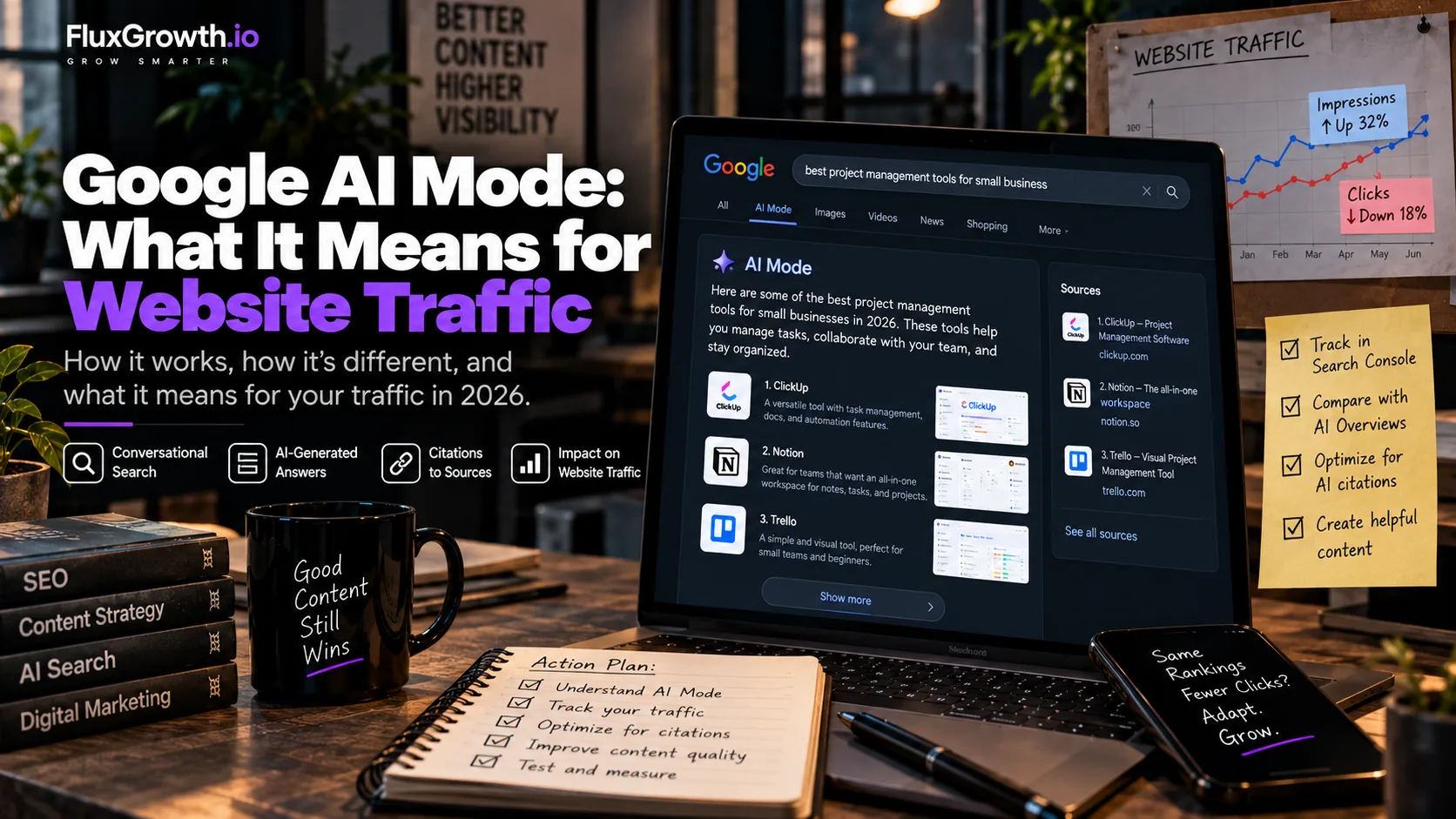
Your rankings look stable. Impressions in Search Console might even be up. Clicks, though, keep slipping, and Google AI Mode is the obvious suspect.
Google AI Mode is a conversational search experience inside Google Search that writes an AI-generated answer, links to the pages it drew from, and lets the searcher keep asking follow-up questions. Its effect on Google AI Mode traffic is real, but it’s narrower and less well measured than most headlines suggest.
Some of that worry is justified. Some of it comes from studies that never measured AI Mode at all (most of the scary numbers you’ve seen are about AI Overviews). Below: which is which, plus a Search Console routine to check your own site.
What is Google AI Mode?
Google AI Mode is a full-page, conversational version of Google Search. Instead of a ranked list of links, it returns a written answer assembled from Google’s index, with links to the pages it relied on, and it keeps context as the searcher asks follow-ups. Google made AI Mode available to all U.S. users in May 2025.
How AI Mode builds an answer
AI Mode doesn’t run a single search. According to Google’s Search Console documentation, AI Mode “groups the user’s question into subtopics and searches for each one simultaneously.” SEOs call this query fan-out.
Google’s May 2026 guide to its generative AI features says they’re rooted in its core ranking and quality systems. So a page Google can’t crawl, index, or show with a snippet won’t be cited in AI Mode either.
Where U.S. searchers find AI Mode in 2026
AI Mode is still a separate experience, not the default results page. Searchers reach it through the AI Mode tab or by asking a follow-up from an AI Overview, a path Google made standard at I/O on May 19, 2026. In June 2026, Google’s Rajan Patel said Google isn’t planning to make AI Mode the default for Chrome searches.
Plenty of people have found it. Google says AI Mode passed 1 billion monthly active users within a year of launch (Sunder Pichai, Google I/O, May 2026).
How is Google AI Mode different from AI Overviews and traditional search?
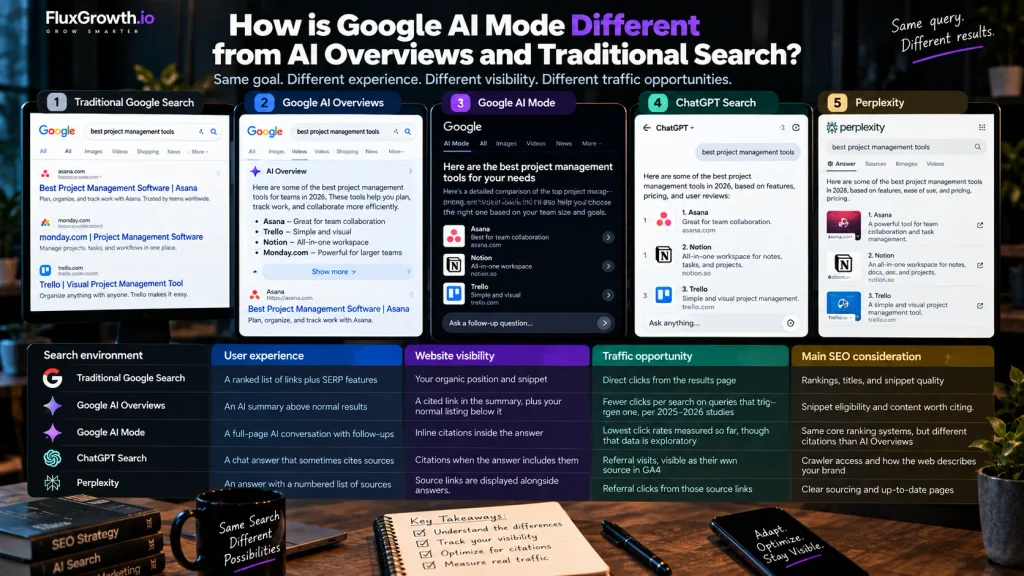
AI Overviews are AI-written summaries placed on top of a normal results page, so the regular links still sit below them. AI Mode replaces that page with a conversation. Fewer links on screen means fewer chances to click, and it’s also why a statistic measured on one surface shouldn’t be pinned on the other.
A few terms, in plain language:
- Zero-click search: a search that ends without a click to any website.
- AI citation: a link or source reference inside an AI-generated answer. Being cited isn’t the same as being clicked.
- GEO and AEO: Generative Engine Optimization and Answer Engine Optimization, labels for optimizing content so AI systems cite it. For a practical guide to improving visibility across AI search platforms, see our guide to AI search optimization.
| Search environment | User experience | Website visibility | Traffic opportunity | Main SEO consideration |
| Traditional Google Search | A ranked list of links plus SERP features | Your organic position and snippet | Direct clicks from the results page | Rankings, titles, and snippet quality |
| Google AI Overviews | An AI summary above normal results | A cited link in the summary, plus your normal listing below it | Fewer clicks per search on queries that trigger one, per 2025–2026 studies | Snippet eligibility and content worth citing |
| Google AI Mode | A full-page AI conversation with follow-ups | Inline citations inside the answer | Lowest click rates measured so far, though that data is exploratory | Same core ranking systems, but different citations than AI Overviews |
| ChatGPT Search | A chat answer that sometimes cites sources | Citations when the answer includes them | Referral visits, visible as their own source in GA4 | Crawler access and how the web describes your brand |
| Perplexity | An answer with a numbered list of sources | Source links are displayed alongside answers. | Referral clicks from those source links | Clear sourcing and up-to-date pages |
Why an AI Overview citation doesn’t carry over to AI Mode
Google AI Mode and AI Overviews usually agree on the answer but cite different pages. Ah-refs compared both surfaces using September 2025 U.S. data from its Brand Radar tool, across 540,000 query pairs. They cited the same URLs only 13.7% of the time, even though the answers were semantically similar (0.86 on a 0-to-1 scale).
So check them separately. Showing up in an AI Overview for “best CRM for small business” tells you nothing reliable about whether AI Mode cites you for the same query.
Does Google AI Mode reduce website traffic?
On the queries where people use it, probably yes. Here’s the thing: the strongest evidence so far measures AI Overviews, not AI Mode. Independent studies keep finding fewer clicks per search when an AI answer appears, and the AI Mode data points the same way. It’s just thinner.
What Google says
Google has argued that AI-powered Search can help users get useful information faster while still directing them to supporting web sources. Avoid stating that AI answers “mostly remove low-value clicks” unless you can cite the specific Google statement supporting that wording.
What independent research shows
Here’s what independent research has actually measured, and on which surface:
Agarwal & Sen field experiment (SSRN, 2026): The study found that, when an AI Overview appeared, outbound organic clicks fell 39.8%, while zero-click searches increased 34.5%. The paper describes this as causal evidence from a randomized field experiment.
Pew Research Center (July 2025): Pew analyzed 68,879 Google searches from 900 U.S. adults. Users clicked a traditional search result 8% of the time when an AI summary appeared, compared with 15% when there was no AI summary. Read the Pew Research Center study
Ah-refs (December 2025 data): Ah-refs analyzed 300,000 keywords and found that the presence of an AI Overview correlated with a 58% lower CTR for the top-ranking page. This is a CTR analysis, not a measurement of total website traffic. Read the Ahrefs study
SparkToro + Similar-web (Jan–Apr 2026): 68.01% of U.S. Google searches ended without an external click. Importantly, SparkToro found that only 0.34% of searches entered AI Mode during this period, so the 68% figure should not be attributed solely to AI Mode. Read the SparkToro analysis
Google’s own reporting: In July 2026, Sunder Pichai said Google’s AI features in Search were sending billions of clicks to websites every week and that AI Mode had surpassed 1 billion monthly active users. These are Google’s own figures, so present them as company-reported rather than independent measurements.
What the evidence can’t tell you yet
Clicks per search isn’t the same as total traffic. If query volume keeps rising, as Google says it is, total clicks to some sites could hold steady even as click-through rates fall. No independent study has settled that. And averages hide a lot (a recipe blog and a B2B software company won’t feel the same effect).
The short version: expect fewer clicks per search on queries that trigger AI answers, and probably fewer still in AI Mode. How many fewer on your site depends on how much of your traffic comes from questions a summary can fully answer.
Which searches and websites are most affected?
Queries a written answer can fully resolve are the most exposed. This section is editorial analysis based on how AI Mode builds answers, not a measured ranking.
By query type
The most exposed queries share one trait. The answer fits on the screen:
- Definitions and explained, like “what is a canonical tag.”
- Comparison questions, like “HubSpot vs. Salesforce for a 10-person sales team,” where AI Mode can build the shortlist itself.
- Long, multi-part questions, which AI Mode is built for.
Less exposed are brand searches and queries that need a tool, a login, or data only you publish. Transactional queries aren’t automatically safe. In July 2026, Google started letting users link apps like Instacart and Canva inside AI Mode, so some tasks now finish without a website visit.
By business model
Publishers and affiliate sites are often more exposed because their content can directly answer the user’s question. A “best budget microphones” roundup, for example, is the kind of content an AI search experience may summarize instead of requiring users to visit every page.
SaaS companies may feel the impact first on top-of-funnel content, such as a project management tool’s “what is a Gantt chart?” explained. E-commerce and local businesses have an additional lever: keeping product information in Google Merchant Center and business information in Google Business Profile accurate and up to date can help products and services appear across Google’s AI search experiences.
External link to add: Place the link on “Google Merchant Center” or “Google Business Profile” to Google’s official guidance on AI features and website visibility.
How can your website still earn visibility and clicks from AI Mode?
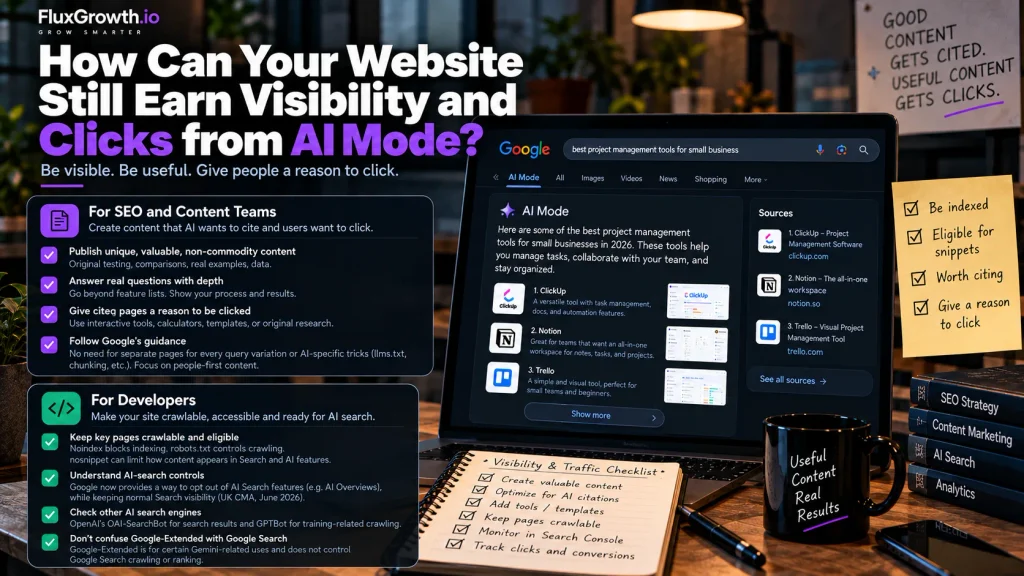
Pages earn AI Mode visibility the same way they earn regular Search visibility: they need to be indexed, eligible for a snippet, and worth citing. Clicks are a separate problem. People click when the summary leaves them something to do, like run their own numbers or check the test results behind a claim.
For SEO and content teams
Google’s guidance emphasizes unique, valuable, non-commodity content. In practical terms, a pricing comparison based on testing each tool’s free plan can provide more value than another rewrite of a vendor’s feature list. Google’s AI features and your website
Google also says there is no need to create separate pages for every query variation or use special AI-focused tactics such as llms.txt, content “chunking,” or AI-specific rewrites. The focus should remain on established SEO practices and genuinely useful, people-first content. Google Search guidance for AI features
Then give cited pages a reason to be clicked. On FluxGrowth, for example, an interactive tool such as an Instagram Reels script generator can provide functionality directly in the browser that an AI answer cannot fully reproduce. Your own testing data, original research, or a useful downloadable template can serve the same purpose.
For developers
- Make key pages crawlable and eligible for Search features. Google says noindex prevents indexing, while robots.txt controls crawling. Controls such as nosnippet can also restrict how content is displayed in Search and AI features. Google: AI features and your website
- Know Google’s AI-search controls. On June 3, 2026, the UK Competition and Markets Authority announced measures requiring Google to provide publishers with a way to opt out of AI Search features such as AI Overviews, while preserving normal Search visibility. UK CMA announcement
- Understand the trade-off. Opting out of Google’s AI Search features can remove a site from those AI experiences while allowing it to remain eligible for traditional Google Search. Whether that makes sense depends on the site’s business model and traffic strategy.
- For other AI search engines, check their crawler controls. OpenAI documents OAI-SearchBot for search results and separately GPTBot for training-related crawling. OpenAI bot documentation
- Don’t confuse Google-Extended with Google Search crawling. Google-Extended controls Google’s use of content for certain Gemini-related purposes; it does not control Google Search crawling or ranking. Google: Google-Extended documentation
How do you measure Google AI Mode traffic?
You can’t isolate Google AI Mode traffic cleanly yet. Search Console folds AI Mode clicks and impressions into its Web search totals, and the newer generative AI report shows impressions only. So you measure around it instead.
What Search Console actually shows
Since June 2025, AI Mode activity counts toward the Performance report’s Web search type. Per Google’s help documentation, a click on an external link in AI Mode counts as a click. There’s no AI Mode filter.
In June 2026, Google added a generative AI performance report for AI Overviews and AI Mode, rolling out to a subset of sites. It shows impressions only. Careful, though: those impressions are already in your Web search totals, so adding them double-counts.
A four-step routine to run monthly
- Split queries by intent. Add a custom regex query filter such as ^(what|how|why|which|best)|vs, then compare CTR for the last three months against the same months a year earlier.
- Flag pages where impressions rise while clicks stay flat. That fits AI answers absorbing the click, though ranking shifts and seasonality can cause it too.
- Judge traffic by outcomes. In GA4, compare conversions per organic session by landing page. AI Mode visits land in Organic Search, but referrals from chatgpt.com and perplexity.ai show up as their own sources.
- Sample priority queries by hand. Once a month, run your 20 most valuable queries in AI Mode and log whether your site is cited.
Does SEO still matter? How SEO, GEO, and AEO fit together
Yes. For Google Search, SEO and AI-search optimization are the same job. Google’s May 2026 guide calls optimizing for its generative AI features “still SEO,” and it points site owners to its advice on evaluating third-party SEO services before buying anything labeled AEO or GEO.
GEO and AEO matter more outside Google, where ChatGPT and Perplexity run their own crawlers and retrieval. Citations are also rarer than people assume: Similar-web found just 6.8% of U.S. ChatGPT desktop queries included citations as of May 2026.
Frequently asked questions
What is Google AI Mode?
Google AI Mode is a conversational search experience in Google Search that answers a query with an AI-generated response, links to supporting pages, and supports follow-up questions. It’s separate from the standard results page and has been available to all U.S. users since May 2025.
Does Google AI Mode reduce website traffic?
Google AI Mode likely reduces clicks per search on the queries where people use it. A 2026 randomized study found fewer outbound clicks among participants sent to AI Mode, though the researchers called that result exploratory.
How is Google AI Mode different from AI Overviews?
AI Overviews are AI summaries at the top of a normal results page, with regular links below. AI Mode replaces the results page with a full conversation. Ah-refs found the two cited the same URLs only 13.7% of the time in September 2025 U.S. data.
Can websites still get clicks from Google AI Mode?
Yes. AI Mode links to the pages it cites, and Search Console counts those clicks. Original data, working tools, and first-hand testing give searchers a reason to click.
Does SEO still matter with Google AI Mode?
Yes. Google says its generative AI features run on its core ranking and quality systems, so optimizing for them is still SEO.
How can I optimize my website for Google AI Mode?
Keep important pages indexable and snippet-eligible, then publish helpful content with original insight. Google says you can skip llms.txt files and content chunking for its AI features.
How do I measure traffic from Google AI Mode in Search Console?
AI Mode clicks and impressions are included in Search Console’s Web search totals, with no filter to isolate them. Compare impressions and clicks by query type over time to estimate the effect.
What to do next
Google AI Mode traffic will look different on every site. Expect fewer clicks on queries a summary can answer, probably fewer in AI Mode than in AI Overviews. The rules for who gets cited haven’t moved, though: it’s still Google’s index and ranking systems deciding.
So the SEO work barely changes. The measurement does. Here’s one thing to do today: open Search Console, split your queries into question-style and brand-style groups, and compare CTR for the last three months against the same period last year. If question CTR fell and brand CTR didn’t, you’ve found your AI exposure.
When you’re ready for the next step, our GEO and AI search guides cover how to track and earn AI citations.