FluxGrowth is reader-supported. Some links in our guides are affiliate links — if you buy through one we may earn a commission, at no extra cost to you. It never changes which tools we recommend. How we test tools.
You don’t need convincing that AI matters. You need to know which company won’t waste six months of your budget figuring that out for you.
That’s the real problem with most “best AI development company” lists. They’re written by people who’ve never sat through a vendor’s discovery phase, watched a proof-of-concept quietly die, or explained to a CFO why the “quick AI pilot” turned into a $400,000 line item.
This guide skips the fluff. Real pricing where it exists. Honest gaps where it doesn’t. A framework for picking a partner who won’t leave you holding an expensive demo nobody uses.
What Are AI Software Development Services?
Definition
AI software development services cover the design, build, and deployment of software that uses machine learning, natural language processing, computer vision, or generative models, basically anything that used to need a person to reason through a decision, predict an outcome, or write the first draft of something.
That’s different from buying ChatGPT Enterprise or bolting an AI add-on onto Salesforce. You’re paying a team, sometimes a platform plus a team to build something trained on your data, for your workflow, that nobody else has.
Types of AI Services
The category spans everything from a single chatbot integration to a full multi-agent system running across your CRM, ERP, and support stack. Some vendors sell pure engineering hours. Others sell a platform with implementation services bolted on. Knowing which one you’re buying matters more than most buyers realize going in.
Industries Using AI Solutions
Healthcare, financial services, retail, logistics, and manufacturing see the highest reported returns right now, mostly through automation, predictive analytics, and decision-support tools. That’s not a coincidence these are industries with high transaction volume and well-defined repetitive tasks, exactly where AI earns its keep fastest.
Why Businesses Need AI Software Development Services
You could try to build this in-house. Some companies should. Most shouldn’t at least not yet.
- Automating repetitive work frees your team from the stuff nobody wants to do anyway: data entry, ticket triage, first-draft reporting.
- Decision-making gets sharper when a model is processing more signals, faster, than a person ever could.
- Customer experience improves through faster response times and more personalized interactions when it’s built well, not bolted on as an afterthought.
- Costs come down in places you can actually measure: support deflection, fraud detection, inventory forecasting.
- Innovation speeds up. Teams that ship AI-assisted features iterate faster than teams still doing everything by hand.
None of that happens automatically. It happens because a development partner understood your specific bottleneck and built for it not because they sold you a generic “AI transformation.”
Types of AI Software Development Services
Custom AI Software Development
Built from the ground up around your data and your specific use case. More expensive and slower than off-the-shelf, but it’s yours, and it doesn’t break when a vendor changes their roadmap.
Generative AI Development
Content generation, copilots, document drafting, code assistance, anything built on large language models. This is where most 2026 budgets are going, and where the gap between a flashy demo and a production system is widest.
Machine Learning Development
Predictive models for forecasting, churn prediction, risk scoring. Less glamorous than generative AI, often more reliably profitable.
Natural Language Processing (NLP)
Sentiment analysis, document classification, multilingual support, search. The unglamorous backbone behind a lot of generative AI products.
Computer Vision Solutions
Image and video analysis quality inspection, medical imaging, property appraisal automation. Heavy lift on data labeling, big payoff in industries with visual inspection bottlenecks.
AI Chatbot Development
Customer-facing or internal. Ranges from a basic FAQ bot to a full agentic system that can actually execute transactions, not just answer questions.
Predictive Analytics Solutions
Using historical data to forecast what happens next demand, churn, maintenance needs. Often the highest-ROI, lowest-drama AI investment a company makes.
AI Integration Services
Wiring AI into systems you already run instead of building from zero. Usually faster and cheaper than custom development, assuming your data is clean enough to work with.
AI Agent Development
Systems that don’t just respond they plan, act, and complete multi-step tasks with limited human input. This is the single biggest shift in how AI development is scoped in 2026, and it shows up in nearly every company profile below.
Top AI Software Development Companies in 2026
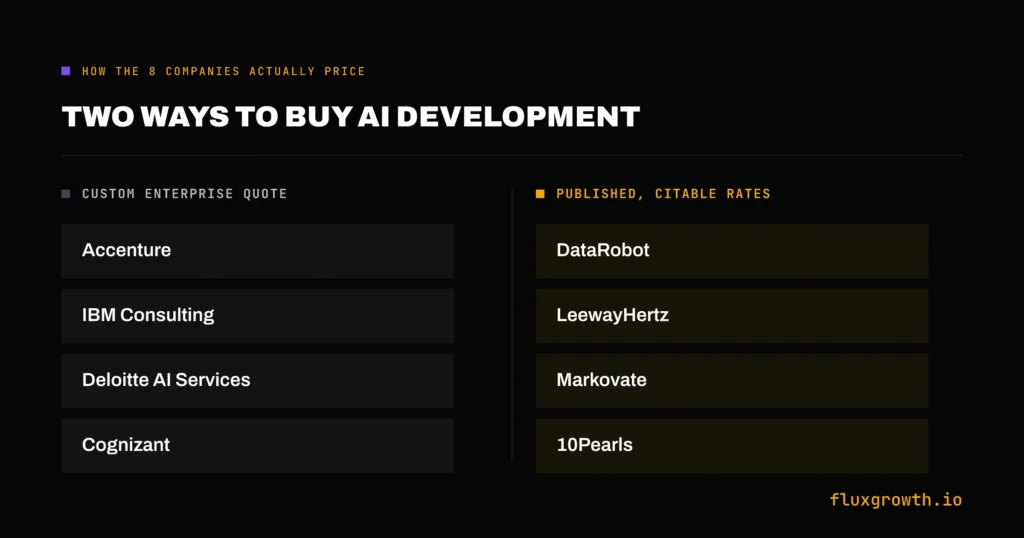
A quick note before you read these. Four of the eight companies below don’t publish pricing at all. Accenture, IBM Consulting, Deloitte, and Cognizant sell custom enterprise engagements, and the number you get depends on scope, region, and how hard you negotiate.
The other four DataRobot, LeewayHertz, Markovate, 10Pearls have real, citable numbers. We’ve marked each accordingly.
1.Accenture
Accenture is the safest, most expensive, and most generic choice on this list. For the right buyer, that’s exactly the point. With roughly 784,000 employees and a proprietary platform called AI Refinery, Accenture builds full-scale AI transformations for the world’s largest enterprises, backed by partnerships with Databricks, OpenAI, Microsoft, and ServiceNow. Its AI revenue hit $2.7 billion in fiscal 2025, tripling from the year before.
Even Accenture isn’t immune to the disruption it sells. Its stock dropped roughly 9–10% in early 2026 on investor fears that coding tools like Claude Code would eat into its highest-margin billable hours. Worth sitting with for a second the company selling you AI transformation is nervous about the same forces transforming it.
If you’re mid-market (roughly $300M–$3B in revenue), don’t write Accenture off. It launched a dedicated unit called Accenture Edge built for exactly that range. Just know the quote you get back will be custom and unpublished, built for a buyer who wants one vendor running strategy, build, and change management end to end.
2.IBM Consulting
IBM’s pitch is different from the rest of this list: it’s the only Big Four-style player with semi-published platform pricing. Watsonx.ai runs on a Standard plan with a $1,110/month instance fee covering a block of usage, plus per-token charges for foundation model inference. Granite models start around $0.10 per million tokens, with third-party models priced separately.
IBM Consulting is also the largest implementation partner for Watson, reportedly delivering 35–50% of enterprise implementations. That transparency comes with a catch, though. Several independent cost analyses suggest Watson’s total cost of ownership often runs higher over a multi-year rollout than going direct to Open AI or Anthropic for comparable workloads; the premium buys you IBM’s governance tooling, on-prem options, and indemnity, not raw model capability.
If you’re regulated (finance, healthcare) and already inside the IBM ecosystem with on-prem requirements that aren’t negotiable, that premium might be the price of doing business. If you’re not, it’s worth pricing OpenAI or Anthropic directly before you assume IBM is the safe default.
3.Deloitte AI Services
Deloitte sells research credibility as much as engineering. Its annual State of AI in the Enterprise report is one of the most-cited primary sources in this space, and the firm backs it up with fast product moves: a new Enterprise AI Navigator tool (launched February 2026) and an expanded Google Cloud agentic transformation practice (April 2026) built around Gemini Enterprise.
Deloitte’s own research is more candid than you’d expect from a firm selling the thing it studies. Only about a third of the organizations it surveyed are using AI to meaningfully transform their business. Another third are redesigning processes around it. The last third still using AI at a surface level, with little real change are probably the ones reading this article right now.
That’s worth sitting with before you sign a contract expecting overnight transformation. There’s no published pricing here, and Deloitte isn’t really built for anyone who wants less than strategy, governance, and delivery under one roof.
4.Cognizant
Cognizant’s 2026 story is security, not capability. Its newly launched Secure AI Services targets a problem most of this list glosses over: agentic systems that act on their own create real governance risk, and Cognizant wants to be the firm that locks that down before it becomes a headline.
It’s not a small operation making that claim, either 200,000+ people took part in Cognizant’s internal AI hackathon, with 53,000 of them actively writing code. Pricing is custom (no surprise at this tier), and it’s the right call for regulated companies that need agentic AI deployed with real audit infrastructure attached, not a chatbot wearing a security badge.
5.DataRobot
DataRobot breaks the mold here because it’s a platform company first, a services company second. Unlike the four above it, you can actually find real numbers.
Cloud enterprise access starts around $150,000 a year. Smaller deployments run $2,500–$7,500 a month. Large-scale rollouts (1,000+ users) climb past $500,000 annually. A Forrester-commissioned study found a potential 514% ROI with payback in as little as three months though that figure comes from a vendor-funded study, so treat it as a ceiling, not an average.
Here’s the honest limitation: DataRobot is built for teams that already have data science depth in-house. Hire it because you don’t have that expertise yet, and it’ll feel like buying a race car before you’ve got a license. If your team already has data scientists on staff, though, this beats stitching together five separate MLOps tools.
6.LeewayHertz
LeewayHertz has been doing this since 2007, and it shows in the client list ESPN, NASCAR, Hershey’s, P&G, and Siemens have all used them, alongside plenty of startups. Hourly rates land somewhere between $50 and $149 depending on which review source you check, and typical full projects run $50,000–$200,000, with some enterprise engagements topping $180,000.
Its proprietary platform, ZBrain, gives it a real edge for clients who want a low-code layer over the AI workflow instead of fully custom code from scratch. That’s also the trade-off: ZBrain-based builds ship faster but can feel less flexible if your use case is unusual. Good fit for anyone a startup to Fortune 500 who wants flexible pricing and doesn’t need a Big Four logo on the contract to feel safe.
7.Markovate
Markovate is the budget-conscious pick on this list, and it earns that label with specifics, not vague promises. A San Francisco-based shop founded in 2015 with roughly 50 engineers and data scientists.
Its delivered results clients are willing to put their names to: a 40% reduction in documentation time for one healthcare client, a 70%+ improvement in quote-generation speed for a SaaS platform, a 30% lift in retail inventory turnover from a predictive analytics build.
MVP-scale projects typically run $30,000–$80,000, which puts Markovate within reach of companies that can’t justify a six-figure AI budget yet. The trade-off is scale (this isn’t the firm for a 5,000-seat enterprise rollout). This is the pick if you’re a startup or mid-market company that needs something scoped and fast, without paying for enterprise-consultancy overhead you’ll never use.
8.10Pearls
10Pearls has been around since 2004, runs a multi-shore delivery model (US-based management, Latin American and Pakistani engineering), and holds ISO 27001 certification — which matters if you’re in healthcare or government and compliance isn’t optional. Minimum project size sits around $50,000, hourly rates run $25–$49, and the full project range stretches from roughly $11,750 to over $2 million depending on scope.
One independent review worth reading before you commit: 10Pearls is described as stronger in software engineering than in pure data science. Solid AI/ML capability, but not the deepest bench if your project is research-heavy rather than implementation-heavy. Still a solid choice if you’re a regulated mid-market company healthcare, fintech, government contractor that wants US-managed delivery without paying full US-onshore rates.
Comparison Table of Leading AI Development Companies
| Company | Best For | Pricing | Industries | Enterprise Focus |
| Accenture | Large enterprises wanting full-scale transformation | Custom, unpublished | Financial services, healthcare, retail, public sector | Very high |
| IBM Consulting | Regulated enterprises already on Watson | Custom + published platform rates (from ~$1,110/mo + per-token) | Finance, healthcare, government | Very high |
| Deloitte AI Services | Enterprises wanting strategy + governance bundled with delivery | Custom, unpublished | Financial services, retail, life sciences, public sector | Very high |
| Cognizant | Enterprises prioritizing agentic AI security and governance | Custom, unpublished | Banking, healthcare, telecom | High |
| DataRobot | Teams with in-house data science wanting a unified platform | From ~$150,000/year, scales with usage | Cross-industry, data-heavy teams | High (platform-led) |
| LeewayHertz | Startups to Fortune 500 wanting flexible AI builds | $50–149/hr; projects typically $50K–$200K | Finance, healthcare, retail, supply chain | Medium–high |
| Markovate | Startups and mid-market needing a fast, scoped build | MVPs roughly $30K–$80K | Healthcare, finance, insurance, manufacturing | Medium |
| 10Pearls | Regulated mid-market wanting US-managed offshore-blended delivery | $25–49/hr; min. project ~$50K | Healthcare, fintech, government, education | Medium–high |
How Much Do AI Software Development Services Cost?
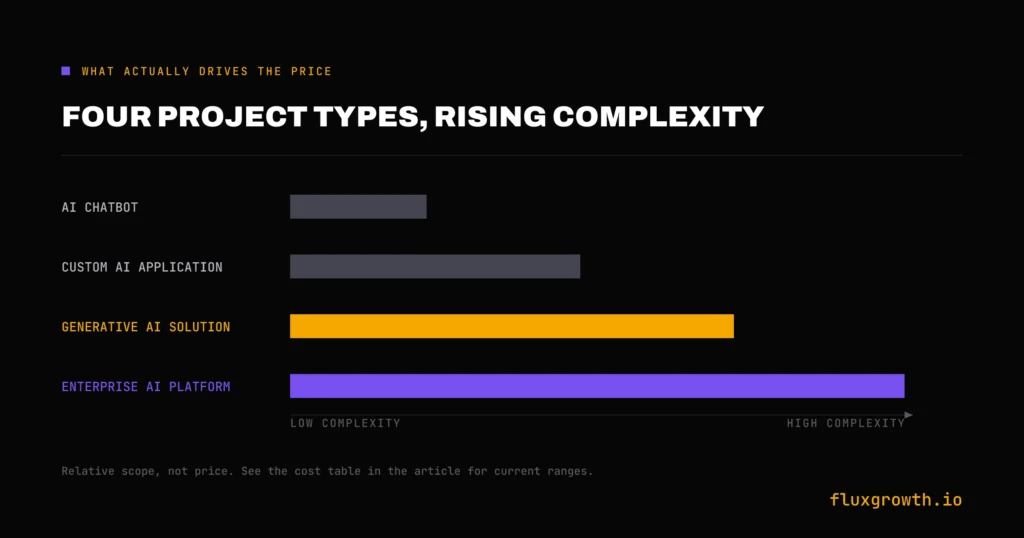
| Project Type | Estimated Cost (2026) |
| AI Chatbot | $5,000–$300,000+ |
| Custom AI Application | $40,000–$500,000+ |
| Enterprise AI Platform | $300,000–$2,000,000+ |
| Generative AI Solution | $15,000–$2,000,000+ |
These ranges are intentionally broad. A rule-based FAQ bot and a multi-agent enterprise assistant both fall under “AI chatbot,” but they are fundamentally different projects.
Several factors determine where a project falls within these ranges:
- Project complexity: A single-use-case AI model costs far less than a multi-agent system connected to multiple business applications.
- Data availability: If your data is fragmented or poorly structured, data preparation can consume a significant share of the project timeline and budget.
- Required expertise: Fine-tuning foundation models typically requires specialized machine learning talent compared with building retrieval-augmented generation (RAG) applications on top of existing models.
- Integration depth: Connecting AI systems to modern APIs is relatively straightforward, while integrating with legacy enterprise systems can substantially increase costs.
- Maintenance requirements: Businesses should typically budget an additional 15%–25% of the initial project cost annually for monitoring, infrastructure, retraining, security updates, and ongoing optimization.
AI spending continues to accelerate globally. Gartner forecasts worldwide AI spending will reach approximately $2.6 trillion in 2026, reflecting strong enterprise investment in AI infrastructure, software, and services. However, organizations are increasingly prioritizing measurable business outcomes over experimental deployments.
How to Choose an AI Development Company
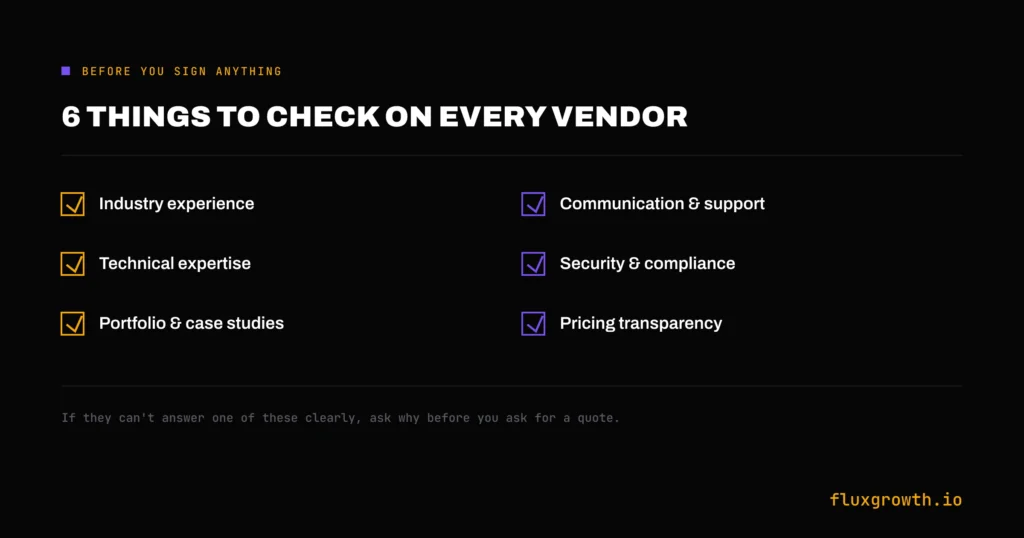
Industry Experience
A vendor that’s built fraud detection for three other banks will move faster than one learning your compliance requirements from scratch.
Technical Expertise
Ask specifically about their stack LangChain or LangGraph for orchestration, which vector database, which evaluation tooling. Vague answers here are a red flag.
Portfolio and Case Studies
Demand named clients and measurable outcomes, not “increased efficiency.” If they can’t share a number, ask why.
Communication and Support
Find out who you’re actually talking to after the contract is signed, not the sales team that pitched you, the engineers who’ll build it.
Security and Compliance
Non-negotiable in healthcare, finance, and government. Ask for certifications (SOC 2, ISO 27001, HIPAA-readiness) up front, not after you’ve signed.
Pricing Transparency
The companies on this list with published rates aren’t necessarily cheaper but you’ll know what you’re walking into before you commit. In my experience, vague pricing usually means longer sales cycles and more uncertainty. Clear pricing doesn’t necessarily mean a vendor is cheaper, but it does make it easier to shortlist providers and avoid budget surprises later in the process.
AI Software Development Process
Discovery and Planning
Defining the actual problem, not the AI buzzword version of it. The best vendors spend real time here before writing a line of code.
Data Collection and Preparation
The least glamorous, most time-consuming stage. Plan for it to take longer than you expect.
Model Development
Building and training the actual system fine-tuning, prompt engineering, or classical ML depending on the use case.
Testing and Validation
Checking accuracy, bias, and edge cases before anything touches production. Skipping this is how companies end up in the news for the wrong reasons.
Deployment
Rolling out to production, ideally in phases rather than all at once.
Ongoing Maintenance
Monitoring for drift, retraining as data changes, fixing what breaks. This never actually ends.
Common Challenges in AI Development
Data Quality Issues
Garbage in, garbage out still applies, no matter how advanced the model is.
Integration Complexity
Legacy systems weren’t built with AI in mind, and bridging that gap is often harder than building the model itself.
High Implementation Costs
Budgets routinely balloon 30–60% over initial estimates when a vendor’s capability statement doesn’t match their actual delivery experience.
Regulatory Compliance
Especially brutal in healthcare and finance, where the rules are still catching up to the technology.
Model Accuracy and Bias
Here’s the thing: most AI projects don’t fail because the model is bad. They fail because nobody checked whether it was solving the right problem in the first place.
Research circulating widely in 2026 puts the share of enterprise AI investments showing zero measurable ROI as high as 95%. Even Accenture’s own materials note that only about 13% of companies report real enterprise-level value from their gen AI work so far, despite most being two or three years into trying. That’s not a reason to avoid AI. It’s a reason to pick a vendor who’ll tell you “no” when your use case doesn’t justify the build.
Future Trends in AI Software Development
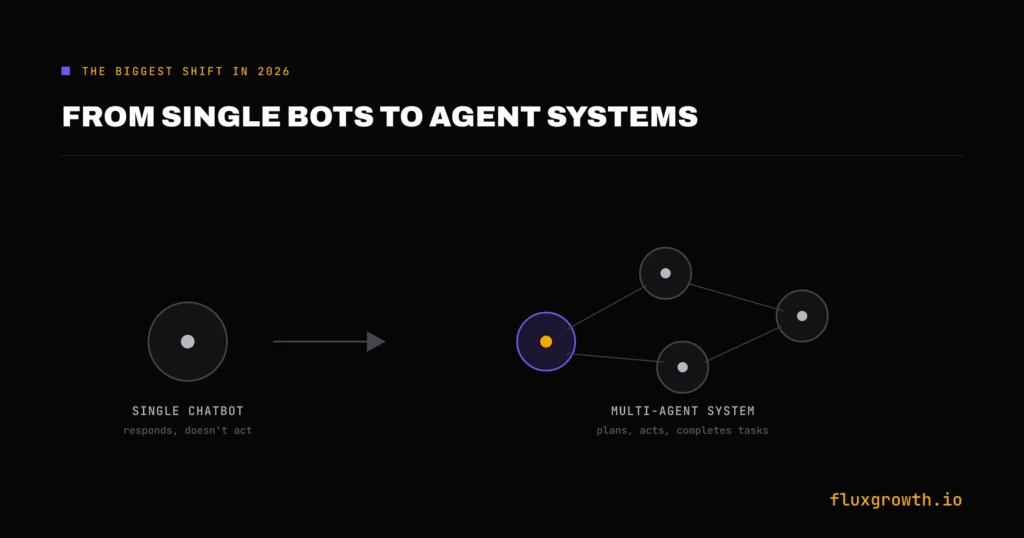
Agentic AI is the story of 2026, full stop. It’s worth treating generative AI and standalone “AI agents” as part of the same trend rather than three separate ones, because in practice they are.
Accenture reported a 327% increase in multi-agent system deployments in just four months. Deloitte’s research shows agentic AI usage climbing from 23% of organizations today to a projected 74% within two years. The shift in how this gets built is just as real Lang Chain and Lang Graph have become the default orchestration layer, with most serious 2026 vendors expected to be fluent in at least one major vector database and one observability tool before you sign a contract.
Vertical, domain-specific models are quietly outperforming general-purpose ones on specialized tasks. A model trained on clinical notes or legal contracts beats a general LLM on that narrow job almost every time.
Multimodal AI systems that handle text, image, and structured data together are moving from research demo to standard enterprise feature. Edge AI gets mentioned in plenty of 2026 forecasts, but for most of the company types on this list, it’s a niche concern rather than a mainstream buying criterion right now.
What I’d Do If I Were Hiring an AI Development Partner Today
If I were hiring an AI development company today, I’d start with a small proof-of-concept instead of committing to a full enterprise rollout immediately. I’d shortlist three vendors, request real case studies, talk to existing clients directly, and insist on measurable success metrics before signing a long-term contract.
In my experience, companies that start small, validate results, and then scale tend to get better outcomes and a lot less budget risk than the ones that go straight for the big rollout.
Frequently Asked Questions
What are AI software development services?
Services that design, build, and deploy software using machine learning, NLP, computer vision, or generative AI to automate tasks, support decisions, or create new products typically delivered by a specialized development company or consultancy.
How much does AI software development cost?
Anywhere from $5,000 for a basic chatbot to $2 million or more for an enterprise-grade platform. Most mid-sized custom projects fall between $40,000 and $500,000.
Which company offers the best AI development services?
It depends on your size and budget. Large enterprises tend toward Accenture, IBM, Deloitte, or Cognizant. Mid-market and startups usually get better value from LeewayHertz, Markovate, or 10Pearls. Teams with in-house data science often prefer a platform like DataRobot.
How long does it take to build AI software?
A basic chatbot can ship in 4-8 weeks. A mid-complexity application takes 3–6 months. A full enterprise platform with multiple integrations often runs 6–12 months or longer.
What industries benefit most from AI?
Healthcare, financial services, retail, logistics, and manufacturing currently see the strongest reported ROI, mostly through automation and predictive analytics.
What is the difference between AI consulting and AI development?
Consulting focuses on strategy, what to build, why, and how it fits your business. Development is the actual engineering work of building and deploying the system. Many firms on this list do both.
Should startups outsource AI development?
In most cases, yes. Building an in-house AI team costs $1.2–$2.5 million a year fully loaded for a six-person team, money most startups should put toward the product itself, not the infrastructure to build it.
What should businesses look for in an AI development company?
Real case studies with named clients and measurable outcomes, transparent pricing (or a clear explanation of why it’s custom), relevant compliance certifications, and a discovery process that questions your assumptions instead of just agreeing with them.
The Bottom Line
The right AI development partner isn’t the one with the biggest name or the slickest deck. It’s the one whose pricing model, client list, and honest limitations actually match what you’re trying to build. Start small, demand real numbers, and don’t sign anything until someone’s told you what could go wrong.