FluxGrowth is reader-supported. Some links in our guides are affiliate links — if you buy through one we may earn a commission, at no extra cost to you. It never changes which tools we recommend. How we test tools.
Gemini 4 Argon vs ChatGPT isn’t a fight with one winner. On independent tests, Google’s Gemini 4 Argon and OpenAI’s GPT-6 Astra (the flagship inside ChatGPT and Codex) score the same: 53 apiece on the Artificial Analysis Intelligence Index.
Argon is cheaper per token right now. Astra leads the agentic, terminal-style coding benchmarks. So the right pick depends on your workflow, your budget, and which tools you already live in.
One date matters more than any benchmark here: November 30, 2026. That’s when Argon’s API price doubles.
What is Gemini 4 Argon, and where can developers use it today?
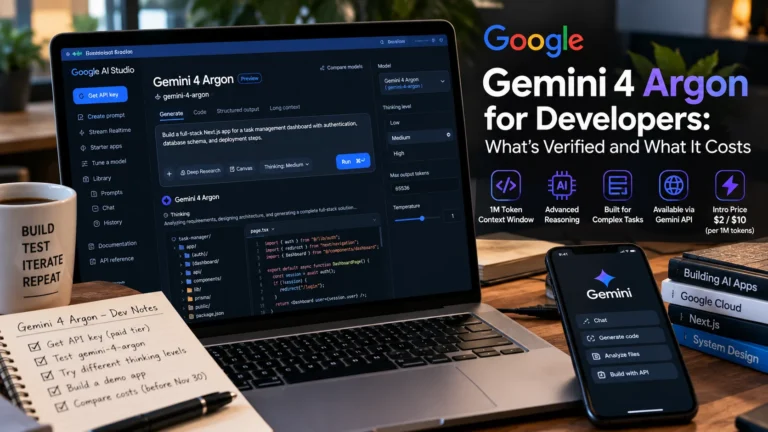
Gemini 4 Argon is Google’s flagship reasoning model, built for complex software engineering, multi-step agents, and long outputs. Google announced it on September 30, 2026, and made it generally available through the Gemini API on October 13, 2026, under the model ID gemini-4-argon. Read Google’s official announcement and Gemini 4 Argon’s model documentation.
The specs that matter for code
Argon’s context window is 1,048,576 tokens, shared across input, thinking, and output. The default output limit is 65,536 tokens, while long decode can generate up to 1 million tokens, minus the input tokens already used. See Google’s Gemini API token-limit guide for the technical details.
Why should developers care? Long decode can help with large code-generation tasks, migration plans, and substantial code changes without manually splitting every response. However, the full output limit requires the appropriate long-decode configuration.
The shared budget is the important constraint. If you submit 900,000 input tokens, only 148,576 tokens remain for thinking and output combined.
Gemini 4 Argon also supports function calling, structured outputs, code execution, search grounding, file search, and three thinking levels: low, medium, and high. Check the official Gemini API guide for supported capabilities and configuration details.
Where you can run it
Here’s the access map as of mid-October 2026:
- Gemini API (paid tier only) and Google AI Studio, billed per token
- Google Antigravity desktop app and CLI, for Google AI Ultra subscribers and eligible Gemini Enterprise accounts
- The Gemini app, for Google AI Pro and Ultra subscribers
- Gemini for business and Google Cloud’s Agent Studio for enterprises
One catch trips people up. Google’s pricing page says Argon isn’t on the free API tier or included with the Google AI Pro plan for API use. Pro gets you Argon in the Gemini app, not in Antigravity.
What does “ChatGPT” actually mean in a coding comparison?
“ChatGPT” now covers several separate surfaces, and only some of them matter for coding. OpenAI splits the product into Chat (conversation), Work (an agent for longer jobs), and Codex (software development), plus the separately billed OpenAI API.
Chat, Work, Codex, and the API
Quick definitions, since these get blurred constantly:
- Chat is the normal conversation window. Good for explaining an error or sketching a function.
- ChatGPT Work is an agent mode for longer, multi-step tasks.
- Codex is OpenAI’s coding agent. It runs as an open-source CLI, a VS Code and JetBrains extension, a desktop app, and cloud tasks that return pull requests.
- The OpenAI API is pay-per-token access for your own apps and scripts. It’s billed separately from any ChatGPT plan.
The two OpenAI models that matter here
A fair comparison needs two OpenAI models, not one.
GPT-6 Astra is OpenAI’s flagship. In regular Chat it appears as “GPT-6 Pro,” available on the Pro, Business, and Enterprise plans. Plus subscribers get Astra only inside ChatGPT Work and Codex, with limited usage.
GPT-6.1 Sol is the price match. OpenAI released it on September 29, 2026, and positioned it close to Astra on agentic coding at one-fifth the per-token price. It’s in Work, Codex, and the API, but not yet in regular Chat.
Gemini 4 Argon vs ChatGPT: what are the key differences?
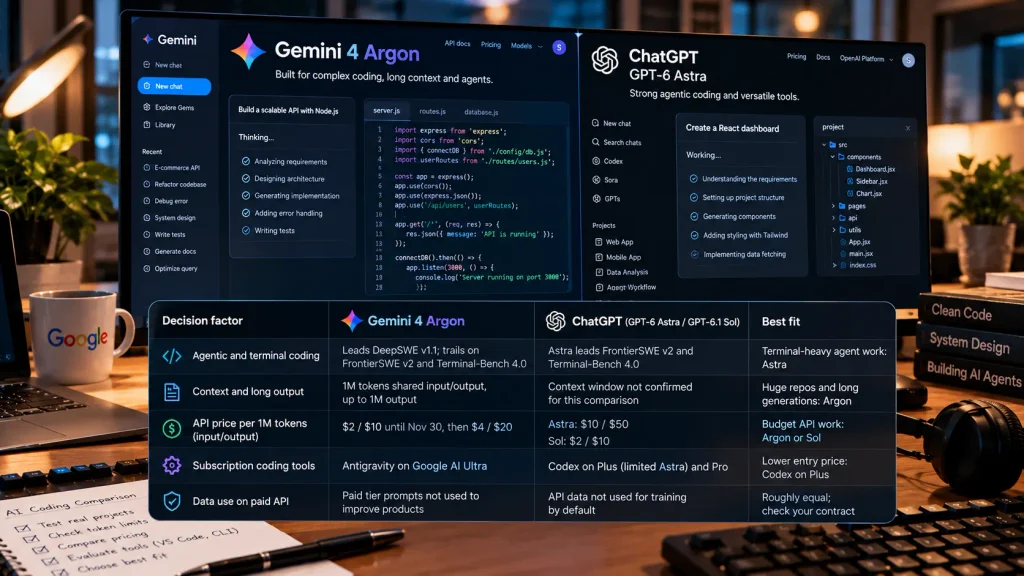
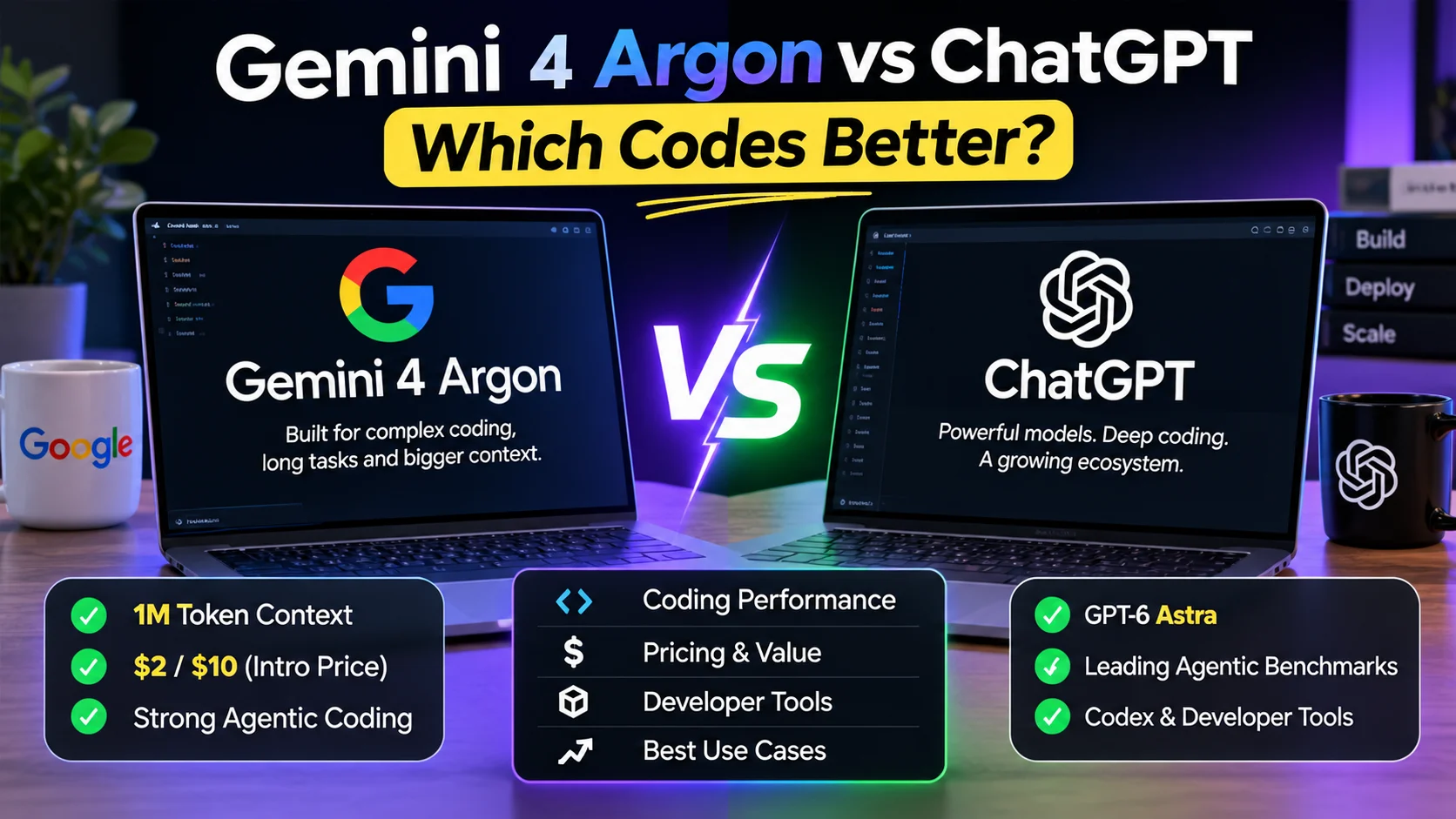
Argon wins on price and context, Astra on agentic coding benchmarks. Codex, meanwhile, runs in more places today: the terminal, VS Code and JetBrains, a desktop app, cloud sandboxes, and GitHub.
| Decision factor | Gemini 4 Argon | ChatGPT (GPT-6 Astra / GPT-6.1 Sol) | Best fit |
| Agentic and terminal coding | Leads DeepSWE v1.1; trails on FrontierSWE v2 and Terminal-Bench 4.0 | Astra leads FrontierSWE v2 and Terminal-Bench 4.0 | Terminal-heavy agent work: Astra |
| Context and long output | 1M tokens shared input/output, up to 1M output | Context window not confirmed for this comparison | Huge repos and long generations: Argon |
| API price per 1M tokens (input/output) | 2/10 until Nov 30, then 4/20 | Astra 10/50; Sol 2/10 | Budget API work: Argon or Sol |
| Subscription coding tools | Antigravity on Google AI Ultra | Codex on Plus (limited Astra) and Pro | Lower entry price: Codex on Plus |
| Data use on paid API | Paid tier prompts not used to improve products | API data not used for training by default | Roughly equal; check your contract |
Pick the tool-chain first, then the model. If your team reviews everything in GitHub pull requests, a slightly stronger model in a tool that can’t comment on a PR won’t save you much time.
For a closer look at OpenAI’s model capabilities and developer use cases, read our guide to GPT-6 Astra: What Developers Should Know.
Which is better for coding? What the benchmarks actually show
Neither model wins coding outright. Google’s own results put Argon ahead on some coding benchmarks, while independent and third-party leader-boards put GPT-6 Astra ahead on the agentic, terminal-based ones.
Vendor-reported results
Google reports Argon at 77.9% on DeepSWE v1.1 versus 74.1% for GPT-6 Astra. On FrontierSWE v2, using Proximal’s public leader-board, Astra leads 65.5% to 55.0%. That’s a 10.5-point gap the other way.
Same “coding” label, opposite winners. That’s normal. Each benchmark tests a different slice of the job, so one headline number tells you very little.
Independent results
Artificial Analysis, which runs its own evaluations, scores Argon (high) and Astra both at 53 on its Intelligence Index. On its own run of Terminal-Bench 4.0, Astra scores 59.1% to Argon’s 57.1%.
Cost per task is where Argon pulls ahead: about $1.99 per average task versus $3.26 for Astra, by Artificial Analysis’s measure. Run 500 agent tasks a week and that $1.27 gap comes to roughly $635 a week (my math, on their averages).
Argon’s figure reflects its introductory rates, the only ones living so far. Expect that edge to shrink once the price doubles on December 1.
Why benchmark leads don’t equal productivity
Benchmarks run on clean, public repos with fixed scoring. Your code base has legacy patterns, flaky tests, and internal APIs no model has seen. A 2-point edge can vanish (or flip) the moment the model meets your monorepo.
Use benchmarks to build a shortlist. Both models are on it.
How do the coding tools compare: Antigravity vs Codex?
Both agents read repos, edit multiple files, run commands, and chain multi-step tasks. The difference is where they live: Codex reaches into GitHub, while Antigravity centers on its own desktop app and CLI.
Google Antigravity
Antigravity is Google’s agent-first development platform. Argon runs in the Antigravity desktop app and CLI, and Google says plugins, skills, and MCP integrations connect the agent to outside data sources.
Google’s support docs also list Argon for Antigravity’s IDE extensions, though not for the separate Antigravity IDE.
The limitation is access. Individual developers need Google AI Ultra (from $99.99 a month) to use Argon in Antigravity at launch.
OpenAI Codex
Codex spans more surfaces today:
- An open-source CLI
- An IDE extension for VS Code and JetBrains
- A desktop app
- Cloud tasks that run in an isolated sandbox and open a pull request for you to review
The GitHub integration is Codex’s clearest edge. Tag @codex on an issue or pull request to start a task, or let it review PRs automatically, following repo guidance from an AGENTS.md file.
One caveat: signing in with an API key instead of a ChatGPT account loses cloud features like GitHub code review and cloud delegation.
Quick take: if your team’s work runs through GitHub pull requests, Codex fits with less setup. If you want the biggest context window inside an agent and you’re already paying for Ultra, Antigravity makes sense.
What does each option cost? Subscriptions vs API billing
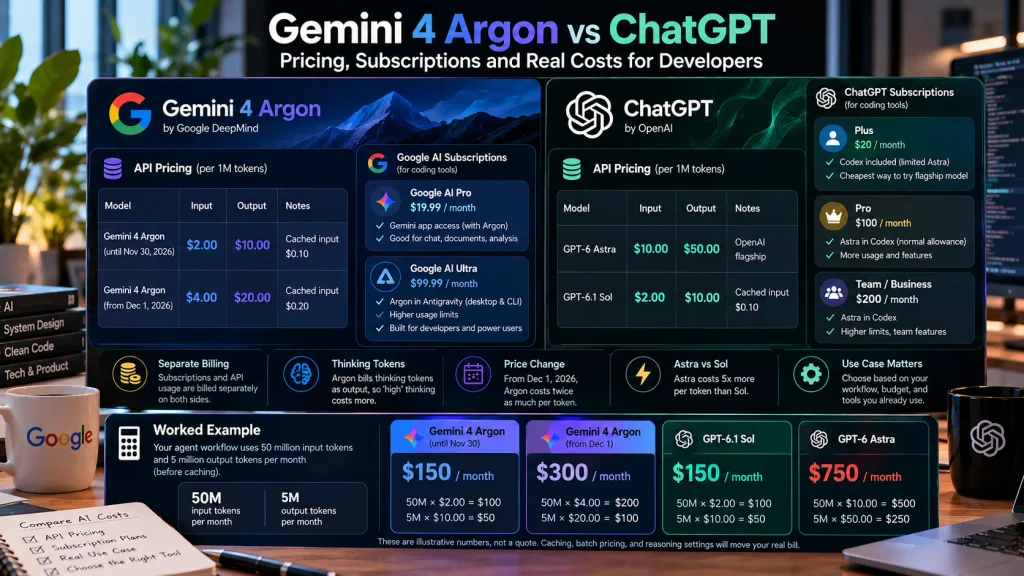
Subscriptions and API usage are billed separately on both sides. A ChatGPT plan doesn’t cover OpenAI API calls, and a Google AI plan doesn’t cover Gemini API calls.
API prices side by side
| Model | Input per 1M tokens | Output per 1M tokens | Notes |
| Gemini 4 Argon (until Nov 30, 2026) | $2.00 | $10.00 | Cached input $0.10 |
| Gemini 4 Argon (from Dec 1, 2026) | $4.00 | $20.00 | Cached input $0.20 |
| GPT-6 Astra | $10.00 | $50.00 | OpenAI flagship |
| GPT-6.1 Sol | $2.00 | $10.00 | Cached input $0.10 |
Two details people miss. Argon bills thinking tokens as output, so the “high” thinking level costs more than “low” on the same prompt. And from December 1, Argon costs twice what GPT-6.1 Sol does per token. Twice.
Subscriptions for coding tools
On the Google side, Argon in Antigravity requires Google AI Ultra, which starts at 99.99amonth.GoogleAIPro(19.99 a month) gets you Argon in the Gemini app only.
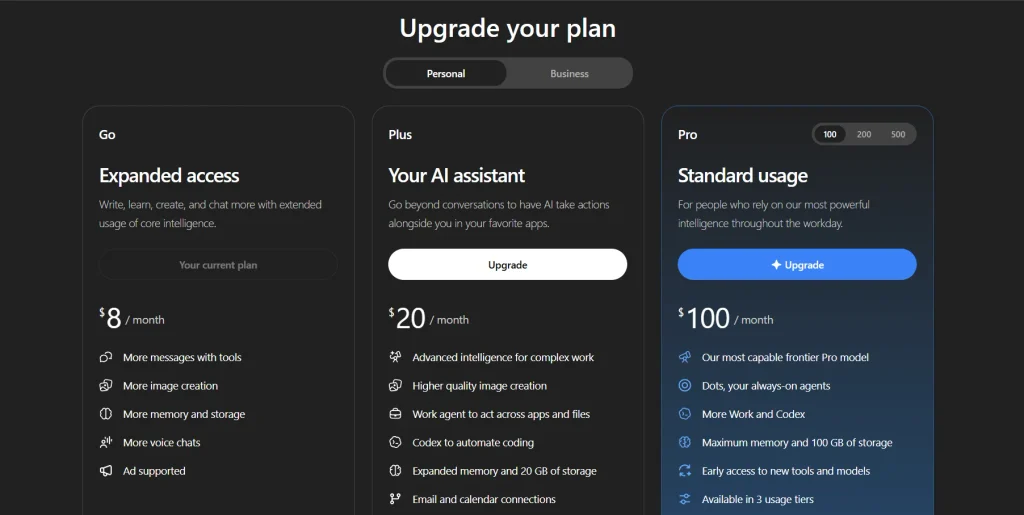
On the OpenAI side, Codex is included in every ChatGPT plan. Plus ($20 a month) includes limited GPT-6 Astra usage in Codex, with credits available for more.
The $100 and $200 Pro plans include Astra within the normal Codex allowance. That makes Codex on Plus the cheapest way to try a flagship model inside a coding agent today.
A worked example
Say your agent workflow uses 50 million input tokens and 5 million output tokens a month (before caching). At list prices:
- Argon until Nov 30: $100 + $50 = $150
- Argon from Dec 1: $200 + $100 = $300
- GPT-6.1 Sol: $100 + $50 = $150
- GPT-6 Astra: $500 + $250 = $750
These are illustrative numbers, not a quote. Caching, batch pricing, and reasoning settings will move your real bill.
The pattern still holds, though. Astra costs five times as much per token as Sol, and Argon’s price doubles in December.
How do privacy and data handling compare for teams?
On paid API tiers, both companies say they don’t train on your code by default. The risk sits in the free and consumer tiers.
For the Gemini API, Google’s terms say that on paid services, it doesn’t use your prompts or responses to improve its products. The unpaid tier is different, so don’t paste proprietary code into a free API key.
For OpenAI, the API services agreement says customer content isn’t used to improve services unless you opt in. Consumer ChatGPT works differently: your conversations can be used for training unless you turn that off in settings.
For teams: use paid API keys or business plans for anything proprietary, and have whoever owns compliance read the actual data-processing terms before you connect a private repo.
How should you test both on your own code base in one afternoon?
Run the same tasks through both tools, with the same instructions and the same acceptance tests. That’s the only comparison that reflects your code.
Pick five to eight tasks from your real backlog
Pull real tickets, not toy problems. For example:
- Generate a React component from a written spec
- Fix a real TypeScript compile error
- Write a Python script for a data cleanup job
- Refactor a Java or PHP class without breaking its tests
- Write unit tests for an untested module
- Explain an unfamiliar part of your repo
- Review an open GitHub pull request
- Automate a repetitive chore, like a release checklist
Keep the conditions equal
Give both tools identical prompts and the same repo state. Match reasoning settings as closely as you can (Argon’s “high” against a comparable Astra or Sol effort level). Then run your existing test suite on every output.
Score what matters
Score each result on six things: correctness (do tests pass), maintainability, security issues introduced, how well it fits your existing code, time to finish, and total token or credit cost. A spreadsheet with one row per task is plenty.
Here’s the thing: you’ll probably find each tool wins different tasks. One might handle the long refactor better while the other writes the sharper PR review. That split is the useful result, because it tells you which tool to reach for on which job.
Which should you choose?
Choose based on your tool-chain and budget, not the benchmark headline. Here’s how I’d match each to a type of developer.
- Solo developer on a budget: start with Codex on ChatGPT Plus. You get a full coding agent and limited flagship access for $20 a month.
- Team that runs on GitHub PRs: Codex. Automatic PR review and @codex mentions fit an existing review flow with little setup.
- Large-repo or long-generation work: Argon via the Gemini API. The 1M shared token budget is its clearest technical advantage.
- High-volume API workloads: test both Argon and GPT-6.1 Sol. They cost the same until November 30, and Sol is cheaper per token after that.
- Terminal-heavy autonomous agents: GPT-6 Astra has the stronger Terminal-Bench and FrontierSWE numbers, if you can absorb the higher price.
- Google Cloud shops: Argon, through Vertex AI and Agent Studio, keeps billing and governance in one place.
What I’d do if I were starting today
I’d test Gemini 4 Argon and OpenAI Codex on the same Next.js or React tasks before committing to either tool. I’d select five real issues from my backlog, run each task with comparable instructions, and evaluate the results using passing tests, code quality, debugging time, and total cost.
I’d also compare Argon through the API with Codex under my intended ChatGPT plan, since subscription access and API billing work differently. Finally, I’d reassess the costs before December 1, 2026, when Argon’s stated introductory pricing is scheduled to end. The best choice is the tool that completes my actual work reliably at a cost I can justify.
FAQ
Is Gemini 4 Argon better than ChatGPT for coding?
Not across the board. Google reports Gemini 4 Argon ahead of GPT-6 Astra on DeepSWE v1.1, while GPT-6 Astra leads on FrontierSWE v2 and Terminal-Bench 4.0. Independent testing from Artificial Analysis scores the two models equally overall.
What’s the difference between Gemini 4 Argon and ChatGPT?
Gemini 4 Argon is a single Google model, while ChatGPT is OpenAI’s app that includes several models and surfaces. For coding, the fair comparison is Argon against GPT-6 Astra or GPT-6.1 Sol, running inside Codex or the OpenAI API.
Which is cheaper for coding, Gemini 4 Argon or ChatGPT?
Through the API, Gemini 4 Argon costs $2 per million input tokens and $10 per million output tokens until November 30, 2026, matching GPT-6.1 Sol. From December 1, Argon rises to $4 and $20, while GPT-6 Astra costs $10 and $50. For subscriptions, Codex on ChatGPT Plus at $20 a month is the cheapest entry point.
Can I use Gemini 4 Argon with a Google AI Pro subscription?
Partly. Google AI Pro includes Gemini 4 Argon in the Gemini app, but not in Google Antigravity or on the free Gemini API tier. Antigravity access requires Google AI Ultra or an eligible Gemini Enterprise plan.
Do ChatGPT Plus users get GPT-6 Astra?
Yes, but only in ChatGPT Work and Codex, with limited usage and the option to buy credits. GPT-6 Astra in regular Chat appears as GPT-6 Pro and requires a Pro, Business, or Enterprise plan.
Can Gemini 4 Argon read an entire code base at once?
Gemini 4 Argon accepts up to 1,048,576 tokens in a single request, shared across input, thinking, and output. That covers many small and mid-sized repositories, but large monorepos may still need file selection or retrieval.
Does a ChatGPT or Gemini subscription include API access?
No. ChatGPT plans and Google AI subscriptions are billed separately from the OpenAI API and the Gemini API. You pay per token for API usage on both platforms.
The bottom line
Gemini 4 Argon vs ChatGPT comes down to tool-chain and budget, because the models themselves are close. Argon gives you the biggest token budget and 2/10 pricing until November 30. Codex gives you PR reviews, cloud tasks, and an IDE extension, starting at $20 a month.
Run the same five tickets through both before the price changes. Which one does your test suite trust more?