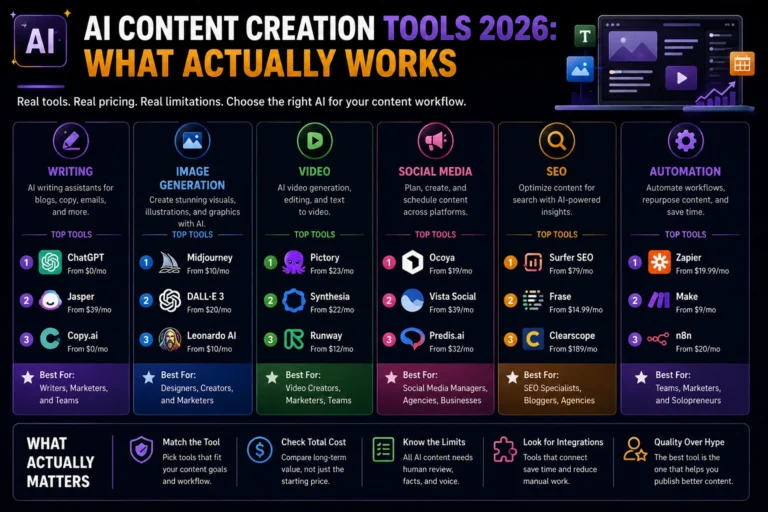
AI Marketing Tools, in essence, are software products that use generative or predictive AI for marketing tasks. Examples include writing, design, video, SEO, email, and workflow automation.
This guide is part of our AI Marketing hub – everything we have published on AI marketing tools and content workflows, in one place.
Thus, most businesses need three to five of them, not fifteen.
However, the right way to choose is by bottleneck, not by feature list.
That last part is where people get stuck.
Moreover, you’ve probably opened a roundup with 36 tools in it.
Many readers scroll halfway, close the tab, and do nothing.
Choosing AI Marketing Tools is not a decision; it’s homework.
So this piece is built differently.
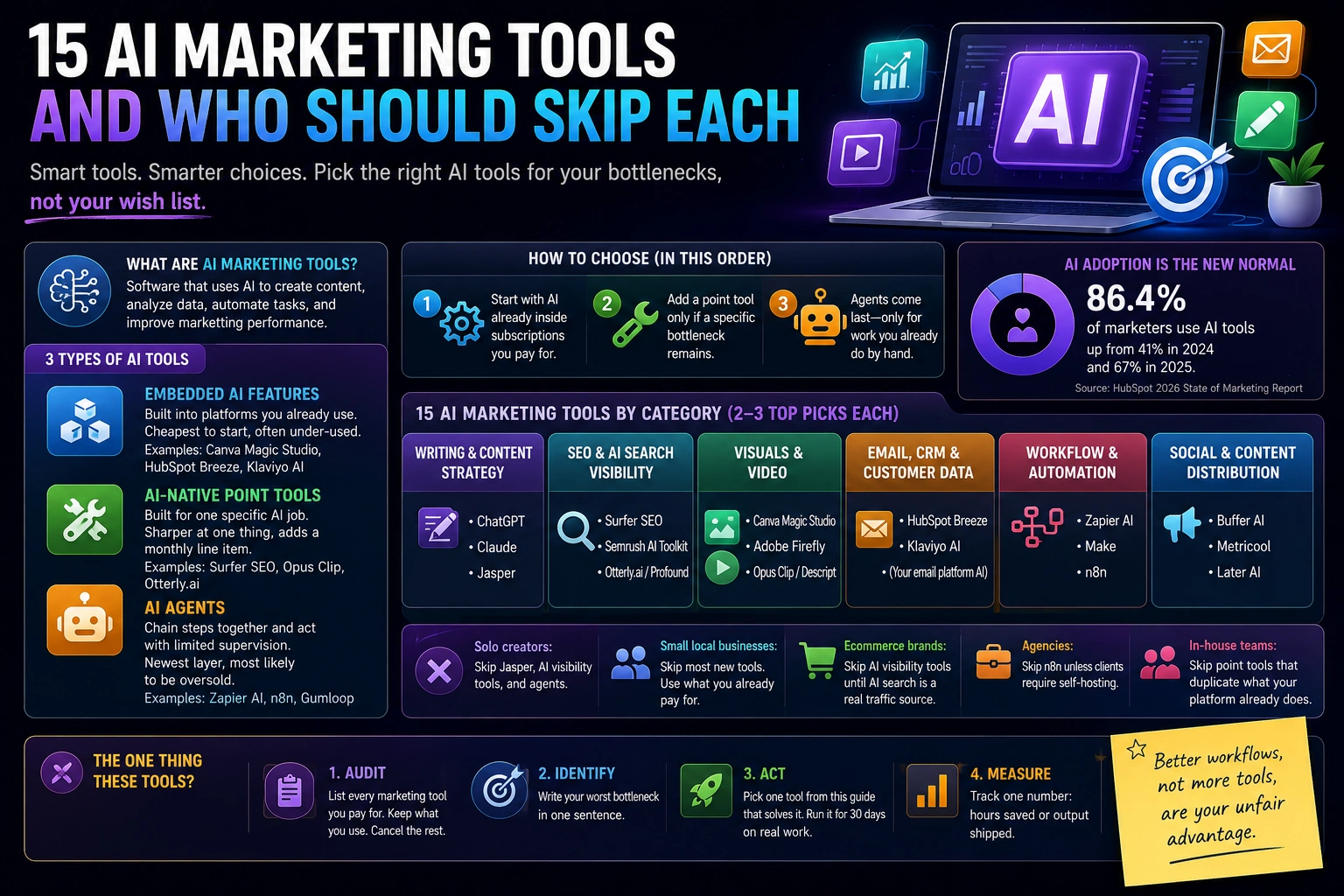
Additionally, six categories, two or three real picks in each.
A plain statement of who should skip each one is provided using AI Marketing Tools.
Then, a table maps five common business types to a specific starting stack. If you want to explore more AI content creation resources, you can also browse AI content creation tools. Where pricing or licensing terms matter, I say exactly what to check and where. Additionally, those details change often; confirm any number on the vendor’s official site before you buy.
What Are AI Marketing Tools, Exactly?
These AI Marketing Tools use machine learning or generative models for marketing tasks. Additionally, they can produce content, analyze performance data, or run multi-step workflows automatically.
The category is muddy because three very different things share the label. Sorting them out saves you money.
Embedded AI features. These are AI capabilities added to software you already pay for. canvas Magic Studio, HubSpot’s Breeze, Klaviyo’s predictive analytics, meat’s advantage campaigns.
You aren’t buying a new tool here. You’re switching on something inside an existing subscription, which makes this the cheapest place to start and the place almost everyone under-uses.
AI-native point tools. Products built around a single AI job. Opus Clip clips long video. Surfer SEO scores on-page optimization. Utterly.ai tracks whether AI assistants mention your brand.
These are sharper than embedded features at their one job. They also add a line item to your bill every month.
AI agents. Tools that chain steps together and act with limited supervision, pulling data, drafting, publishing, reporting. Zapier’s agent features, n8n workflows with an llm node, Gumloop. This is the newest layer and the one most likely to be oversold to you right now.
So the buying order matters more than the buying list. Start with the AI already inside subscriptions you pay for. Add a point tool only when a specific bottleneck survives that. Agents come last, and only for work you’ve already done by hand.
Reverse the order and you get the familiar outcome. Nine subscriptions, three that anyone opens.
Adoption stopped being a differentiation a while ago. HubSpot’s 2026 State of Marketing Report, drawn from more than 1,500 marketers, puts AI tool usage at 86.4%, up from 41% in the 2024 edition and 67% in 2025.
Which means your competitor has the same ChatGPT subscription you do. The gap now is workflow design, not access.
Which AI Tools Are Best for Writing and Content Strategy?
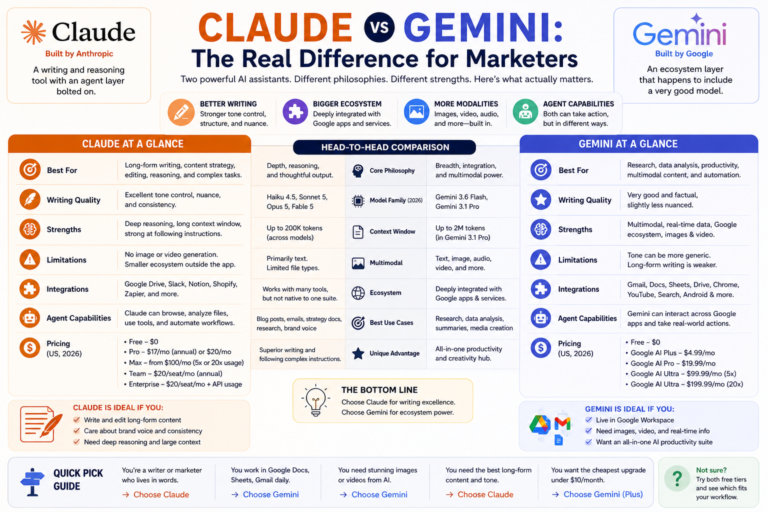
For most marketers, ChatGPT handles research and strategy, Claude handles long-form drafting and brand-voice consistency, and Jasper earns its price only when a team needs shared brand governance across several writers. All three write competently. They fail in different places, and that’s what should drive your pick.
ChatGPT
ChatGPT is the strongest general-purpose option for the thinking work that happens before writing. Audience research, positioning angles, campaign concepts, competitive tear downs.
Custom GPTs are the underused part. Save a brief, a voice guide, and three examples of your best work, then stop re-pasting context every session.
Where it’s weakest: long-form drafting. ChatGPT tends toward tidy, evenly-weighted paragraphs that read like every other piece of AI content on the internet, and it drifts off a voice guide over long outputs.
It’s also the tool people most often use badly, asking for a finished blog post instead of using it to pressure-test an argument before they write one.
Best for: solo marketers and small teams who need one tool that does a bit of everything. Skip if: your main job is publishing 2,000-word articles weekly. Something else will draft better.
Pricing: ChatGPT offers Go at $8/month, Plus at $20/month, and Pro at $200/month in the U.S. Business pricing is separate and starts at $25/user/month monthly or $20/user/month annually from August 19, 2026.
Claude
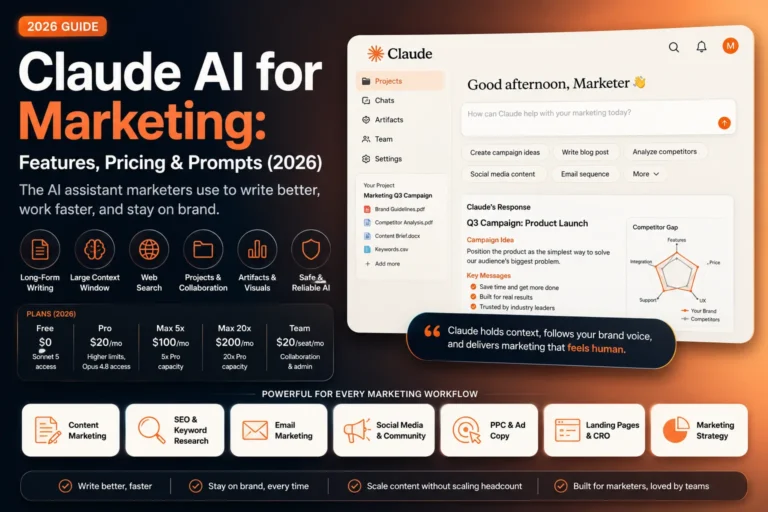
Claude holds a defined voice across long documents better than the alternatives, which matters if you’re producing articles, email sequences, or scripts where consistency is the product.
It also handles large document sets well. Drop in five customer interview transcripts and a positioning doc, and you get analysis that quotes specifics back at you rather than summarizing in generalities.
The trade-off is real, though. Fewer built-in marketing conveniences, and no image generation. It’s a writing and analysis tool, not a marketing suite.
Best for: long-form content, editing existing drafts, working across multiple source documents. Skip if: you want templates and campaign workflows out of the box.
Pricing: Claude has a Free plan, Pro at $20/month ($200/year), and Max at $100/month (5×) or $200/month (20×). Team and Enterprise plans are also available.
Jasper
Jasper sits in an awkward spot in 2026, and I’d rather say that plainly than pretend otherwise. Its core writing quality is no longer meaningfully ahead of ChatGPT or Claude, because everyone is building on similar underlying models.
What Jasper still sells is governance. Locked brand voices, shared templates, approval workflows, campaign-level asset generation across a team.
That’s a genuine problem for a five-person team where everyone prompts differently. Not for one person.
Best for: in-house teams of 3+ writers who need consistent output without individual prompt skill. Skip if: you’re a freelancer or solo operator. You’re paying for coordination features you don’t need.
Pricing: Jasper’s Pro plan is $59/seat/month when billed annually or $69/seat/month when billed monthly. Pro includes one seat; Business uses custom pricing for larger teams and adds advanced governance, API access, custom agents, and additional team capabilities. Jasper also offers a 7-day free trial.
What AI Tools Help With SEO and AI Search Visibility?
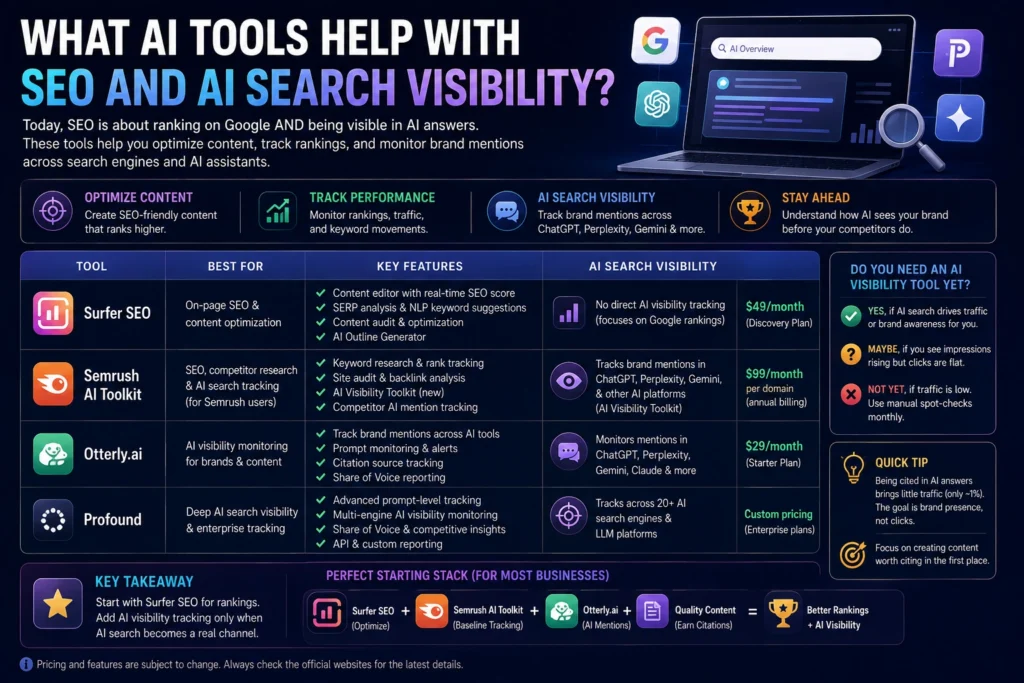
SEO tools now split into two jobs: optimizing pages for Google rankings, and tracking whether AI assistants mention your brand at all. Surfer SEO covers the first. Semrush’s AI Toolkit and dedicated trackers like Utterly.ai or Profound cover the second.
Most businesses need the first immediately and the second only once AI search is a real traffic source for them.
The reason the second category exists comes down to click behavior. Pew Research Center tracked the browsing of 900 U.S. adults across nearly 69,000 Google searches in March 2025. When an AI summary appeared, users clicked a traditional search result in 8% of visits, compared with 15% when no summary appeared. Clicks on the sources cited inside the summary happened just 1% of the time.
It cuts both ways. Being cited inside an AI answer sends you very little traffic.
But being absent from the answer means you’re invisible to a growing share of people who never scroll past it. So the value is brand presence, not clicks, and pricing this category as if it were a traffic channel is how people overpay for it.
Surfer SEO
Surfer scores a draft against what’s currently ranking for your target keyword: term coverage, headings, structure, length. It works best as an editing pass rather than a writing guide, and it’s genuinely good at catching subtopics you skipped.
Its failure mode is over-optimization. Chase a high content score and you’ll produce a page stuffed with awkward term insertions that reads worse than the draft you started with.
Treat the score as a checklist. Ignore it once you’re in the seventies, and never let it override an editorial judgment.
Best for: anyone publishing SEO content regularly who wants a structural second opinion.
Pricing: Surfer plans start at $49/month (Discovery), with Standard at $99/month, Pro at $182/month, and Peace of Mind at $299/month on annual billing. Content/AI limits vary by plan
Semrush AI Toolkit
If you already pay for Semrush, its AI visibility module is the cheapest way to see whether ChatGPT, Perplexity, and Gemini mention your brand for the prompts that matter in your category. You get prompt tracking, competitor comparison, and AI-oriented site audits inside a dashboard you already know.
It’s shallower than the dedicated tools. Fewer engines, fewer prompts, less citation-level detail. For a business testing whether AI search matters at all, shallow is fine.
Best for: existing Semrush subscribers who want a baseline without adding a vendor. Pricing:
Pricing: Semrush AI Visibility Toolkit starts at $99/month per domain when billed annually. The base plan includes 25 tracked prompts, 300 AI Analysis reports/day, and 1 domain for Brand Performance.
Utterly.ai and Profound
These two sit at opposite ends of the dedicated AI visibility market. Utterly is the low-commitment entry point for solo operators and small businesses who want prompt monitoring without an enterprise contract. Profound is the other end: deep prompt-level tracking across many engines, enterprise pricing, sales-led on-boarding.
Both answer the same question. When someone asks an AI assistant about your category, what does it say, and are you in the answer?
Best for: brands where AI search is already a named channel or a client deliverable.
Skip if: you’re per-traffic. Ask ChatGPT, Perplexity, and Gemini ten category questions once a month and log the answers in a spreadsheet. Same signal, no invoice.
Pricing: OtterlyAI starts at $29/month. Profound pricing varies by plan and currently includes custom enterprise pricing; verify the latest quote before publishing
Do You Actually Need an AI Visibility Tool Yet?
Probably not, if you’re under roughly 10,000 monthly organic visitors.
The honest test: open Google Search Console and check whether impressions are climbing while clicks flatten. That gap is your signal. Until you see it, the manual spot-check gives you the same information for free, and the money is better spent producing content worth citing in the first place.
What Are the Best AI Tools for Visuals and Video?
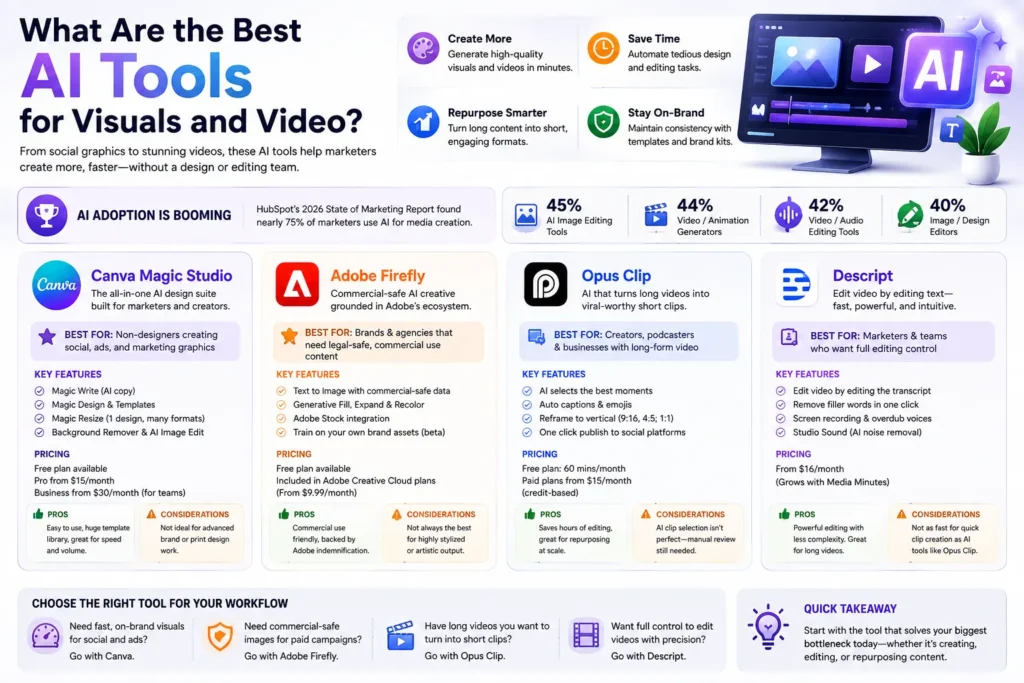
canvas Magic Studio is the default for non-designers producing social and ad creative. Adobe Firefly is the pick when commercial-use safety is a real requirement. For video, Opus Clip turns long recordings into short clips automatically, and descriptor edits video by editing a transcript.
Visual work is where AI adoption is heaviest right now. HubSpot’s 2026 State of Marketing Report found nearly 75% of marketers using AI for media creation, including video and images, with AI image editing tools at 45% usage, video or animation generators at 44%, video or audio editing tools at 42%, and image or design editors at 40%. HubSpot’s 2026 State of Marketing Report
canvas Magic Studio
canvas AI lives inside the design tool most small businesses already use, which is most of the argument for it. Magic Resize adapts one design across placements. Magic Write drafts caption copy in context. Background removal and generative fill handle the fiddly edits that used to mean opening photo shop.
What it isn’t: a precision design tool. Anything needing exact brand typography control, print production, or complex layered work will frustrate you inside an hour.
Best for: small businesses and creators producing high-volume social and ad creative without a designer.
Pricing: canvas offers a Free plan with limited AI usage. Paid Pro and Business plans provide higher AI limits, premium content, and additional brand/team features; Enterprise pricing is custom
Adobe Firefly
Firefly’s differentiation is provenance. Adobe trained it on Adobe Stock and public-domain content specifically so commercial users have a clearer rights position, and Adobe offers indemnification on some plans.
If you’re producing client work or paid ad creative at scale, that matters more than small quality differences between generators.
Output quality is competitive but not category-leading for stylized or illustrative work. Some creative teams still concept elsewhere and then rebuild in Firefly for anything shipping publicly.
Best for: agencies, e commerce brands, and anyone whose creativity appears in paid placements. Pricing and indemnification terms:
Opus Clip
Opus Clip takes a long video, finds the segments most likely to perform as shorts, and outputs them captioned and re framed to vertical. For anyone sitting on podcast episodes, webinars, or long YouTube uploads, it turns a dead archive into a posting schedule.
Its clip selection is decent, not brilliant. Expect to reject a good share of what it suggests, and expect to fix caption errors on technical terms and proper nouns. It saves the tedious part, not the judgment part.
Best for: creators and businesses with existing long-form video and no editor.
Pricing: OpusClip offers a free plan with 60 processing minutes/month. Paid plans provide larger monthly processing-credit allowances, so compare the included minutes not just the subscription price when estimating your real cost
descriptor
descriptor’s premise still feels slightly unreasonable. It transcribes your video, and you edit the video by editing the transcript. Delete a sentence in the text and it’s gone from the footage. Filler-word removal takes one click across an entire recording.
It’s the better pick over Opus Clip if you want editorial control instead of automated output. It’s also slower, and it expects you to actually edit.
Best for: anyone producing regular video who wants control without learning a timeline editor.
Pricing: descriptor starts at $16/month. Current plans use Media Minutes and AI Credits rather than transcription-hour limits; unused monthly minutes and credits don’t roll over.
What AI Tools Handle Email, CRM, and Customer Data?
For teams already on HubSpot, Breeze adds AI drafting, lead scoring, and reporting inside the CRM without a new vendor. For e commerce, Klaviyo’s predictive features (churn risk, expected next order date, send-time optimization) are the strongest reason to be on it rather than a general email tool.
Both are embedded features, not new subscriptions. If you pay for either platform, you almost certainly have capabilities switched off right now.
HubSpot Breeze works best where the CRM is genuinely the system of record. It drafts emails with account context, scores leads against your closed-won patterns, and answers reporting questions in plain language.
But if half your contacts have no life cycle stage set, lead scoring returns confident noise. Garbage in, faster garbage out.
Klaviyo’s AI depends entirely on transactional history. Predicted lifetime value and churn probability need order data to learn from, which is why it’s an e commerce answer and a weak fit for service businesses with long, irregular purchase cycles.
Pricing: HubSpot Marketing Hub scales by marketing-contact tier, with Starter from $20/month per seat, Professional from $890/month, and Enterprise from $3,600/month. Klaviyo offers a Free plan, while paid pricing scales with active profiles/contact volume and channel usage, including email and SMS.
The Problem Nobody Markets Around
AI professionalization applied to a messy list produces worse output, faster. Duplicate contacts, stale segments, and tagged events don’t get fixed by a smarter model. They get amplified, because the model confidently personalizes around bad signals.
So before you turn on predictive segmentation, spend a week on duplication and event tagging. glamorous work. It’s also the highest-return AI prep most small teams never do.
What AI Tools Automate Marketing Workflows and Run Agents?
Zapier is the right default for connecting marketing tools without code. Make suits branching, multi-path workflows better. n8n is the pick for teams that need self-hosting for data or compliance reasons. All three now include AI steps, so a workflow can call a model mid-sequence rather than just shuttling data between apps.
Zapier wins on integration breadth. If a marketing tool exists, Zapier probably connects to it, and building a working automation takes minutes.
The cost model is the catch. Pricing scales with task volume, so a Zap that fires on every form submission, every Slack message, and every calendar change burns through your allowance faster than the tier price suggests.
Make gives you a visual canvas with real branching, error handling, and loops. Think of a lead form that routes one way for a $500 inquiry and another way for a $50,000 one, with a retry step when the CRM call fails. More capable per operation, steeper to learn.
n8n can be self-hosted, which is the entire argument for it. If customer data can’t leave your infrastructure, or if your automation volume makes per-task pricing painful, this is the answer. It expects more technical comfort than the other two.
Pricing: Compare these tools by actual workflow volume, not headline price: Zapier by tasks, Make by credits, and n8n by workflow executions. A complex workflow can consume substantially more usage on Zapier or Make, while n8n counts the complete execution regardless of workflow complexity.
Where Social Scheduling Fits
Buffer and Metricool both added AI captioning, best-time posting, and re purposing suggestions. None of it is a reason to switch platforms.
Spend one afternoon inside whatever scheduler you already pay for, find the AI menu (it’s usually buried in the composer, not the settings), and decide from there. Odds are good you’re paying for something you’ve never clicked.
Can You Legally Use AI-Generated Content in Commercial Marketing?
Yes, in the sense that no U.S. law stops you from publishing AI-assisted marketing content. But whether you own that content is a separate question, and it’s the one most roundups skip or get wrong.
The U.S. Copyright Office says copyright protection requires sufficient human authorship. Purely AI-generated material is not copyright able by itself, while human-authored expression, creative selection or arrangement, and sufficiently creative modifications can receive protection. The Office also says that prompts alone generally do not provide sufficient human control over the expressive elements.
Three consequences that actually affect a marketing team:
A purely AI-generated logo may not be yours to protect. You can use it. A competitor may be able to use something very similar without infringing, because you may hold no copyright in it.
Commercial-use rights come from the vendor, not from the law. Your right to use a tool’s output commercially lives in that tool’s terms of service. Some tools restrict commercial use on free tiers. Some grant it only above a certain plan. Read the terms for every generator whose output ships publicly.
Indemnification is the term that matters at scale. If a third party claims your AI-generated asset infringes their work, indemnification decides whether the vendor defends you or you’re on your own. Adobe and a few enterprise vendors offer it under specific conditions. Most consumer tools don’t.
Where the real uncertainty sits: how much human modification is enough to make an AI-assisted work protect able. There’s no bright-line percentage, and anyone quoting you has made it up. So document your editorial process on anything you’d want to defend later.
Which AI Marketing Stack Fits You?
| Business type | Biggest bottleneck | Core stack | Realistic monthly cost | Skip for now |
| Solo creator / freelancer | Production volume | ChatGPT or Claude + Canva + Opus Clip | $20–$35/mo | AI visibility tools, Jasper, agents |
| Small local business | Consistency, not volume | Canva + your email platform’s built-in AI + ChatGPT | $20–$50/mo | Everything else, genuinely |
| Ecommerce brand | Creative volume + retention | Klaviyo AI + Adobe Firefly + Canva + Zapier | $75–$200+/mo | Dedicated AI visibility, Jasper |
| Marketing agency | Client throughput + reporting | Claude + Surfer + Firefly + Make + an AI visibility tool | $250–$500+/mo | n8n unless clients require self-hosting |
| In-house team (5–20) | Coordination, not capability | Jasper or Claude + HubSpot Breeze + Surfer + Zapier | $500+/mo | Point tools that duplicate HubSpot features |
The takeaway per use case: if you’re solo, spend on creation tools, because your bottleneck is how fast you can make things. Agencies are the opposite. Their constraint is throughput across accounts, so automation pays back first and hardest.
commerce brands should put money into customer data before creative. And the small local business? Buy nothing this month. Go switch on the AI already sitting inside your canvas account and your email platform, then come back in 30 days.
In-house teams are the odd one out. The problem usually isn’t capability, it’s five people prompting five different ways, which is the one case where governance features earn their price.
What I’d Do If I Were Building an AI Marketing Stack Today
I’d start with one tool. Not four.
The sequence: name your worst bottleneck in one sentence. Not “we need more content,” but “it takes me six hours to turn a podcast episode into a week of social posts.” Specific enough that you’d know if it went away.
Then pick one tool that targets exactly that. Run it for 30 days on real client or business work, not test prompts. Measure one number, hours saved or output shipped. If neither moved, cancel and try a different tool against the same bottleneck.
Only then do you add a second tool.
My starting four for most people: a general model for thinking and drafting, canvas for visuals, whatever AI is already sitting unused inside your email platform, and one automation connecting them. That’s a capable stack, and for most people it’s cheaper than their current tool sprawl.
The rule I’d enforce hardest: cancel anything you haven’t opened in three weeks. Subscriptions accumulate quietly, and money is the smaller cost. Every extra tool is another login, another place your brand assets live, another thing to keep current.
One caution on agents. Don’t automate a workflow you haven’t run manually at least ten times. You can’t specify a process you don’t understand yet, and an agent running a bad process just produces bad output faster.
Frequently Asked Questions
What are AI marketing tools?
AI marketing tools are software products that use artificial intelligence to perform marketing tasks such as writing content, generating images and video, optimizing pages for search, personalizing email, and automating workflows. They fall into three groups: AI features built into platforms you already use, standalone tools built around one AI job, and agents that execute multi-step processes. Most businesses get the best return from the first group before buying anything new.
What is the best AI tool for marketing?
There’s no single best AI marketing tool the right choice depends on your needs. ChatGPT and Claude are strong for writing and strategy, Canva handles everyday visuals, Adobe Firefly is useful when commercial usage rights matter, and Opus Clip and Descript are strong for video repurposing. Choose the tool that solves your biggest bottleneck rather than the one with the longest feature list.
How much do AI marketing tools cost per month?
AI marketing tools range from free plans to several hundred dollars per month, with enterprise platforms often using custom pricing. A basic solo stack can start around $20–$50/month, while a small-business stack can realistically reach $75–$250+/month, depending on the tools and usage. The bigger cost driver is often usage-based pricing: automation platforms charge by tasks, credits, or executions, while video tools can charge by processing minutes. Your actual bill therefore depends on how much you use the tools, not just the headline subscription tier.
Can I use AI-generated images and copy commercially?
Usually, yes but commercial-use rights depend on the specific tool and plan. The U.S. Copyright Office says purely AI-generated material is not copyright able by itself, while sufficiently creative human contributions can be protected. Check each vendor’s current commercial-use terms, especially for free plans and generated images. For paid advertising or higher-risk commercial work, also consider vendors that offer contractual IP indemnification.
Does using AI content hurt your Google rankings?
No. Google does not penalize content simply because AI was used to create it. Google evaluates content based on factors such as usefulness, originality, accuracy, and relevance, regardless of how it was produced. However, using AI to mass-produce low-value pages primarily to manipulate search rankings can violate Google’s scaled content abuse policy and lead to lower visibility.
Can AI replace a marketing team?
No, and the data points the other way. HubSpot’s 2026 State of Marketing Report found 86.4% of marketers now use AI tools, which means AI capability no longer separates one team from another. What separates results is strategy, brand judgment, and knowing which output is worth shipping. AI removes execution time. It doesn’t supply taste or accountability.
The One Thing to Do This Week
Here’s the thing: nobody wins this by owning the most software. The people getting real returns from AI marketing tools picked three, learned them properly, and stopped shopping.
So here’s the action. Open your billing page and list every marketing tool you pay for. Mark the ones you’ve opened in the last three weeks. whatever unmarked either gets used deliberately this month or gets canceled.
Then take your worst bottleneck, in one sentence, and pick one tool from this article that targets it. Run it for 30 days on real work. Measure one number.