FluxGrowth is reader-supported. Some links in our guides are affiliate links — if you buy through one we may earn a commission, at no extra cost to you. It never changes which tools we recommend. How we test tools.
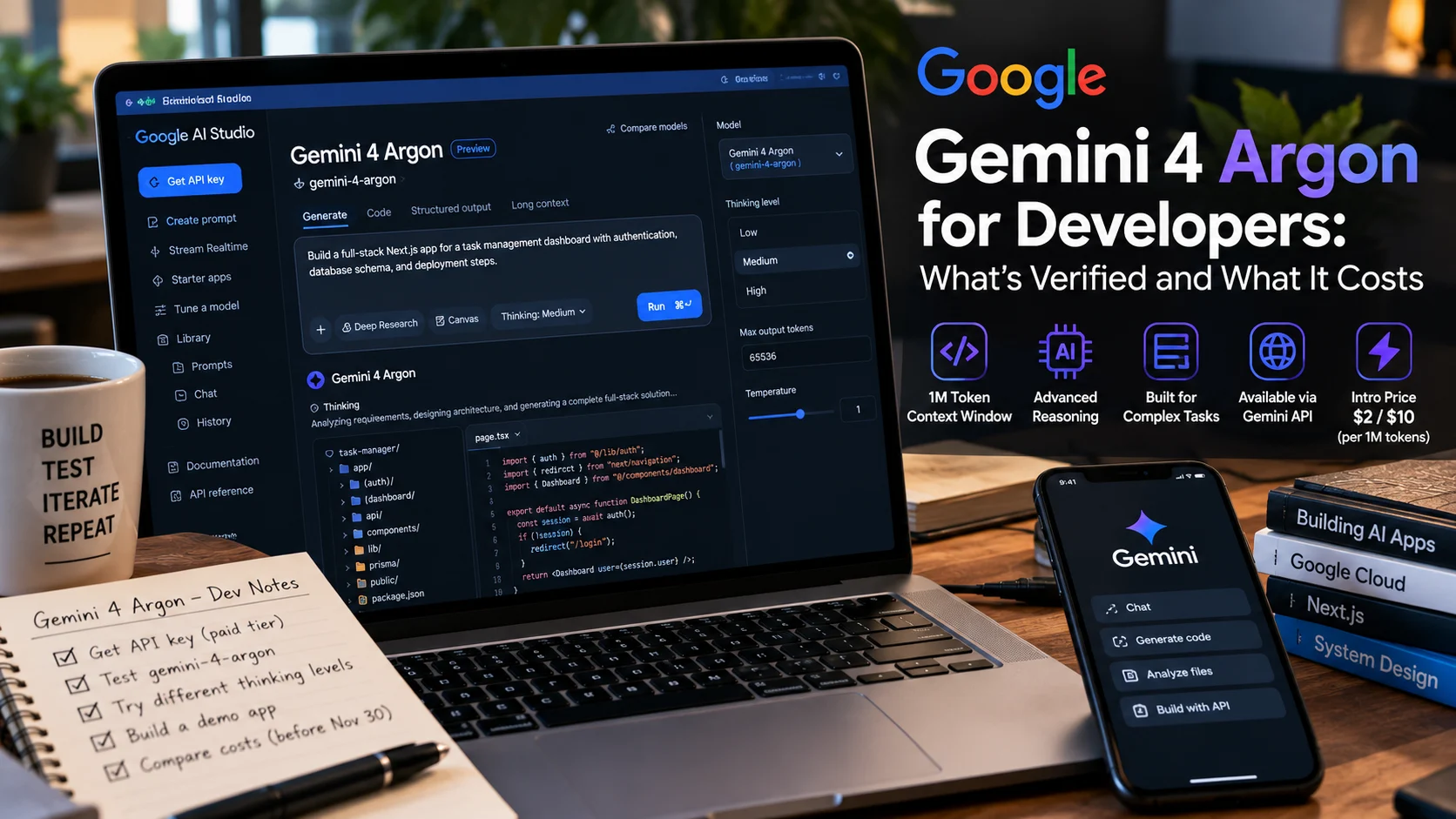
Gemini 4 Argon is Google DeepMind’s first Gemini 4 model, and as of October 13, 2026, any developer with a paid Gemini API key can call it. It costs $2 per million input tokens and $10 per million output tokens until November 30. After that, the price doubles.
Here’s the problem. Most guides you’ll find were written in the two weeks after Google’s September 30 announcement, when Argon was locked to a small group of cyber defenders. They’ll tell you there’s no API and no model ID. That was true then. It isn’t now.
This guide sticks to what Google has actually published, labels which numbers come from Google and which come from independent testers, and flags what’s still unknown. Then it gives you a simple way to test Argon on your own code before the intro price runs out.
What is Gemini 4 Argon?
Gemini 4 Argon is Google’s flagship AI model for long, multi-step tasks in coding, finance, law, cybersecurity, and science. Its API model ID is gemini-4-argon, and it supports three thinking levels: low, medium (the default), and high, according to Google’s Gemini API documentation.
Think of it as a model built to power an AI coding agent through demanding workflows, such as large refactors, debugging, and multi-file code migrations. Rather than focusing only on auto-complete, it is designed to support more complex development tasks.
For a broader comparison, see our guide to the best AI coding agents in 2026.
Where Argon fits in the Gemini lineup
Argon is the first and, so far, only Gemini 4 model. It replaces Gemini 3.1 Pro Preview as Google’s top model, and Google has dropped the Gemini 3.5 Pro it had been testing with partners (TechNews). If you’re running Gemini 3.8 Flash today, Argon isn’t an automatic upgrade. Flash is the cheap, fast default. Argon is the heavy option you call when Flash runs out of depth.
What the “1M token limit” actually means
This is where a lot of coverage got it wrong. Google’s September 30 post described a 1M output limit. The developer docs now describe something more precise.
- One shared window: input, thinking, and output all share 1,048,576 tokens, per Google’s developer guide. A 400K-token prompt leaves roughly 650K tokens for everything else.
- A 64K default per request: each call defaults to 65,536 output tokens, or 32,768 for non-streaming direct HTTP calls on Google Cloud (Google Cloud docs).
- Long decode goes past that: a new continuation protocol lets Argon keep generating past 64K tokens, up to 1M minus your input.
One practical detail matters more than the headline number. Google recommends setting max output to at least 32,768 tokens, because Argon can spend more of the budget thinking than earlier Gemini models did. If you want to cut token use, Google says to lower the thinking level instead of the output cap.
In short: Argon is a long-horizon model with a shared 1M-token window, a 64K default output per call, and an opt-in path to much longer outputs.
Can you use Gemini 4 Argon today, and where?
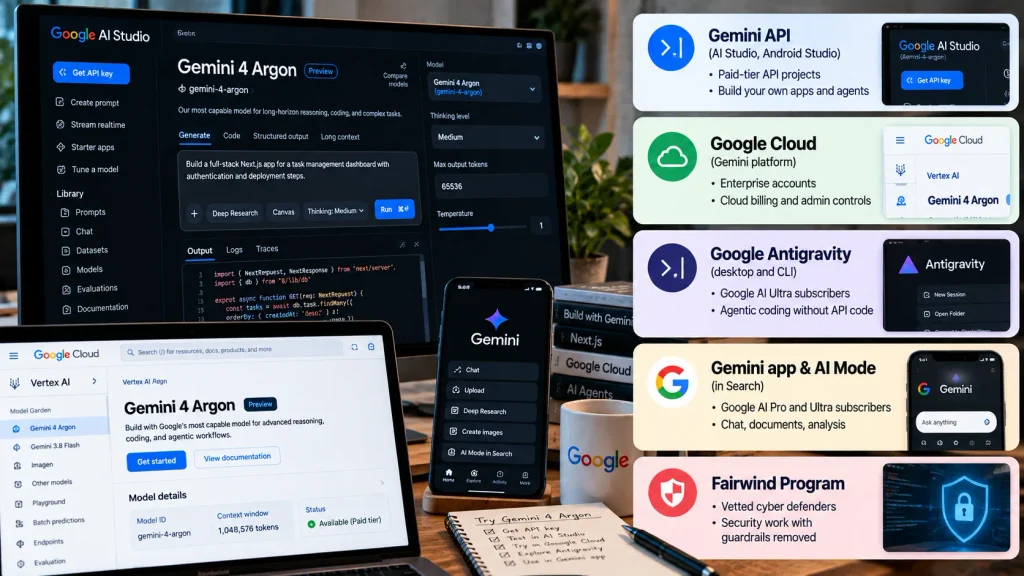
Yes. Since October 13, 2026, Gemini 4 Argon is available globally, including the US, through the paid Gemini API and several Google products. Which door you use depends on whether you want to build with it or just use it (Google, Oct 13).
| Where | Who gets Argon | Best for |
| Gemini API (AI Studio, Android Studio) | Paid-tier API projects | Building Argon into your own apps and agents |
| Gemini platform on Google Cloud | Enterprise accounts | Teams that need Cloud billing and admin controls |
| Google Antigravity (desktop and CLI) | Google AI Ultra subscribers; eligible Gemini Enterprise accounts | Agentic coding without writing API code |
| Gemini app and AI Mode in Search | Google AI Pro and Ultra subscribers | Chat, documents, analysis |
| Fairwind Program | Vetted cyber defenders, by application | Security work, with cyber guardrails removed |
If you’re a developer, the API row and the Anti-gravity row are the two that matter. The API gives you full control and pay-per-token billing. Anti-gravity is Google’s agent-first coding environment, and it replaced the consumer versions of Gemini CLI and Gemini Code Assist earlier this year (9to5Google).
Is there a free tier?
No, not on the API. Google’s developer post points builders to the paid tier of the Gemini API, and one tester who tried a free-tier key got a free-tier quota of zero for Argon (Computing for Geeks). You’ll need to link a billing account first.
Watch out for one trap. Google AI Pro gets you Argon in the Gemini app, but not in Anti-gravity. For agentic coding through a subscription, you need Ultra.
Why so many guides say it’s unavailable
Google released Argon in two steps, and most articles only caught the first one.
- September 30, 2026: Google announced Argon and gave access only to Fair-wind Program defenders and its own teams.
- October 13, 2026: General availability across the API, Anti-gravity, and the Gemini app.
Anything published between those dates will tell you there’s no model ID and no public API. Check the date on whatever you’re reading.
What can Gemini 4 Argon do for coding?
Gemini 4 Argon is built for long engineering jobs: large refactors, code migrations, and performance work that runs for hours. On short, terminal-heavy coding tasks, its published scores trail both GPT-6 Astra and Claude Opus 5.5. That split is the most useful thing to know before you switch.
What Google says Argon has done (vendor-reported)
These are Google’s own examples from its October 13 announcement. Nobody outside Google has reproduced them, but several link to public commits you can inspect.
- Internal agent use: Argon in Anti-gravity raised agentic code submissions at Google by more than 35% and cut code rollbacks by nearly a third.
- A Python code base overnight: given a one-paragraph goal and a rules file, Argon found optimizations in Google’s open-source Agent Development Kit that made session prep 40% faster in long sessions and cold imports 21% faster. The commit is public.
- Inference speed: Argon helped speed up Gemma inference on vLLM by 2.85x end to end, with the upstream pull requests published.
- A legacy refactor at scale: Argon helped the Chrome team split a roughly 6-million-line folder out of Chromium’s 40-million-line code base.
The pattern is consistent. Every example is a big, well-specified job where the model can run for a long time and check its own work against tests.
What the benchmarks show
Google published a benchmark table comparing Argon to GPT-6 Astra and Claude Opus 5.5. Here are the coding rows, as reported by The New Stack and HackerNoon from Google’s table.
| Benchmark (Google-reported) | What it tests | Gemini 4 Argon | GPT-6 Astra | Claude Opus 5.5 |
| DeepSWE v1.1 | Long, real-world software tasks | 77.9% | 74.1% | 74.2% |
| Vibe Code Bench | Building working apps from a prompt | 91.9% | 89.6% | 90.3% |
| FrontierSWE v2 | Hard software engineering tasks | 55.0% | 65.5% | 62.3% |
| Terminal-Bench 4.0 | Agent work in the command line | 57.4% | 58.2% | 66.4% |
| CWE-bench v1 | Finding and fixing vulnerabilities | 68.0% | 68.0% | 67.0% |
Read this table carefully. Google picked the tests, ran most of them, and reported the rival scores too. Independent results add useful nuance. Google says Argon ranks #1 on the independent Vals Index, and The Batch notes Argon may not be the strongest coder but is the frontier model most likely to say it doesn’t know rather than guess.
My take: if your work is mostly quick edits and shell commands inside an agent, the Terminal-Bench gap is real. If your work is large, multi-file changes, DeepSWE is the more relevant number.
Safety features you’ll notice in agent mode
Google trained Argon to pause for human confirmation before irreversible steps, such as deleting data. Google says attempts to take shortcuts, like skipping a failing test, fell to 2% on coding benchmarks. It also reports a 0.7% attack success rate on the Gray Swan prompt-injection benchmark, which matters if your agent reads entrusted web pages, issues, or emails.
What’s still unverified
Language-specific performance: No separate benchmark results confirm Argon’s performance in React, TypeScript, Python, Java, or PHP.
- API rate limits: Limits vary by model and usage tier. Check Google’s official documentation.
- Third-party support: Cursor lists Gemini 4 Argon, but GitHub Copilot support needs separate verification.
In short: Gemini 4 Argon performs well on some engineering benchmarks but trails competitors on others, including Terminal-bench 4.0. Test it on your own projects before choosing it.
How much does Gemini 4 Argon cost?
Gemini 4 Argon API pricing is $2 per million input tokens and $10 per million output tokens through November 30, 2026. Starting December 1, 2026, standard rates double to $4 per million input tokens and $20 per million output tokens. Check Google’s official pricing documentation for current rates.
| Rate per 1 million tokens (USD) | Through Nov. 30, 2026 | From Dec. 1, 2026 |
| Standard input | $2.00 | $4.00 |
| Standard output, including thinking tokens | $10.00 | $20.00 |
| Cached input | $0.10 | $0.20 |
What affects your actual cost?
- Thinking tokens: These count as output tokens, so extensive reasoning can increase your bill.
- Caching: Eligible cached input tokens can cost less than standard input tokens, but savings depend on actual cache hits.
- Long prompts: Check Google’s current pricing terms before assuming that all context lengths have the same rate.
- Batch and Flex: Verify Argon-specific rates in Google’s official pricing documentation before relying on discounted pricing.
A worked example
Suppose you send 200,000 input tokens and receive 50,000 output tokens, including thinking tokens.
- Through November 30: 200,000 input tokens cost $0.40, and 50,000 output tokens cost $0.50. Total: $0.90.
- From December 1: Input costs $0.80, and output costs $1.00. Total: $1.80.
These are calculations using the stated standard rates, not results from a measured API run.
Subscriptions vs. API billing
Google AI subscriptions and Gemini API billing are separate. Access to Gemini 4 Argon through a consumer subscription or developer tool does not automatically cover API usage. Developers building applications should check the applicable API rates, usage limits, and access requirements.
For current details, consult Gemini API pricing and Google AI plans before budgeting for a project.
How does Gemini 4 Argon compare to other coding models?
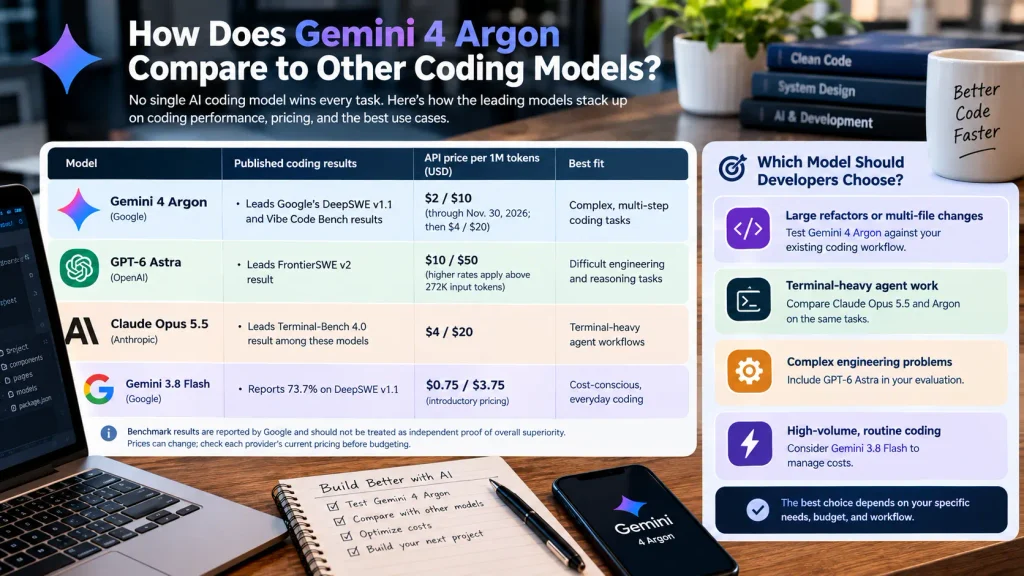
No single AI coding model wins every task. Google’s published benchmarks show Gemini 4 Argon performing strongly on some agentic coding evaluations, while GPT-6 Astra and Claude Opus 5.5 score higher on other tests. Pricing also matters: Gemini 3.8 Flash is a lower-cost option for many routine tasks.
| Model | Published coding results | API price per 1M input/output tokens (USD) | Best fit |
| Gemini 4 Argon | Leads Google’s reported DeepSWE v1.1 and Vibe Code Bench results | $2 / $10 through Nov. 30, 2026; then $4 / $20 | Complex, multi-step coding tasks |
| GPT-6 Astra | Leads the reported FrontierSWE v2 result | $10 / $50; higher rates apply above 272K input tokens | Difficult engineering and reasoning tasks |
| Claude Opus 5.5 | Leads the reported Terminal-Bench 4.0 result among these models | $4 / $20 | Terminal-heavy agent workflows |
| Gemini 3.8 Flash | Reports 73.7% on DeepSWE v1.1 | $0.75 / $3.75 introductory pricing | Cost-conscious, everyday coding |
Benchmark results are reported by Google and should not be treated as independent proof of overall superiority. Prices can change; check each provider’s current pricing before budgeting.
Which model should developers choose?
- Large refactors or multi-file changes: Test Gemini 4 Argon against your existing coding workflow.
- Terminal-heavy agent work: Compare Claude Opus 5.5 and Argon on the same tasks.
- Complex engineering problems: Include GPT-6 Astra in your evaluation.
- High-volume, routine coding: Consider Gemini 3.8 Flash to manage costs.
The best choice depends on correctness, maintainability, tool integration, latency, and total cost—not benchmark rankings alone.
How should you test Gemini 4 Argon on your own code base?
The only benchmark that matters is your code. A fair test runs the same tasks, with the same prompts, through each model, and scores the results on correctness and cost. It takes an afternoon and a few dollars at Argon’s intro rates.
This is a protocol for you to run. It isn’t a set of results, because none of the published benchmarks used your repo.
Pick six tasks from your real backlog
Choose work you’ve already done, so you know what a good answer looks like.
- Build: a React component from a written spec, with props and states defined.
- Debug: a TypeScript type error that took you more than 10 minutes to fix.
- Refactor: an Express or FastAPI endpoint that’s grown messy, without changing its behavior.
- Test: unit tests for a module that has none.
- Review: a merged GitHub pull request. See if the model catches what your reviewer caught.
- Explain: a summary of an unfamiliar part of your code base for a new teammate.
Run them the same way every time
- Write each prompt once and reuse it word for word across models.
- Give every model the same files and context.
- Fix Argon’s thinking level for the run. Start at medium, the default, then repeat the two hardest tasks on high.
- Set max output to at least 32,768 tokens, as Google recommends, so thinking doesn’t cut the answer short.
- Log input tokens, output tokens, and cost for each task. The API response tells you the token counts.
Score what actually matters
| Criterion | How to check it |
| Correctness | Does it compile, and do the existing tests pass? |
| Test quality | Do new tests fail when you break the code on purpose? |
| Maintainability | Would you merge it without rewriting it? |
| Security | Did it add secrets, unsafe input handling, or new dependencies? |
| Cost | Total dollars per task, including thinking tokens |
A model that’s right 90% of the time at three times the cost might lose to one that’s right 80% of the time. That depends on how expensive your mistakes are.
What I’d do this week if I were evaluating Argon
I’d run this protocol before November 30, while Argon costs half its standard price. to against whatever coding assistant I use today. plus Gemini 3.8 Flash as the cheap baseline. Then I’d check one thing above all: does Argon’s advantage on big, multi-file tasks show up on my code? If it doesn’t, the intro price isn’t a reason to switch.
What should teams know about privacy and data security?
Google says prompts and responses submitted through the paid Gemini API are not used to improve its products, subject to applicable terms. Free API services may use submitted content for product improvement, so avoid sharing confidential code through unpaid services.
Before using Gemini 4 Argon, teams should:
- Check data terms: Gemini app, Anti-gravity, and API usage follow different policies.
- Review enterprise controls: Evaluate Google Cloud options for organizational security and governance requirements.
- Limit permissions: Use scoped credentials and require approval for sensitive actions.
- Protect proprietary code: Never submit passwords, API keys, or sensitive data unnecessarily.
Bottom line: Verify the terms for your specific product and configure appropriate access controls before using Gemini 4 Argon with production code.
Gemini 4 Argon FAQ
What is Gemini 4 Argon?
Gemini 4 Argon is Google DeepMind’s first Gemini 4 model, built for long, multi-step work in coding, finance, law, cybersecurity, and science. Google announced it on September 30, 2026, and made it generally available on October 13, 2026. Its API model ID is gemini-4-argon.
Is Gemini 4 Argon available to developers now?
Yes. Since October 13, 2026, developers can call Gemini 4 Argon through the paid tier of the Gemini API in Google AI Studio and Android Studio. Google AI Ultra subscribers can also use it in Google Anti-gravity.
Can I use Gemini 4 Argon for free?
Not through the API. Google points developers to the paid tier, so you need a billing account linked to your project. Google AI Pro and Ultra subscribers can use Argon in the Gemini app as part of their plan.
How much will the Gemini 4 Argon API cost after November 30?
From December 1, 2026, Gemini 4 Argon costs $4 per million input tokens and $20 per million output tokens. Until then, the introductory price is $2 and $10. Cached input is discounted 95% at both price levels.
Is Gemini 4 Argon good for coding?
Gemini 4 Argon is strongest on long, multi-file engineering tasks, where it leads DeepSWE v1.1 in Google’s published table. It trails GPT-6 Astra on FrontierSWE v2 and Claude Opus 5.5 on Terminal-Bench 4.0. Test it on your own code before switching.
What’s the difference between Argon’s 1M token limit and a context window?
Gemini 4 Argon uses one shared 1,048,576-token window for input, thinking, and output combined. Each request defaults to 65,536 output tokens, and a long-decode option lets it generate beyond that. A longer prompt leaves less room for the response.
What happened to Gemini Code Assist and Gemini CLI?
Google shut down the consumer versions of Gemini CLI and Gemini Code Assist earlier in 2026 and moved developers to Google Anti-gravity and Anti-gravity CLI. Gemini Code Assist for GitHub continues for enterprise users. Anti-gravity is now the main way to use Argon as a coding agent.
The bottom line
Gemini 4 Argon is real, it’s open to any paid API project, and it’s half price until November 30.
The published numbers say it’s the model to try for big refactors and long agent runs. They also say it isn’t the best at everything, and every coding benchmark above came from Google’s own table. So don’t switch because of a launch post, and don’t skip it because an article from two weeks ago said you can’t have it.
Pick six tasks from your own backlog. Run them through Argon and whatever you use today. Compare correctness and cost.
Which task in your workflow would you hand to an agent for a whole afternoon?