FluxGrowth is reader-supported. Some links in our guides are affiliate links — if you buy through one we may earn a commission, at no extra cost to you. It never changes which tools we recommend. How we test tools.
GPT-6 Astra is out. But the real question isn’t whether it exists — it’s whether the wins justify switching your stack. OpenAI shipped it to a small set of organizations first, and then opened it to ChatGPT Plus, Pro, Business, and Enterprise users, plus the OpenAI API, Microsoft Azure, and AWS Bedrock. In the API it’s gpt-6-astra, and it’s the priciest general model OpenAI sells right now.
Here’s the thing almost everything you’ve read about Astra traces back to OpenAI’s own benchmark tables. So this piece splits what OpenAI confirmed from what independent testers actually measured. Because if you’re about to point production traffic at a model, that’s the gap that costs you money.
Here’s the thing — almost everything you’ve read about Astra traces back to OpenAI’s own benchmark tables. So this piece splits what OpenAI confirmed from what independent testers actually measured. Because if you’re about to point production traffic at a model, that’s the gap that costs you money.
What Is GPT-6 Astra?
GPT-6 Astra is OpenAI’s newest flagship model, built for complex reasoning, coding, computer use, research, and document creation. In short, OpenAI announced it September 3, 2026, and Sam Altman called it a “new capability level.”
And you reach it three ways: in ChatGPT (Plus and up), through the API, and inside Codex, OpenAI’s coding agent. In fact, the API name is just gpt-6-astra. So it outputs text, but it takes multimodal input more on that below.
What’s still fuzzy is the framing. For example, OpenAI calls Astra a “generational leap,” and its president floated it as a step toward AGI. But that’s positioning, not spec. Still, the confirmed capabilities stand on their own.
Is GPT-6 Astra Officially Released?
Yes. GPT-6 Astra is officially released and generally available as of September 2026. So here’s the split so you know what’s solid ground.
Confirmed (official OpenAI): Astra launched September 3, 2026 to select organizations, and then rolled out more broadly the next day across ChatGPT paid tiers, the API, Azure, and AWS Bedrock. Also, it’s in ChatGPT Work and Codex.
Reported (reputable third parties): Evaluators like Artificial Analysis, DataCamp, and Vellum have published benchmark breakdowns. They’re useful, but their harnesses differ from OpenAI’s, so exact scores move around between sources.
Unconfirmed: Anything calling Astra flatly “the best” for coding. In fact, the independent picture is messier than that, as you’ll see.
What’s Actually New in the GPT-6 Astra?
The real upgrades are in context, tool use, and agentic work not raw IQ. Here’s what the docs actually pin down.
Context window and reasoning effort
GPT-6 Astra has a 1,050,000-token context window and returns up to 128,000 tokens per response. That’s enough to drop a good chunk of a code-base into one request. One catch worth designing around: cross 272K input tokens and the whole request jumps to the long-context rate, so the back half of that window costs real money.
Reasoning effort is adjustable low, medium, high, high, max. Crank it up for hard problems, but expect more latency and more tokens on the bill. Like OpenAI’s recent reasoning models, Astra uses max_completion_tokens instead of max_tokens, and temperature is off while reasoning runs (per LiteLLM’s integration notes).
Tool use, function calling, and structured outputs
GPT-6 Astra supports function calling and Structured Outputs. For tool calling, OpenAI recommends the Responses API, while Structured Outputs can enforce responses against a JSON Schema. This matters for developers building agents, APIs, and applications that need reliable machine-readable data.
Important: GPT-6 Astra tool calling requires the Responses API, not legacy Chat Completions.
Multi-modal input
Astra reads mixed input and writes text. It accepts PDFs, images, and text. Practically: feed it a screenshot of a broken UI, a PDF spec, or an architecture diagram right alongside your prompt, not just a wall of text.
The Codex memory change
This is the update that’ll change your day and barely make the headlines. In Codex, Astra keeps notes across context windows instead of squashing everything into one running summary, and older windows stay searchable. Translation: a long debugging session stops forgetting why your first fix failed. If you’ve watched an agent lose the plot halfway through a task, you know what that’s worth.
GPT-6 Astra for Developers: Real Coding Use Cases
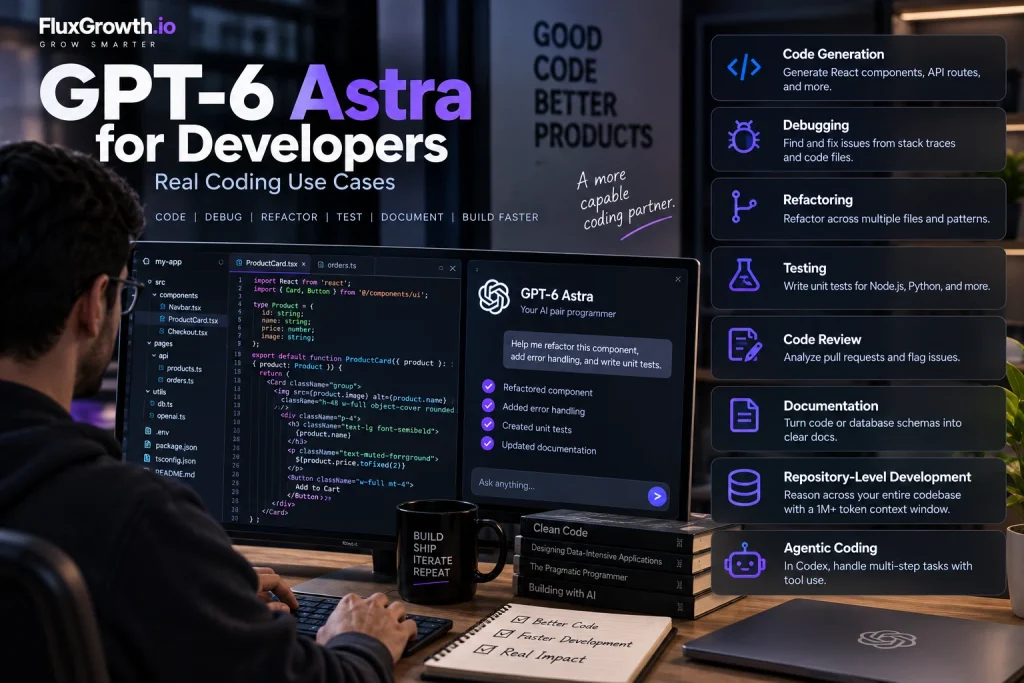
GPT-6 Astra is designed for complex coding, reasoning, and multistep software-engineering workflows. OpenAI specifically positions it for coding and broader end-to-end tasks, while individual results will depend on the code-base, instructions, and workflow.
Code generation. GPT-6 Astra can generate code for tasks such as React components, API routes, and debugging existing code. OpenAI’s current coding documentation provides GPT-6 Astra examples for analyzing and fixing code through the Responses API.
Debugging. Paste a stack trace plus the relevant Python or TypeScript files and it’s good at isolating the cause. The Codex memory change helps here, specifically it can recall why the earlier fix didn’t work.
Refactoring. The big context window lets you hand over several files at once for a coordinated refactor, like migrating a TypeScript module to a new pattern. Catch: the more files you include, the faster you hit that long-context price tier.
Testing. It’ll write unit tests for a Node.js function or a Python endpoint. Run them anyway a generated test can pass while asserting the wrong thing.
Code review. Point it at a GitHub pull request diff and it flags likely issues and style problems. First pass, not a gate.
Documentation. Reliable at turning a function or a Postgres schema into readable docs. Low risk, high time-savings.
Repository-level development. This is where the million-token window earns its keep Astra reasons across a repo, not a single file. It’s also where the bill climbs fastest.
Agentic coding. In Codex, Astra works through multi-step tasks with tool use. On launch day, the team behind the Devin coding agent said they dropped Astra into Devin’s harness and got state-of-the-art results on their internal benchmark, with better code-base understanding out of the box. That’s an OpenAI-published testimonial, so weigh it accordingly.
GPT-6 Astra vs Previous OpenAI Models
Against GPT-5.6 Sol, the previous flagship, Astra’s confirmed gains cluster in agentic, terminal, and computer-use work, not blanket coding wins.
Start with where it clearly pulls ahead. On Terminal-Bench 4.0 (software engineering, system config, and data analysis in a terminal), Astra hits about 57.7% against Sol’s 37.3%. On OSWorld 2.0 it scores 72.6% while averaging roughly 40 minutes a task Sol scores 65.7% and takes about 75. Faster and more accurate on computer use. That’s not a rounding error.
Now the part the launch post skips. On core coding benchmarks like Deep SWE and Frontier Code, Astra sits about level with Claude Fable 5.1, Claude Opus 5, and even a Gemini Flash model on Deep SWE, one read even puts it slightly behind Sol (68% vs 72%). One evaluator has Fable 5.1 ahead of Astra on Artificial Analysis’s Intelligence Index (66 to 61) and its Coding Agent Index (70 to 67); a second read of the same source has them tied at the top. When two passes over one evaluator disagree, that’s your signal: coding is a tight race, not a coronation.
Then cost. Astra runs about 2.5x Sol per token ($10/$50 per million versus $4/$20), and cost per task lands higher even after Astra uses slightly fewer output tokens on some jobs. Better news on reliability: Artificial Analysis clocked Astra’s hallucination rate dropping from 92% to 51% at max effort with accuracy going up at the same time.
One fair-play footnote on all these cross-model numbers. Epoch AI, which runs FrontierMath, says OpenAI funded it and holds exclusive access to part of the set and some of OpenAI’s reported competitor scores come from configs with fewer safeguards. Read any vendor’s benchmark table with one eyebrow raised.
GPT-6 Astra vs AI Coding Assistants, Agents, and IDEs
GPT-6 Astra is a model, not a tool. It’s the engine; the tools are the car.
Quick definitions, because these words get mixed up constantly. An AI coding assistant generates, explains, or reviews code inside your editor the autocomplete-and-chat stuff. An AI coding agent runs multi-step tasks on its own and checks in at gates. An AI-powered IDE builds those features into the editor itself. A terminal coding agent works in your command line. Repository-aware AI reasons across the whole code-base, not just the open file.
Astra sits under all of them. Codex is an agent that can run on Astra; a third-party assistant might route to Astra through the API. So “Astra vs your coding assistant” is the wrong match-up. The real question is which model your assistant runs, and whether Astra’s strengths and price fit what you throw at it.
How Developers Could Use GPT-6 Astra in Real Projects
Astra earns its price on tasks that are long, multi-step, and worth a review gate. Concrete workflows, each with the thing most likely to bite you.
- Build a React component. Input: your design plus existing props. AI task: generate the component. Your review: check accessibility and state logic. Output: typed, working JSX. Risk: it invents props that don’t match your system.
- Debug a Python API. Input: stack trace plus route files. AI task: locate the bug. Your review: confirm the root cause. Output: a proposed fix. Risk: a plausible fix that treats the symptom, not the cause.
- Refactor a TypeScript code-base. Input: several files. AI task: apply a consistent pattern. Your review: run the test suite. Output: coordinated edits. Risk: long-context pricing on big file sets.
- Generate unit tests. Input: a function. AI task: write tests. Your review: verify the assertions. Output: a test file. Risk: tests that pass but assert wrong behavior.
- Review a GitHub pull request. Input: the diff. AI task: flag issues. Your review: decide what’s real. Output: a comment list. Risk: false positives and missed logic bugs.
- Analyze a repository. Input: the repo in context. AI task: map structure and dependencies. Your review: sanity-check the summary. Output: an architecture overview. Risk: the highest token cost of anything here.
- Generate technical documentation. Input: code plus a schema. AI task: write docs. Your review: check accuracy. Output: readable Markdown. Risk: low a safe first use case.
GPT-6 Astra API and Pricing
$10 per million input tokens, $50 per million output that’s the standard tier. The fine print moves your bill more than the headline does. Verified rate card from OpenAI’s pricing page and corroborating trackers:
- Standard: $10.00 input / $50.00 output per million; cached input drops to $1.00, cache writes are $12.50.
- Long context: requests over 272K input tokens bill the whole request at $20 in / $75 out.
- Batch and Flex: half price $5 in, $25 out for evaluations, backfills, and offline work.
- Fast mode: double the standard rate for up to 2x speed.
- Data residency: regional processing adds a 10% uplift.
A few things the pricing page won’t shout. There’s no free API tier, and in ChatGPT, Astra starts on the $20/month Plus plan, not Free. Sol sits on promotional pricing at least through November 21, 2026, which is exactly why Astra’s 2.5x premium looks so steep today; that gap could narrow the day Sol’s promo ends. And if your app reuses a long system prompt or the same tool definitions across calls, cached input at $1 per million is the biggest lever you’ve got. Use it.
Privacy and Security Considerations for Dev Teams
Before you pipe source code or customer data into GPT-6 Astra, treat it like any outside service that sees sensitive material. Astra raises the stakes a notch: it’s OpenAI’s first model to hit the Critical cybersecurity tier under the Preparedness Framework, which is why the public version refuses certain security prompts outright.
Your own checklist is the boring, familiar one which is exactly the point. Keep API keys out of prompts and out of the repo you hand the model; put them in a secrets store. Assume anything you send may be logged unless your tier and settings say otherwise, so check OpenAI’s retention terms before customer PII goes near a request. Keep a human reviewing anything the model writes to production.
One Astra-specific wrinkle: that million-token window makes it easy to paste a whole config file “for context” and ship a live AWS key along with it. Strip secrets before the file goes in, not after.
Comparison: Which Option Fits Which Job
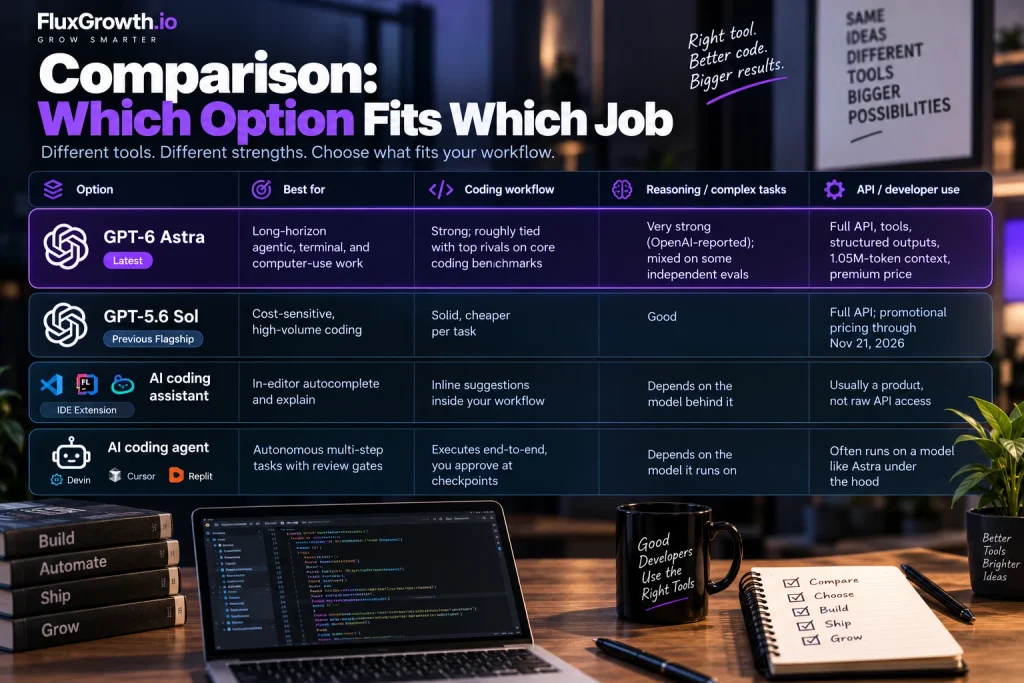
No single row wins outright. Match the option to the documented use case.
| Option | Best for | Coding workflow | Reasoning / complex tasks | API / developer use |
| GPT-6 Astra | Long-horizon agentic, terminal, and computer-use work | Strong; roughly tied with top rivals on core coding benchmarks | Very strong (OpenAI-reported); mixed on some independent evals | Full API, tools, structured outputs, 1.05M-token context, premium price |
| GPT-5.6 Sol (previous flagship) | Cost-sensitive, high-volume coding | Solid, cheaper per task | Good | Full API; promotional pricing through Nov 21, 2026 |
| AI coding assistant | In-editor autocomplete and explain | Inline suggestions inside your workflow | Depends on the model behind it | Usually a product, not raw API access |
| AI coding agent | Autonomous multi-step tasks with review gates | Executes end-to-end, you approve at checkpoints | Depends on the model it runs on | Often runs on a model like Astra under the hood |
Frequently Asked Questions
What is the GPT-6 Astra?
GPT-6 Astra is OpenAI’s newest flagship model, built for complex reasoning, coding, computer use, research, and document creation. OpenAI announced it on September 3, 2026. It’s available in the API as gpt-6-astra, and inside ChatGPT and Codex.
Is the GPT-6 Astra officially released?
Yes. In fact, OpenAI released GPT-6 Astra to select organizations on September 3, 2026, with broader availability the next day across ChatGPT paid plans, the OpenAI API, Microsoft Azure, and AWS Bedrock.
Is GPT-6 Astra available through the API?
Yes. Specifically, GPT-6 Astra is available through the OpenAI API under the model name gpt-6-astra, and also through Microsoft Azure and AWS Bedrock. There is no free API tier.
How much does the GPT-6 Astra cost?
GPT-6 Astra costs $10.00 per million input tokens and $50.00 per million output tokens on the standard API tier, per OpenAI’s pricing page. For example, cached input drops to $1.00, batch and flex run at half price, and requests over 272K input tokens bill at a higher long-context rate.
Is GPT-6 Astra better for coding than previous models?
It’s clearly better at agentic and terminal-based coding tasks than GPT-5.6 Sol, but on core coding benchmarks, independent evaluators put it roughly level with rivals like Claude Fable 5.1 and Opus 5. For everyday code generation, the gain over the previous flagship is modest relative to the cost.
Can developers use GPT-6 Astra for production applications?
Yes. GPT-6 Astra is generally available through the API for production use, with function calling, structured outputs, and enterprise access on business tiers. Verify data-retention terms and cost-per-task against your current workflow before you switch production traffic.
Is GPT-6 Astra better than Claude or Gemini for developers?
It depends on the task. Independent benchmarks show GPT-6 Astra winning on terminal and computer-use work while landing roughly even with Claude Fable 5.1 and Opus 5 on general coding, so the “best” model varies by workload rather than being settled.
The Bottom Line
GPT-6 Astra is a genuine step up for long-horizon agentic, terminal, and computer-use work, roughly a wash on everyday coding, and it costs about 2.5x the previous flagship. That makes it a workload-by-workload call, not an obvious upgrade. Don’t switch on OpenAI’s benchmark tables alone; the independent numbers are mixed, and the price premium is real today while Sol sits on promo pricing.
The move that beats any blog post: take one small, non-production task you already understand, run it through Astra, and compare cost-per-task and output against your current setup. Decide per workflow. Then scale what actually pays off.