FluxGrowth is reader-supported. Some links in our guides are affiliate links — if you buy through one we may earn a commission, at no extra cost to you. It never changes which tools we recommend. How we test tools.
ChatGPT now handles 900 million weekly active users, according to Open AI’s February 2026 announcement. That’s not a typo, and it’s not a future projection. It’s happening right now, while your competitors are still arguing about whether “AI search” is a real channel or just a buzzword.
This guide is part of our GEO & AI Search hub – everything we have published on getting cited by AI search engines, in one place.
Here’s the uncomfortable part: you can rank #1 on Google and still be invisible. Ahrefs found that AI Overviews cut organic click-through on the top organic result by as much as 58% as of December 2025. Your audience is asking ChatGPT, Perplexity, and Google’s AI Mode for recommendations instead of clicking through ten blue links and if you don’t know whether you’re showing up in those answers, you’re flying blind.
That’s the gap the best GEO tools are built to close. In this guide, I’m comparing six platforms I’ve actually used Profound, Semrush’s AI Visibility Toolkit, Ahrefs Brand Radar, Perc AI, Otterly AI, and Nightwatch so you can pick the one that fits your budget and your workflow instead of guessing from a features chart.
What Is Generative Engine Optimization (GEO)?
GEO is the practice of optimizing your content so AI engines ChatGPT, Perplexity, Gemini, Google AI Overviews cite you, mention you, or recommend you inside a generated answer. It’s not a rebrand of SEO. It’s a different game with different scoring.
GEO vs Traditional SEO: What’s the Difference?
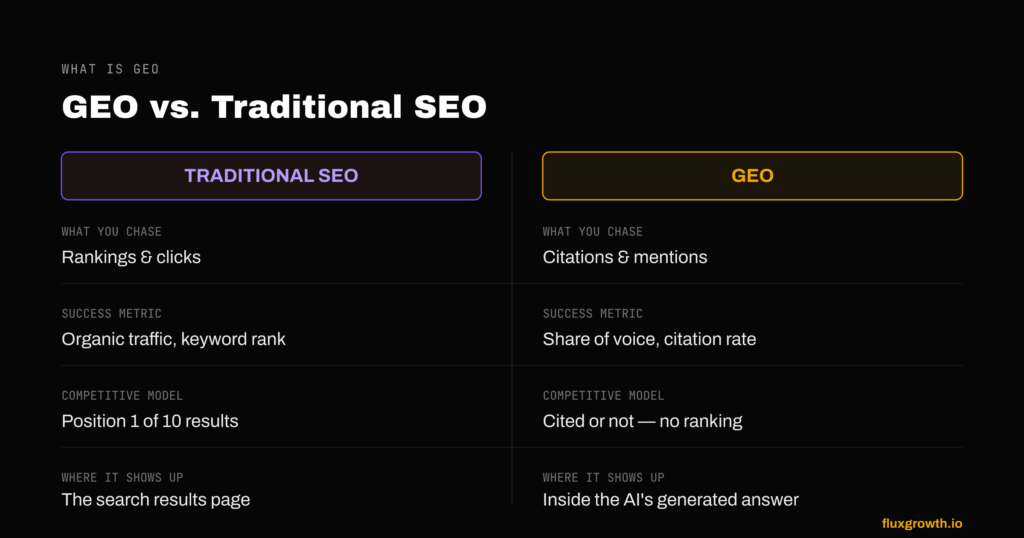
Traditional SEO chases rankings. You optimize a page, you climb the SERP, you get clicks. GEO chases citations. An AI model reads dozens of sources, synthesizes an answer, and either includes your brand in that answer or doesn’t and there’s no “position 1” to fight for, just a yes-or-no on whether you showed up at all.
The metrics are different too. SEO success looks like organic traffic and keyword rankings. GEO success looks like a share of voice how often you’re mentioned relative to competitors across a set of prompts and citation frequency.
You can have great SEO and terrible GEO. I’ve watched it happen to sites that rank on page one for their main keywords and still never get mentioned when someone asks ChatGPT the equivalent question conversationally.
Why is GEO Important in 2026?
Google’s AI Overviews now appear in roughly 18% of all searches and in 57% of long-tail, high-intent queries, per data tracked through Q2 2026.
Seer Interactive’s analysis of 53 brands and 5.47 million tracked queries found something sharper: organic CTR on AI Overview queries dropped from 1.76% to 0.61% between June 2024 and September 2025. A 61% decline. It partially recovered to around 2.4% by February 2026, but the dip happened, and plenty of brands never recovered their share of it.
That recovery matters, but don’t read it as “the threat passed.” It means the brands who adapted are clawing back visibility. The ones who didn’t are still stuck at the bottom of that curve.
How AI Search Engines Find and Cite Content?
Most AI engines use some version of retrieval-augmented generation, or RAG. The model doesn’t just answer from memory it pulls in live content, evaluates it, and decides what to cite. Two things matter here. First, can the AI actually access your content (clean schema, fast load times, no JavaScript walls blocking the crawler)? Second, once it can read you, does it trust you enough to cite you over a competitor?
That second question comes down to entity authority: does the model understand who you are and what you’re an expert in. Brands with scattered, inconsistent information across the web score worse here, even with technically perfect pages.
How We Tested and Ranked the Best GEO Tools?
I didn’t build this comparison from marketing pages or product demos. I tested each tool using a live content website, tracking AI visibility, citations, and brand mentions across ChatGPT, Google AI Overviews, Perplexity, and Gemini over a four-week period.
For consistency, every tool was evaluated against the same set of target keywords, branded queries, and informational prompts. I monitored how often the website appeared in AI-generated answers, how accurately each platform reported citations, and how quickly visibility changes were reflected in the dashboard.
My ranking criteria focused on six factors:
- AI visibility tracking accuracy
- Citation monitoring capabilities
- Competitor analysis features
- Ease of use
- Reporting and data quality
- Pricing and overall value
Evaluation Criteria
I scored every tool against six things that actually matter once you’re paying for this monthly, not just on launch day excitement:
- AI visibility tracking — does it monitor the engines your audience actually uses, or just ChatGPT?
- Citation monitoring — can it tell you which sources are getting cited instead of just whether you showed up?
- Accuracy — does the data match what you see when you manually check the same prompts?
- Ease of use — can someone on your team get useful data in under an hour, or does it need a data analyst?
- Pricing — what does it actually cost once you add the engines, users, and prompts you need (not the headline number)?
- Integrations — does it connect to the tools you already use, or live in its own silo?
Best GEO Tools in 2026 (Quick Comparison Table)
| Tool | Best For | AI Platforms Covered | Starting Price |
| Semrush AI Visibility Toolkit | Teams already inside Semrush | ChatGPT, AI Overviews, Perplexity | $99/mo/domain |
| Ahrefs Brand Radar | Pairing AI visibility with backlink data | ChatGPT, AI Overviews, Gemini, Perplexity, Copilot, AI Mode | $129/mo (base plan) |
| Profound | Enterprise AI visibility intelligence | ChatGPT, Gemini, Perplexity, Copilot, and more | $99/mo (limited) |
| Peec AI | Agencies and brand monitoring | ChatGPT, Perplexity, Gemini, Copilot, AI Overviews | $89/mo |
| Otterly AI | SMBs and budget-conscious teams | Google AI Overviews, ChatGPT, Perplexity, Copilot | $29/mo |
| Nightwatch | Rank tracking + AI as an add-on | Traditional SERPs + AI tracking beta | $32/mo (+$99 AI add-on) |
1. Profound
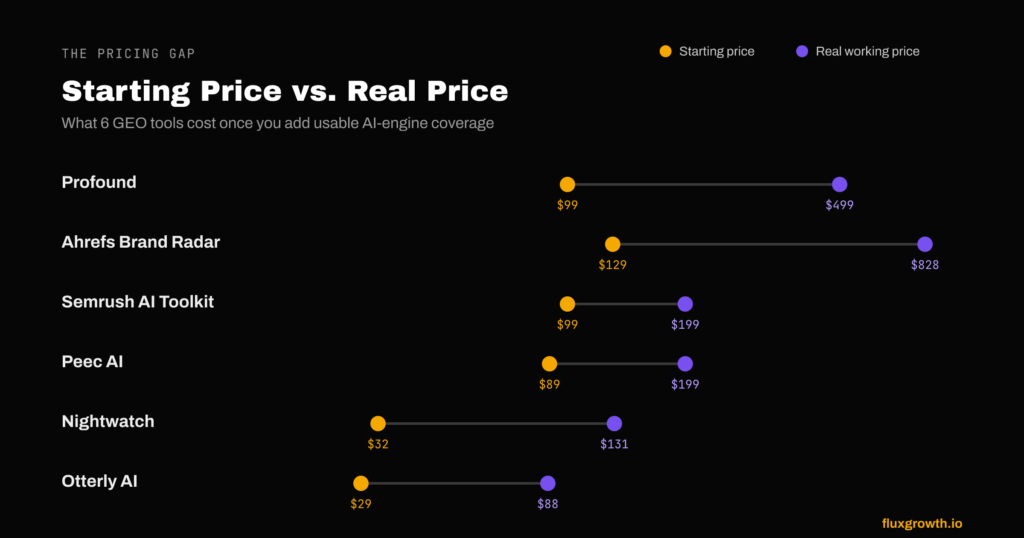
Profound is the name that comes up first in almost every GEO conversation right now, and for good reason it’s raised over $58 million across multiple funding rounds and counts brands like Ramp, Figma, and DocuSign as customers. It’s also the tool where the gap between “starting price” and “real price” is widest.
Key Features
Profound’s standout feature is its Conversation Explorer, which gives you access to a database of real user conversations with LLMs not simulated prompts, actual queries people are asking. That’s a meaningfully different dataset than tools that only run your own prompt list against the models. It also supports cross-model prompt testing, so you can run the same query across ChatGPT, Gemini, and Perplexity and compare how each one answers.
Pros and Cons
The depth of data is genuinely the best in this category, multiple competitor reviews and our own testing put it ahead of Semrush and Ahrefs on raw analytical horsepower.
The trade-off? Profound is built for analysis, not execution. You’ll get sharp diagnostics about where you’re losing visibility, but you’re implementing the fix yourself, or piping the data into another tool entirely.
And the Starter plan is a trap for anyone evaluating this seriously: it only tracks ChatGPT, which tells you almost nothing about your visibility on Perplexity or Gemini.
Pricing
Profound’s Starter plan begins at $99/month and includes ChatGPT tracking with a 50-prompt limit. The Growth plan costs $399/month and adds broader AI search coverage, including Google AI Overviews and Perplexity. Enterprise pricing is custom and requires contacting the sales team. Most businesses looking for comprehensive GEO tracking will likely need the Growth plan or higher.
Full access to all 10+ tracked models typically requires a custom Enterprise quote.
Who Should Use It?
Profound makes sense if you’re an enterprise brand with a dedicated analyst who can turn raw visibility data into action, and your budget can absorb $400-500+ a month without blinking. If you’re a solo creator or a small team that needs answers, not just data, you’ll likely outgrow the Starter tier in a week and feel the Growth tier’s price tag immediately.
2. Semrush AI Visibility Toolkit
If you already live inside Semrush for keyword research and backlinks, this is the lowest-friction way into GEO. It doesn’t ask you to learn a new platform, it just adds a new tab.
Key Features
The toolkit pulls from a prompt database Semrush says exceeds 239 million entries, refreshed daily the kind of number that sounds like marketing copy until you run a real prompt and watch actual volume data populate instead of a guess.
But the feature that actually changes how you work is simpler: your Google ranking and your ChatGPT visibility sit on the same screen. No second login, no exporting two reports and stitching them together in a spreadsheet at 11 PM before a client call.
Pros and Cons
The integration with existing Semrush data is the entire value proposition, and it delivers. You’re not paying for a second login or a second learning curve.
The flip side: if AI visibility is your only need, you’re paying for a lot of SEO suites you might not use. Per-domain, per-user pricing adds up fast too, especially once you’re tracking multiple sites or onboarding several team members.
Pricing
The AI Visibility Toolkit runs $99/month per domain as a standalone add-on. Each additional user with toolkit access costs another $99/month. Bundled into Semrush One, plans start around $199/month and scale up to $549/month for the Advanced tier, which folds in the full Classic SEO toolkit alongside AI visibility.
Who Should Use It?
This is the right call if you’re already paying for Semrush and want AI visibility without onboarding a new vendor. Skip it if you only need AI tracking at that point, you’re better served by a dedicated tool that doesn’t bundle in SEO features you won’t touch.
3. Ahrefs Brand Radar
Ahrefs built its reputation on backlink data, and Brand Radar applies that same “the web is a graph of entities” thinking to AI visibility. The pitch is compelling. The pricing is where things get complicated.
Key Features
Brand Radar tracks six AI platforms Google AI Overviews, AI Mode, ChatGPT, Perplexity, Gemini, and Copilot off a database Ahrefs says covers 200+ million search-backed prompts.
Here’s the feature that actually matters if you do content or link-building work: correlation data. Pull up a page, check its referring domain count, see whether that lines up with how often it gets cited in AI answers. If you’re an agency selling link building, that’s not just a feature it’s a second retainer’s worth of pitch material.
Pros and Cons
The ecosystem integration is real if you’re tracking backlinks and keywords in Ahrefs already, layering on AI visibility costs you a workflow change, not a new tool.
The accuracy question is the bigger concern, though. Dageno AI’s independent testing found Brand Radar reporting just 3 ChatGPT mentions for a tracked brand globally when the actual count was 123. That’s not a rounding error; that’s a tool missing 97% of what’s actually happening. Reddit visibility for AI search specifically isn’t tracked either (only Reddit’s presence in regular Google results is).
Pricing
Ahrefs plans start at $29/month (Starter) and $129/month (Lite). Brand Radar is available as an add-on, with pricing typically starting around $199/month per AI platform or $699/month for broader multi-platform coverage, though Ahrefs has adjusted pricing and availability several times. Businesses should confirm current Brand Radar pricing directly within their Ahrefs account before budgeting. Custom prompt tracking and higher usage limits may increase the total monthly cost significantly.
Who Should Use It?
Worth it if you’re already deep in the Ahrefs ecosystem and want the backlink-to-citation correlation story for client reporting. Not worth it if AI visibility is your primary goal at $828+/month for full coverage, you’re paying roughly 2.5x the category average for data that independent tests say still has accuracy gaps.
4. Percy AI
Peer AI is the tool that shows up repeatedly in agency reviews as the one that doesn’t punish you for growing your team. Alex Birkett, who runs an agency and has tested most of this category firsthand, calls it the most margin-friendly option for agencies and the pricing structure backs that up.
Key Features
Every plan includes unlimited team seats, which matters the moment you’re managing more than one brand or bringing clients into the dashboard. Peec tracks ChatGPT, Claude, Gemini, Perplexity, and Google AI Overviews, with daily updates and competitor benchmarking built in. It also supports 115+ languages and unlimited countries on every tier useful the second you have an international client.
Pros and Cons
The unlimited-seats model and the unlimited free pitch projects (for prospecting before a client signs) are genuine differentiators in this category, where most competitors charge per user. The limitation is depth: Peec is built for monitoring and benchmarking, not for executing content fixes. You’ll still need a separate workflow to act on what it tells you.
Pricing
Perc AI starts at $89/month (some sources list this in euros, around €89, given the company’s German base) for the Starter plan with 25 prompts. Pro runs roughly $199/month, and Growth/Enterprise tiers scale up to around $499/month depending on prompt volume and engine coverage.
Who Should Use It?
A strong fit for agencies managing multiple client accounts who don’t want per-seat costs eating their margin, and for in-house teams that want clean, fast monitoring without a steep learning curve. Less of a fit if you need deep technical diagnostics or built-in content generation Peec doesn’t do either.
5. Otterly AI
Otterly is the entry point most budget-conscious teams land on first, and at $29/month, it’s hard to argue with the math. The question is whether “cheapest” and “good enough” overlap for your use case.
Key Features
Otterly covers four core engines on its base plans: Google AI Overviews, ChatGPT, Perplexity, and Copilot. You get a Brand Visibility Index and a GEO Audit that runs a SWOT-style pass on your content gaps useful, if a little generic-feeling the first time you see it.
The feature worth knowing about, though, is the Semrush App Center integration. If your team already runs Semrush, you can pull Otterly’s GEO data straight into that workflow instead of paying Semrush another $99 a month for its own AI toolkit. That’s a real workaround, not a marketing footnote.
Pros and Cons
The price-to-feature ratio is the best in this comparison, full stop. The trade-off shows up at scale: covering engines beyond the core four (Gemini, Meta AI, Grok) requires add-on modules running $59-149 each, and data refreshes weekly rather than daily on the lower tiers, a real gap if your category moves fast.
Pricing
Otterly AI starts at $29/month for its Lite plan and includes a 14-day free trial with no credit card required. Paid plans scale based on tracked prompts, reporting features, and team size. Additional AI engine coverage and advanced capabilities may require add-on purchases, while Enterprise pricing is available through custom quotes.
Who Should Use It?
Right call for small teams and solo operators who want to start tracking AI visibility without committing real budget, especially if your category lives mostly in ChatGPT, Perplexity, and Google’s AI surfaces. Reconsider if you need Gemini or Grok coverage out of the box the add-on costs erode the budget advantage fast.
6. Nightwatch
Nightwatch is worth including here for one reason: it’s honest about what it is. This is a rank tracker that adds AI visibility as a layer, not a GEO platform pretending to also do rank tracking.
Key Features
The core product is a well-regarded SEO rank tracker. Geo-grid local tracking, site audits, backlink checking the stuff agencies have relied on for years.
The AI Tracking add-on is newer, and it shows. It’s still in beta, covering ChatGPT and Gemini with sentiment analysis and citation monitoring layered on top. Solid for a beta. Not something I’d build a whole AI visibility strategy around yet.
Pros and Cons
If you need rank tracking as your primary workflow and want AI visibility as a bonus rather than a dedicated investment, Nightwatch’s pricing makes that easy. The honesty about the AI layer being additive not foundational is refreshing in a category full of overstatement. The real limitation is coverage: the AI add-on tracks far fewer engines and with less depth than any dedicated GEO tool on this list.
Pricing
The base plan starts at $32/month for 250 tracked keywords, billed annually. The AI Tracking add-on runs an additional $99/month for 100-500 prompts, putting the realistic floor for AI visibility specifically at around $131/month.
Who Should Use It?
Good fit if rank tracking is already your primary need and you want AI visibility bundled in rather than managed separately. Not the right tool if AI visibility is your main goal the beta-stage add-on isn’t built to carry that weight on its own.
Essential Features to Look for in GEO Tools
AI Citation Tracking
This is the core function: does the tool tell you when and where an AI engine cites your brand, not just whether a generic mention happened.
Brand Mention Monitoring
Beyond citations, you want visibility into unlinked mentions of places your brand gets referenced without a clickable source, which is common in AI-generated answers.
AI Visibility Reporting
Look for clear, exportable reports you can actually hand to a client or a boss without translating the data yourself first.
Prompt Tracking
The tool should let you set custom prompts that match how your actual audience asks questions, not just generic keyword-style queries.
Competitor Analysis
You need to see who’s winning the citations you’re not getting, and ideally, which sources are feeding that competitor’s visibility.
Historical Data
AI citations swing by 40-60% month to month, per AirOps’ 2026 State of AI Search report. That’s not a typo; a brand can be the top recommendation in ChatGPT on Tuesday and gone by Friday, purely because the model’s context shifted.
Without historical data, you can’t tell whether that’s a real trend or just noise. Most teams find this out the hard way, after panicking over a one-week dip that reverses itself before they’ve even finished writing the Slack message.
How to Choose the Best GEO Tool?
For Bloggers
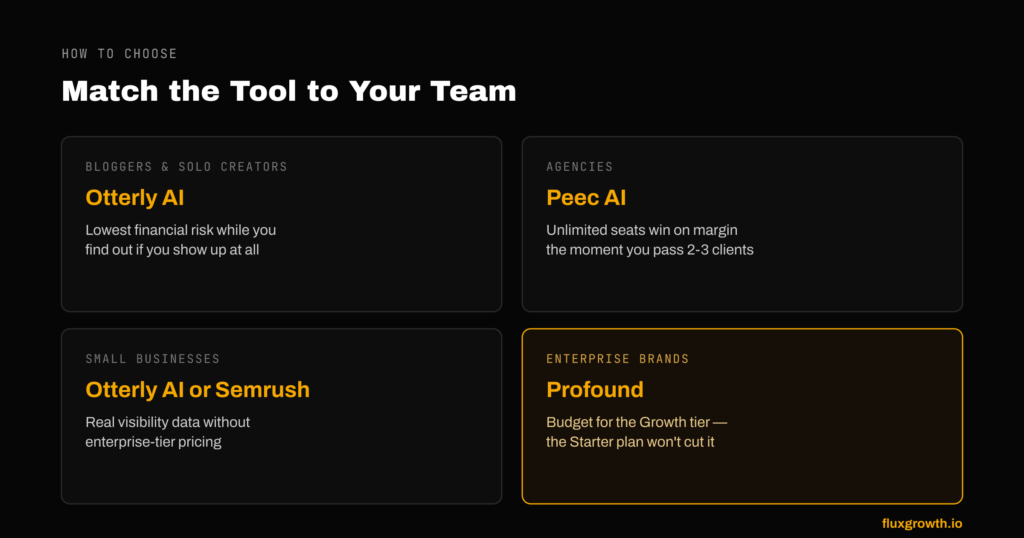
Start with Otterly AI or Peec AI’s entry tier. You need to know whether you’re showing up at all before you invest in deeper diagnostics.
For Agencies
Perc AI’s unlimited-seat model solves the cost-scaling problem most directly. If you need revenue attribution to justify retainers, look at tools built around that specific use case as you scale.
For Small Businesses
Otterly AI or Semrush’s toolkit (if you’re already a Semrush customer) give you real data without enterprise pricing.
For Enterprise Brands
Profound’s depth of data is hard to match, but a budget for the Growth tier or above the Starter plan won’t give you usable coverage.
Best GEO Tools by Use Case
Best GEO Tool for Beginners
Otterly AI, for the reasons covered above lowest financial risk while you figure out whether GEO matters for your category.
Best GEO Tool for Enterprises
Profound, provided you’ve got the budget and the internal analyst capacity discussed earlier.
Best GEO Tool for Agencies
Perc AI, on the strength of unlimited seats and pitch-friendly pricing already detailed in its section above.
Best Budget GEO Tool
Otterly AI’s $29/month Lite plan remains the lowest credible entry point in this entire comparison.
GEO Best Practices for 2026
Optimize for AI Citations
Structure content as direct, factual answers lead with the answer, then explain. AI models pull cleanly-stated facts more readily than buried ones.
Build Topical Authority
Cover the cluster around your core topic, not just the head term. An AI model is more likely to cite you as an expert on “running shoes” if you’ve also published on pronation, arch support, and marathon training.
Use Structured Data
Schema markup helps AI crawlers parse your content correctly. This is foundational, not optional, in 2026.
Create Expert-Led Content
Models are trained to avoid citing generic, unverified claims. First-person expertise and named credentials carry more weight than they did even a year ago.
Monitor AI Mentions Regularly
Given the 40-60% monthly swing in AI citations, a quarterly check tells you almost nothing. Monthly, at minimum, is the realistic floor for catching real shifts.
Frequently Asked Questions
What are GEO tools?
GEO tools track how often your brand appears in AI-generated answers from engines like ChatGPT, Perplexity, and Google AI Overviews, and help you identify what’s driving or blocking that visibility.
Which is the best GEO tool in 2026?
There isn’t one universal winner. Profound leads on data depth for enterprise budgets, Peec AI leads for agencies, and Otterly AI leads for anyone starting on a tight budget.
Are GEO tools different from SEO tools?
Yes. SEO tools track rankings and clicks. GEO tools track citations and share of voice inside AI-generated answers, which often happens with zero clicks at all.
How do GEO tools work?
Most run a set of prompts against AI engines on a recurring schedule, then parse the responses to detect brand mentions, citations, sentiment, and competitor presence.
Can GEO tools help websites appear in ChatGPT?
They can show you whether you’re appearing and why competitors are winning citations you’re not, but the actual fix: better content, cleaner schema, stronger entity signals is still on you to implement.
How much do GEO tools cost?
Entry points range from $29/month (Otterly AI) to $400-500+/month for enterprise tools like Profound, with most mid-market options landing between $89 and $200/month.
Is GEO replacing SEO?
No. It’s sitting alongside SEO as a parallel discipline. You still need traditional search visibility. GEO addresses the growing slice of queries that never produce a click at all.
Final Verdict
After testing all six platforms side by side, here’s where I landed. Profound takes both best overall and best enterprise pick the data depth and model coverage to justify the price once you’re past the Starter tier, and nothing else here gets as close to conversation-level detail. Otterly AI is the best budget option, full stop, at $29/month with real multi-engine coverage.
If you’re an agency, Perc AI‘s unlimited seats change the math enough that it deserves its own category. If you’re already paying for Semrush or Ahrefs, adding their AI modules costs less than a new subscription. Just go in knowing the real price once you add the engines you need.
Pick one tool, set it up against your actual brand this week, and see where you stand. The gap between “ranking #1” and “getting cited” is the gap that’s deciding who wins the next five years of search.