FluxGrowth is reader-supported. Some links in our guides are affiliate links — if you buy through one we may earn a commission, at no extra cost to you. It never changes which tools we recommend. How we test tools.
For fifteen years, SEO ran on a simple promise: rank near the top, earn the click. AI Search in 2026 broke that promise in two places at once. Google now answers a big share of queries right on the results page through AI Overviews and AI Mode, so a #1 ranking no longer guarantees the visit it used to. And ChatGPT and Perplexity answer questions before a user ever opens Google.
That doesn’t mean SEO is finished. It means “ranking” and “getting traffic” have quietly split into two different jobs. This piece covers what actually changed in 2026, what didn’t, and what to do about it — written for marketers, publishers, and the developers who have to build the fix. One ground rule before we start: I’ll flag whether each claim is a confirmed fact, a Google statement, independent research, or a rumor going around SEO Twitter. Those aren’t the same thing, and lately people keep treating them like they are.
What is AI search in 2026?
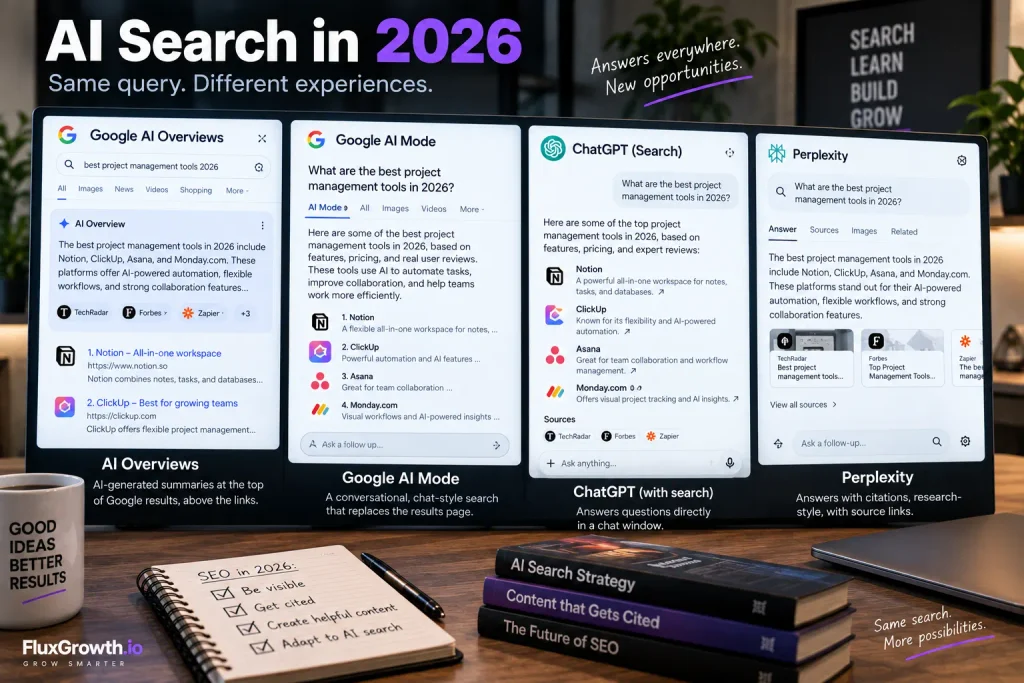
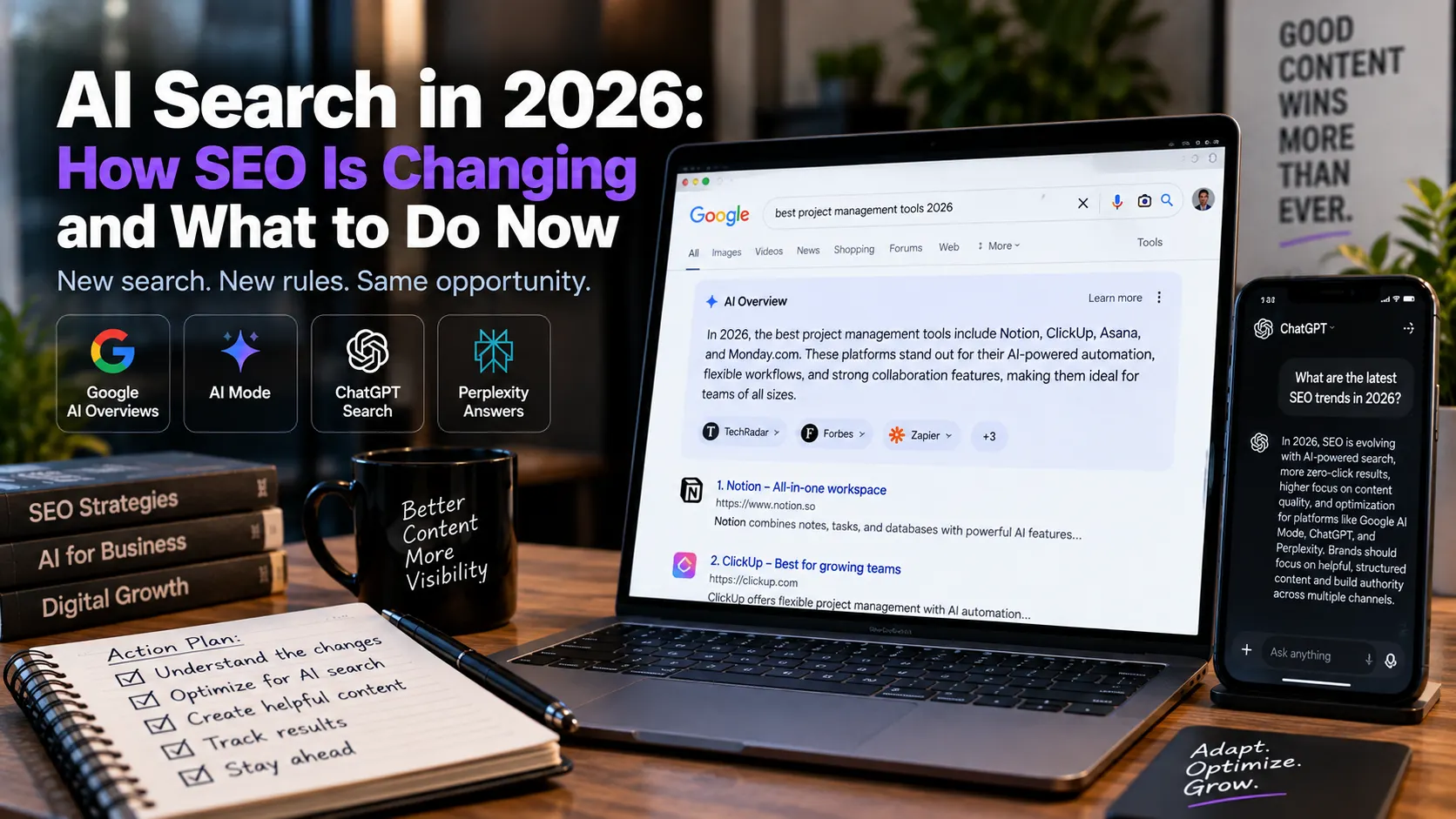
AI search is any search experience where a system writes the answer from multiple sources instead of just handing back a list of links. In 2026, that covers four surfaces US users touch every day.
AI Overviews are the AI-generated summaries at the top of many Google results pages, above the blue links. Google AI Mode is a separate, chat-style search that replaces the results page with a conversational answer built by a Gemini model. ChatGPT (with search on) and Perplexity answer questions directly in a chat window — Perplexity leans hardest into cited, research-style answers. And traditional ranked results still sit underneath all of it.
Ranking in results vs. being cited in an AI answer
This is the distinction the whole piece rests on. Ranking means your page shows up in the list for a query. Being cited means an AI system pulls from your page to build its written answer, usually with a small source link. You can rank #3 and get cited. You can rank #1 and get skipped. Related — but no longer the same game.
How is AI search changing traditional SEO?
Rankings still matter. Visibility just got wider than the blue link. The clearest evidence is Pew Research Center’s July 2025 study of roughly 69,000 real Google searches from 900 US adults: when an AI summary appeared, people clicked a traditional result 8% of the time, versus 15% when no summary showed. Pew calls this an association, not proof of cause, and it’s a Google-only snapshot from March 2025.
The pattern underneath is simple: impressions up, clicks down. BrightEdge reported that total search impressions climbed after AI Overviews launched even as click-through dropped. Translation the same query now puts your brand in front of more people who never click it. Appearing, getting clicked, and getting cited used to rise and fall together. They don’t anymore.
What are AI Overviews doing to clicks?
AI Overviews are cutting click-through rates on the queries they touch, and the independent studies agree on direction while arguing about size. Ahrefs analyzed 300,000 keywords in December 2025 and found an AI Overview correlated with a 58% lower click-through rate for the top-ranking page. Seer Inter-active’s September 2025 study of 3,119 informational queries put the drop around 61%.
Why the studies disagree
The numbers vary because the methods do. They differ on query type (informational queries bleed the most), device, industry, and how each one even defines a “click.” Ahrefs works from keyword-level data; Seer used Search Console and Google Ads data across 42 organizations; Pew tracked real browsing. Treat any single percentage as one lens, not the verdict.
The counterpoint worth knowing
Two facts cut against the panic. First, Google says AI Overviews increase overall search usage for the queries where they appear but that’s Google’s own number, not independent research, so hold it loosely. Second, Seer’s follow-up data showed CTR on AI Overview queries clawing back to 2.4% by February 2026 after hitting bottom in late 2025.
Here’s the thing: clicks didn’t vanish. They got fewer and pickier. The person who does click has usually already read the summary, ruled out a couple of options, and decided you’re worth the tap. That’s where zero-click search (a search that ends without anyone visiting a website) stops being a curiosity and turns into something you have to plan around.
How is Google AI Mode different from traditional search and from AI Overviews?
AI Mode is a full conversational search, not a summary box. AI Overviews sit on top of the normal results page; AI Mode replaces that page with a back-and-forth chat run by a Gemini model. Google launched it to US users in May 2025 after a Search Labs pilot, and at Google I/O on May 19, 2026, said AI Mode had passed one billion monthly users with Gemini 3.5 Flash as its default model. That billion-user figure is Google’s own, not third-party verified.
One claim needs a label. Trade-press reporting in July 2026 described Google making an AI answer the default for every query, with blue links shoved below the fold across all of Search. That goes further than anything Google actually said. Google’s VP of Search, Liz Reid, stated on record that the new search box does not mean users will only get AI responses, and that classic results still exist. Read the “blue links are dead” version as reported and disputed not confirmed.
For SEO, AI Mode changes the shape of the query itself. It uses query fan-out breaking one question into several sub-questions, running them at once, then merging the results usually paired with retrieval-augmented generation (RAG), where the system pulls real pages first and writes from them. That rewards content that covers a topic deeply enough to answer the follow-ups, not just the one keyword. Long-tail and complex queries that used to drive almost no traffic now feed straight into these answers.
What do GEO and AEO actually mean for SEO?
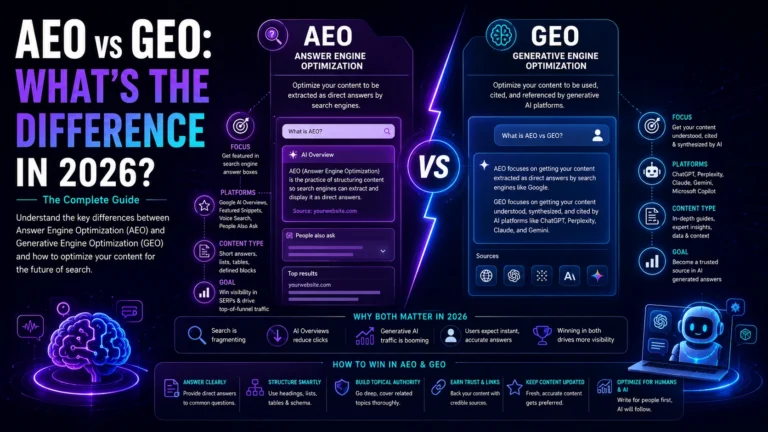
GEO stands for Generative Engine Optimization: shaping content so AI engines cite it in their answers. For a practical guide to improving visibility across AI search engines, see our AI search optimization guide. AEO stands for Answer Engine Optimization, a near-identical idea aimed at being the answer a system returns. Both mean optimizing for the AI answer instead of the ranked link.
So are they a new discipline replacing SEO? Google’s answer is blunt. Its 2026 guidance on generative AI features tells site owners that AEO and GEO are, functionally, still SEO there’s no special schema.org markup for AI features, and tactics like content “chunking,” llms.txt files, and chasing inauthentic mentions aren’t worth your time. The research agrees. The Princeton paper that coined the term GEO (Aggarwal et al., ACM KDD 2024, tested across 10,000 queries) found the biggest citation gains came from adding statistics, quotations, and source citations and that keyword stuffing flat-out failed. Those are content-quality moves, not a separate playbook. GEO is an extension of good SEO, not a replacement for it.
How do you get cited in AI search?
There’s no trick that guarantees an AI citation Google confirms there’s no special markup and no separate “AI index” to game. What the evidence supports is boring but real: make your content easy for a machine to lift and easy for a reader to trust. Lead each section with a direct, self-contained answer, then explain. Use headings that mirror the questions people actually ask. One idea per paragraph. Name the thing (“Perplexity does X”) instead of leaning on “it.”
The Princeton findings are your best map here: pages packed with specific statistics, direct quotes from credible sources, and clear citations earned the largest visibility lift. Add the stuff a rehash of other people’s posts can never contain your own data, your own testing, a real author with real expertise plus entity clarity, internal links, and current dates. Strong technical SEO underneath keeps all of it retrievable.
Does traditional SEO still matter in 2026?
Yes — AI search sits on top of a strong website, it doesn’t replace the need for one. Every AI surface pulls from content it can crawl, index, and understand. If Google can’t render your page, an AI Overview can’t cite it.
The fundamentals of doing the work haven’t changed much: crawl-ability, clean architecture, matching intent, genuinely helpful content, internal links, fast pages, real authority. Structured data isn’t required for AI features (Google has said so directly), but it still earns rich results and helps machines parse your page so keep it.
What changed is the stakes. That same foundation now feeds two systems instead of one the ranked results, and the AI answer built on top of them. A weak site loses twice now.
What should developers and technical teams change?
Technical teams should make the important information both reachable and lift-able. Start with the basics AI retrieval depends on: put critical content in index-able HTML text, not locked behind JavaScript that never renders, and make sure pages return clean status codes.Google’s JavaScript SEO documentation, explains how Google processes JavaScript content. For the tools that can help with AI-search and SEO workflows, see our best AI SEO tools in 2026 guide.
From there, a practical list for engineering:
- Put the key answer in real text near the top, in a heading-plus-paragraph shape a system can lift cleanly.
- Write descriptive, question-shaped headings instead of clever ones.
- Strengthen entity relationships, consistent names, a clear Organization and Author identity, internal links that connect related topics so systems can map your site.
- Keep structured data accurate and matched to what’s actually on the page; don’t mark up content users can’t see. Google’s structured data guidelines
- Watch Google Search Console for shifts, and build channels that don’t depend on Google email, community, direct, and referral from the AI platforms themselves.
How do you measure AI-search visibility?
You can measure part of it, and no single tool catches all of it. Google Search Console now has a Generative AI performance report, and clicks and impressions from AI Overviews and AI Mode get folded into the “Web” search type which means you can’t cleanly split an AI Mode click from a classic blue-link click. That’s a real limit to plan around.
Watch these together: organic impressions and clicks and the gap between them, click-through rate on your key queries, referral traffic from AI domains like chatgpt.com and perplexity.ai in your analytics, and branded search volume as a stand-in for AI-driven awareness. Where you can see citations directly Perplexity shows its sources, and third-party trackers sample AI answers log them. But there’s no universal “AI visibility score” yet, and measurement stays fragmented across platforms. Be skeptical of any tool claiming access to Google’s internal AI metrics; Google has said flatly that none exist.
How each search environment compares
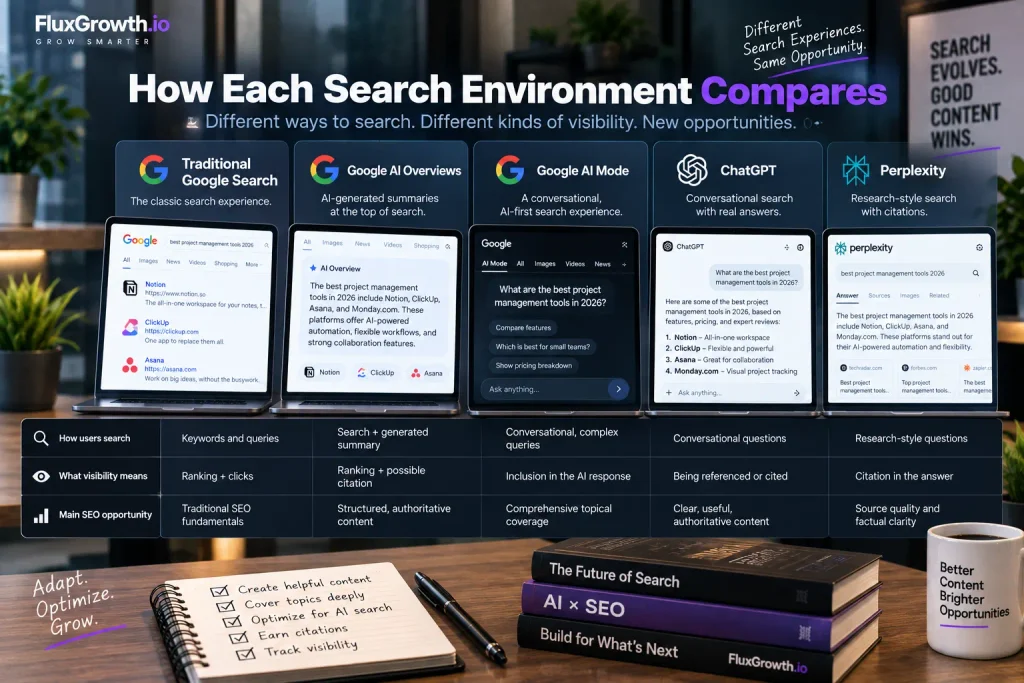
| Search environment | How users search | What visibility means | Main SEO opportunity |
| Traditional Google Search | Keywords and queries | Ranking + clicks | Traditional SEO fundamentals |
| Google AI Overviews | Search + generated summary | Ranking + possible citation | Structured, authoritative content |
| Google AI Mode | Conversational, complex queries | Inclusion in the AI response | Comprehensive topical coverage |
| ChatGPT | Conversational questions | Being referenced or cited | Clear, useful, authoritative content |
| Perplexity | Research-style questions | Citation in the answer | Source quality and factual clarity |
No platform “wins” here. Each one rewards slightly different work, and a site that nails the fundamentals tends to show up across more than one.
A practical SEO strategy for 2026
- Protect your existing organic traffic. Pull your top pages by traffic and revenue, and check which queries now trigger AI Overviews. Know what’s exposed before you react.
- Identify your zero-click queries. Find high-impression, low-click pages in Search Console — these are answers Google is now handling on the page. Decide which are worth defending and which to re-purpose.
- Improve pages that already earn impressions. You’re being shown; you’re not being clicked. Sharpen the answer, add depth the summary can’t replace, and give a reason to visit.
- Add original information and first-hand expertise. Your own tests, numbers, and screenshots are the one thing an AI summary of the web can’t reproduce. This is your citation edge.
- Make important answers easy to extract. Lead with the answer, use question-shaped headings, one idea per paragraph, statistics with named sources.
- Build brand and direct traffic. The more people search for you by name or come to you directly, the less any single algorithm change can hurt.
- Monitor AI-search developments. This field is moving monthly. Track your referral sources and treat “exact date” rumors on social media as unverified until a primary source confirms them.
FAQ
Is SEO still relevant in 2026?
Yes. SEO fundamentals, crawl-ability, helpful content, site architecture, and authority are the entry requirements for both traditional rankings and AI search features. What’s changed is that visibility now includes AI citations and zero-click impressions, not just clicks. The work matters more, not less.
How does AI search affect SEO?
AI search adds new surfaces where your content can appear, and it changes how clicks behave. Pew Research Center found users click a traditional result less often when an AI summary is present (8% vs. 15% in its 2025 study). SEO now optimizes for being ranked and being cited, which are related but separate outcomes.
Will AI Overviews reduce organic traffic?
For many informational queries, yes independent studies from Ahrefs and Seer Interactive in late 2025 measured click-through rate drops of roughly 58% to 61% when an AI Overview appears. Impact varies widely by query type and industry, and transactional or navigational queries are affected less. Always check your own Search Console data rather than assuming an industry average applies to you.
What is GEO in SEO?
GEO stands for Generative Engine Optimization: structuring content so AI engines like ChatGPT, Perplexity, and Google’s AI features cite it in generated answers. The Princeton research that named the field found statistics, quotations, and source citations produced the biggest visibility gains. In practice, GEO overlaps heavily with high-quality SEO.
How do I get my website cited by AI search engines?
There’s no guaranteed method, and Google confirms there’s no special markup for it. What helps is leading with clear, self-contained answers, adding original data and specific statistics, demonstrating first-hand experience, and keeping strong technical SEO so systems can crawl and understand your pages. Trustworthy, extractable content is the closest thing to a reliable lever.
Is Google AI Mode replacing traditional Google Search?
Not as of 2026. Google’s VP of Search stated that its AI-first search box does not mean users only get AI responses, and classic results still exist. AI Mode has grown quickly Google reports over a billion monthly users but reports that blue links have been fully replaced are trade-press claims that go beyond Google’s official statements.
What’s the difference between SEO and GEO?
SEO optimizes for ranking in a list of search results; GEO optimizes for being cited inside an AI-generated answer. The tactics overlap heavily: clear structure, authority, and original information serve both. Google’s own guidance treats GEO and AEO as extensions of SEO rather than a separate discipline.
The bottom line
AI search in 2026 didn’t end SEO. It gives your content more places to show up and more ways to get missed. Rankings and clicks still count. They just share the stage now with AI citations, brand mentions, and the times you show up in an answer nobody clicks. The sites winning this aren’t buying “AI visibility” tools or stuffing llms.txt files. They’re publishing a summary and can’t fake their own test data, a screenshot of the thing actually working, a real opinion someone could disagree with.
One move you can make today: open Search Console, sort your pages by impressions, and find the ones shown far more than they’re clicked. Those are the queries AI is already answering for you. Start there.