FluxGrowth is reader-supported. Some links in our guides are affiliate links — if you buy through one we may earn a commission, at no extra cost to you. It never changes which tools we recommend. How we test tools.
An AI checker is a tool that estimates how likely it is that a piece of text was written by an AI model like ChatGPT, Claude, or Gemini. It gives you a probability, not proof. That one difference matters more than any feature on a pricing page.
Picture a student who wrote every word of her history essay herself. It comes back flagged as 68% AI. Now she has to prove a negative, and the tool that flagged her can’t explain why.
This guide shows you how AI checkers work, what independent research says about their accuracy, and why they sometimes flag human writing. Then it compares five popular tools for students, teachers, writers, and publishers. You’ll also get a step-by-step way to use one without trusting the score more than it deserves.
What is an AI checker?
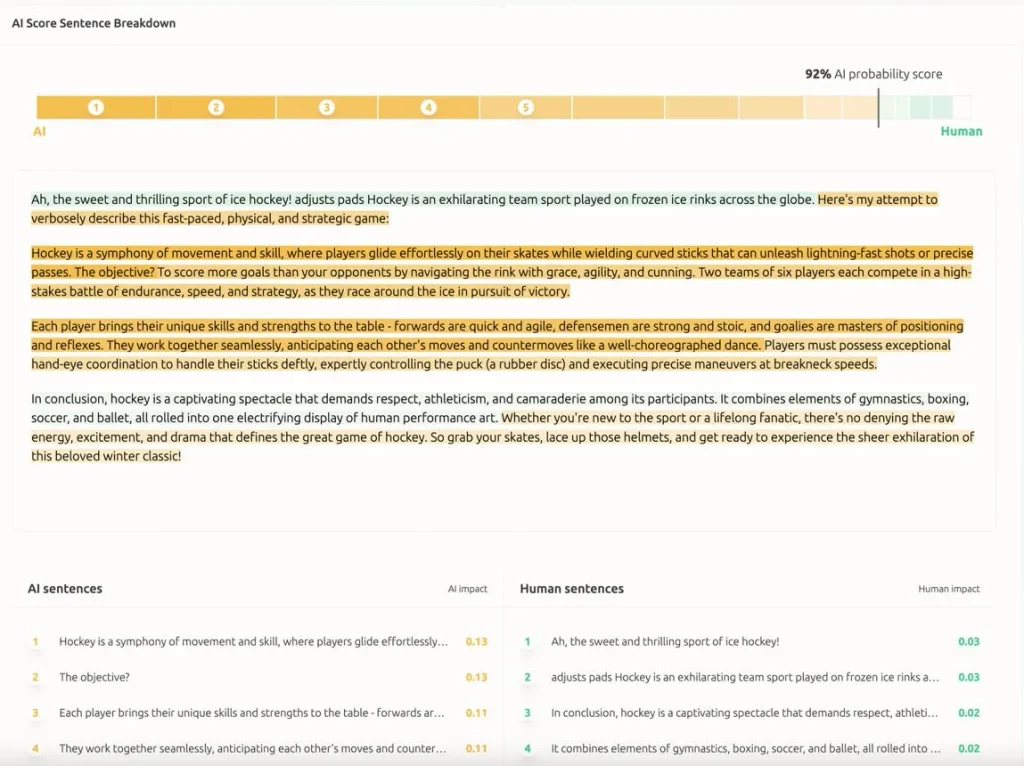
An AI checker scans text and returns a score for how likely it is that a language model produced it. Most tools also highlight the specific sentences that pushed the score up.
AI checker, AI detector, AI content checker: same tool
You’ll see “AI checker,” “AI detector,” “AI content detector,” and “AI writing detector” used for the same product. GPTZero, Originality.ai, and Winston AI all do the same core job under different labels. Don’t let the naming convince you one is a different category.
How it differs from the tools people confuse it with
This is where most mix-ups happen. A plagiarism checker and an AI checker answer completely different questions.
| Tool | The question it answers |
| AI checker / AI detector | Does this text look like a language model wrote it? |
| Plagiarism checker | Does this text match something already published or submitted? |
| AI plagiarism checker | Usually both checks bundled in one scan |
| Grammar checker | Is this text correct and clear? |
| AI writing assistant | Writes or rewrites text for you (ChatGPT, Claude, Gemini) |
| AI humanizer | Rewrites AI text so detectors score it lower |
| AI content verification tool | Broader term: may cover text, images, and deepfakes |
Here’s the practical difference. A plagiarism checker can point to the exact source a sentence was copied from. An AI checker has no source to point to. It’s judging style, not matching text. That’s why an AI score is so much harder to defend or dispute.
How does an AI checker work?
An AI checker works by measuring how predictable your text is. Language models write by picking likely next words, so AI text tends to be smoother and more predictable than the way most people write.
Perplexity and burstiness, in plain English
Perplexity measures how predictable a sequence of words is to a language model. Low perplexity means the wording is relatively predictable, while high perplexity means it is less predictable. Some AI detectors use this statistical signal to identify patterns associated with AI-generated writing.
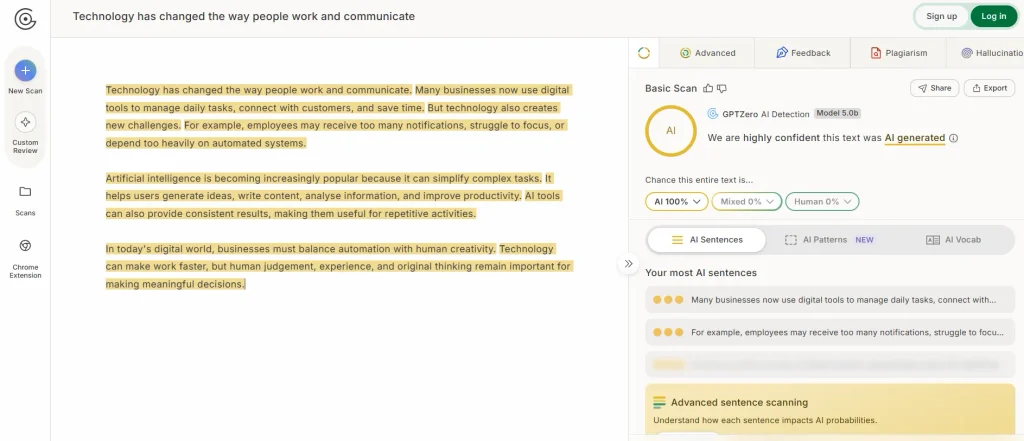
Burstiness describes variation in sentence length, structure and writing patterns. Human writing often contains a mixture of short and long sentences, while AI-generated text can sometimes follow more consistent patterns.
However, modern AI detectors may use additional techniques, including machine-learning classifiers trained on human-written and AI-generated text.
For example, GPTZero says it moved beyond its original perplexity-and-burstiness approach to a deep-learning architecture in 2023. This shows why detection methods should be checked individually rather than assumed to be the same across all tools.
Why you get a probability, not a verdict
An AI checker never sees how a text was made. It sees only the finished words and compares them with patterns it learned. A careful human can write predictable text, and a model can be prompted to write unpredictable text. So every score is an estimate with error on both sides.
In short: AI checkers judge how a text reads, not where it came from. Treat the number as a reason to look closer, never as the answer.
How accurate are AI checkers?
AI checkers are accurate enough to flag text worth a second look, but not accurate enough to prove who wrote something. That’s the consistent finding across independent research, and some vendors admit it too.
Vendor claims vs. independent research
The clearest evidence comes from OpenAI itself. It launched an AI text classifier in January 2023 and pulled it on July 20, 2023, “due to its low rate of accuracy.” On OpenAI’s own test set, it caught 26% of AI-written text and wrongly flagged human text 9% of the time (OpenAI, 2023). If the company that builds ChatGPT couldn’t reliably spot its own output, that tells you how hard the problem is.
Independent researchers keep landing in the same place:
- Weber-Wulff et al. (2023) evaluated 14 AI detection tools, including 12 publicly available tools, Turnitin, and PlagiarismCheck. Their findings were concerning: all 14 tools scored below 80% accuracy, and only five exceeded 70%. The researchers concluded that these tools were “neither accurate nor reliable.” They also found that detectors frequently misclassified AI-generated text as human-written, with approximately 20% of AI-generated texts likely to be misattributed to humans. (International Journal for Educational Integrity, 2023).
- The RAID benchmark (2024), from researchers at the University of Pennsylvania and others, used over 6 million AI generations. It notes that many detectors claim 99%+ accuracy, then found them easily fooled by paraphrasing, different sampling settings, and models they hadn’t seen (Dugan et al., ACL 2024).
Turnitin is unusually open about its own limits. It says its document-level false positive rate is under 1% when more than 20% of a document is flagged. But its sentence-level false positive rate is about 4%, so roughly 4 in every 100 highlighted sentences may be human-written (Turnitin).
Can AI checkers detect ChatGPT, Claude, and Gemini?
AI checkers can often detect raw, unedited output from ChatGPT, Claude, and Gemini, especially in longer texts. They struggle more with newer models they weren’t trained on. RAID found unseen generative models were one of the main ways detectors failed.
So a vendor’s list of “supported models” is a snapshot. Every new model release starts a catch-up period.
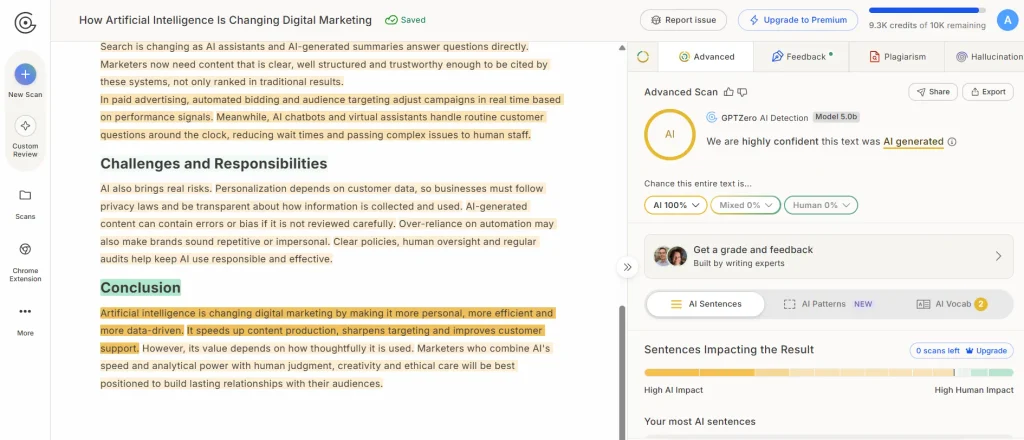
To see how much detector results can vary, we ran the same ChatGPT, Claude, and Gemini samples through two AI detection tools. The scores are compared below.
Paraphrased, edited, and “humanized” text
This is where detection breaks down. Weber-Wulff’s team found that manual editing, machine paraphrasing, and translation made results worse. The Stanford study showed simple prompting tricks could also slip past detectors (Liang et al., 2023).
That cuts both ways. Light editing can hide real AI use, while the human writer who never touched AI can still get flagged.
In short: Detectors catch obvious, unedited AI text far better than anything someone has worked on. Every published false positive rate is above zero, including the vendors’ own.
What causes AI checkers to have false positives?
A false positive happens when an AI checker labels human writing as AI-generated. It usually comes down to writing that’s predictable for reasons that have nothing to do with AI.
Non-native English writing. This is the best-documented cause. Stanford researchers ran seven detectors on 91 TOEFL essays by non-native speakers and 88 essays by U.S. eighth graders. The detectors flagged the TOEFL essays as AI 61.3% of the time on average, while handling the eighth-grade essays well (Liang et al., 2023). A smaller vocabulary means more predictable word choice, and that’s exactly what detectors read as AI.
Short texts. OpenAI said its classifier got more reliable as text got longer (OpenAI, 2023). Turnitin raised its minimum from 150 to 300 words for the same reason (Turnitin). A discussion post or a product blurb gives a detector very little to work with.
Low scores. Turnitin found more false positives when it detected under 20% AI writing. It now shows an asterisk instead of a number in the 1–19% range (Turnitin guide).
Mixed documents. In Turnitin’s analysis, 54% of false-positive sentences sat right next to real AI writing. The handoff points between human and AI text are where mistakes cluster.
Formulaic writing. Lab reports, legal boilerplate, and templated SEO intros all follow tight patterns. Since detectors reward unpredictability, rigidly structured human writing can score high. That’s an inference from how perplexity works, not a measured rate.
AI-powered editing. Basic spelling and grammar corrections are different from accepting AI-generated sentence rewrites. When a writing assistant substantially rewrites your sentences, it introduces AI-generated wording into your draft. Some academic publishers, including Elsevier and Oxford University Press, distinguish routine proofreading from substantive AI-assisted rewriting and may require disclosure of the latter.
Which AI Checker Should You Use? 5 Tools Compared
The best AI checker depends on your needs. GPTZero is useful for free spot checks, Originality.ai offers website scanning for publishers, Copyleaks supports multilingual detection, Winston AI provides OCR features for scanned documents, and Turnitin is designed for institutions that already have access.
Here is how their features and pricing compare. Prices are in USD, checked in November 2026. Annual prices are shown as effective monthly rates where applicable.
| AI checker | Best for | Free option | Paid pricing | Standout feature |
| GPTZero | Students, teachers and occasional checks | 10,000 words/month; 10,000 characters per scan | Premium: $23.99/month or $12.99/month billed annually | Sentence-level highlights and browser extension |
| Originality.ai | Publishers, SEO teams and agencies | Basic: 3 scans/day, up to 2,000 words per scan | Pro: $14.95/month or $12.95/month billed annually | AI detection, plagiarism checks and website scans |
| Copyleaks | Multilingual content | Limited free checking; exact usage allowance should be confirmed | Personal: $16.99/month or $13.99/month billed annually | AI detection in 30 languages |
| Winston AI | Educators and document reviewers | 2,000 credits for a 14-day trial | Essential: $18/month or $10/month billed annually | OCR support for images and handwriting on supported plans |
| Turnitin | Schools and universities | No individual AI detection plan | Institutional pricing | AI writing reports integrated into academic workflows |
Note:-Pricing and included features can change. Check each provider’s official pricing page before purchasing.
Which AI Checker Should You Choose?
- Best for free checks: GPTZero, with its 10,000-word monthly allowance.
- Best for publishers and agencies: Originality.ai, particularly for website scanning and combined content checks.
- Best for multilingual writing: Copyleaks, which supports 30 languages for AI detection, including Hindi.
- Best for scanned documents: Winston AI, with OCR capabilities on supported plans.
- Best for educational institutions: Turnitin, when your school or university already provides access.
Remember that AI detection scores are estimates, not proof of authorship. Even established tools can misclassify human-written or AI-generated content. Use their results as supporting information rather than the sole basis for important decisions.
Free vs. paid AI checker: what’s the real difference?
A free AI checker is fine for occasional spot checks. Paid plans mostly buy you volume, file uploads, shareable reports, and team or API access, not a fundamentally smarter detector.
First, check whether “free” means a plan or a trial. GPTZero’s free tier renews monthly. Winston AI’s free option ends after 14 days. Originality.ai has no free plan at all.
Here’s when paying makes sense:
- You check more than a few thousand words a week.
- You need PDF or DOCX uploads instead of pasting text.
- You have to share a report with a client, editor, or student.
- You want the check built into a CMS, LMS, or your own app through an API.
If none of those apply, stay on a free tier. Run two of them side by side instead of paying for one.
How do you use an AI checker the right way?
Use an AI checker as the first step of a review, never the last. These six steps keep a single score from doing more damage than it should.
- Check enough text. Aim for at least 300 words. Turnitin won’t score less than that, and short samples are less reliable everywhere.
- Run two different tools. If they disagree sharply, the text is ambiguous, and that’s useful information in itself.
- Read the highlights, not the headline number. Look at which sentences got flagged. Is it the boilerplate intro, or the actual argument?
- Know the threshold. A 15% score means something very different from 85%. Turnitin won’t even show a number under 20%.
- Compare against known writing. Run a sample the person wrote before ChatGPT existed. If that also scores high, the tool is reacting to their style.
- Talk before you decide. Ask about drafts, notes, and sources. The conversation tells you more than the scan.
What should you do if an AI checker flags your own writing?
If an AI checker flags writing you did yourself, respond with evidence of your process, not just a denial. A score is an estimate. A draft history is a record.
Build your evidence kit:
- Version history. Google Docs (File > Version history) and Microsoft Word with OneDrive both keep timestamped versions. A document that grew over three evenings looks nothing like one pasted in at once.
- Drafts, outlines, and notes. Even rough bullet points show where your ideas came from.
- Your sources. Bookmarks, PDFs you annotated, library records.
- Older writing samples. Work from before 2023 shows your natural style.
- The research. Link the Stanford study and Turnitin’s own false-positive guidance when you ask for a review.
Then ask for a conversation, not a ruling. Something like: “I wrote this myself and I’d like to walk you through my drafts and sources. Can we look at which sentences were flagged together?”
If you’re a teacher, start in the same place. Turnitin publishes guides for exactly this conversation, built around open questions rather than accusations (Turnitin). Ask the student to explain a paragraph in their own words. People who wrote something can usually talk about it.
And if you write for clients, get ahead of it. Keep drafts by default, and agree upfront on how AI checker results will be handled.
My advice for freelancers and content writers: Never rely on a final AI detection score to prove how an article was created. Keep your original drafts, research notes, document history, and sources as evidence of your writing process. If a client’s AI checker flags your work, review the highlighted sentences together before accepting the result. A detection score alone should never decide whether your work is original or acceptable.
How should students, teachers, writers, and businesses use AI checkers?
Each group should use an AI checker for a different job, and none should use it as the only evidence.
Students
Run your own work through a free checker before you submit, so a surprise score doesn’t land on you first. Keep your drafts. Follow your school’s AI policy over any tool’s opinion.
Teachers and schools
Treat a high score as a reason to talk, not a finding. The Stanford researchers specifically cautioned against using detectors in evaluative or educational settings, especially for non-native English writers (Liang et al., 2023). Process-based work like in-class drafts, outlines, and short oral check-ins does more than any detector.
Writers, agencies, and publishers
Use AI checkers as an additional quality-control tool alongside plagiarism checks and editorial review. A high detection score should prompt further investigation, not automatic rejection.
Google does not penalise content simply for being AI-generated. It prioritises helpful, original, high-quality content. However, publishing unoriginal content to manipulate rankings may violate Google’s scaled content abuse policy.
HR and business teams
Be careful with cover letters and writing tests. They’re short and often formulaic, which are both known false-positive triggers. A detector score alone shouldn’t decide a hiring outcome.
Is it safe to upload your work to an AI checker?
Uploading work to an AI checker means sharing your text with a third-party service. Before submitting unpublished manuscripts, client documents, legal drafts or student records, review the provider’s privacy policy.
Data retention and AI training policies differ between providers. For example, Originality.ai offers 30 days of scan-history access on Pro and pay-as-you-go plans and 365 days on Enterprise. However, scan-history availability does not necessarily mean the same retention period applies to every stored copy. Its privacy policy also allows model training using scan history unless you opt out.
Before Uploading, Check These Four Things
- AI training: Does the provider use submitted text to train its models? Can you opt out?
- Data retention: How long is your content stored, and can you request deletion?
- Student privacy: Does your institution have an appropriate FERPA-compliant arrangement with the provider?
- Free checks: Does the privacy policy differ between public checkers, free accounts and paid subscriptions?
If the provider’s data practices are unclear, avoid uploading confidential documents. Use a short, non-sensitive excerpt instead.
How do you choose the right AI checker?
Choose an AI checker by your volume, your stakes, and your language, not by the accuracy number on its homepage. Five questions settle it:
- How many words do you check a month?
- What happens to someone if the tool gets it wrong?
- Is the writing in English, or something else?
- Do you need file uploads, reports, or an API?
- Can you live with the vendor’s data policy?
What I’d do if I were choosing today
If I were choosing an AI checker today, I wouldn’t spend money immediately. I’d start with GPTZero’s free plan and Copyleaks’ free AI detection check to understand how each tool evaluates the same content. I’d compare their results before deciding whether a paid subscription is actually necessary.
For individual creators, students, and freelance writers, free tools can be a reasonable starting point. But if I were managing a content team or publishing articles regularly, I’d consider Originality.ai’s pay-as-you-go option before committing to a monthly plan.
My biggest advice is simple: don’t treat an AI detection score as proof. These tools can make mistakes, and even genuinely human-written content can sometimes get flagged. Always review the highlighted sentences, check the original drafts, and consider the context before making a decision.
At FluxGrowth, I believe the best way to evaluate any AI tool is to look beyond its marketing claims and understand how well it performs in real-world situations. Choose a tool that fits your workflow, budget, and actual requirements rather than paying for features you may never use.
My final verdict: Start free, compare results, upgrade only when you need more capacity, and always keep human judgment in the process.
AI checker FAQ
What is an AI checker?
An AI checker is a tool that estimates the probability that text was written by an AI model such as ChatGPT, Claude, or Gemini. It analyzes how predictable the writing is and returns a score, often with flagged sentences. I can’t prove who wrote something.
How accurate are AI checkers?
AI checkers are reasonably good at spotting raw, unedited AI text, and much weaker on edited or paraphrased text. Independent studies, including a 2023 test of 14 tools and the 2024 RAID benchmark, found detectors unreliable once text was modified. Even OpenAI withdrew its own classifier in 2023 because of low accuracy.
Can AI checkers detect ChatGPT?
AI checkers can often detect unedited ChatGPT output, especially in longer passages. Detection gets less reliable after editing or paraphrasing, and with newer models a detector wasn’t trained on. Treat a ChatGPT flag as a probability, not a confirmation.
Is there a free AI checker?
Yes. GPTZero offers a free plan with a monthly word allowance, and Copyleaks offers a free web check without an account. Winston AI offers a 14-day trial instead of a permanent free plan. Free tools are fine for occasional checks.
Can an AI checker flag human writing as AI?
Yes, and it happens often enough to matter. A 2023 Stanford study found seven detectors flagged essays by non-native English speakers as AI 61.3% of the time on average. Short, formulaic, or mixed human-and-AI texts also raise the risk.
Can AI checkers detect paraphrased or humanized AI text?
Not reliably. Research shows paraphrasing and rewriting tools sharply reduce detection rates. A low AI score therefore doesn’t prove text is human, just as a high score doesn’t prove it’s AI.
Should teachers use AI checker scores as proof of cheating?
No. AI checker scores are probabilistic and carry documented false positives, and Turnitin itself hides scores below 20% to avoid misreading. Teachers should use a score to start a conversation and look at drafts and processes before reaching any conclusion.
The bottom line
An AI checker is a useful flashlight and a terrible judge. It can point you to text worth a closer look, but it can’t tell you who wrote it, and the research behind that limit is solid.
Pick your tool by what you actually need. That might be a free plan for spot checks, credits for client content, or multilingual support. Then build your process around the score, not on top of it.
Your next step is simple. Before you ever judge someone else’s writing, run something you wrote yourself through two free AI checkers. Seeing your own work flagged is the fastest way to learn how much weight a score deserves.