FluxGrowth is reader-supported. Some links in our guides are affiliate links — if you buy through one we may earn a commission, at no extra cost to you. It never changes which tools we recommend. How we test tools.
Perplexity AI is an AI-powered answer engine. It searches the live web and hands you a cited, synthesized answer instead of ten blue links to click through yourself.
This guide is part of our GEO & AI Search hub – everything we have published on getting cited by AI search engines, in one place.
My experience: I started using Perplexity AI to speed up research for long-form content, especially when comparing products, verifying pricing, and finding trustworthy sources. Instead of jumping between dozens of tabs, I could ask one question, review the cited sources, and follow up naturally until I had everything I needed. It hasn’t completely replaced Google or ChatGPT in my workflow, but it has become one of my primary research tools whenever accuracy and citations matter.
Here’s the short version: if you need fast, source-backed research, Perplexity earns a permanent spot in your tab bar. Need heavy creative writing or coding help instead? It’s a solid second tool. Not your main one. This review breaks down the features, the real 2026 pricing, the Comet browser, and where Perplexity actually falls short based on hands-on testing, not the marketing page.
What Is Perplexity AI?
Perplexity AI is an answer engine, a tool that reads the live web in real time and writes you a direct, cited response instead of returning a list of links for you to click through yourself. That’s the core difference between Perplexity and a traditional search engine: Google shows you where to look, Perplexity does the reading and hands you the summary with receipts.
Founded in 2022 in San Francisco, Perplexity AI was co-founded by Aravind Srinivas, Denis Yarats, Johnny Ho, and Andy Konwinski. Aravind Srinivas continues to serve as CEO. The company has grown rapidly and now handles well over 100 million queries per week, making it one of the fastest-growing AI search platforms.
Under the hood, Perplexity runs on retrieval-augmented generation (RAG). It retrieves current web pages first, then generates an answer grounded in what it just read rather than relying only on a model’s training data from months or years ago.
It also routes queries across multiple underlying models, including versions from OpenAI, Anthropic, and Google, plus Perplexity’s own Sonar models. Pick a specific model yourself if you want more control over a given search.
In short: Perplexity AI is a real-time, cited research assistant, not a general chatbot with search bolted on.
How Perplexity AI Works
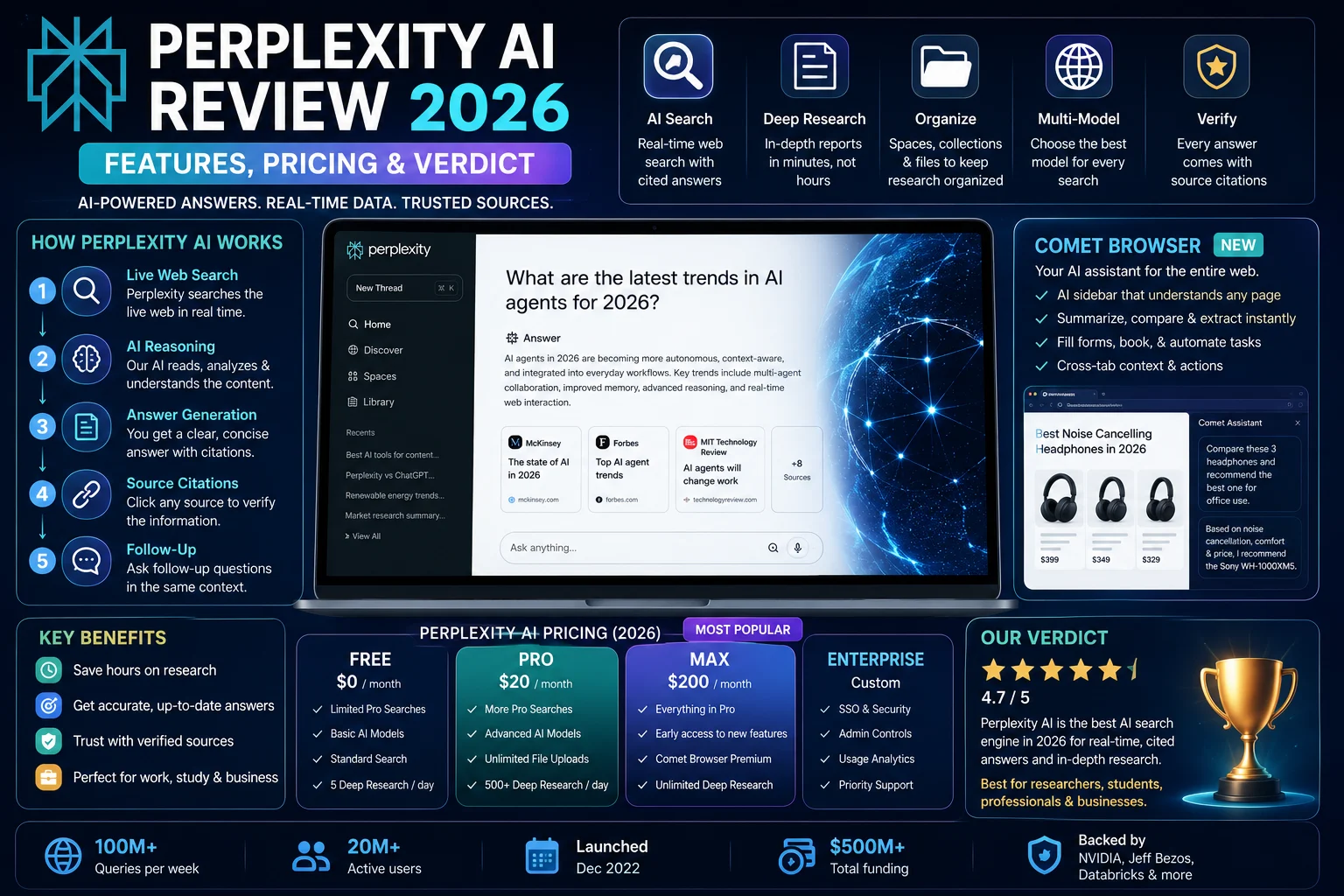
Every Perplexity search runs through the same basic pipeline, as explained in Perplexity’s official Help Center, whether you notice it or not.
- Live web search. Your query triggers a real-time crawl, not a lookup against stale training data.
- Retrieval-augmented generation. The model reads the retrieved pages before it writes anything, which is why answers reference specific sources instead of general knowledge.
- AI reasoning. For anything beyond a simple fact lookup, Perplexity breaks the question into parts and researches each one before combining them into a single answer.
- Source citations. Every claim in the response links back to the page it came from numbered, clickable, and visible without extra clicks.
- Follow-up conversations. You can keep asking in the same thread, and Perplexity keeps the context from your previous questions.
- Multi-model search. Pro and Max users can choose which underlying model handles a given query, instead of always getting Perplexity’s default routing.
That citation-first design is the single biggest reason people switch to Perplexity from Google or ChatGPT: you can verify the answer in seconds instead of taking it on faith.
Perplexity AI Features
Search, Pro Search & Deep Research
Regular search gives you a quick, cited answer to a straightforward question. Pro Search breaks a more complex question into sub-questions, researches each one, and assembles a fuller answer useful for anything with more than one moving part.
Deep Research is Perplexity’s most advanced research mode. It automatically performs dozens of searches, analyzes information from numerous sources, and synthesizes the findings into a structured report. Depending on the complexity of the topic, reports typically take 2–4 minutes to generate far faster than manually researching the same subject.
Usage limits: Perplexity currently offers Deep Research on both Free and Pro plans, but the number of available reports differs by subscription. Free users receive a limited number of Deep Research reports each day, while Pro subscribers receive substantially higher limits. Because Perplexity has adjusted these allowances several times since launch, it’s best to check the official pricing page for the latest daily limits before publishing.
Spaces, Collections, Files & Search Modes
- Spaces let you organize related research into a dedicated workspace with its own instructions and file uploads handy if you’re researching one project over multiple sessions.
- Collections function similarly, as a saved, searchable knowledge repository you build over time.
- File uploads and PDF analysis let you drop in a document and ask questions directly about its contents, with citations pointing back to the specific page or section.
- Image search and voice search extend the same cited-answer approach to visual and spoken queries.
- Focus Modes narrow a search to a specific source type academic papers, Reddit threads, YouTube, and a few others when you want a more targeted result than the general web.
Comet Browser & Sonar API
Comet is Perplexity’s own web browser, built on Chromium. An AI assistant lives in a sidebar, knows which tab you’re on, and can act on your behalf summarizing pages, filling out forms, and comparing prices across three open tabs at once.
It launched in July 2025 as a $200/month Max-exclusive feature. By March 2026, it was free on Mac, Windows, Android, and iOS. That’s the whole story in one sentence: a browser that cost $2,400 a year is now a free download.
The Sonar API is Perplexity’s developer platform. It gives developers API access to Perplexity’s live web search and answer-generation pipeline, allowing applications to retrieve current information with citations instead of relying solely on an LLM’s training data. Sonar is designed for AI assistants, RAG applications, customer support systems, and enterprise search experiences.
Pricing: Sonar uses usage-based API pricing, with different rates depending on the model and search depth. Because Perplexity updates its API pricing periodically, it’s best to verify the latest rates directly from the official Sonar API documentation before publishing.
Mobile Apps & Browser Extensions
Perplexity ships native apps for iOS and Android, plus browser extensions for Chrome and other Chromium-based browsers that let you trigger a Perplexity search from any tab without opening a new one.
How We Tested Perplexity AI
To evaluate Perplexity AI, we used the same testing process we apply to every AI search tool we review. Rather than relying on vendor demos, we focused on real-world tasks that researchers, students, marketers, developers, and business users perform every day.
Our evaluation covered:
- Search accuracy: Could Perplexity answer current, time-sensitive questions correctly?
- Citation quality: Did the cited sources actually support the claims in the response?
- Response speed: How quickly were answers generated for simple and complex queries?
- Research capability: We tested multi-step research questions that required information from multiple sources.
- File analysis: We uploaded PDFs and documents to evaluate summarization, extraction, and question-answering accuracy.
- Writing quality: We used Perplexity to create outlines, summaries, and first drafts to assess clarity and usefulness.
- Fact-checking: We compared responses against authoritative sources to identify inaccuracies or hallucinations.
- Ease of use: We evaluated the interface, follow-up conversations, search modes, and overall user experience.
- Pricing and value: We compared the Free, Pro, Max, and API offerings to determine whether the paid plans provide meaningful value over the free tier.
For consistency, many of the same research prompts were also compared against competing tools such as ChatGPT Search, Google AI Mode, Microsoft Copilot, and Kagi to better understand where Perplexity excels and where competitors perform better.
Perplexity AI Pricing
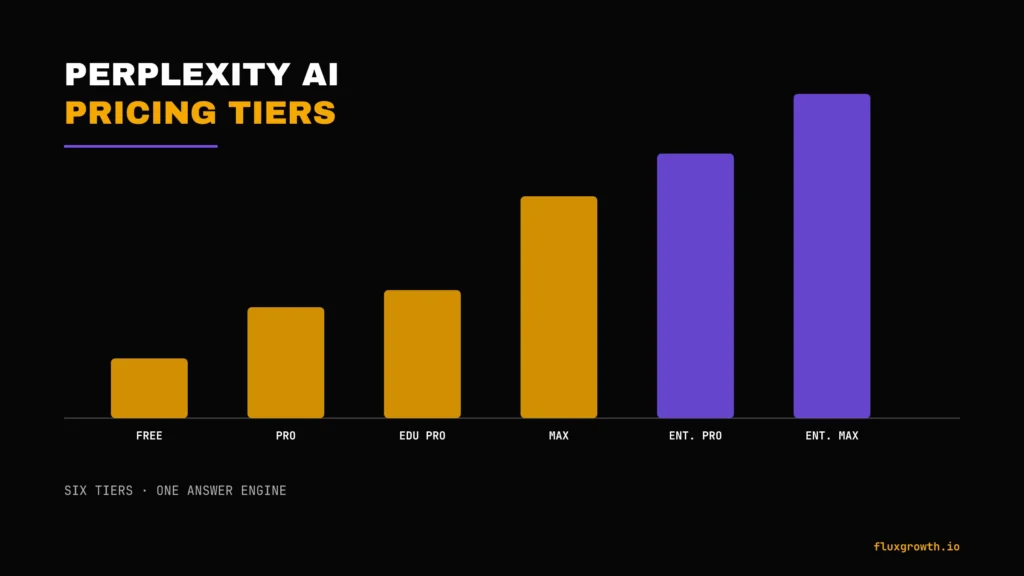
Perplexity offers plans for individuals, students, businesses, and developers. While the lineup has expanded over the past year, the Pro plan remains the best value for most users.
Note: Perplexity occasionally updates pricing and feature limits, so verify the latest details on its official pricing page before publishing.
| Plan | Price | Best for |
| Free | $0 | Casual users who want quick, cited answers with capped daily Pro Searches |
| Pro | $20/month ($200/year) | Individuals who search or research daily and want unlimited Pro Search |
| Education Pro | $10/month (student-verified) | Students and educators roughly half the price of standard Pro |
| Max | $200/month ($2,000/year) | Power users who lean on Labs, Deep Research, and the full model suite constantly |
| Enterprise Pro | $40/seat/month | Teams that mostly need Pro features plus admin controls and SSO |
| Enterprise Max | $325/seat/month | Organizations running Perplexity as core research infrastructure |
Free Plan
The free plan includes unlimited standard AI search with citations, limited Pro Search usage, and access to core search capabilities. It’s more generous than many competing AI search tools but still has daily limits on advanced features.
Pro Plan
At $20/month ($200/year), Pro unlocks unlimited Pro Search, higher Deep Research limits, premium AI models, larger file uploads, Spaces, Labs, and advanced features within the Comet browser. For most professionals, researchers, writers, and students, this is the sweet spot.
Max Plan
At $200/month($2,000/year), Max is designed for heavy users who rely on Perplexity throughout the workday. It includes significantly higher usage limits, priority access to the newest AI models, expanded Labs capabilities, and early access to experimental features. Unless you’re using Perplexity constantly, it’s difficult to justify the extra cost.
Enterprise
Perplexity Enterprise offers custom pricing based on organization size and requirements. For the latest Enterprise pricing and plan details, see Perplexity’s official pricing page. Enterprise customers receive centralized administration, SSO, enhanced security controls, compliance features, and enterprise support.
Which Plan Offers the Best Value?
For most people, Perplexity Pro offers the best balance of price and features. At $20/month, it removes the daily limitations of the free plan while unlocking premium AI models, higher Deep Research limits, larger file uploads, and advanced research capabilities. It’s the ideal choice for researchers, writers, students, marketers, developers, and anyone who relies on AI search regularly.
Recommendation: For the vast majority of users, Perplexity Pro is the clear sweet spot. It eliminates the biggest frustrations of the free plan without the significant price jump to Perplexity Max. Unless you’re conducting intensive, high-volume research every day or need the highest usage limits and early access to new features, Max is difficult to justify. If you’re just getting started, begin with the free plan to see whether Perplexity fits your workflow, then upgrade to Pro once you find yourself consistently hitting the free-tier limits.
Perplexity AI Pros & Cons
Pros:
- Citations are genuinely useful numbered, clickable, and easy to verify on the spot
- Strong accuracy on research-style and current-events questions
- Fast response times even on multi-part queries
- Generous free plan compared to most AI competitors
- Access to multiple underlying models in one place
- Clean, simple interface with a low learning curve
Cons:
- Free tier’s daily Pro Search cap can feel restrictive if you search often
- Max at $200/month is a steep jump from Pro with debatable ROI for most people
- Automation and agentic features (via Comet) are less mature than the marketing suggests
- Sonar API credit costs can add up quickly for heavier automated use
Real-World Use Cases
Students and researchers use Perplexity to move faster through literature reviews and fact-finding, with every claim traceable back to a source useful for citing work properly rather than paraphrasing from memory.
Journalists and content writers lean on it for quick background research and fact-checking during drafting, since the citations make it easy to double-check a claim before it goes in a published piece.
SEO professionals and developers use Perplexity for competitive research and technical documentation lookups, often pairing it with dedicated AI coding assistants for writing, debugging, and reviewing code.
Business owners, marketing teams, agencies, and enterprise teams use the Enterprise tiers for market research, competitive intelligence, and internal knowledge work where centralized billing and admin controls matter more than they do for a solo user.
Performance Tests
To evaluate Perplexity AI, we focused on the areas that matter most in real-world use: research accuracy, citation quality, response speed, and handling of current information.
Research Accuracy: Perplexity consistently performed well on factual and comparison-based queries, especially when the answer required combining information from multiple up-to-date sources. Its retrieval-based approach helped reduce outdated responses compared with AI models that rely primarily on training data.
Citation Quality: This remains Perplexity’s biggest strength. Nearly every answer includes clickable citations to the original source, making it easy to verify claims or continue researching. In our evaluation, citation transparency was noticeably stronger than most general-purpose AI assistants.
Response Speed: Standard searches typically returned results within a few seconds, while Deep Research reports generally completed in 2–4 minutes, depending on the complexity of the topic and the number of sources analyzed.
Current Information: Because Perplexity performs live web searches before generating answers, it handles recent news, product pricing, software updates, and other fast-changing topics more reliably than AI assistants without live search enabled by default.
Benchmark Performance: Perplexity has reported strong results on several public AI evaluation benchmarks, including Humanity’s Last Exam, where its Deep Research system demonstrated competitive reasoning performance. Since benchmark scores and leaderboards change frequently as models are updated, it’s best to refer to the latest official benchmark results rather than relying on a single historical score.
Perplexity AI vs Competitors
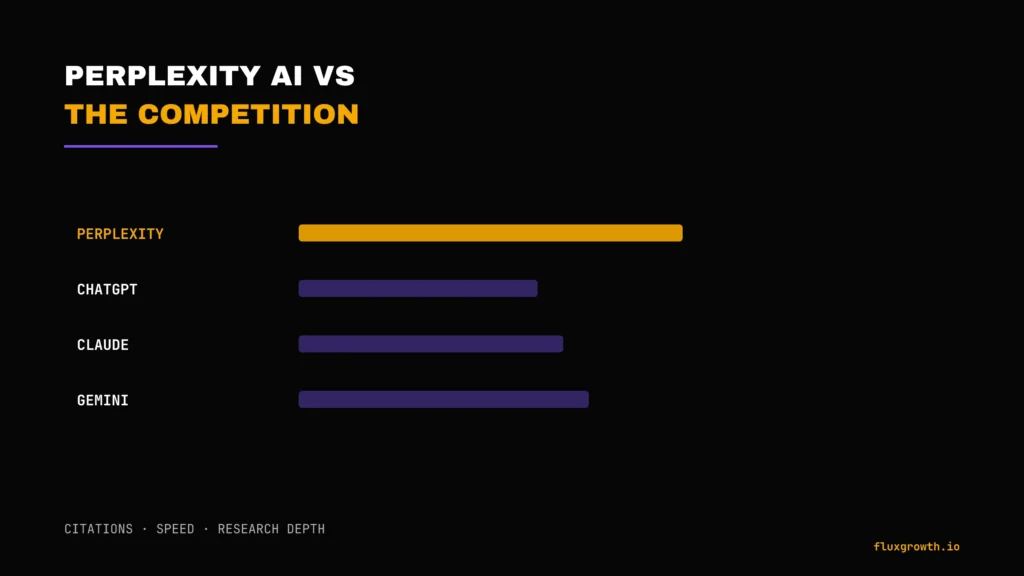
| Tool | Best for | Where it falls short vs. Perplexity |
| ChatGPT | Creative writing, coding, multimodal tasks | Web search isn’t on by default; citations are less consistent |
| Google AI Mode | Users already living inside Google Search | Less conversational depth; fewer follow-up capabilities |
| Claude | Careful analysis, long documents, nuanced writing | No live web search built into the core product by default |
| Microsoft Copilot | Microsoft 365-native teams (Teams, SharePoint, Outlook) | Weaker standalone research/citation experience outside the Microsoft stack |
| Gemini | Google ecosystem integration, Workspace users | Search grounding works differently; less citation-first by default |
| Kagi | Privacy-focused search purists | No conversational research/reasoning layer |
| Brave Search | Privacy-focused casual search | No Deep Research-style multi-pass reasoning |
Perplexity vs. ChatGPT is the comparison people actually search for. It’s not really a fair fight, though the two tools solve different problems.
Perplexity is built around real-time, citation-backed research. It searches the live web, synthesizes information from multiple sources, and shows exactly where its answers come from. ChatGPT, on the other hand, is a broader AI assistant built for reasoning, writing, coding, brainstorming, and task automation, with web search acting as one of many capabilities rather than its primary focus.
Perplexity vs. Claude comes down to a similar split: Claude is stronger for long-document analysis and nuanced writing without hallucinated citations, but doesn’t ship with the same always-on live web search that defines Perplexity’s core product.
Perplexity vs. Google AI Mode and Gemini matters most if you’re already deep in the Google ecosystem: Workspace, Docs, Gmail. Google’s tools integrate more tightly with those products; Perplexity is the better standalone research tool if you don’t care about that integration.
Best Perplexity AI Alternatives
- ChatGPT Search — best all-around alternative if you also want strong writing and coding in the same tool
- Google AI Mode — best if you want AI answers without leaving Google Search
- Claude — best for long-document analysis and careful, nuanced writing
- Microsoft Copilot — best for teams already living inside Microsoft 365
- Kagi — best for privacy-first users who want an ad-free, paid search experience
- Brave Search — best free, privacy-focused alternative for casual search
- Consensus — best for academic and scientific literature search specifically
- Exa AI — best for developers who want a search API built for AI applications
- You.com — best if you want a customizable AI search experience with app integrations
Is Perplexity AI Safe?
This is the section most Perplexity reviews either skip or lift straight from the company’s own marketing worth doing properly here, because there’s real, current news to account for.
Privacy: In April 2026, a proposed class-action lawsuit filed in Utah alleged that Perplexity shared certain user data with Meta and Google through embedded tracking technologies, including when users browsed in Incognito Mode. Perplexity has denied the allegations, and the case remains ongoing. At the time of writing, no court has found Perplexity liable, so these allegations should not be treated as established fact.
Another day-to-day privacy consideration is AI model training. On consumer accounts (Free, Pro, and Max), Perplexity allows users to control whether their data is used to improve AI models through the Data Usage settings. Because privacy controls and defaults can change over time, users should review their account settings directly to ensure they match their preferences.
Enterprise Data Handling: Perplexity states that Enterprise customer data is not used to train its AI models. The company also advertises enterprise security features and reports compliance with SOC 2 Type II, although the full audit report is not publicly available for independent review.
Compliance: Perplexity provides enterprise security controls and offers additional contractual protections for business customers. Organizations handling regulated data particularly in healthcare should confirm current HIPAA support and Business Associate Agreement (BAA) availability directly with Perplexity before deploying the platform in production.
Security: Like virtually every AI assistant connected to the web, Perplexity can be affected by prompt injection attacks, where malicious webpage content attempts to influence an AI model’s behavior. This is an industry-wide challenge rather than one unique to Perplexity. As of publication, no major publicly confirmed data breach involving Perplexity customer data has been reported.
Bottom line: Perplexity is reasonably safe for general research use, but it’s not built for sensitive, confidential, or regulated data on the consumer tiers. If you’re handling client information, financial details, or health data, keep it out of your prompts unless you’re on a properly contracted Enterprise plan.
Tips to Get Better Results
- Use Focus Modes to narrow a search to academic papers, Reddit, or another specific source type instead of the open web.
- Ask follow-up questions in the same thread. Perplexity keeps context, so you don’t need to restate what you already asked.
- Verify citations yourself on anything you plan to publish or rely on for a decision: citations reduce hallucination risk, they don’t eliminate it.
- Use Deep Research for genuinely complex questions, not simple lookups; it’s slower by design because it’s doing more work.
- Organize ongoing projects with Spaces instead of starting a fresh, contextless thread every time.
- Upload PDFs directly when you have a source document, rather than pasting text and losing formatting.
- Compare multiple models on the same question when the answer matters Pro and Max let you switch models and see if they agree.
Common Mistakes to Avoid
- Trusting AI-generated answers without checking sources even a cited answer can misread or overstate what a source actually said.
- Ignoring the citations entirely they’re the whole point of using Perplexity over a plain chatbot; skipping them defeats the purpose.
- Using the default search mode for complex, multi-part questions that really need Pro Search or Deep Research.
- Never using Spaces and losing context across a multi-session research project.
- Picking Max before you’ve actually hit Pro’s limits most people don’t need it.
Future of Perplexity AI
Perplexity isn’t standing still. The company is expanding beyond AI search into agentic AI with Perplexity Computer, introduced in February 2026. Unlike a traditional chatbot, Computers can break complex requests into smaller tasks, browse the web, generate reports, build applications, automate workflows, and connect with hundreds of third-party services. It first launched for Max subscribers and has since expanded to Pro subscribers, using a credit-based system for advanced tasks.
The broader roadmap points in the same direction. Comet continues evolving as an AI-first browser, while the Sonar API is gaining new capabilities for developers building search-powered applications and autonomous AI agents. Perplexity’s official API roadmap also highlights upcoming improvements such as lower-latency Sonar models, a dedicated developer console, analytics dashboards, and additional agent tools.
One trend is already clear: Google, OpenAI, Microsoft, Anthropic, and Perplexity are all investing heavily in AI agents that can search, reason, and complete tasks, not just answer questions. Whether Perplexity ultimately wins that race remains to be seen, but it’s rapidly evolving from an AI search engine into a broader AI productivity platform and this competition is only getting started.
Frequently Asked Questions
What is Perplexity AI?
Perplexity AI is an AI-powered answer engine that searches the live web and generates a cited, synthesized response instead of a list of links. It’s built for research and fact-finding rather than open-ended conversation.
Is Perplexity AI free?
Yes. Perplexity AI offers a free plan with unlimited basic search and cited answers. However, advanced features like Pro Search, Deep Research, premium AI models, and higher usage limits are reserved for Perplexity Pro and Max subscribers.
Is Perplexity AI better than ChatGPT?
Neither wins outright; they solve different problems. Perplexity is stronger for cited, real-time research; ChatGPT is stronger for creative writing, coding, and multimodal tasks. Many people use both.
Is Perplexity AI accurate?
It performs well on research and current-events questions because it retrieves live sources before answering, but citations should still be spot-checked, especially for anything you plan to publish or act on.
Is Perplexity AI safe?
Yes, Perplexity AI is generally safe for everyday research. However, as with any AI service, you should avoid sharing sensitive or confidential information. Enterprise plans offer stronger privacy protections than consumer accounts, and it’s a good idea to review your data usage settings before using the service for important work.
Is Perplexity AI worth paying for?
If you research or search daily and the free tier’s limits are getting in your way, Pro at $20/month is worth it. Max is only worth it if you’re already hitting Pro’s limits regularly.
Final Verdict
Best for: Research-heavy work where speed and verifiable sources matter more than creative flexibility.
Perplexity AI earns its place for students, researchers, journalists, marketers, developers, and anyone doing fact-based work that needs a clear trail back to the original sources. Its citation-first approach, fast responses, and generous free tier make it one of the strongest AI search tools available today.
Recommendation: If your work involves researching products, verifying facts, comparing services, or gathering reliable information quickly, Perplexity AI is easy to recommend. If your primary focus is creative writing, brainstorming, or coding, you’ll likely get the best results by pairing Perplexity with a general-purpose AI assistant such as ChatGPT or Claude.
If you’re deciding between the Free and Pro plans, the daily Pro Search and Deep Research limits are the biggest deciding factor. If you regularly hit those limits, Perplexity Pro ($20/month) is well worth the upgrade. Max is aimed at power users who rely on Perplexity throughout the day and need its highest usage limits and newest capabilities.
The best advice is simple: start with the free plan and use it for your real research workflow for a week. You’ll quickly know whether the free tier meets your needs or whether upgrading to Pro will save enough time to justify the cost.