FluxGrowth is reader-supported. Some links in our guides are affiliate links — if you buy through one we may earn a commission, at no extra cost to you. It never changes which tools we recommend. How we test tools.
Last updated: [August 2026 ]
If you’re comparing ChatGPT vs Claude, you’re probably asking one simple question: Which AI assistant is actually worth paying for? Both platforms promise better writing, faster coding, smarter research, and higher productivity. In practice, they excel at different things, and choosing the wrong one can mean paying for features you’ll rarely use.
If you’ve spent any time comparing ChatGPT and Claude, you’ve probably noticed both companies claim to be the “best AI” for basically everything. That’s not much help when you’re trying to decide if $20 or $200 — a month is worth it.
This guide skips the marketing copy. It compares ChatGPT vs Claude on the things that actually change how your day goes: pricing, coding output, writing quality, security and where each one falls short. By the end, you’ll know which tool fits your specific work, not which one wins an abstract popularity contest.
What Is ChatGPT? What Is Claude?
ChatGPT is OpenAI’s assistant, running on the GPT model family. Claude is Anthropic assistant, running the Claude family. Both talk back in plain English. You’ll find them on your phone, your desktop, or through a developer API. What’s different isn’t the product shape — it’s the bet each company made on what to get good at first.
OpenAI went wide. Images, video, voice mode, a sprawling plugin ecosystem if it’s a format, ChatGPT probably does it. Anthropic went deep instead: long documents, careful instruction-following, and (especially through Claude Code) the kind of multi-file coding work that breaks most other assistants.
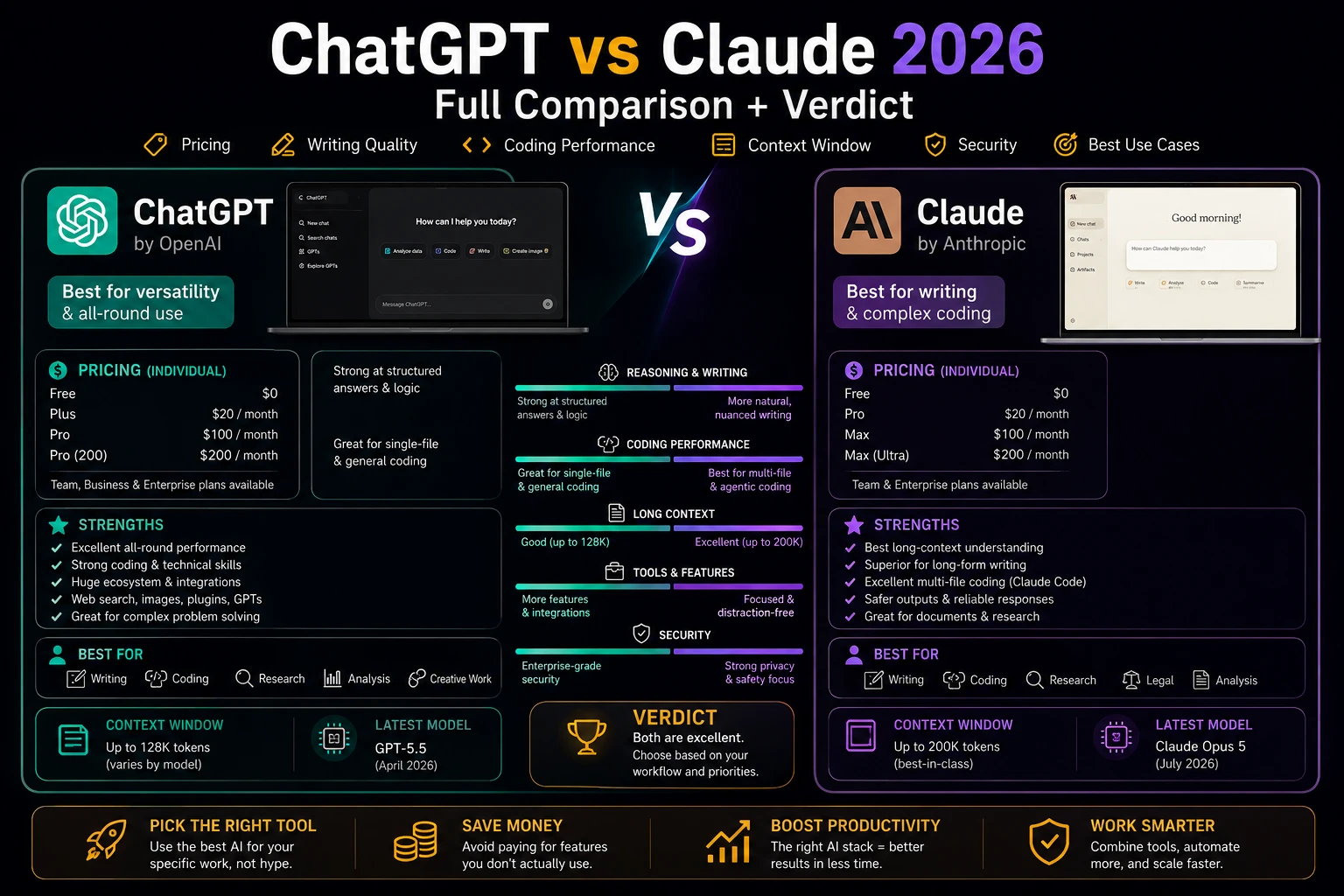
As of 2026, OpenAI’s flagship model is GPT-5.5, released in April 2026, while Anthropic latest flagship Claude family includes Claude Opus 5, introduced in July 2026 after earlier Opus 4.x releases. Both companies continue to release new models and improvements regularly, so benchmark results and feature comparisons should be treated as snapshots rather than permanent rankings.
ChatGPT vs Claude Pricing in 2026
At the entry paid tier, ChatGPT Plus and Claude Pro cost the same: $20 per month in the United States. From there, their pricing models begin to diverge. OpenAI offers additional plans aimed at heavier individual usage, while Anthropic focuses on higher usage limits through its Max plans before moving to custom-priced Team and Enterprise offerings.
Individual plans
- ChatGPT offers a Free plan, Go at $8/month (where available), Plus at $20/month, Pro at $100/month, and a higher Pro tier at $200/month for users with demanding workloads. Team, Business, and Enterprise plans are available separately for organizations.
- Claude offers a Free plan, Pro at $20/month or $17/month with annual billing ($200 paid upfront), and Max plans starting at $100/month, with a higher $200/month tier for substantially larger usage limits. Team and Enterprise plans are available through Anthropic for business customers with custom pricing.
Team and business plans
- ChatGPT Business costs $25/user/month (monthly) or $20/user/month (annual) with a 2-user minimum. It includes admin controls, same SSO, a shared workspace, and business data is excluded from model training by default.
- Claude Team costs $30/user/month (monthly) or $25/user/month (annual) with a 5-user minimum. Teams that need higher usage limits and expanded Claude Code access can upgrade to Premium seats, while Claude Enterprise is available with custom pricing.
Enterprise
Both companies quote custom Enterprise pricing you talk to sales, not a checkout page. If you’re evaluating Enterprise, ask both vendors directly about data residency, SSO/SCIM support, and compliance certifications rather than trusting a third-party estimate.
The takeaway: don’t pick based on price alone. At the individual level, the cost is nearly identical. The decision should come down to what you’re actually doing with the tool.
Reasoning and Writing Quality
Reasoning is an AI model’s ability to solve multi-step problems, follow complex instructions, and produce logical, consistent answers.
Claude is known for strong long-context reasoning and careful instruction following, making it well suited for document analysis, legal drafting, research, and other tasks that require maintaining context across lengthy conversations. ChatGPT, by contrast, excels at structured problem-solving, technical explanations, coding, and executing detailed prompts with consistency. Neither model is universally “smarter”their strengths depend on the task.
Writing quality is more subjective. Many users and independent reviewers prefer Claude for long-form writing because its responses often read more natural and require less editing. ChatGPT remains an excellent writing assistant, especially when given a clear prompt, and benefits from a broader ecosystem of tools such as web search, image generation, and custom GPTs.
Related: Picking a tool mainly for writing: we ran the same prompt through Claude, ChatGPT and Gemini and scored the drafts in our guide to the best AI tool for content writing.
Example: Using the same prompt “Write a 500-word blog introduction explaining why small businesses should adopt AI automation” Claude typically produces a more conversational first draft with smoother transitions and a more natural tone. ChatGPT usually delivers a clearer, more structured response with stronger formatting and organization. In practice, Claude often requires fewer stylistic edits, while ChatGPT may need minor wording refinements depending on the desired voice. Both can produce high-quality results when given a detailed prompt.
Coding Performance
This is where the two tools get compared most aggressively, and where the numbers shift every few months.
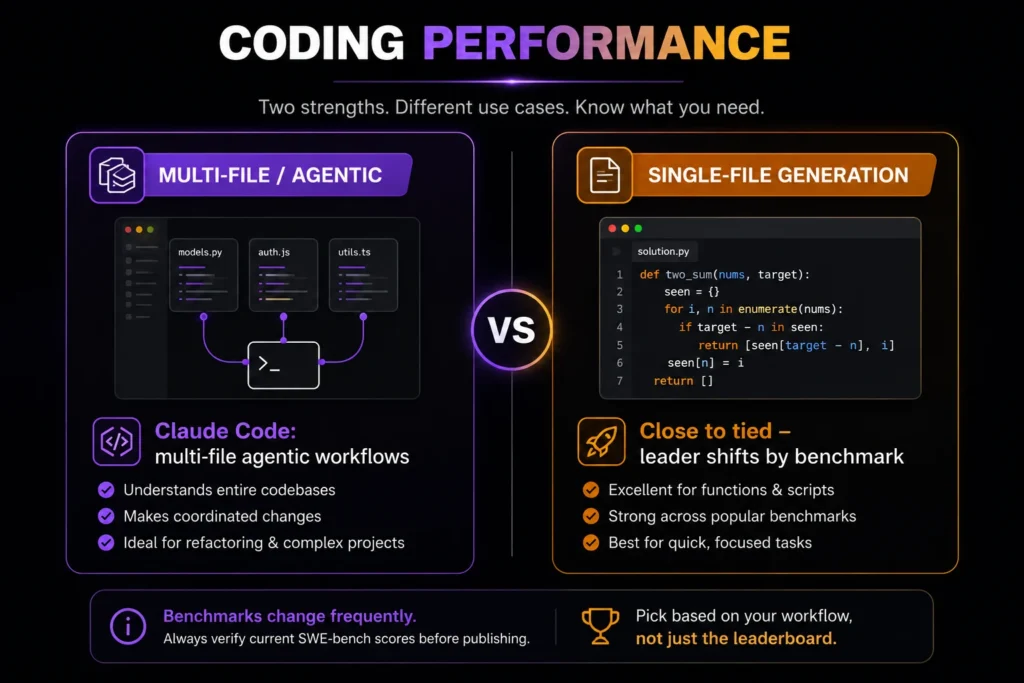
Multi-file, agent coding: Anthropic Claude Code is a terminal-based coding assistant designed to work across an entire code base. It can analyze multiple files, understand project structure, and make coordinated changes while preserving consistency across interconnected components. This makes it particularly well suited for large repositories, refactoring, and long-running development tasks.
Single-shot code generation: For individual functions, scripts, and small coding tasks, ChatGPT and Claude perform similarly well. Independent evaluations such as the SWE-bench leader board show that coding performance changes as new models are released, so benchmark rankings should be treated as a snapshot rather than a permanent winner. Both generate high-quality code, explain logic, and fix bugs effectively. The better choice usually depends on the programming language, prompt, and specific use case rather than a consistent performance gap.
IDE and terminal integration. ChatGPT’s Codex and OpenAI’s broader plugin ecosystem give it an edge in raw number of connected tools and developer environments. Claude Code’s strength is depth within its own workflow rather than breadth of integration.
Bottom line for developers: single-file scripts? Either tool gets you there, no real difference. Touching a big, existing code base on a regular basis is a different story that’s where the agent multi-file workflow earns its keep, and it’s worth testing on your own rep before you commit to one.
Context Window and Long Documents
Think of the context window as the model’s short-term memory for one conversation, measured in tokens (roughly ¾ of a word each). Feed it a 200-page contract, and a small window means it’s forgotten page 3 by the time it reaches page 150. A bigger one doesn’t.
Both ChatGPT and Claude support very large context windows, but the exact limits vary by model, subscription plan, and whether you’re using the consumer app or the API. Claude is generally recognized for its strong performance on long-document analysis, while ChatGPT also handles lengthy files effectively through its latest GPT models. Because OpenAI and Anthropic update model capabilities regularly, they always verify the current context limits on their official documentation before relying on a specific token count.
If your work regularly involves dropping in a 100-page PDF, a legal contract, or an entire code base, ask both vendors directly what the context limit is on the specific plan you’re buying, not the marketing page’s headline number.
integration, Security, and Compliance for Business Buyers
If you’re buying for a team, these questions matter more than benchmark scores:
- SSO and User Management: Both ChatGPT Business/Enterprise and Claude Team/Enterprise support same SSO, while advanced user provisioning (SCIM) is primarily available on Enterprise plans.
- Data Privacy: OpenAI and Anthropic do not use Business or Enterprise customer data to train their models by default. Individual plans have different privacy settings, so review your account configuration before sharing sensitive information.
- Compliance: Both vendors offer enterprise-grade security, including SOC 2 Type II compliance. Additional certifications and compliance features vary by plan and should be verified against each vendor’s Trust Center.
- integration: ChatGPT offers a broader ecosystem of integration and custom GPTs, while Claude stands out with Claude Code and Model Context Protocol (MCP) support for developer-focused workflows.
What to check before purchasing: Ask each vendor about SSO, SCIM, data residency, audit logs, retention policies, HIPAA support (if required), API security, and compliance certifications. These requirements often have a greater impact on purchasing decisions than benchmark scores alone.
Customer Support and Automation Use Cases
Stop asking which model is smarter. Wrong question. The real one: which tool plugs into what you’re already running without three weeks of custom engineering first.
- If your support tickets, CRM, and internal docs already live in tools with strong ChatGPT plugin support, that integration breadth can save real setup time.
- If your automation involves an AI agent reading and editing structured data (code, configuration files, or long internal documents) with minimal errors, Claude’s instruction-following and long-context handling tend to hold up better over long agent runs. If you’re evaluating AI platforms for automation, compare the strengths of today’s leading business tools in our guide to best AI platforms for business.
Example: A customer support team could use ChatGPT to summarize support tickets, draft replies, and update CRM records through existing integration. A software development team, on the other hand, might use Claude Code to review a large repository, refactor code across multiple files, and explain complex implementation changes while maintaining context throughout the project.
What I’d Do If Starting Today
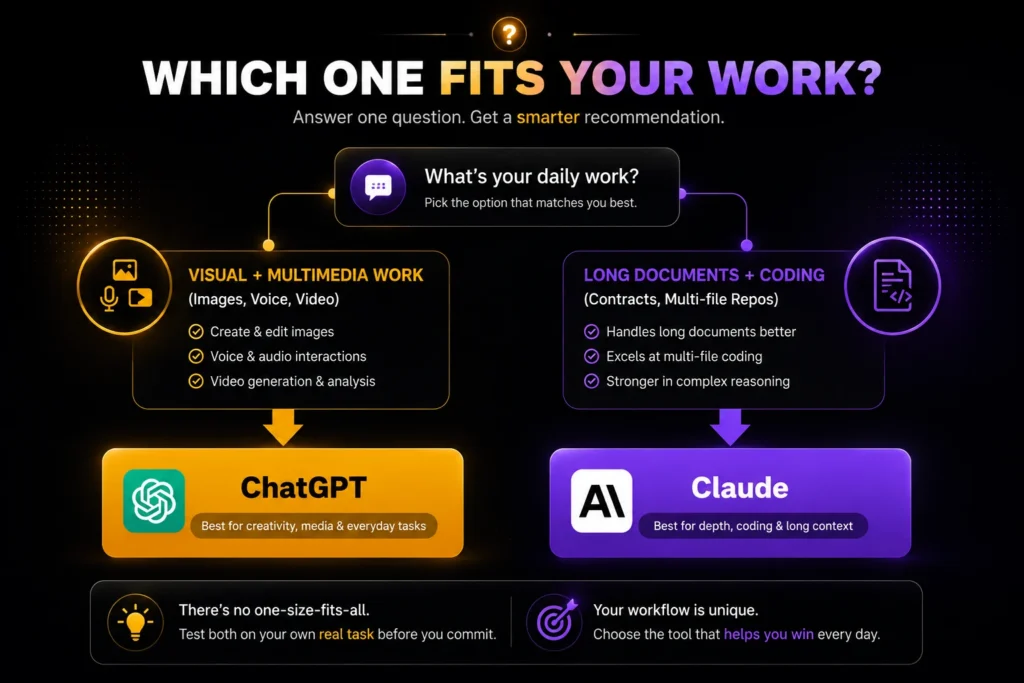
If you’re a solo creator, marketer, consultant, or small business owner, start with ChatGPT. It offers the most versatile all-around experience, combining writing, coding, web search, image generation, custom GPTs, and a broad integration ecosystem in a single platform.
If you’re managing a small software development team, Claude is a compelling choice especially if your work involves large code bases, long technical documents, or repository-wide code changes. Claude Code and its strong long-context capabilities make it particularly effective for developer workflows.
The one situation where running both makes sense is when your team handles a mix of business and engineering work. Many organizations use ChatGPT for research, content creation, brainstorming, and everyday productivity, while relying on Claude for long-form writing, document analysis, and complex coding tasks. The combined cost is often justified if both tools are used regularly and improve team productivity.
ChatGPT vs Claude: Quick Comparison
| Plan Tier | ChatGPT | Claude | Best For | Standout Feature |
| Free | Free | Free | Casual and occasional users | Basic AI chat and writing assistance |
| Individual Paid | Plus: $20/month | Pro: $20/month ($17/month billed annually) | Daily productivity, writing, coding, and research | ChatGPT: Web search, image generation, voice, custom GPTs • Claude: Long-context reasoning and natural writing |
| Power User | Pro: $100/month or $200/month | Max: $100/month or $200/month | Heavy users, agencies, developers | Higher usage limits, priority access to latest models |
| Team / Business | Business: $20/user/month (annual) or $25/user/month (monthly), 2-user minimum | Team: $25/user/month (annual) or $30/user/month (monthly), 5-user minimum | Small and midsize teams | Admin controls, SAML SSO, business data excluded from model training by default |
| Enterprise | Custom pricing | Custom pricing | Large organizations with security and compliance requirements | Enterprise security, SCIM, audit logs, compliance features, dedicated support |
Takeaway: If price is your only consideration, ChatGPT Plus and Claude Pro are effectively tied at $20/month. The better choice depends on your work: ChatGPT is stronger for an all-in-one AI experience with web search, image generation, voice, and integration, while Claude stands out for long-document analysis, natural writing, and large-scale coding workflows.
Frequently Asked Questions
Is Claude better than ChatGPT for coding?
For single-file coding tasks, ChatGPT and Claude perform similarly well. For large code bases and multi-file projects, Claude Code generally has an advantage thanks to its strong long-context understanding and agent coding workflow.
Which is cheaper for a small team?
For individuals, ChatGPT Plus and Claude Pro both cost $20/month. Team pricing is where they split: ChatGPT Business runs $20-25/user/month with just a 2-user minimum, while Claude Team runs $25-30/user/month and needs at least 5 seats. That gap makes ChatGPT Business the cheaper pick for most small teams, especially ones under five people.
Can I use both ChatGPT and Claude?
Yes. Many freelancers, agencies, and small teams run both, for example, ChatGPT for visual content and voice-based work, and Claude for long-document analysis and coding. There’s no technical conflict in subscribing to both, and the combined monthly cost at the entry tier is still lower than most single-seat SaaS tools.
Does ChatGPT or Claude have better data privacy?
Both OpenAI and Anthropic state that Business, Team, and Enterprise customer data is not used to train their AI models by default. Individual plans have different privacy settings, so review your account settings and each company’s privacy policy before sharing sensitive information.
Which has a bigger context window?
Both ChatGPT and Claude support very large context windows, but the exact limit depends on the model and plan you’re using. API models and consumer apps often have different limits, so always check the latest official documentation for the specific version you’re comparing. For most users, both platforms can comfortably handle long documents and extended conversations.
Do ChatGPT and Claude generate images?
ChatGPT generates images naively through DALL-E and also offers video generation and voice mode. Claude does not generate images naively as of 2026. If image or video generation is part of your workflow, that’s a meaningful point in ChatGPT’s favor.
Which one should a non-technical small business owner use?
For most day-to-day marketing writing, brainstorming, and customer communication, either tool handles the basics well. If you need visuals, social captions with generated images, or voice interaction, ChatGPT’s built-in tools save you a separate app. If your work leans toward long documents contracts, reports, research Claude’s context handling and writing quality are worth testing first.
Conclusion
Neither ChatGPT nor Claude is a universal winner; the right pick depends on whether your daily work leans toward visual and multimedia tasks (ChatGPT) or long-document reasoning and code base-scale coding (Claude). The fastest way to find out which fits you is to run the same real task through both this week: a client email, a piece of code, a document summary and see which output needs less editing. Try that comparison with your own work before committing to a single subscription.