FluxGrowth is reader-supported. Some links in our guides are affiliate links — if you buy through one we may earn a commission, at no extra cost to you. It never changes which tools we recommend. How we test tools.
You search your own core topic, and an AI Overview answers it before your page even shows up. So does SEO still matter? Yes. That’s the short version of this whole guide.
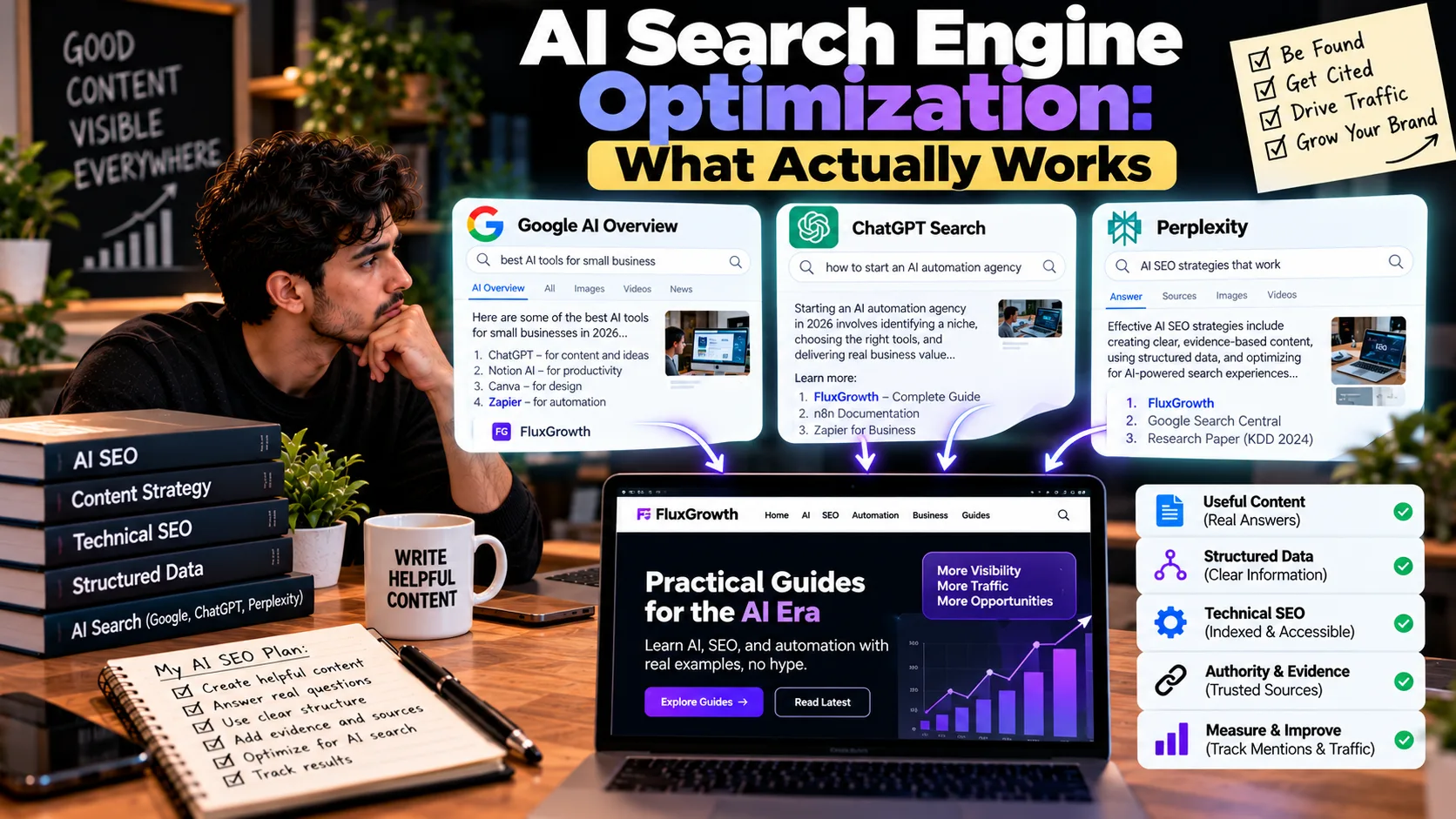
AI search engine optimization is the work of making your pages easy for AI-powered search, like Google AI Overviews, ChatGPT search, and Perplexity, to find, understand, and cite. Most of that work is classic SEO done well. The rest is clearer writing, better evidence, and a measurement setup that didn’t exist a year ago.
Below, every tactic is graded by evidence: what Google, OpenAI, and Perplexity actually document, what independent research shows, and what’s still a guess. Then you get a 30-day plan you can start this week. No promised citations, though. Nobody can honestly promise those.
What is AI search engine optimization?
AI search engine optimization (AI SEO) is the practice of improving how often and how accurately AI-powered search experiences surface, summarize, and cite your content. It covers Google AI Overviews and AI Mode, ChatGPT search, Perplexity, and similar tools. It builds on traditional SEO rather than replacing it.
“AI SEO” means two different things
Search “AI SEO” and half the results are about using AI tools to do SEO, like drafting meta descriptions with ChatGPT. That’s a different job. This guide covers getting your content found and cited inside AI answers.
SEO, AI SEO, GEO, and AEO in plain English
- Traditional SEO: Improves visibility in traditional search results through useful content, indexing, and technical optimization.
- AI SEO: A broad term for improving visibility in AI-powered search experiences.
- GEO: Focuses on how content appears in generative AI answers. The concept was studied in a 2023 paper published at KDD 2024. Learn more in our guide to the best GEO tools in 2026.
- AEO: Focuses on making content useful for direct answers and answer-based search experiences.
These terms overlap and have no universally agreed definitions. Google’s May 2026 guidance says optimizing for generative AI search is still SEO.
Sources: Google Search guidance · GEO research paper
| Approach | Main purpose | What to prioritize | Important limitation |
| Traditional SEO | Visibility in classic search results | Crawlability, indexing, relevance, useful content, links | Rankings and traffic are never guaranteed |
| AI search optimization | Discoverability and usefulness in AI-powered search | Clear answers, reliable evidence, accessible pages, SEO fundamentals | Citation mechanisms aren’t fully transparent |
| Generative engine optimization (GEO) | How content may be represented in generative answers | Context, evidence, clear entity naming, useful content | Research results conflict and vary by system |
| Answer engine optimization (AEO) | Content that works for direct answers | Precise explanations, question coverage, clean structure | A clear answer doesn’t guarantee selection |
| Combined strategy | Classic search and AI discovery together | Technical SEO, original content, authority, measurement | Needs ongoing testing and adjustment |
The takeaway: the combined strategy is the right default for almost every site, because every AI engine covered here still starts by retrieving pages from a search index.
How do AI search engines find and cite your content?
AI search engines retrieve pages from a search index, then generate an answer grounded in what they retrieved, linking to some of those sources. So the first gate hasn’t changed: an engine has to crawl and index your page before it can cite it.
Google AI Overviews and AI Mode
Google AI Overviews and AI Mode pull from Google’s regular Search index. Google’s documentation says these features rely on its core ranking and quality systems and use two techniques worth knowing.
Retrieval-augmented generation (RAG) means the model writes its answer from pages it just retrieved, not from memory alone. Query fan-out means Google may run several related searches across subtopics before composing a response.
The eligibility rule is mechanical. Google’s “AI features and your website” page says a page must be indexed and eligible to show in Search with a snippet to appear as a supporting link. There are no extra requirements beyond that.
ChatGPT search
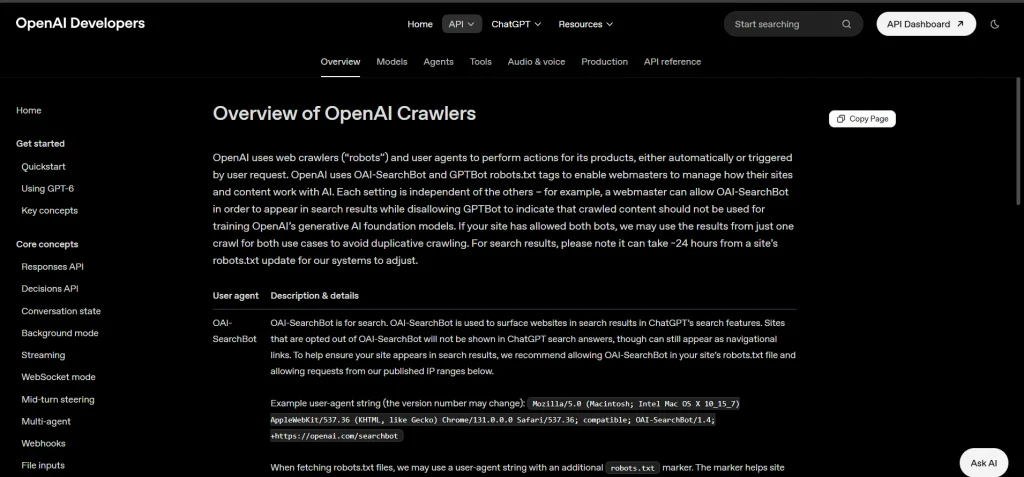
ChatGPT search depends on a crawler called OAI-SearchBot. OpenAI’s crawler documentation says sites that opt out of OAI-SearchBot won’t be shown in ChatGPT search answers, though they can still appear as navigational links. A separate bot, GPTBot, covers model training. Different bot, different job.
Perplexity
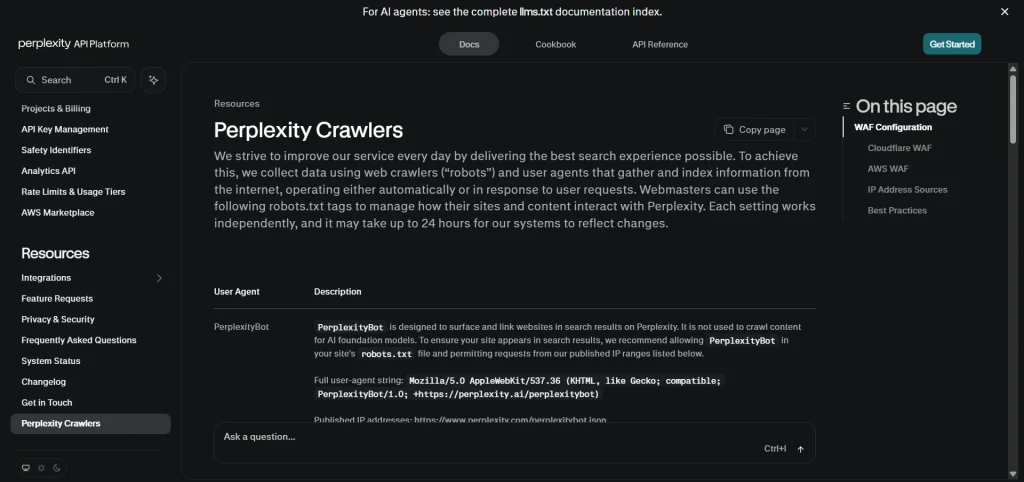
Perplexity works the same way with different names. Its documentation says PerplexityBot is designed to surface and link websites in Perplexity’s results and recommends allowing it. A second agent, Perplexity-User, fetches pages when a person asks a question, and Perplexity says it generally ignores robots.txt because a human started the request.
Rankings, citations, and clicks are three different wins
A citation isn’t a click, and that gap matters for your traffic forecast. Pew Research Center tracked 900 U.S. adults in March 2025 (published July 2025). When an AI summary appeared, users clicked a traditional result in 8% of visits, versus 15% when no summary appeared. Only 1% of visits included a click on a link inside the summary.
Google called the methodology flawed, and the data is over a year old. The direction still holds: a citation is exposure, a click is a visit, and you should measure them separately.
Which AI SEO tactics are proven, and which are hype?
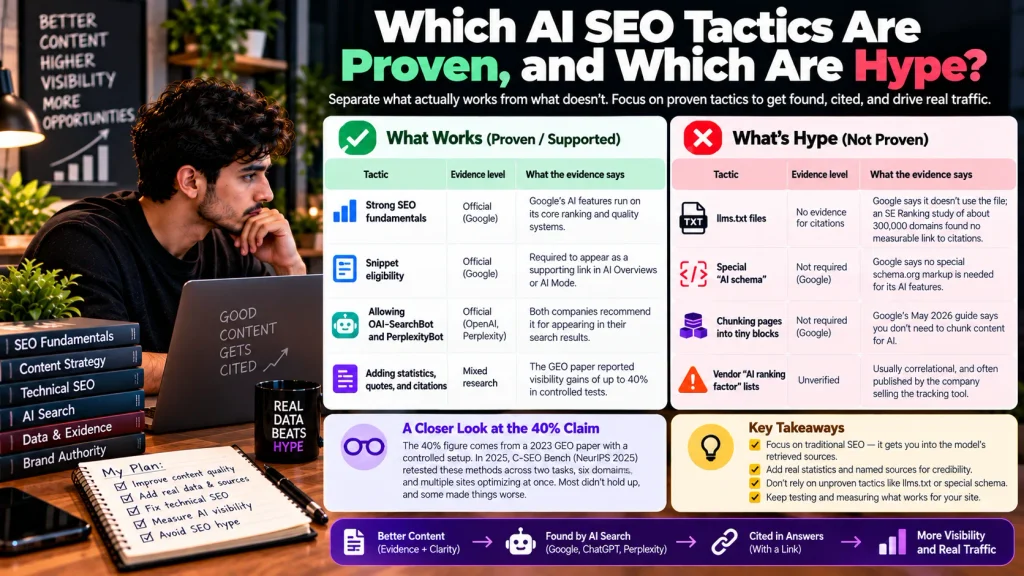
The best-supported AI SEO tactics are the boring ones: crawl-able, index-able, genuinely useful pages. Many AI-specific tactics, like llms.txt files and special schema, have no evidence of increasing citations, and Google says its AI features don’t need them.
Each tactic below is graded by the strongest source behind it.
| Tactic | Evidence level | What the evidence says |
| Strong SEO fundamentals | Official (Google) | Google’s AI features run on its core ranking and quality systems |
| Snippet eligibility | Official (Google) | Required to appear as a supporting link in AI Overviews or AI Mode |
| Allowing OAI-SearchBot and PerplexityBot | Official (OpenAI, Perplexity) | Both companies recommend it for appearing in their search results |
| Adding statistics, quotes, and citations | Mixed research | The GEO paper reported visibility gains of up to 40% in controlled tests; C-SEO Bench (NeurIPS 2025) found most such methods largely ineffective and sometimes harmful |
| llms.txt files | No evidence for citations | Google says it doesn’t use the file; an SE Ranking study of about 300,000 domains found no measurable link to citations |
| Special “AI schema” | Not required (Google) | Google says no special schema.org markup is needed for its AI features |
| Chunking pages into tiny blocks | Not required (Google) | Google’s May 2026 guide says you don’t need to chunk content for AI |
| Vendor “AI ranking factor” lists | Unverified | Usually correlational, and often published by the company selling the tracking tool |
Here’s the thing — the 40% figure everyone quotes came from a controlled setup where one site optimized at a time. In 2025, C-SEO Bench retested these methods across two tasks (question answering and product recommendations), six domains, and multiple sites optimizing at once. Most didn’t hold up, and some made things worse.
What worked better? Traditional SEO, the work that gets a page into the model’s retrieved sources in the first place.
My read? Keep adding real statistics and named sources, because readers trust them. Just don’t treat them as a citation hack.
Five mistakes that waste AI SEO budget
- Blocking the wrong bot. Blocking OAI-SearchBot when you meant to block GPTBot removes you from ChatGPT search answers. And blocking Google-Extended doesn’t remove you from AI Overviews at all.
- Paying anyone to “optimize” your llms.txt.
- Rewriting good pages into choppy fragments of Q&A because someone said AI likes chunks.
- Treating one screenshot of one prompt as a ranking report. AI answers change from run to run.
- Dropping Google SEO to chase GEO, when C-SEO Bench found traditional SEO beat most GEO-style tweaks.
What technical setup does AI search actually require?
AI search runs on the same technical base as Google Search: a page has to be crawl-able, indexed, and allowed to show a text snippet. The one AI-specific step is making sure robots.txt and your firewall let in OAI-SearchBot and PerplexityBot, the crawlers behind ChatGPT search and Perplexity.
Indexing and snippet controls
Google supports nosnippet, data-nosnippet, max-snippet, and noindex to control how content appears in Search. These controls can also affect AI search features; nosnippet is not an AI-only opt-out.
Google now offers a site-level Search generative AI control in Search Console to include or exclude content from AI Overviews, AI Mode, and specified generative AI features in Discover. See the official instructions.
robots.txt for AI crawlers
Check yourdomain.com/robots.txt and your CDN or security settings. If you want these crawlers to access your content, make sure they aren’t blocked. Learn more in our guide to why AI agents get blocked by websites.
User-agent: OAI-SearchBot
Allow: /
User-agent: PerplexityBot
Allow: /
Know the difference: OpenAI’s OAI-SearchBot supports search discovery, while GPTBot is associated with model training. Google’s Google-Extended controls certain uses of content for Gemini training and grounding; Googlebot controls crawling for Google Search, including AI Overviews.
Check Cloudflare, too: Since September 15, 2026, Cloudflare’s defaults for newly on boarded domains block Training and Agent bots on pages displaying ads, while Search crawlers remain allowed by default. Review your actual configuration because existing settings and custom rules can change access.
Sources: Google’s content controls, Google Search generative AI control, and Cloudflare’s AI bot policies.
Add a clearer practical takeawayExplain each crawler control in a table
JavaScript and accessible content
Keep your main content in the HTML your server sends whenever possible. Google can render JavaScript, but not all search and AI crawlers support it, and Perplexity’s documentation does not confirm whether PerplexityBot executes JavaScript.
If important answers appear only after client-side scripts run, some crawlers may miss them. Use server-side rendering or static rendering for key content, and test what crawlers can access.
Source: Google’s JavaScript SEO guidance · Perplexity bot documentation
What structured data does and doesn’t do
Structured data like Product, Organization, LocalBusiness, and Article markup still clarifies entities and can earn rich results in classic search. But Google says no special schema is needed for its AI features. Add it because it describes your page accurately, not for a citation bump.
How do you research conversational and fan-out queries?
Conversational keyword research means finding the long, specific questions people ask AI tools (think “best CRM for a two-person real estate team”), plus the sub-questions an engine will search on their behalf. Start with data you already own in Search Console, then map each topic into the follow-up questions it naturally raises.
Mine long queries you already rank for
In Search Console → Performance → Search results → Query → Custom (regex), paste:
^(\S+\s){6,}\S+$
This filters queries of seven or more words, helping you identify specific questions for your content.
Google reported in May 2026 that AI Mode queries averaged three times the length of traditional Google Search queries. Use long queries alongside People Also Ask questions to find relevant content ideas.
Sources: Google AI Mode research · Search Console regex guide
Map one topic into its fan-out questions
Query fan-out gives you a planning method. Picture a Phoenix HVAC company targeting “Should I repair or replace a 12-year-old AC unit?” An AI engine might also search for typical AC lifespan, repair versus replacement cost, SEER2 efficiency standards, local rebates, and signs of compressor failure.
Each sub-question becomes either an H2 on the main page or its own page that links back.
How do you write content AI search can understand and cite?
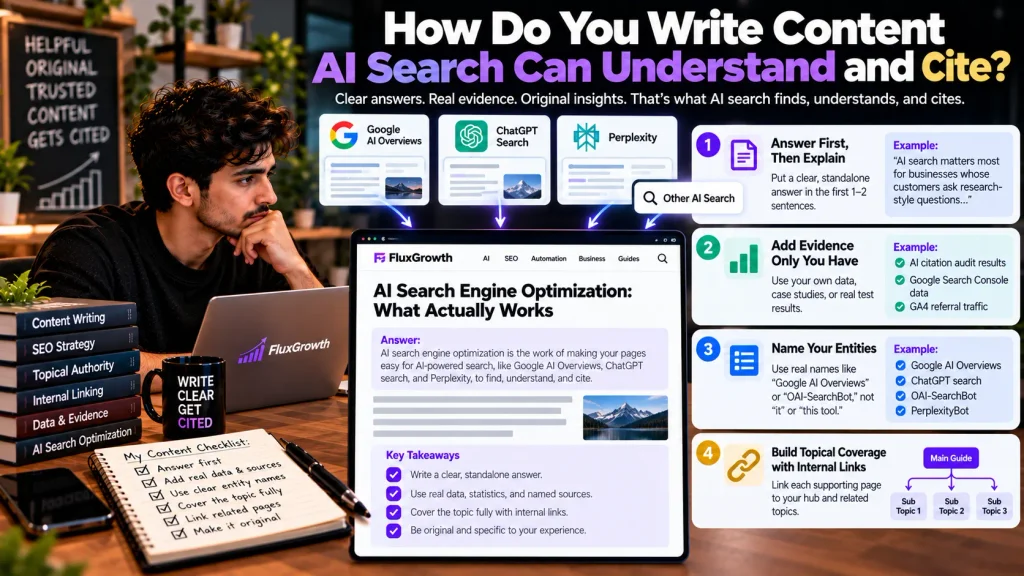
Every section should open with a direct answer that makes sense on its own, back it with a named source, and call things by their real names instead of “it.” That’s the formatting half. The bigger half is originality: Google’s May 2026 guide says unique, helpful content will do more for your generative AI visibility than any other suggestion in it.
Answer first, then explain
Put the answer in the first one or two sentences under every heading, then add conditions and examples. A phone skimmer gets the answer instantly, and a retrieval system gets a passage that stands on its own.
Compare these two openings.
Before: “There are a lot of things to think about when deciding whether AI search matters for your business, and the answer depends on many factors.”
After: “AI search matters most for businesses whose customers ask research-style questions, like ‘which accounting software works for a three-person agency.’ If your buyers mostly search your brand name, classic SEO still drives most of your traffic.”
The second version names a real buyer question and the condition that changes the answer. That’s what makes it quotable.
Add evidence only you have
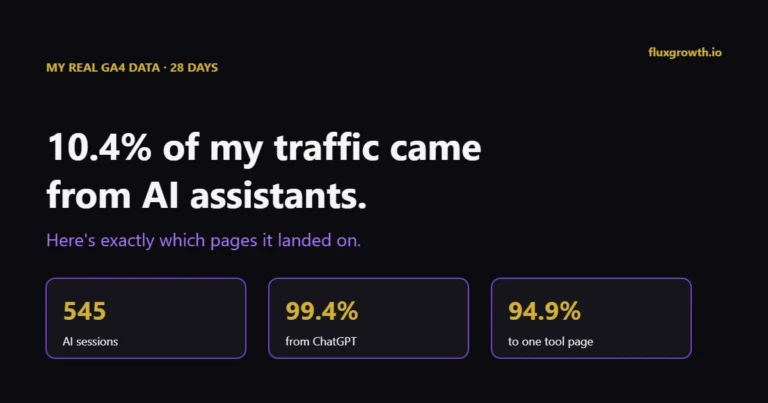
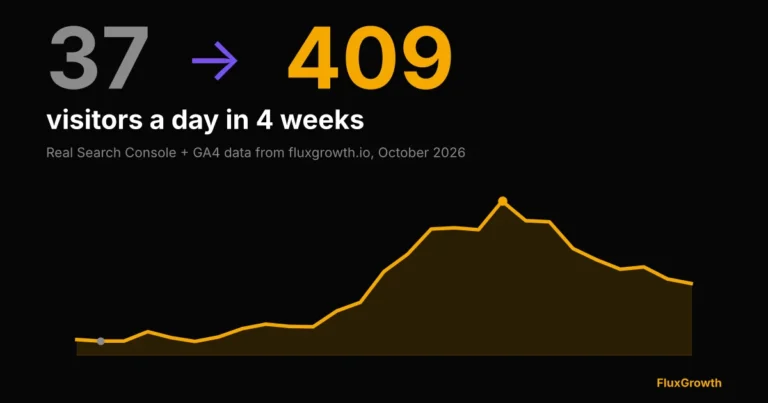
Use real FluxGrowth data to make your content original and credible. Share verified AI citation audit results, Google Search Console performance, or GA4 referral traffic.
For example, test 40 queries across four AI search engines and report actual citations, test dates, and limitations.
Important: Don’t publish estimated results as facts. Run the test first, then add your findings.
Name your entities
Write “Google AI Overviews” or “OAI-SearchBot,” not “it” or “this tool,” especially at the start of a paragraph. Pronouns break the moment a sentence gets lifted out of context. Spell out an acronym on first use too, so “generative engine optimization (GEO),” then GEO afterward.
Build topical coverage with internal links
Google lists find-able internal links among the SEO fundamentals that still matter for its AI features. Link each supporting page up to its hub and sideways to its siblings. For the HVAC company, a “How long do AC units last in Arizona?” post links to the repair-or-replace guide, and the guide links back.
How do you measure AI search visibility, and which tools help?
You measure AI search visibility in three places: Search Console for impressions in Google’s AI features, Google Analytics 4 (GA4) for visits from AI tools, and repeated prompt tests for engines that report nothing. Each one under-counts. So compare month over month instead of trusting any single snapshot.
The Search Console generative AI report
Google launched dedicated Search Generative AI performance reports in Search Console on June 3, 2026. The Search version shows impressions in AI Overviews and AI Mode by page, country, device, and date.
Know its limits, though. It reports impressions only, doesn’t separate AI Overviews from AI Mode, and the same data still counts inside your overall Performance report. Clicks from AI Overviews show up in GA4 as ordinary google / organic traffic.
AI referrals in GA4
In GA4, go to Admin → Data display → Channel groups and create a custom channel named AI Referrals.
Set the session source to match this regex:
.*(chatgpt\.com|perplexity\.ai|gemini\.google\.com|copilot\.microsoft\.com|claude\.ai).*
Move the channel above Referral so matching sessions are classified correctly.
Important: Treat AI referral data as an estimate, not a complete count. ChatGPT’s tracking tags temporarily disappeared in October 2026 but were reported restored by October 16. Visits without a recognizable source may appear as Direct.
Sources: GA4 custom channel groups · ChatGPT UTM tracking update
Prompt-tracking tools, and how to judge them
Tools such as Semrush, Ahrefs, Profound, and Otterly.ai track brand mentions and citations across supported AI search platforms.
Before paying, ask:
- Coverage: Which AI engines and countries are supported?
- Frequency: How often is each prompt checked?
- Transparency: Can you inspect and export actual AI responses?
- Prompt selection: Are prompts based on your research or chosen by the tool?
AI visibility scores are estimates based on sampled prompts, not a complete record of every AI answer. Repeat checks and review the underlying responses before drawing conclusions.
Disclosure: If FluxGrowth develops or sells a GEO tool, disclose that relationship here so readers can evaluate the recommendations fairly.
Your 30-day AI search engine optimization plan
If I were starting from zero today, this is the order I’d work in. Thirty days won’t prove much alone, but it gives you a clean baseline and one round of real changes.
Week 1: Check access
Audit robots.txt for OAI-SearchBot and PerplexityBot, then your CDN and security plugin settings. Run URL Inspection on your top 20 pages to confirm indexing and snippet eligibility. Set up the GA4 AI Referrals channel and screenshot your Search Console generative AI numbers, if the report is available on your property.
Week 2: Pick 10 pages and map their questions
Choose 10 pages that already earn impressions, ideally ranking somewhere between positions 3 and 15 for question-style queries. For each one, list five to eight fan-out questions using the regex filter and People Also Ask.
Week 3: Rewrite openings and add evidence
Rewrite the first two sentences under every H2 so they answer the heading directly. Add one piece of first-party evidence per page, fix vague pronouns, and link each page to its hub. Update the “last updated” date only when the change is substantive.
Week 4: Measure and decide
Compare AI impressions and AI referrals against your Week 1 baseline. Then run 20 target prompts three times each in ChatGPT, Perplexity, and Google AI Mode, and log every brand mention and citation in a spreadsheet. Keep the changes that move anything. Repeat the cycle on the next 10 pages.
FAQ
What is AI search engine optimization?
AI search engine optimization is making your content easy for tools like Google AI Overviews, ChatGPT search, and Perplexity to find, understand, and cite. It relies on SEO fundamentals plus clear, evidence-backed writing. No method guarantees a citation.
How is AI SEO different from traditional SEO?
Traditional SEO aims for rankings in a results list, while AI SEO aims for citations inside a generated answer. The work overlaps heavily, since AI engines retrieve pages from search indexes first. The biggest difference is measurement.
How do I optimize my website for Google AI Overviews?
Google says there are no extra requirements to appear in AI Overviews beyond being indexed and eligible to show with a snippet. Focus on helpful, original content, crawl-able pages, and internal links. Check that no nosnippet tag is blocking your important pages.
How can my website appear in ChatGPT search?
Allow OAI-SearchBot in your robots.txt file, since OpenAI says sites that opt out won’t appear in ChatGPT search answers. Then make sure your pages are publicly accessible and answer specific questions clearly. Blocking GPTBot affects training, not ChatGPT search.
Does GEO replace traditional SEO?
No. Generative engine optimization builds on traditional SEO rather than replacing it. Google says optimizing for its generative AI features is still SEO, and the C-SEO Bench study found traditional SEO strategies were significantly more effective than most GEO-style content tweaks.
Do I need llms.txt or a special schema for AI search?
Google says you don’t need llms.txt, special AI files, or special schema to appear in its generative AI features. Independent research hasn’t found that llms.txt increases AI citations. Standard structured data is still worth adding when it accurately describes your page.
How can I measure AI search visibility?
Use the Search Console generative AI report for impressions in AI Overviews and AI Mode, and a custom GA4 channel for visits from ChatGPT and Perplexity. For other engines, run the same prompts repeatedly and track mentions. Each method under-counts, so watch trends.
Where this leaves you
AI search engine optimization isn’t a new discipline. It’s SEO with a stricter editor. AI engines still cite the pages they can crawl, trust, and quote without rewriting, and since June 2026 you can at least see in Search Console whether yours show up in Google’s AI features.
Do one thing today: open your robots.txt and confirm OAI-SearchBot and PerplexityBot aren’t blocked. It takes two minutes. Then work through the 30-day plan, one batch of 10 pages at a time.
Want the deeper playbooks? Browse the GEO and AI search guides on FluxGrowth.